Microbial Testing
In remote Australian communities, tap water that looks clear can carry E. coli. Regular microbial testing of water and food is the only reliable way to detect contamination before people get sick — and the method used in a school lab is the same one used by public health authorities.
Practise this lesson
Four printable worksheets that build from the foundations up to exam-style questions — start at whatever level suits you.
A student testing water samples from three sources — tap water, a local creek, and a rainwater tank — gets the following results after 48 hours of incubation on nutrient agar plates:
- Tap water: 3 colonies visible
- Creek water: 214 colonies visible
- Rainwater tank: 0 colonies visible
Before reading: what conclusions can and cannot be drawn from these results alone? Write down two things the data tells you and two things it does not tell you.
Know
- The purpose of microbial testing of water and food
- The standard method: serial dilution, plating, colony counting
- Key variables: independent, dependent, controlled
- Validity, reliability, and accuracy in microbial investigations
Understand
- Why serial dilution is necessary before plating
- Why colony counts are estimates, not exact counts
- How to identify and control sources of error in microbial testing
Can Do
- Design a valid microbial testing investigation with identified variables
- Calculate colony counts per mL from serial dilution data
- Evaluate the validity and reliability of a microbial investigation
Core Content
Microbial contamination is invisible — testing is the only way to detect it
Water carrying dangerous levels of E. coli, Salmonella or Cryptosporidium looks, smells, and tastes identical to safe water — the only way to know is to test for the organisms directly.
Contaminated water and food are among the leading causes of infectious disease globally. Unlike chemical contamination, microbial contamination is invisible. The only way to detect it is through microbial testing.
Microbial testing determines whether a sample contains harmful microorganisms — and at what concentration. In public health, water is considered safe for drinking if it contains fewer than 1 colony forming unit (CFU) of E. coli per 100 mL. Food safety standards set similar thresholds for Salmonella, Listeria, and other pathogens.
Drinking water
Recreational water
Food safety
School investigations
What to write in your book
- Microbial contamination is invisible — testing is the only detection method
- Safe drinking water: <1 CFU E. coli per 100 mL (Australian guidelines)
- E. coli = indicator of faecal contamination (signals other pathogens may be present)
- E. coli is used because it is easy to culture and count
Why is E. coli used as the indicator organism for water safety?
Serial Dilution Method
The viable plate count, step by step
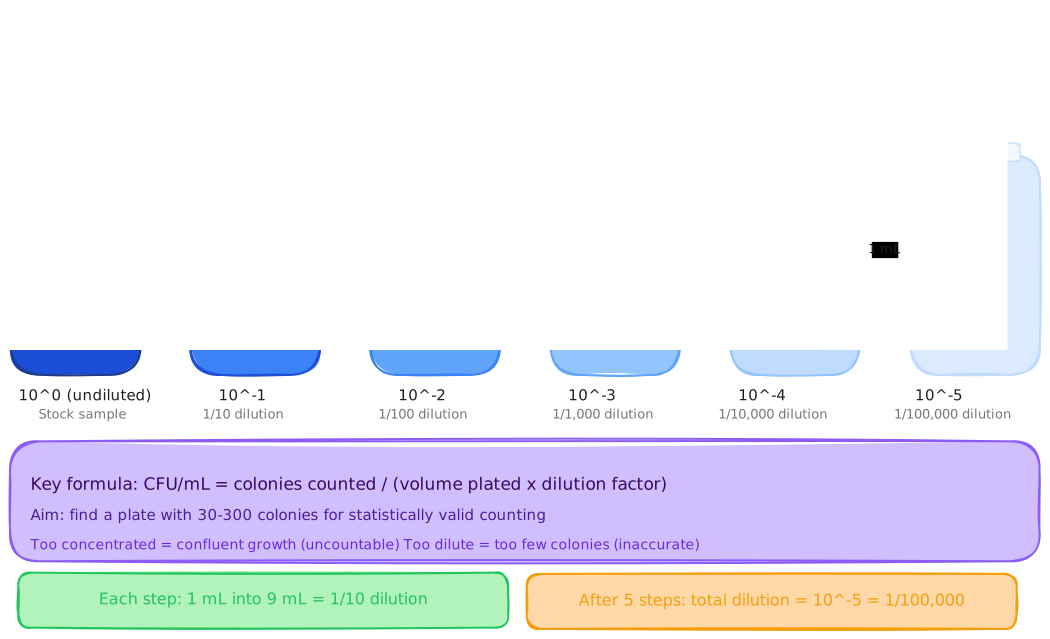
The core technique of microbial testing is the serial dilution and plate count method — diluting a sample until colonies become countable, then scaling back up.
Microbial testing of water or food samples follows a standard procedure. The core technique is the serial dilution and plate count method — also called the viable plate count or colony count method.
Collect and prepare the sample
Collect a measured volume of water (e.g. 1 mL or 10 mL) or a weighed food sample (e.g. 1 g dissolved in 9 mL sterile water) using aseptic technique. Aseptic technique — sterile equipment, closed containers, no talking over open plates — is essential to prevent contamination of the sample.
Serial dilution
Transfer 1 mL of sample into 9 mL sterile water — this is a 1:10 (10⁻¹) dilution. Repeat to create 10⁻², 10⁻³, 10⁻⁴ dilutions. Serial dilution is necessary because heavily contaminated samples produce uncountable plates (confluent growth). Countable plates have 30–300 colonies.
Inoculate agar plates
Using a sterile loop or pipette, spread 0.1 mL or 1 mL from each dilution onto a labelled nutrient agar plate. Include a negative control (sterile water only) to check for contamination of the medium. Include a positive control (known bacterial suspension) to confirm the medium supports growth.
Incubate
Invert plates (to prevent condensation dripping onto colonies) and incubate at 25°C–37°C for 24–48 hours. Higher temperatures encourage faster growth but may select for different species. Temperature is a key controlled variable.
Count colonies and calculate CFU/mL
Count colonies on the plate with 30–300 colonies (most accurate range). Calculate: CFU/mL = colony count ÷ (volume plated × dilution factor). Multiple replicates should be averaged for reliability.
What to write in your book
- Method: collect → serial dilute → plate → incubate (inverted) → count
- Serial dilution needed: concentrated samples give confluent (uncountable) growth
- Count plates with 30–300 colonies; CFU/mL = colonies ÷ (volume × dilution factor)
- Negative control = contamination check; positive control = growth check
CFU/mL = colony count ÷ (volume plated × dilution _____).

Koch's postulates provide the logical framework for proving that a specific microbe causes a specific disease. Each step eliminates alternative explanations.
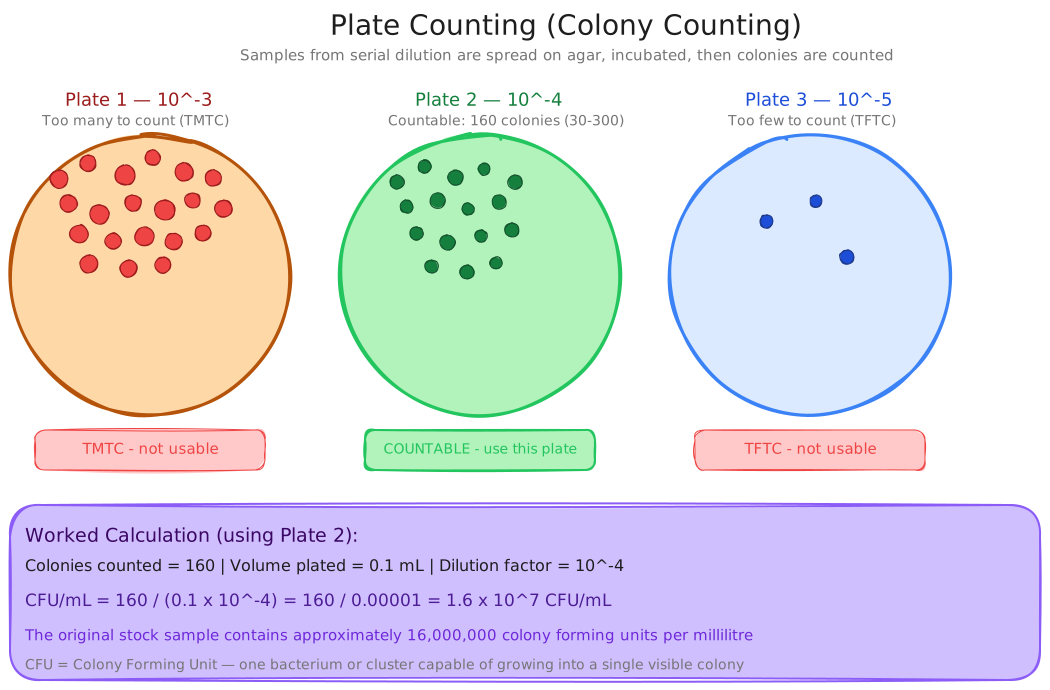
Plate Counting — Colony Estimation
BIO11/12-2 · variables, controls, validity vs reliability vs accuracy
A strong microbial investigation identifies its variables, justifies its controls, and is designed to maximise both validity and reliability.
The HSC requires you to be able to design and evaluate microbial testing investigations.
| Design Element | What It Means | Example in Microbial Testing |
|---|---|---|
| Research question | A clear, testable question linking independent and dependent variables | "Does water from a local creek contain higher bacterial concentrations than tap water?" |
| Hypothesis | A testable prediction based on prior knowledge | "Creek water will contain significantly higher CFU/mL than tap water due to runoff contamination" |
| Independent variable | What is deliberately changed | The water source (tap, creek, rainwater tank) |
| Dependent variable | What is measured in response | Colony count (CFU/mL) on nutrient agar after 48 hours |
| Controlled variables | What is kept constant | Volume plated, agar type, incubation temperature and time, dilution method, colony counting method |
| Negative control | Rules out contamination from equipment/media | Plate inoculated with sterile distilled water only — should show 0 colonies |
| Positive control | Confirms the medium and conditions support growth | Plate inoculated with known E. coli suspension — should show predictable growth |
| Replication | Repeating measurements to improve reliability | At least 3 plates per dilution per sample; average the counts |
Validity vs Reliability vs Accuracy
What to write in your book
- IV = water source; DV = colony count (CFU/mL); controlled = volume, agar, temp, time
- Negative control (sterile water) → 0 colonies; positive control (known culture) → growth
- Validity = measures what it claims; Reliability = consistent/repeatable; Accuracy = close to true value
- ≥3 replicates per dilution; average counts
A negative control plate (sterile water only) should show:
Error Spotting — Flawed Investigation Design
Pattern B — Error Spotting
A student designed the following investigation to compare the bacterial contamination of tap water and creek water. The method contains four significant errors in experimental design or procedure. Identify each error, explain why it is a problem, and describe how to correct it.
- Collected 10 mL of tap water and 10 mL of creek water in the same unwashed glass bottle, then divided into two samples in the lab.
- Added 1 mL of each sample directly to a nutrient agar plate without serial dilution and spread with a sterile loop.
- Incubated all plates right-side up at 37°C for 24 hours, then counted all visible colonies.
- Used only one plate per sample and one dilution level. Concluded that creek water had "more bacteria" because it had more colonies.
- Identify all four errors in the method above.
- For each error, write one sentence explaining specifically why it affects the validity or reliability of the investigation.
- Rewrite the method as a corrected, improved procedure using appropriate scientific technique.
BIO11/12-3 · BSL-1 organisms and standard precautions
Any practical involving microorganisms requires a risk assessment — and used cultures must always be treated as potentially pathogenic.
In a school laboratory, water and food microbial testing involves BSL-1 (Biosafety Level 1) organisms — generally considered low risk for healthy individuals but requiring standard precautions.
What to write in your book
- School microbial work = BSL-1; treat all cultures as potentially pathogenic
- PPE: gloves, lab coat, safety glasses; no eating/drinking; no mouth pipetting
- Disposal: autoclave (121°C/15 min) or 10% bleach (30 min) — never open plates after incubation
- Spills: cover with 10% bleach-soaked towel, leave 20 min
After incubation, used agar plates can be opened and thrown straight into the general waste bin.
Serial dilution is necessary before plating because concentrated samples would produce too many colonies to count accurately.
A colony-forming unit (CFU) on an agar plate always represents exactly one individual bacterial cell.
Across remote Aboriginal and Torres Strait Islander communities in Australia, access to safe drinking water has been a persistent public health challenge. A 2021 report by the Australian National University found that up to 40% of remote community water supplies had detectable E. coli at some point during the study period — indicating faecal contamination. In many cases, the water looked and tasted clean. The consequences are direct: gastroenteritis, particularly in children under five, is significantly more prevalent in remote communities than in urban Australia, and repeated gut infections in early childhood are linked to long-term developmental and growth impacts. The same microbial testing method used in a school laboratory — serial dilution and colony counting on selective media — is the primary tool used by environmental health officers to assess these water supplies. The difference between a safe and unsafe result is quantitative: fewer than 1 CFU of E. coli per 100 mL is safe; any detectable CFU/100 mL requires immediate investigation and treatment. You will apply this testing framework in Activity 1 and Short Answer Q3.
Valid Investigation Design — 7 Steps
Serial Dilution and Plate Count
- Purpose: estimate bacterial concentration (CFU/mL) in water or food.
- Serial dilution: 1 mL sample into 9 mL sterile water = 10⁻¹; repeat to 10⁻⁴.
- Count plates with 30–300 colonies for accuracy.
- CFU/mL = colonies ÷ (volume plated × dilution factor).
Controls and Their Purpose
- Negative control (sterile water): rules out medium/equipment contamination — should give 0 colonies.
- Positive control (known culture): confirms medium supports growth — should give expected colonies.
- Both are required for a valid investigation.
Validity, Reliability, Accuracy
- Validity: measuring what you claim — use correct medium, proper controls, aseptic technique.
- Reliability: consistent results — multiple replicates, standardised volumes and conditions.
- Accuracy: close to true value — calibrated pipettes, 30–300 colony range.
Safety in Microbial Testing
- Aseptic technique: flame loops, no talking over plates, closed containers.
- Gloves and lab coat; no eating or drinking in the lab.
- All used plates: autoclave or 10% bleach for 30 min before disposal.
- Spills: 10% bleach, leave 20 min before cleaning.
A fresh set drawn from this lesson's question bank — feedback shown immediately. +5 XP per correct · +25 XP all correct
Pick your answer, then rate your confidence — that tells the system what to drill next.
UnderstandBand 3(3 marks) 1. Describe the serial dilution and plate count method for estimating the bacterial concentration of a water sample. In your answer, explain why serial dilution is necessary and why only plates with 30–300 colonies are used for counting.
1 mark: serial dilution procedure correctly described · 1 mark: why dilution is necessary · 1 mark: why 30–300 range
EvaluateBand 5(3 marks) 2. A student investigating microbial contamination of food samples uses only one plate per sample with no replicates and no controls. Evaluate this investigation design, identifying two specific limitations and explaining how each affects the validity or reliability of the results.
1 mark: first limitation linked to validity/reliability · 1 mark: second limitation linked to validity/reliability · 1 mark: overall evaluative statement
ApplyBand 5(4 marks) 3. An environmental health officer tests drinking water from a remote community bore and finds 4 CFU of E. coli per 100 mL. The Australian Drinking Water Guidelines allow fewer than 1 CFU of E. coli per 100 mL. Explain what this result indicates about the water's safety, why E. coli is used as the test organism rather than testing directly for all possible pathogens, and describe one immediate public health action that should be taken.
1 mark: result indicates water is unsafe · 1 mark: E. coli as faecal indicator · 1 mark: E. coli is practical to culture and count · 1 mark: appropriate immediate public health action
Show all answers
Multiple choice
MC answers and full explanations are shown inline as you complete each question. Use the retry button to attempt a fresh set from the lesson bank.
Short Answer Model Answers
Q1 (3 marks): The serial dilution and plate count method begins by transferring 1 mL of the water sample into 9 mL of sterile distilled water, creating a 10⁻¹ dilution. This step is repeated using 1 mL of each new dilution to produce a series of dilutions (10⁻², 10⁻³, 10⁻⁴ etc.). A measured volume (typically 0.1 mL or 1.0 mL) from each dilution is spread onto a labelled nutrient agar plate using aseptic technique. Plates are inverted and incubated at a set temperature for 24–48 hours, then colonies are counted. Serial dilution is necessary because heavily contaminated samples produce confluent (lawn) growth when plated directly — individual colonies cannot be counted when bacteria are so numerous that their colonies overlap and merge. Only plates with 30–300 colonies are used because below 30 colonies, random statistical variation becomes proportionally significant, while above 300, colonies are too crowded to distinguish individually, and multiple bacteria from the original sample may produce a single colony, leading to underestimation.
Q2 (3 marks): Limitation 1: Using only one plate per sample means the results cannot be assessed for reliability — if a single plate gives an unusual result due to uneven spreading, a stray contaminant, or counting error, there is no way to identify this as an outlier. Reliability requires at least three replicates per condition so results can be averaged and variability assessed. Limitation 2: Having no negative control means there is no way to determine whether any colonies that appear on sample plates came from the sample itself or from contamination of the agar medium or equipment. If the medium was contaminated, all colony counts would be artificially inflated and the results would be invalid — but without the negative control, this cannot be detected. Overall, this investigation design is inadequate for drawing reliable or valid conclusions: it cannot distinguish genuine results from experimental error, and the absence of replicates means the results cannot be confirmed or reproduced.
Q3 (4 marks): A result of 4 CFU of E. coli per 100 mL indicates the water is unsafe for drinking. The Australian Drinking Water Guidelines specify that fewer than 1 CFU per 100 mL is required — this bore water contains four times the maximum acceptable concentration of E. coli. E. coli is used as the indicator organism rather than testing directly for all possible pathogens for two reasons: first, E. coli is a reliable indicator of faecal contamination — its presence shows that sewage, animal waste, or contaminated runoff has entered the supply, and wherever E. coli is present, other faecal pathogens (Salmonella, Campylobacter, Cryptosporidium) may also be present. Second, testing for every possible pathogen individually would be impractical, time-consuming, and expensive — E. coli is easy to culture, straightforward to identify and count, and provides a reliable proxy for the entire spectrum of faecal pathogens in a single test. An appropriate immediate public health action is to issue a boil-water advisory to all households using the bore, requiring water to be boiled before drinking, while the contamination source is investigated and the bore water treated or an alternative supply identified.
Five timed questions on microbial testing and investigation design. Beat the boss to bank a tier — gold (perfect + fast), silver (80%+), or bronze (cleared).
⚔ Enter the arenaFace the boss using your knowledge of microbial testing methods and Koch's postulates. Pool: lessons 1–5.
You were shown three colony counts — tap water (3), creek water (214), rainwater tank (0) — and asked what the data does and does not tell you.
What the data tells you: creek water has a substantially higher total bacterial count than tap water; the rainwater tank showed no growth under these specific conditions; tap water has low but detectable bacteria.
What the data does not tell you — and this is the critical part: it does not tell you whether any of these bacteria are pathogens. Total colony count on nutrient agar counts all bacteria that can grow under those conditions — including harmless environmental organisms. It does not tell you whether E. coli (the faecal indicator) is present, whether viruses or protozoa are present (these don't grow on nutrient agar), or whether the rainwater is truly safe (zero colonies could mean no bacteria grew under these conditions, not that the water is free of all pathogens). A clean total count is reassuring, but full safety assessment requires selective media and indicator organism testing.
If you identified that the data doesn't confirm the absence of pathogens or viral contamination — excellent reasoning. The limitations of any testing method are as important as the results.