Biology • Year 12 • Module 7 • Lesson 5
Microbial Testing
Build the core vocabulary, procedure steps, and conceptual foundations of the serial dilution and plate count method used in water and food safety testing.
1. Label the serial dilution procedure
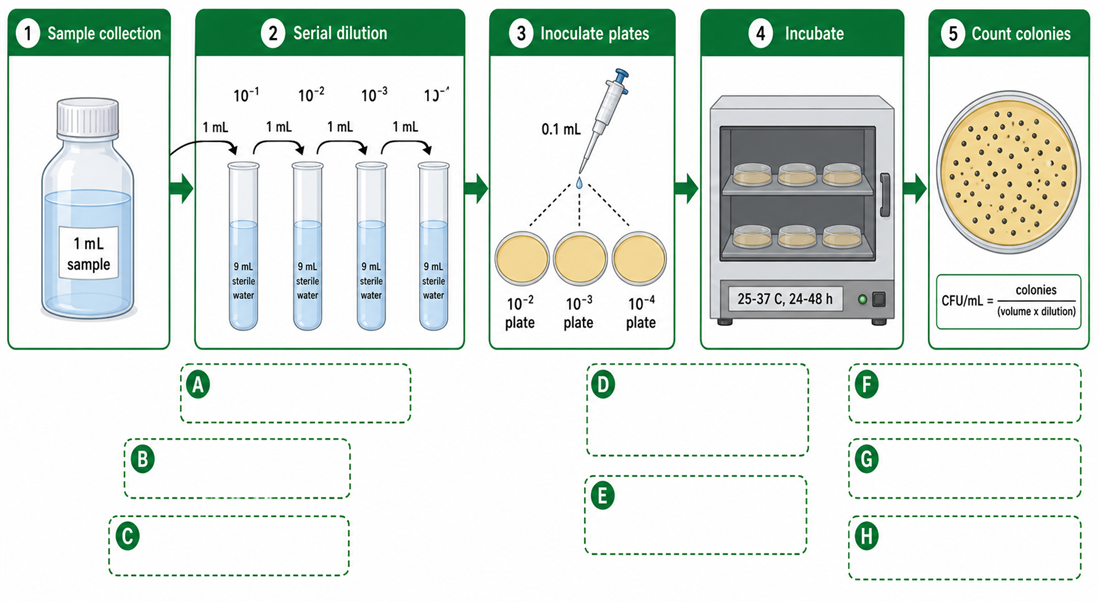
The image below shows the five-stage serial dilution and plate count method for estimating bacterial concentration in a water sample. Write the missing labels into boxes A–H. Each label is drawn from the lesson's Key Terms or from Card 2 (The Standard Method). 8 marks
| Box | Your label |
|---|---|
| A | |
| B | |
| C | |
| D | |
| E | |
| F | |
| G | |
| H |
2. Term–definition match
The ten definitions below are shuffled. In the right-hand column write the matching term from this list: microbial testing, serial dilution, colony forming unit (CFU), aseptic technique, negative control, positive control, reliability, validity, incubation, indicator organism. 10 marks
| # | Definition (shuffled) | Matching term |
|---|---|---|
| 2.1 | Laboratory testing used to detect and estimate the concentration of microorganisms in a sample of water or food. | |
| 2.2 | Stepwise dilution in which a fixed volume (1 mL) of a sample is transferred repeatedly into fresh sterile water (9 mL), reducing concentration by a factor of ten each step. | |
| 2.3 | A single viable cell (or cluster of cells) from the original sample that grows into one visible colony on an agar plate. | |
| 2.4 | A rigorous set of practices — including flaming loops, working near a Bunsen, and keeping containers closed — to prevent contamination of cultures and the environment. | |
| 2.5 | A control plate inoculated with sterile distilled water only; any growth on it indicates contamination of the medium or equipment. | |
| 2.6 | A control plate inoculated with a known bacterial suspension; confirms the medium and conditions support growth. | |
| 2.7 | The consistency of results when measurements are repeated under the same conditions; improved by using multiple replicate plates. | |
| 2.8 | The extent to which an investigation measures what it claims to measure; requires appropriate controls, correct medium and aseptic technique. | |
| 2.9 | The period during which inoculated agar plates are held at a set temperature to allow bacterial colonies to grow to a visible size. | |
| 2.10 | A species whose presence in water signals the likely presence of faecal pathogens; E. coli serves this role in drinking-water testing. |
3. True or false — with correction
For each statement, circle T or F. If the statement is false, write the corrected version on the line below it. 10 marks (1 T/F, 1 correction where false)
3.1 A colony visible on a nutrient agar plate represents exactly one bacterium from the original sample. T / F
3.2 Serial dilution is necessary because heavily contaminated samples would produce too many colonies to count individually on an undiluted plate. T / F
3.3 The Australian Drinking Water Guidelines set the safe limit for E. coli in drinking water at fewer than 10 CFU per 100 mL. T / F
3.4 Agar plates should be incubated in an inverted position so that condensation dripping from the lid does not disturb colonies. T / F
3.5 A negative control plate that shows zero colonies confirms that the agar medium is sterile and that all colonies on sample plates came from the sample. T / F
4. Function recall
Answer each in 1–2 sentences using precise terms from the lesson. 8 marks (2 each)
4.1 What is the function of serial dilution in the plate count method?
4.2 What is the function of the negative control in a microbial testing investigation?
4.3 Why is E. coli used as the indicator organism in drinking-water testing rather than directly testing for every possible pathogen?
4.4 What is the function of aseptic technique during the inoculation step of the plate count method?
5. Fill in the blanks — the plate count method in context
Complete the paragraph below using words from the word bank. Each word is used once only. 8 marks
When testing water for microbial contamination, scientists use _______________ to reduce the bacterial concentration to a countable level before spreading the sample onto agar plates. Without dilution, heavily contaminated samples produce _______________ growth — a continuous lawn of bacteria in which individual colonies cannot be distinguished. Each visible colony grows from one or more _______________ (CFUs) from the original sample, so counts are estimates rather than exact figures. Plates are _______________ at a controlled temperature and time to allow growth. Using _______________ technique throughout prevents introduction of outside bacteria that would artificially inflate counts. Performing multiple replicate plates for each dilution level improves the _______________ of the results. Escherichia coli is used as an _______________ organism because its presence signals _______________ contamination, implying that other pathogens such as Salmonella or Campylobacter may also be present.
6. Build a concept map
Draw labelled arrows between the six terms below to show how they connect. Each arrow must carry a linking phrase (e.g. “is reduced by”, “improves”, “detects”, “requires”). Aim for at least 6 labelled arrows. 6 marks
Supplied terms: serial dilution · aseptic technique · colony forming unit (CFU) · validity · negative control · E. coli indicator.
Q1 — Labelled serial dilution diagram
A: serial dilution (method name). B: 1:10 (or 10−1 per step — 1 mL into 9 mL sterile water). C: 1 mL (volume transferred at each step). D: to prevent condensation dripping onto colonies and spreading them (inversion prevents distortion of colony count). E: 25°C–37°C (acceptable incubation temperature range for most water bacteria). F: 30–300 colonies (the countable range — below 30 is statistically unreliable; above 300 individual colonies cannot be distinguished). G: colony forming unit (CFU) — one colony grows from one original viable cell or cluster, not just one bacterium. H: CFU/mL (the unit reported for the original sample after back-calculation).
Q2 — Term–definition matches
2.1 microbial testing • 2.2 serial dilution • 2.3 colony forming unit (CFU) • 2.4 aseptic technique • 2.5 negative control • 2.6 positive control • 2.7 reliability • 2.8 validity • 2.9 incubation • 2.10 indicator organism.
Q3 — True / false with correction
3.1 False. Correction: A colony grows from one colony forming unit (CFU), which may be one bacterium or a small cluster of bacteria that were not fully separated. By the time the colony is visible it contains millions of cells. The plate count estimates CFUs, not individual bacteria.
3.2 True.
3.3 False. Correction: The Australian Drinking Water Guidelines set the safe limit at fewer than 1 CFU of E. coli per 100 mL — not 10 CFU per 100 mL. Any detectable E. coli requires immediate investigation.
3.4 True.
3.5 True. (Accept also: a zero-colony negative control supports the validity of the experiment by ruling out contamination of the medium or equipment as a source of colonies on sample plates.)
Q4.1 — Function of serial dilution
Serial dilution reduces the bacterial concentration of a sample to a level where individual colonies can be counted on an agar plate (30–300 colonies). Without dilution, highly contaminated samples produce confluent (lawn-like) growth where colonies overlap and individual CFUs cannot be distinguished, making accurate counting impossible.
Q4.2 — Function of negative control
The negative control (sterile distilled water plated on agar) tests whether the growth medium or equipment is contaminated. It should produce zero colonies; any growth indicates external contamination, meaning the investigation is invalid because colonies on sample plates cannot be confidently attributed to the sample alone.
Q4.3 — Why E. coli is used as indicator
E. coli is a reliable indicator of faecal contamination — its presence signals that sewage or animal waste has entered the water supply, meaning other faecal pathogens (Salmonella, Campylobacter, Cryptosporidium) may also be present. Testing for every possible pathogen individually would be impractical and expensive; E. coli is easy to culture on selective media, straightforward to count, and provides a reliable proxy for the full range of faecal contamination.
Q4.4 — Function of aseptic technique during inoculation
Aseptic technique (using sterile loops or pipettes, not talking over open plates, working near a Bunsen flame) prevents bacteria from the environment contaminating the agar plates. Without it, colonies on the plates could come from external sources rather than the water sample, inflating counts and invalidating results.
Q5 — Cloze answers (in order of blanks)
serial dilution • confluent • colony forming units • incubated • aseptic • reliability • indicator • faecal
Q6 — Sample concept map
Acceptable arrows include:
- serial dilution —reduces concentration so→ colony forming unit (CFU) counting is possible
- aseptic technique —prevents contamination and so improves→ validity
- negative control —detects equipment/medium contamination and so protects→ validity
- aseptic technique —ensures colonies on plates originate from→ colony forming unit (CFU) (in the sample)
- E. coli indicator —signals faecal contamination and is detected by→ serial dilution + CFU count
- negative control —requires→ aseptic technique (to ensure it genuinely shows zero growth)
Award 1 mark per correctly labelled arrow that respects biological direction. Award full marks for any six valid arrows.