Pesticides and Genetic Engineering
In the 1950s, screwworm flies were destroying livestock across the southern United States at a cost of hundreds of millions of dollars per year. Scientists solved it not with pesticides but with biology — by releasing 2 billion sterile flies per week until the wild population collapsed. A disease vector was eradicated from a continent using only sterilisation and arithmetic.
Practise this lesson
Four printable worksheets that build from the foundations up to exam-style questions — start at whatever level suits you.
Mosquitoes transmit malaria, dengue, Zika, yellow fever, and Ross River virus. Researchers are developing genetically modified mosquitoes whose offspring do not survive to adulthood — releasing them into wild populations to suppress mosquito numbers.
Before reading: what concerns would you raise about releasing genetically modified organisms into a wild population? And what are the potential benefits? Predict at least two of each before reading.
Know
- How pesticides are used to control disease vectors
- The sterile insect technique (SIT) — mechanism and examples
- How genetic engineering is used in disease control (GM mosquitoes, Bt crops)
- The risks and limitations of each approach
Understand
- Why pesticide resistance develops (same evolutionary logic as antibiotic resistance)
- Why SIT is species-specific and less ecologically damaging than broad-spectrum pesticides
- The ethical and ecological arguments for and against GMO release
Can Do
- Evaluate the effectiveness of pesticides, SIT, and genetic engineering approaches
- Apply the SIT mechanism to a novel vector control scenario
- Assess the environmental and ethical trade-offs of GMO vector control
Core Content
Killing the vectors that carry pathogens between hosts
Pesticides are chemical substances used to kill or repel organisms that transmit disease. In the context of infectious disease control, they primarily target arthropod vectors — insects and arachnids that carry pathogens between hosts.
| Pesticide Class | Mode of Action | Target Vectors | Example Use |
|---|---|---|---|
| Organochlorines (e.g. DDT) | Disrupts insect nervous system — keeps sodium channels open causing continuous nerve firing and paralysis | Mosquitoes, lice, flies | WHO malaria eradication campaigns 1955–1969; now banned or restricted in most countries due to persistence and bioaccumulation |
| Organophosphates (e.g. malathion) | Inhibits acetylcholinesterase — prevents breakdown of acetylcholine at nerve synapses, causing continuous nerve stimulation | Mosquitoes, flies, ticks | Mosquito control programs; indoor residual spraying for malaria |
| Pyrethroids (e.g. permethrin) | Disrupts sodium channels in nerve membranes — similar mechanism to DDT but biodegrades faster | Mosquitoes, sandflies, ticks | Insecticide-treated bed nets (ITNs) for malaria prevention; tick control |
| Insect growth regulators (e.g. methoprene) | Mimic insect hormones (juvenile hormone) — prevent larvae from maturing to adults | Mosquito larvae in water | Larvicides added to water bodies to prevent mosquito breeding |
| Biological pesticides (e.g. Bt — Bacillus thuringiensis) | Bacterial toxin (Cry protein) disrupts insect gut epithelium — specific to insects with alkaline gut pH | Mosquito larvae, caterpillars | Bti (B. thuringiensis israelensis) applied to water bodies; also used in GM crops |
Pesticide Resistance
Pesticide resistance develops through exactly the same mechanism as antibiotic resistance — natural selection. A small proportion of insect vectors carry mutations that confer resistance (e.g. altered sodium channels, increased detoxification enzyme production). When pesticide is applied, susceptible individuals are killed and resistant individuals survive and reproduce. Over generations, the resistant genotype becomes dominant in the population.
Insecticide resistance is now widespread in Anopheles mosquitoes (malaria vectors) globally — particularly to pyrethroids used in bed nets. This is one of the greatest threats to malaria control programs.
What to write in your book
- Pesticides target vector nervous systems (DDT, pyrethroids, organophosphates), growth (IGRs), or gut (Bt).
- Pyrethroids are used in insecticide-treated bed nets (ITNs) for malaria prevention.
- Pesticide resistance evolves by natural selection — identical logic to antibiotic resistance.
- DDT: effective but bioaccumulates and breeds resistance — now banned/restricted.
Pesticide resistance develops through the same mechanism as antibiotic resistance: _____ selection.
Apply to Unfamiliar — Wolbachia and Dengue Control
Pattern C — Apply to Unfamiliar
Read the following scenario and apply your knowledge of disease control strategies to answer the questions.
- Wolbachia-infected mosquitoes are released and mate with wild mosquitoes. Explain how Wolbachia spreads through the wild population over time without continued releases, using your knowledge of inheritance.
- Unlike SIT, this approach does not reduce the mosquito population — it changes the mosquito population. Evaluate whether this is a strength or a limitation compared to SIT.
- The WMP emphasises that this approach is "not genetic modification." Explain the biological basis for this distinction and evaluate whether it is scientifically meaningful from a risk assessment perspective.
- Dengue incidence fell by 77% in Wolbachia areas. Evaluate whether this constitutes a successful disease control intervention, referring to the concepts of control, elimination, and eradication.
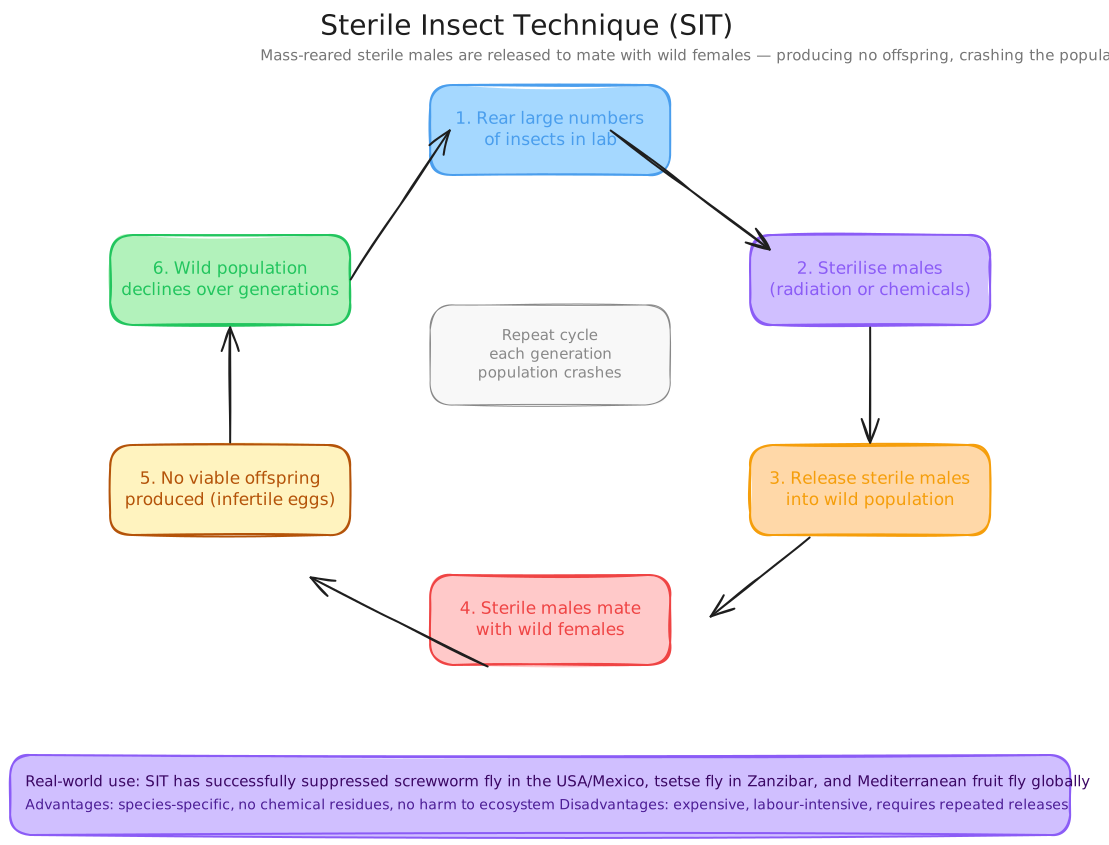
Sterile Insect Technique Cycle
Using the pest's own reproductive behaviour against it
The sterile insect technique is an elegant biological control method that uses the target species' own reproductive behaviour against it. Rather than killing insects with chemicals, SIT collapses the wild population by flooding it with sterile males that compete for matings with wild females — producing no offspring.
SIT exploits the insect's own mating behaviour — the more sterile males released relative to wild males, the faster the population collapses
| Feature | SIT | Chemical Pesticides |
|---|---|---|
| Mechanism | Reproductive failure — population declines over generations | Direct killing of insects — immediate effect |
| Species specificity | Highly specific — sterile insects only compete with their own species | Often broad-spectrum — kills non-target insects including pollinators |
| Resistance development | Very low risk — resistance to mating with sterile males is not a selectable trait | High risk — insecticide resistance evolves through natural selection |
| Environmental impact | Low — no chemical residues; no bioaccumulation | Can be high — bioaccumulation, food chain effects, off-target toxicity |
| Limitations | Expensive; requires continuous large-scale rearing and release; only eradicates, does not prevent re-invasion | Cheaper per application; immediate effect; resistance and ecological damage are major concerns |
| Example success | Screwworm eradicated from North and Central America; Mediterranean fruit fly controlled in parts of Australia | DDT eliminated malaria from southern Europe — but resistance and environmental damage led to restrictions |
What to write in your book
- SIT steps: mass-rear → sterilise males (radiation/GM) → release in large numbers → wild females mate with sterile males → no offspring → population collapses.
- Species-specific, no chemical residues, and resistance-proof (no selectable trait).
- Trade-off: expensive, needs sustained releases, and does not prevent re-invasion.
Insects readily evolve resistance to the sterile insect technique, just as they evolve resistance to chemical pesticides.
The sterile insect technique (SIT) involves releasing large numbers of sterilised male insects to reduce reproduction in wild populations.
Genetically modified crops, such as Bt cotton, produce toxins that harm all organisms, including humans and beneficial insects.
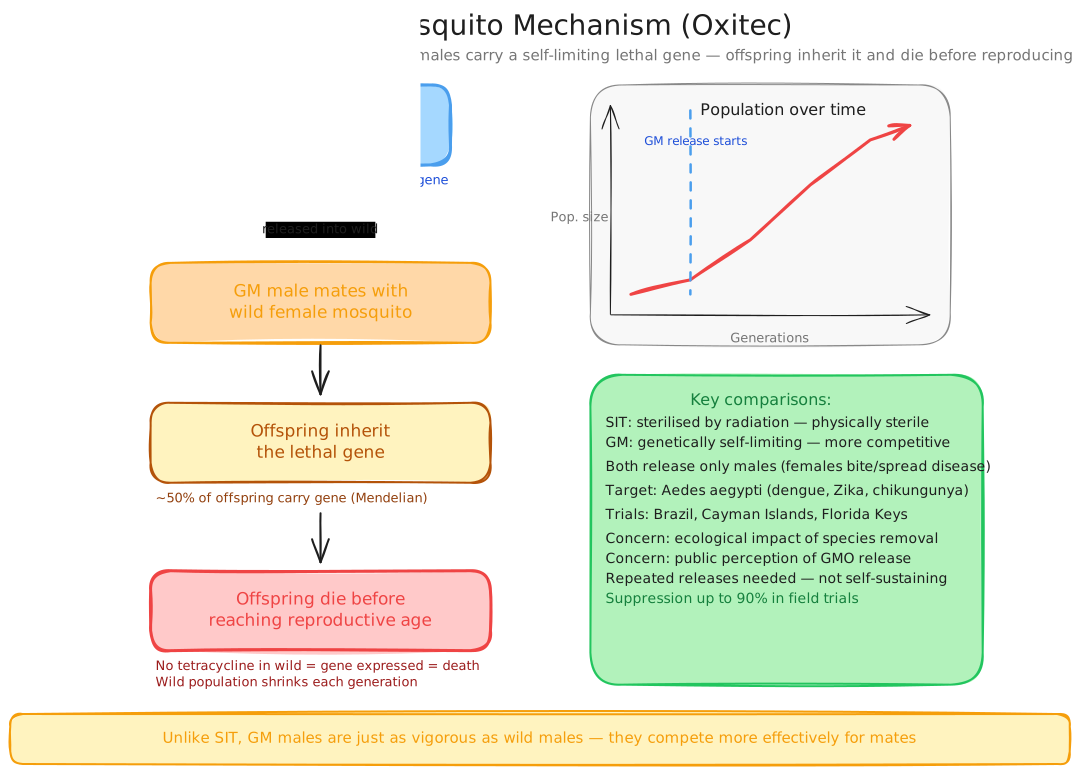
GM Mosquito Population Suppression
From GM mosquitoes to Bt crops and Wolbachia
Advances in genetic engineering have created new tools for controlling disease vectors and the pathogens they carry. These range from GM mosquitoes to genetically modified crops producing their own insecticides.
GM Mosquitoes — OX513A and Gene Drive
Two distinct GM mosquito approaches have been developed for controlling Aedes aegypti (the primary vector of dengue, Zika, chikungunya, and yellow fever):
- OX513A (Oxitec self-limiting strain): Male mosquitoes are genetically modified to carry a "self-limiting" gene — they produce offspring that die before reaching adulthood unless a specific antibiotic (tetracycline) is present in their environment. Releasing these males produces matings with wild females whose offspring die — similar in effect to SIT but using genetic modification rather than radiation. Field trials in Brazil, Cayman Islands, and Florida have shown population reductions of 70–90% in target areas.
- Gene drive: A genetic modification that is inherited by nearly all offspring (rather than the usual 50%) — using CRISPR-Cas9 to cut and replace a gene at high efficiency. Gene drives can spread a sterility gene or a pathogen resistance gene through a wild population within a few generations. Still largely experimental; major concerns about irreversibility and potential unintended spread beyond the target area.
GM Crops with Insecticidal Properties (Bt crops)
Bacillus thuringiensis (Bt) produces proteins (Cry proteins) toxic to insect larvae. The gene encoding these proteins has been inserted into crop plants (cotton, maize) — so the plant itself produces insecticide in its tissues, protecting against insect damage without external pesticide application. While not directly controlling infectious disease vectors in most cases, Bt crops significantly reduce insecticide use in agriculture — reducing selection pressure for insecticide resistance in non-target insect populations.
GM Livestock and Pathogen Resistance
Genetic engineering is also being explored to create livestock resistant to specific pathogens. GM pigs resistant to African swine fever virus and GM cattle resistant to bovine tuberculosis have been developed in research settings. These reduce both disease burden in agriculture and the risk of zoonotic transmission to humans.
What to write in your book
- OX513A: self-limiting GM males → offspring die before adulthood (needs continuous release).
- Gene drive: CRISPR-driven inheritance >50% spreads a trait fast — powerful but irreversible/experimental.
- Bt crops: plant expresses bacterial Cry toxin, cutting external pesticide use.
- Wolbachia: NOT GM — natural maternally-inherited bacterium that lowers mosquito vector competence.
Wolbachia-based mosquito control is NOT classed as genetic modification because:
The New World screwworm (Cochliomyia hominivorax) was once the most economically damaging livestock pest in North America. The fly lays eggs in open wounds on warm-blooded animals — including humans. The larvae feed on living tissue, causing progressive flesh destruction and death. In the 1950s, it cost the US livestock industry hundreds of millions of dollars annually.
The screwworm program is the largest biological pest eradication in history. It succeeded not with chemicals but with a precise understanding of insect reproductive biology — and the industrial scale to exploit it. You will apply SIT principles in Activity 1 and Short Answer Q3.
Pesticides
- Target insect nervous systems, growth, or gut.
- DDT: sodium channel disruption — effective but bioaccumulates.
- Pyrethroids: sodium channel disruption — used in bed nets.
- Resistance develops via natural selection — same mechanism as antibiotic resistance.
Sterile Insect Technique (SIT)
- Mass rear → sterilise by radiation/GM → release males.
- Sterile males mate with wild females → no offspring.
- Population declines over generations.
- Species-specific; no resistance possible; no chemical residues.
- Example: screwworm eradicated from North America (1966).
Genetic Engineering
- GM mosquitoes (OX513A): self-limiting gene → offspring die.
- Gene drive: spreads modification through population rapidly via CRISPR.
- Bt crops: insect-killing bacterial toxin expressed in plant tissue.
- Wolbachia: not GM — bacteria that reduce mosquito vector competence.
Evaluating Approaches
- Pesticides: effective short-term; resistance and ecological damage are concerns.
- SIT: no resistance; species-specific; expensive and logistically demanding.
- GM: highly targeted; ethical and ecological concerns; regulatory challenges.
- No single approach is sufficient — integrated pest management combines multiple strategies.
Disease Vector Control Methods — Comparison
A fresh set drawn from this lesson's question bank — feedback shown immediately. +5 XP per correct · +25 XP all correct
Pick your answer, then rate your confidence — that tells the system what to drill next.
ApplyBand 4(3 marks) 1. Describe the sterile insect technique, explaining the mechanism by which it reduces a pest population. Explain why resistance to SIT is very unlikely to develop compared to resistance to chemical pesticides.
1 mark: SIT mechanism correctly described · 1 mark: why resistance unlikely (no selectable trait) · 1 mark: contrast with pesticide resistance
AnalyseBand 4(3 marks) 2. Compare the use of chemical pesticides and genetic engineering (using one specific example of each) for controlling disease vectors. In your answer, evaluate each approach on its effectiveness, potential for resistance, and ecological impact.
1 mark: pesticide — effectiveness, resistance, ecological impact with example · 1 mark: GM approach with example · 1 mark: evaluative comparison on at least two criteria
EvaluateBand 5(4 marks) 3. Evaluate the use of the sterile insect technique as a strategy for disease vector control. In your answer, refer to the screwworm eradication program as evidence of effectiveness, discuss the limitations of SIT, and explain the conditions under which SIT is most likely to succeed.
1 mark: screwworm evidence with specific data · 1 mark: limitations · 1 mark: conditions for success · 1 mark: overall evaluative conclusion
Show all answers
Multiple choice
Q1 — C: SIT works through reproductive failure — wild females that mate with sterile males produce no offspring. Over successive generations, the number of fertile matings declines, each generation produces fewer individuals, and the population collapses. Competition for food (A) is not the mechanism. Pheromone repulsion (B) is not how SIT works. Sterile males do not carry pathogens (D).
Q2 — A: SIT is species-specific (sterile males only compete for mates within their own species) and resistance cannot develop because there is no selectable trait — wild females cannot detect which males are sterile, so there is no fitness advantage to avoiding them. (B) is wrong — SIT requires expensive mass-rearing facilities and is generally more costly than pesticide use. (C) is wrong — SIT requires multiple generations to reduce population. (D) is wrong — each species requires its own rearing and release program.
Q3 — D: Resistance develops through natural selection — pre-existing mutations conferring resistance survive pyrethroid exposure and reproduce. Mosquitoes do not deliberately evolve (A). Pyrethroids do not mutate mosquito genes (B). Behavioural avoidance of bed nets is a separate phenomenon from biochemical resistance (C), and it is not "conditioning" in the classical sense.
Q4 — B: The self-limiting gene requires tetracycline to suppress — in the wild environment without tetracycline, offspring die before reproducing. The gene cannot spread or accumulate in the wild population. Releases must be continued to maintain population suppression. (A) is wrong — the gene eliminates itself. (C) describes gene drive — not OX513A. (D) is wrong — genes cannot transfer horizontally between animals as described.
Q5 — C: DDT use was restricted primarily because of resistance development in mosquito populations and environmental persistence causing bioaccumulation through food chains — particularly affecting birds of prey (peregrine falcon, bald eagle) through thinning of eggshells. (A) is wrong — cost was not the primary reason. (B) is partially supported (some carcinogenic evidence) but was not the primary driver of the ban. (D) is biologically incorrect.
Short Answer Model Answers
SA1: The sterile insect technique (SIT) works by overwhelming the wild insect population with sterile males. Large numbers of the target insect are reared in a controlled facility, males are sterilised (typically using low-dose radiation that disrupts sperm without affecting mating behaviour or competitiveness), and then released into the wild in numbers that greatly exceed the wild male population. Wild females encounter and mate predominantly with sterile males. Since the mating is biologically normal but produces no viable offspring, each generation produces fewer individuals than the last. If the release ratio (sterile males to wild males) remains sufficiently high and is sustained, the wild population declines with each generation and can be eradicated from the target area. Resistance to SIT is very unlikely to develop because there is no selectable trait available to select for. In pesticide resistance, resistant individuals survive lethal exposure and reproduce — their resistance gene provides a direct survival advantage that natural selection can act upon. In SIT, females cannot distinguish sterile from fertile males by any physical, chemical, or behavioural cue. There is therefore no variation in fitness between females that "avoid" sterile males (who cannot detect them) and those that do not — no resistance trait can be selected. A female that somehow "preferred" fertile males would need to be able to identify them, which is biologically not possible in species where SIT succeeds.
SA2: Chemical pesticides — example: pyrethroids in insecticide-treated bed nets (ITNs) for malaria prevention. Pyrethroids are highly effective at killing Anopheles mosquitoes on contact with treated nets, immediately reducing the number of infective bites received by people sleeping inside. Effectiveness is high in the short term but is being progressively undermined by widespread pyrethroid resistance in Anopheles populations across sub-Saharan Africa — the primary malaria burden region. Resistance develops through natural selection: mosquitoes with sodium channel mutations survive pyrethroid exposure and reproduce. Ecologically, pyrethroids can affect non-target insects including aquatic invertebrates and pollinators when used as spray applications, though bed net applications are more contained. Genetic engineering — example: OX513A self-limiting GM Aedes aegypti for dengue control. OX513A males carry a self-limiting gene — offspring die before adulthood unless tetracycline is present. Field trials in Brazil and Florida showed 70–90% population reductions. Resistance risk is very low: the self-limiting gene eliminates itself with each generation and cannot accumulate. Ecological impact is minimal — the approach targets only Aedes aegypti (its own species) and introduces no chemical residues. However, OX513A requires continuous releases (the gene does not persist without maintenance), faces regulatory hurdles in many countries, and public acceptance is variable. Comparing the two: both are effective, but pyrethroids are cheaper and provide immediate effect while GM approaches are more targeted, produce no chemical residues, and carry lower resistance risk. Pyrethroids face a serious and worsening resistance problem; GM approaches face regulatory and social acceptance barriers. Neither approach alone is sufficient — integrated vector management combining multiple strategies is most effective.
SA3: The screwworm eradication program provides compelling evidence of SIT effectiveness. The New World screwworm was causing hundreds of millions of dollars in annual livestock losses in the United States in the 1950s. Beginning with a successful island trial on Curaçao in 1958 (eradication within months), the program was scaled to the continental United States. At peak operation, the rearing facility in Mission, Texas produced and released approximately 2 billion sterile flies per week. The screwworm was eradicated from the continental United States by 1966 and subsequently from Mexico and Central America by 1991. A sterile fly barrier is now maintained at the Panama-Colombia border to prevent re-invasion from South America where the species persists. This represents complete eradication of a major livestock pest from an entire continent without chemical pesticide use — an extraordinary outcome that has never been matched by pesticide-based approaches for a vertebrate livestock pest. Despite this success, SIT has significant limitations. It is expensive: mass-rearing, sterilisation, and release logistics require sustained investment. It does not prevent re-invasion — the Panama barrier requires continuous maintenance. It is most effective against species where females mate only once in their lifetime (as screwworm females do) — if females can re-mate after encountering a sterile male, the effectiveness of each sterile mating is reduced. The required release ratio (sterile males must substantially outnumber wild males) means that in large, dense wild populations, the logistical scale becomes challenging. SIT is most likely to succeed when: (1) the target species has single-mating females, maximising the impact of each sterile mating; (2) the target area has geographic barriers that limit re-invasion (islands, isthmuses, mountain ranges); (3) the species can be mass-reared in large numbers under controlled conditions; and (4) sufficient funding and political will sustain releases for multiple generations. Overall, SIT is a highly effective, ecologically clean, and resistance-proof approach to vector control in appropriate conditions. Its limitations are logistical and economic rather than biological — which distinguishes it favourably from the escalating resistance challenges facing chemical pesticide programs.
Five timed questions on pesticides, SIT, and genetic engineering. Beat the boss to bank a tier — gold (perfect + fast), silver (80%+), or bronze (cleared).
⚔ Enter the arenaThe ultimate Module 7 challenge — use all your knowledge to defeat the final boss. Pool: lessons 1–17.
You were asked to predict both the benefits and concerns of releasing GM organisms into wild populations.
The benefits you likely identified: reduced disease transmission, reduced pesticide use, species-specific targeting, lower ecological collateral damage than broad pesticides. These are all well-supported by the evidence from SIT, OX513A, and Wolbachia programs.
The concerns you likely raised: spread to other species (gene transfer), ecological consequences of population reduction, irreversibility, public acceptance. These are legitimate — though the specifics matter. Self-limiting approaches (OX513A, SIT) are by design reversible and self-extinguishing. Gene drive approaches are a genuinely different situation — the irreversibility concern is well-founded and is why gene drive research has strict laboratory containment requirements and cautious regulatory frameworks globally.
The key tension this lesson: every tool has trade-offs. Pesticides are cheap and fast but generate resistance and ecological damage. SIT is clean but expensive. GM approaches are targeted but face legitimate ethical and regulatory challenges. The honest answer to "which approach is best" is: it depends on the vector, the disease burden, the geography, the resources available, and the acceptable risk tolerance — which is why integrated pest management uses multiple strategies simultaneously.