Biology • Year 12 • Module 7 • Lesson 17
Pesticides and Genetic Engineering
Lock in core vocabulary for disease vector control — pesticide classes, the sterile insect technique, and GM approaches including OX513A and gene drive.
1. Label the sterile insect technique (SIT) cycle
The diagram below shows the four stages of SIT as applied to the New World screwworm (Cochliomyia hominivorax) eradication program. Write the missing labels into boxes A–H. Each label is drawn from the lesson's Key Terms or from the SIT section of the lesson. 8 marks
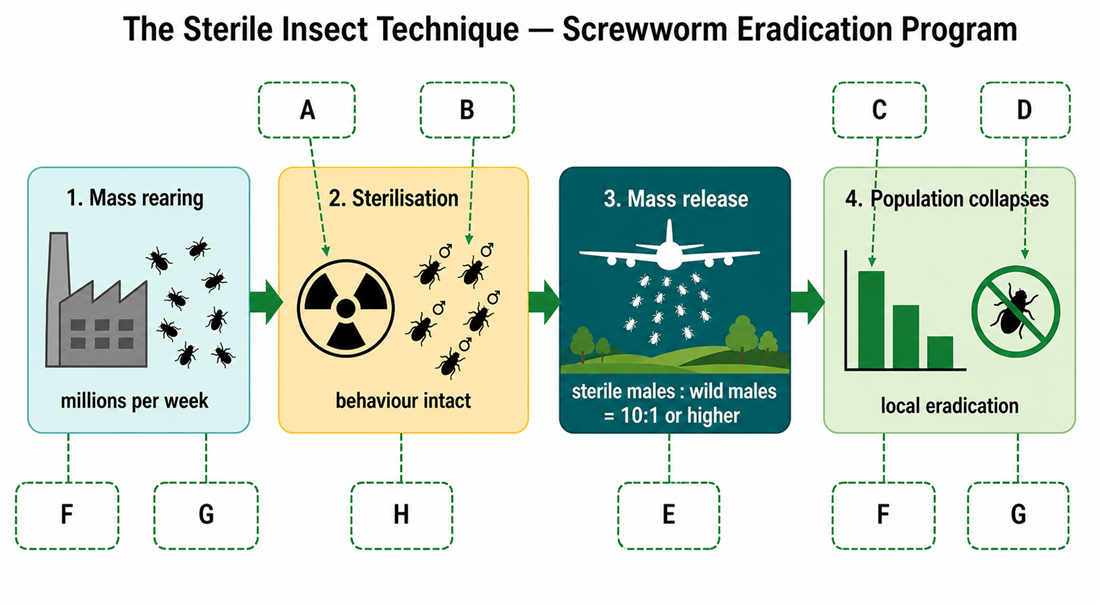
- A — method used to sterilise mass-reared insects _______________________
- B — sex of insects released into the wild _______________________
- C — what happens when a wild female mates with a sterile male _______________________
- D — reason resistance to SIT is very unlikely to develop _______________________
- E — the approximate release ratio required (sterile : wild males) _______________________
- F — target pest species eradicated from North America by 1966 _______________________
- G — term for a strategy that reduces disease spread by targeting the vector _______________________
- H — one advantage of SIT over chemical pesticides _______________________
| Box | Your label |
|---|---|
| A | |
| B | |
| C | |
| D | |
| E | |
| F | |
| G | |
| H |
2. Term–definition match
The ten definitions below are shuffled. In the right-hand column write the matching term from this list: pesticide, vector control, sterile insect technique, genetic engineering, gene drive, non-target effect, organophosphate, pyrethroid, Bt (Bacillus thuringiensis), OX513A. 10 marks
| # | Definition (shuffled) | Matching term |
|---|---|---|
| 2.1 | A chemical used to kill or repel pests, including organisms that transmit disease. | |
| 2.2 | A genetic system that causes a chosen allele to be inherited by nearly all offspring rather than the Mendelian 50%, enabling rapid population-wide spread of a modification. | |
| 2.3 | A class of insecticide that inhibits the enzyme acetylcholinesterase, preventing breakdown of acetylcholine at nerve synapses; example — malathion. | |
| 2.4 | Releasing sterile males so wild females produce no viable offspring, causing the target population to decline over generations. | |
| 2.5 | A naturally occurring soil bacterium whose Cry proteins disrupt the gut epithelium of susceptible insect larvae; used in sprays and GM crops. | |
| 2.6 | Direct modification of DNA to produce desired traits; used to create self-limiting mosquitoes and crops expressing insecticidal proteins. | |
| 2.7 | An unintended impact on organisms other than the pest or disease vector being targeted by a control strategy. | |
| 2.8 | A self-limiting strain of GM Aedes aegypti developed by Oxitec, whose offspring die before adulthood unless the antibiotic tetracycline is present. | |
| 2.9 | A class of synthetic insecticide that disrupts sodium channels in insect nerve membranes; used in insecticide-treated bed nets for malaria prevention; example — permethrin. | |
| 2.10 | Strategies that reduce disease spread by targeting the organisms that transmit pathogens between hosts. |
3. True or false — with correction
For each statement, circle T or F. If the statement is false, write the corrected version on the line provided. 8 marks (1 for T/F, 1 for correction where needed)
3.1 DDT was discontinued primarily because it was too expensive to produce at scale. T / F
3.2 Pesticide resistance develops because the chemical pesticide causes mutations in insect DNA, producing a resistant generation. T / F
3.3 The sterile insect technique is species-specific because sterile males only compete for mates within their own species. T / F
3.4 Gene drive mosquitoes and OX513A mosquitoes both use the same biological mechanism to suppress wild populations. T / F
4. Function recall
Answer each in 1–2 sentences using precise terms from the lesson. 10 marks (2 each)
4.1 What is the mechanism by which pyrethroids kill insect vectors, and why does this make them effective as insecticide-treated bed nets for malaria control?
4.2 What is the function of insect growth regulators (such as methoprene) in mosquito control, and at what life stage do they act?
4.3 What is the function of the "self-limiting gene" in OX513A male mosquitoes when they mate with wild females?
4.4 What is the ecological function of Wolbachia bacteria when introduced into wild Aedes aegypti mosquito populations?
4.5 What is the function of Cry proteins (produced by Bacillus thuringiensis) when a susceptible insect larva ingests them?
5. Fill-the-blank paragraph — pesticide resistance
Complete the paragraph below by writing the correct word or phrase from the word bank on each line. Each term is used once. 8 marks
Word bank:
natural selection · mutations · resistant · dominant · acetylcholinesterase · pyrethroid · sodium channels · Anopheles
Pesticide resistance develops through — the same mechanism responsible for antibiotic resistance. A small proportion of insect vectors carry that confer resistance. When a pesticide is applied, susceptible individuals are killed, while individuals survive and reproduce. Over successive generations, the resistant genotype becomes in the population. For example, mosquitoes (the malaria vector) have developed widespread resistance to insecticides, which work by disrupting in nerve membranes. Organophosphate resistance involves altered , the enzyme these insecticides target.
Q1 — Labelled SIT diagram
A: gamma radiation (or low-dose radiation; also accept: X-rays/radiation). B: males (sterile males only are released). C: no viable offspring are produced / offspring die before reproducing. D: females cannot distinguish sterile from fertile males — there is no selectable trait for "resistance" (females that somehow "avoided" sterile males cannot detect them, so no resistance gene can be selected). E: 10:1 or higher (sterile males must substantially outnumber wild males). F: New World screwworm (Cochliomyia hominivorax). G: vector control. H: any of: no resistance development / species-specific / no chemical residues / no bioaccumulation in food chains.
Q2 — Term–definition matches
2.1 pesticide • 2.2 gene drive • 2.3 organophosphate • 2.4 sterile insect technique • 2.5 Bt (Bacillus thuringiensis) • 2.6 genetic engineering • 2.7 non-target effect • 2.8 OX513A • 2.9 pyrethroid • 2.10 vector control.
Q3 — True / false with correction
3.1 False. Correction: DDT was discontinued (banned or restricted in most countries) primarily because resistance developed in target mosquito populations and because of environmental persistence and bioaccumulation in food chains, causing reproductive failure in raptors such as the peregrine falcon — not due to cost.
3.2 False. Correction: pesticide resistance is not caused by the pesticide inducing mutations. Resistance develops through natural selection — pre-existing resistance mutations are already present in a small proportion of the insect population before pesticide exposure. When the pesticide kills susceptible individuals, only the already-resistant individuals survive and reproduce, so the resistant genotype increases in frequency.
3.3 True.
3.4 False. Correction: OX513A is a self-limiting strain — offspring of sterile males die before adulthood because the self-limiting gene is always active unless tetracycline is present; it produces population suppression by reproductive failure. Gene drive uses CRISPR-Cas9 to spread a modification through nearly all offspring of matings, rapidly changing the entire wild population's genotype; the mechanism is inheritance-based spread, not simple offspring death. The two approaches differ fundamentally in how they achieve population-level effects.
Q4.1 — Pyrethroid mechanism
Pyrethroids disrupt sodium channels in insect nerve membranes, keeping them open and causing continuous nerve firing that results in paralysis and death. In insecticide-treated bed nets, mosquitoes that land on or attempt to bite through the net are exposed to the pyrethroid and killed or repelled before they can feed, protecting sleeping occupants from infective bites.
Q4.2 — Insect growth regulators
Insect growth regulators such as methoprene mimic juvenile hormone in insects, preventing larvae from undergoing the hormonal changes needed to mature into adults. They act at the larval stage — when applied to water bodies where mosquitoes breed, they kill larvae before they can develop into biting adult vectors.
Q4.3 — OX513A self-limiting gene
When OX513A males mate with wild females, offspring inherit the self-limiting gene. In the wild environment, where the antibiotic tetracycline is absent, the self-limiting gene is always active and causes the offspring to die before reaching adulthood. The result is that each mating between a wild female and an OX513A male produces no surviving offspring, reducing the next generation's population size.
Q4.4 — Wolbachia in Aedes aegypti
When Wolbachia bacteria infect Aedes aegypti, they reduce the mosquito's ability to transmit dengue, Zika, and chikungunya viruses by competing with the viruses for resources inside the mosquito. Because Wolbachia is inherited maternally, infected females pass it to all offspring, allowing it to spread naturally through the wild population without continued releases — gradually reducing the vector competence of the whole mosquito population.
Q4.5 — Cry proteins (Bt)
Cry proteins disrupt the epithelium of the insect gut. The alkaline pH of susceptible insect guts (such as mosquito larvae or lepidopteran caterpillars) activates the toxin, which binds to and punches holes in gut-lining cells, causing them to lyse. The insect stops feeding and dies from gut damage and sepsis. The effect is specific to insects with alkaline gut pH; vertebrates and most other non-target organisms are not affected.
Q5 — Cloze paragraph
In order: natural selection — mutations — resistant — dominant — Anopheles — pyrethroid — sodium channels — acetylcholinesterase.