Adaptive Immunity — Antigens and Antibodies
A lock has one key. Your immune system has a different B cell for every possible pathogen — billions of different locks, each waiting for its matching key. When the right one arrives, that B cell multiplies into an army and floods the body with its specific antibody. This is humoral immunity.
Practise this lesson
Four printable worksheets that build from the foundations up to exam-style questions — start at whatever level suits you.
You had chickenpox as a child. Twenty years later, someone sneezes chickenpox virus near you. You don't get sick.
Before reading: at the molecular level, what do you think is preventing you from getting chickenpox a second time? Where is the "memory" stored, and how does it work fast enough to stop an infection that moves quickly?
Know
- What an antigen is and where antigens are found
- The structure and function of antibodies
- Clonal selection and clonal expansion
- The difference between plasma cells and memory B cells
Understand
- Why clonal selection is the key to specificity in adaptive immunity
- How antibodies neutralise pathogens through different mechanisms
- Why the secondary response is faster and stronger
Can Do
- Describe the sequence from antigen exposure to antibody production
- Explain clonal selection using the lock-and-key analogy
- Compare the primary and secondary immune responses using a graph
Core Content
Antigens and the epitopes antibodies recognise
An antigen is any molecule that the adaptive immune system can recognise and respond to specifically — and antibodies bind to just one small region of it, the epitope.
An antigen is any molecule recognised by the adaptive immune system that triggers a specific immune response. Most antigens are proteins or polysaccharides found on the surface of pathogens — but they can also be found on pollen, transplanted cells, or even the body's own abnormal cells in autoimmune disease.
The part of the antigen that is actually recognised by an antibody or lymphocyte receptor is called the epitope (or antigenic determinant). An epitope is the specific region of an antigen that an antibody binds to, and one antigen can have many epitopes — each stimulating a different B cell clone.
Pause — copy the highlighted points into your book before moving on.
The immune system tolerates self-antigens (your own normal molecules) but attacks non-self antigens (foreign molecules) — this self vs non-self recognition is the basis of immune specificity.
Add the self vs non-self point to your notes before the check below.
The specific part of an antigen that an antibody actually binds to is called the _____.
A Y-shaped protein with a unique binding site
We just saw that an antigen carries many small epitopes. That raises a question: what is it about an antibody that lets it lock onto just one of them? This card answers it → the antibody's Y-shape with its one unique variable binding site.
Every antibody has the same basic Y-shape, but a unique antigen-binding site that matches exactly one epitope.
Antibodies (immunoglobulins) are Y-shaped proteins made by plasma cells. The variable region is the unique antigen-binding site (fits one epitope); the constant (Fc) region sets the antibody's class and effector functions. Each antibody has two identical binding sites.
Antibody structure — the variable regions give each antibody its unique specificity; the constant region determines its class and effector functions
Pause — copy the highlighted structure points, using the diagram to label variable vs constant regions.
Antibodies neutralise pathogens through several mechanisms:
- Neutralisation: antibody binds to pathogen surface, physically blocking it from attaching to host cell receptors
- Opsonisation: antibody coating marks pathogen for phagocytosis — phagocytes have Fc receptors that bind the constant region
- Complement activation: antibody-antigen complexes activate the complement cascade, leading to membrane attack complex formation
- Agglutination: antibodies clump pathogens together (each antibody has two binding sites), making them easier to phagocytose and preventing spread
Four antibody actions: neutralisation (block attachment), opsonisation (mark for phagocytosis), complement activation (membrane attack complex), agglutination (clumping). Antibodies mark or block pathogens — they don't kill them directly.
Add the four antibody actions to your notes before the check below.
Which part of an antibody determines which specific antigen it can bind?
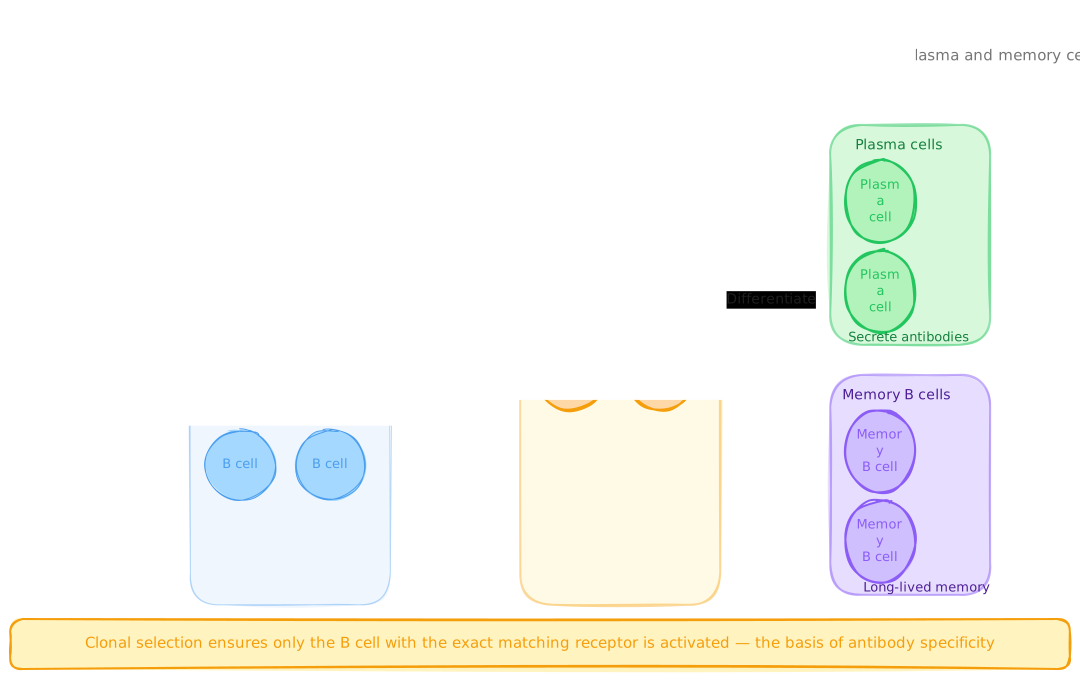
Clonal Selection and Expansion
Finding and multiplying the one matching B cell
We just saw that every antibody fits only one specific epitope. That raises a problem: the body can't pre-make an antibody for every possible germ. This card answers it → clonal selection is how the body finds and mass-produces the one matching B cell on demand.
The body holds millions of different B cell clones, each able to bind only one antigen — clonal selection is how the right one is found and turned into an army.
Each B cell has a unique B cell receptor (BCR) that binds only one specific antigen. Before any infection, most of these B cells are naive (never exposed to their antigen).
Clonal selection and expansion — one matching B cell becomes an army of plasma cells AND a bank of memory cells for future protection
Clonal selection: the antigen selects the one B cell whose BCR matches it. With a T helper co-stimulatory signal, that B cell undergoes clonal expansion — dividing into plasma cells (short-lived antibody factories) and memory B cells (long-lived, for a faster second response).
Pause — copy the highlighted clonal selection sequence, using the flowchart to get the order right.
During clonal selection, how many B cell clones are activated by a given antigen?
Annotated Diagram — Clonal Selection and Antibody Production
Pattern A — Draw and Annotate
In your book, draw a diagram showing the full sequence from antigen entry to antibody release. Your diagram must include and label:
- An antigen-presenting dendritic cell displaying antigen fragments on MHC II.
- A population of at least five different naive B cells with different-shaped BCRs — only one matches the antigen.
- The selected B cell binding the antigen and receiving a signal from a T helper cell.
- Clonal expansion — show the selected B cell dividing into multiple identical cells.
- Two final outcomes: a cluster of plasma cells releasing Y-shaped antibodies, and a separate cluster of memory B cells.
- An arrow showing antibodies binding to the original antigen, with a label explaining the effector function (choose one: neutralisation, opsonisation, or agglutination).
Why the second exposure is so much faster
We just saw that clonal selection leaves behind a reserve of memory B cells. That raises a question: what difference do those memory cells actually make next time? This card answers it → they explain why the second response is far faster and stronger than the first.
The dramatic difference between first and second exposure to an antigen is explained entirely by memory B cells.
The secondary response is faster (memory B cells activate within hours) and produces far more antibody — this is the basis of vaccination and lifelong immunity
Primary response: 7–14 days, lower antibody level, IgM then IgG. Secondary response: 1–3 days, much higher and longer-lasting level, mainly IgG — because memory B cells activate immediately. This is the basis of vaccination and lifelong immunity.
Pause — copy the highlighted primary vs secondary comparison, and sketch the graph shape.
The secondary immune response is faster and produces more antibody than the primary response.
Clonal selection activates only the B cell clone whose receptor matches a specific antigen.
Antibodies are produced by T cells and directly kill pathogens by piercing their cell membranes.
Interpreting Primary and Secondary Response Data
Pattern A — Structured Data Analysis
The table below shows antibody levels (arbitrary units) measured in a patient's blood following two exposures to the same pathogen.
| Day | Antibody level (AU) | Event |
|---|---|---|
| 0 | 0 | First exposure to pathogen |
| 5 | 2 | — |
| 10 | 45 | — |
| 14 | 80 | Peak primary response |
| 21 | 40 | — |
| 35 | 12 | — |
| 60 | 8 | Second exposure to same pathogen |
| 62 | 35 | — |
| 64 | 180 | — |
| 67 | 420 | Peak secondary response |
| 80 | 200 | — |
| 100 | 95 | — |
- Draw a labelled graph of antibody level (y-axis) vs day (x-axis). Mark the two exposure events and label the primary and secondary response peaks.
- Calculate the ratio of peak secondary antibody level to peak primary antibody level. What does this ratio indicate about the effectiveness of immunological memory?
- The primary response took 14 days to reach its peak. The secondary response reached its peak by day 67 — only 7 days after the second exposure. Explain this difference at the cellular level.
- After day 35, antibody levels in the primary response declined to 12 AU by day 60. Yet when the second exposure occurred, the patient responded rapidly. What does this suggest about where immunological memory is stored?
- A student claims: "The patient was immune after the first exposure because antibody levels didn't drop to zero." Evaluate this claim using the data.
When you were infected with the varicella-zoster virus (chickenpox) as a child, your adaptive immune system mounted a primary response: dendritic cells presented viral antigens, the matching B cell clone was selected and expanded, plasma cells flooded your bloodstream with anti-varicella antibodies, and memory B cells formed. The infection resolved in 1–2 weeks. The plasma cells died within weeks. But the memory B cells persisted — some for the rest of your life. Twenty years later, when the same virus enters your respiratory tract, those memory B cells are activated within hours. They divide rapidly into new plasma cells and flood the bloodstream with high-affinity IgG antibodies before the virus can establish a significant infection. You experience no symptoms — or only a very mild response — because the secondary immune response eliminates the virus before it reaches the threshold for illness. This is also why the chickenpox vaccine works: it introduces a weakened form of the virus that stimulates the same primary response and memory formation — without causing the disease. You will apply this to primary vs secondary response graphs in the practice questions.
Antigens and Antibodies
- Antigen: any foreign molecule triggering an immune response.
- Epitope: the specific region an antibody binds to.
- Antibody: Y-shaped protein; variable region = antigen-specific; Fc region = effector functions.
- Each antibody has TWO identical antigen-binding sites.
Clonal Selection and Expansion
- Millions of B cells, each with unique BCR — only one matches any given antigen.
- Matching B cell binds antigen + receives T helper signal → activated.
- Activated B cell divides → plasma cells (antibody factories) + memory B cells.
- T helper signal required — prevents accidental self-activation.
Antibody Functions
- Neutralisation — blocks pathogen from binding host receptors.
- Opsonisation — coats pathogen for phagocytosis.
- Complement activation — triggers membrane attack complex.
- Agglutination — clumps pathogens together.
Primary vs Secondary Response
- Primary: 7–14 days to peak; lower antibody levels; IgM then IgG.
- Secondary: 1–3 days to peak; much higher levels; mainly IgG.
- Secondary faster because memory B cells are pre-existing and activate immediately.
- Basis of vaccination — primary response without full disease.
B Cell Activation Pathway