Biology • Year 12 • Module 7 • Lesson 11
Adaptive Immunity — Antigens and Antibodies
Apply knowledge of clonal selection, antibody mechanisms, and primary vs secondary immune response to real data and scenarios.
1. Sequence the steps — from antigen exposure to antibody production
The eight events below describe the humoral immune response after a person is exposed to Streptococcus pyogenes (the cause of strep throat). They are shuffled. Write the correct order (1–8) in the Order column. 8 marks
| Order | Event |
|---|---|
| S. pyogenes surface proteins are processed and displayed on MHC II by a dendritic cell in the lymph node. | |
| IgG antibodies bind to S. pyogenes surface antigens, coating the bacterium (opsonisation). | |
| The selected B cell receives a co-stimulatory signal from a T helper cell that has independently recognised the same antigen. | |
| Plasma cells die off; antibody levels in blood decline over weeks. | |
| The one B cell from millions whose BCR matches the S. pyogenes antigen binds it — clonal selection. | |
| S. pyogenes enters the respiratory epithelium and is phagocytosed by a dendritic cell. | |
| The activated B cell undergoes clonal expansion, differentiating into plasma cells and memory B cells. | |
| Phagocytes with Fc receptors bind the opsonised bacteria and engulf them. |
2. Interpret real data — primary and secondary antibody response
The graph below shows serum antibody levels (IgM and IgG combined, arbitrary units) measured in a healthy adult following two exposures to the varicella-zoster virus (chickenpox). The data are adapted from published immunology studies of primary varicella infection and secondary exposure. 10 marks
2.1 Identify the peak antibody level during the primary response and the day on which it occurred. Calculate the ratio of the secondary peak to the primary peak. 2 marks
2.2 The primary response took 14 days to reach its peak. The secondary response reached its peak by day 67 — only 7 days after the second exposure. Explain this difference at the cellular level. 3 marks
2.3 Between days 35 and 60 (primary response), antibody levels fell to approximately 8 AU, yet the patient responded rapidly to the second exposure. What does this indicate about how immunological memory is stored? 2 marks
2.4 A student claims: "The patient was immune after the first exposure because antibody levels never dropped to zero." Evaluate this claim using the data and your lesson knowledge. 3 marks
3. Spot the errors — what's wrong with this student's antibody diagram?
A Year 12 student drew the diagram below to explain how antibodies defend against pathogens. There are three biological errors. Identify each error and write the correction. 6 marks — 2 per error: 1 identify, 1 correct
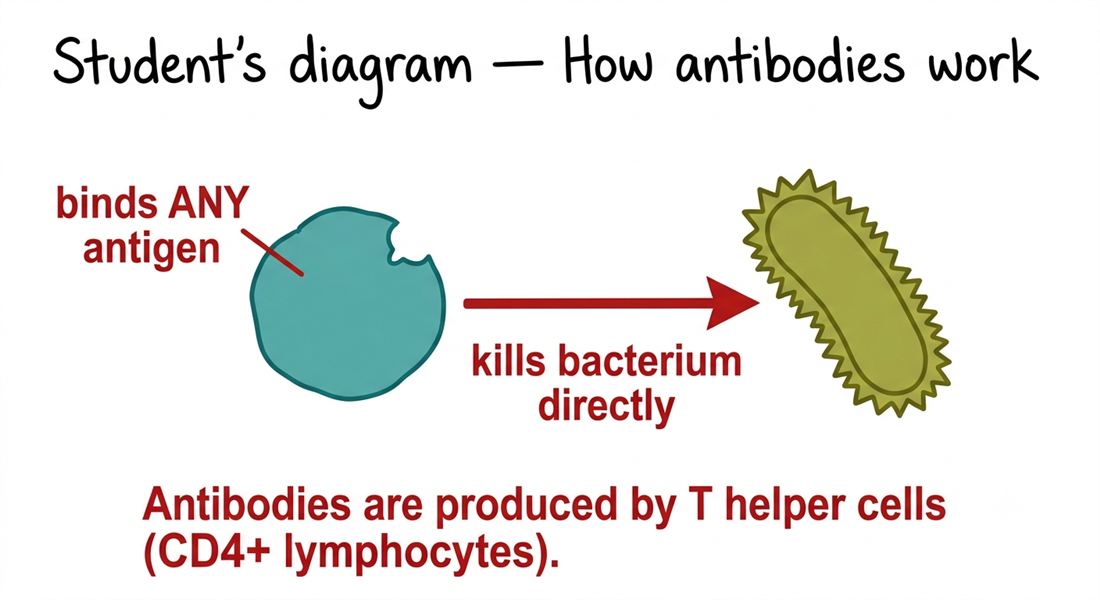
3.1 Error 1: What is wrong?
Correction:
3.2 Error 2: What is wrong?
Correction:
3.3 Error 3: What is wrong?
Correction:
4. Case study — COVID-19 booster doses and memory
During Australia's COVID-19 vaccination rollout (2021–2022), health authorities recommended booster doses of mRNA vaccines (e.g. Comirnaty / Pfizer-BioNTech) approximately 3–6 months after the primary two-dose series. Studies showed that antibody levels against the SARS-CoV-2 spike protein declined significantly in the months after the primary series, yet recipients of a booster shot showed antibody levels 10–40 times higher than their primary-series peak within 7 days. 5 marks
4.1 Using your knowledge of clonal selection, explain why the primary vaccine series generates both short-term antibody protection and long-term immunological memory. 2 marks
4.2 Explain, at the cellular level, why the booster dose produced a much larger antibody response within 7 days — faster and larger than the primary series response. 2 marks
4.3 A commentator wrote: "If antibody levels fall after vaccination, the vaccine has stopped working." Is this claim biologically justified? Justify your answer in one sentence. 1 mark
Q1 — Correct sequence
Correct order: (6) S. pyogenes enters and is phagocytosed → (1) antigens displayed on MHC II by dendritic cell → (5) B cell with matching BCR binds (clonal selection) → (3) T helper co-stimulatory signal → (7) clonal expansion → plasma cells + memory B cells → (2) IgG opsonises bacteria → (8) phagocytes with Fc receptors engulf bacteria → (4) plasma cells die, antibody levels decline.
Award 1 mark for each correctly placed event pair (max 8). Accept minor variation in the ordering of events that logically occur in parallel (e.g. 2 and 8 may be considered simultaneous).
Q2.1 — Primary peak and ratio (2 marks)
Primary peak: approximately 80 AU at day 14. Secondary peak: approximately 420 AU at day 67. Ratio: 420 ÷ 80 = 5.25. The secondary response produced roughly 5× more antibody than the primary response, demonstrating the enhanced effectiveness of immunological memory.
Q2.2 — Cellular explanation of response speed (3 marks)
During the primary response, clonal selection must first identify the rare B cell clone (from millions with different BCRs) whose receptor matches the varicella-zoster antigen [1]. This takes 7–14 days as dendritic cells process and present antigen, the matching naive B cell encounters it, receives a T helper signal, and then undergoes clonal expansion [1]. During the secondary response, memory B cells formed during the primary response are already pre-selected for that antigen — they exist in much greater numbers, are already matched, and activate within hours without needing to search through naive B cells, producing plasma cells and antibodies within 1–3 days [1].
Q2.3 — Where memory is stored (2 marks)
The rapid secondary response despite low circulating antibody levels shows that immunological memory is stored cellularly — in long-lived memory B cells — not as pre-existing circulating antibodies [1]. The memory B cells persisted in lymph nodes and bone marrow through the low-antibody period (days 35–60) and reactivated rapidly on second exposure [1].
Q2.4 — Evaluate the student's claim (3 marks)
The claim is partly correct but misleading [1]. Low residual antibody levels (8 AU by day 60) do offer some baseline protection, but they are insufficient to explain the rapid secondary response — at 8 AU, the antibody titre is too low to neutralise a meaningful viral dose [1]. The real basis of ongoing immunity is the pool of memory B cells (not circulating antibodies), which activate within hours of second exposure and produce new antibodies in large quantities before the virus can establish a significant infection [1].
Q3 — Diagram critique (6 marks)
3.1 Error 1 (circular blob, "binds ANY antigen"): Antibodies are Y-shaped proteins with two identical antigen-binding sites (Fab regions) whose variable region binds only one specific epitope — not any antigen. Correction: redraw as a Y-shape with two Fab arms; label "binds ONE specific epitope (antigen-specific)". [1 + 1]
3.2 Error 2 ("kills bacterium directly"): Antibodies do not kill pathogens directly. They flag the pathogen for destruction by other mechanisms (opsonisation for phagocytosis, complement activation, agglutination, neutralisation). Correction: label the arrow "opsonises / marks for phagocytosis — phagocytes with Fc receptors complete the destruction". [1 + 1]
3.3 Error 3 ("produced by T helper cells"): Antibodies are produced by plasma cells — differentiated B cells that have undergone clonal selection and expansion. T helper cells provide the co-stimulatory signal for B cell activation but do not produce antibodies. Correction: change caption to "Antibodies are produced by plasma cells (activated B cells)". [1 + 1]
Q4.1 — Primary series generates short and long-term immunity (2 marks)
The mRNA vaccine introduces the SARS-CoV-2 spike protein antigen. Clonal selection identifies the B cell clone with a BCR matching the spike protein epitope [1]. After activation and clonal expansion, the clone differentiates into plasma cells (producing antibodies for weeks — short-term protection) and memory B cells (long-lived — the basis of long-term immunological memory) [1].
Q4.2 — Why the booster is faster and larger (2 marks)
The booster dose acts as a second exposure to the spike antigen. The memory B cells formed after the primary series are activated within hours — without needing a new round of clonal selection from naive cells [1]. Memory B cells exist in much larger numbers than the original naive clone and are already pre-selected; they rapidly differentiate into plasma cells producing large amounts of high-affinity IgG, explaining the 10–40× larger response in only 7 days [1].
Q4.3 — Declining antibodies ≠ vaccine failure (1 mark)
No — the claim is not justified: declining antibody levels do not mean the vaccine has stopped working, because immunological memory is stored in long-lived memory B cells that can rapidly regenerate antibody production on re-exposure, even when circulating antibody levels are low. [1]