Biology • Year 12 • Module 7 • Lesson 11
Adaptive Immunity — Antigens and Antibodies
Lock in the core vocabulary and structural knowledge for antigens, antibody structure, clonal selection, and primary vs secondary immune response.
1. Label the antibody structure diagram
The diagram below shows a simplified Y-shaped antibody (IgG class). Write the correct label into each box A–H using the word bank provided. 8 marks
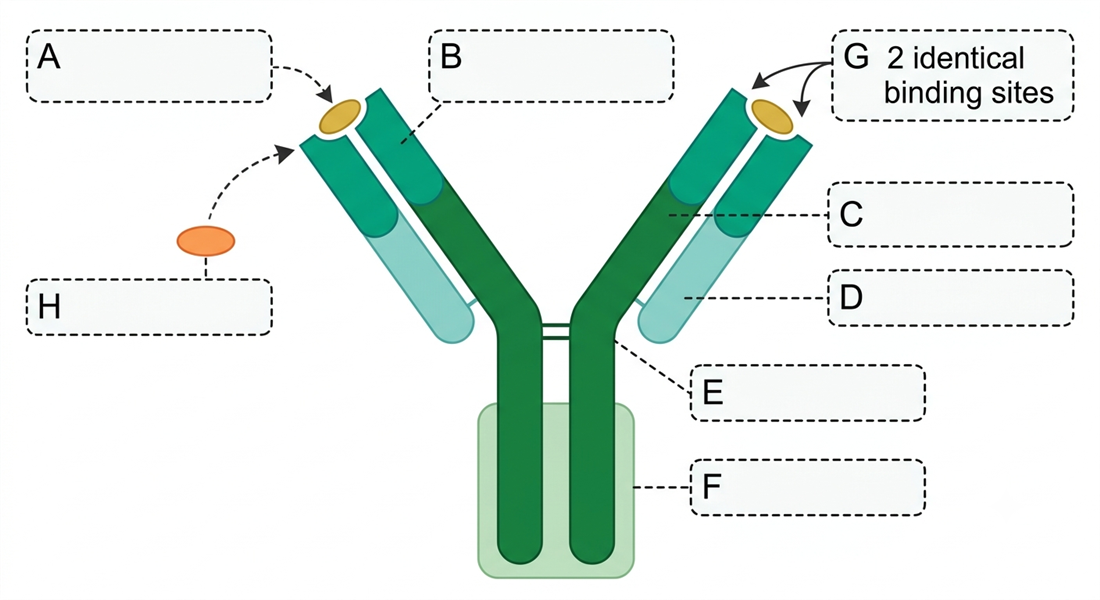
Word bank: antigen-binding site (Fab region) · variable region · heavy chain · light chain · hinge region · Fc (constant) region · two identical binding sites · epitope
| Box | Your label |
|---|---|
| A | |
| B | |
| C | |
| D | |
| E | |
| F | |
| G | |
| H |
2. Term–definition match
Match each definition to its correct term from the word list below. Write the term in the right-hand column.
Terms: antigen · epitope · antibody · clonal selection · clonal expansion · plasma cell · memory B cell · opsonisation · agglutination · neutralisation 10 marks
| # | Definition | Term |
|---|---|---|
| 2.1 | A Y-shaped protein produced by an activated B cell that binds a specific antigen. | |
| 2.2 | The specific region of an antigen recognised by an antibody or B cell receptor. | |
| 2.3 | Any foreign molecule that can be recognised by the adaptive immune system and trigger a specific response. | |
| 2.4 | The process by which the single B cell whose receptor matches an antigen is identified and activated from a pool of millions. | |
| 2.5 | The rapid division of the selected B cell to produce a large population of identical cells. | |
| 2.6 | A differentiated B cell that secretes thousands of identical antibodies per second. | |
| 2.7 | A long-lived B cell that persists after the primary response and enables rapid re-activation on second exposure. | |
| 2.8 | An antibody effector function in which pathogen surface antigens are coated so phagocytes bind and engulf more efficiently. | |
| 2.9 | An antibody effector function in which the two binding sites of an antibody cross-link multiple pathogens into clumps. | |
| 2.10 | An antibody effector function in which the antibody physically blocks a viral surface protein from binding its host cell receptor. |
3. True or false — with correction
Circle T or F. If false, write the corrected statement on the line below. 8 marks (1 for T/F, 1 for each correction where needed)
3.1 Once produced, an antibody can bind to any antigen in the body because it circulates freely in the bloodstream. T / F
3.2 Clonal selection activates the one B cell from millions whose B cell receptor (BCR) matches the specific antigen presented. T / F
3.3 The secondary immune response is slower and produces fewer antibodies than the primary response because the B cells must be selected again from scratch. T / F
3.4 T helper cells provide a co-stimulatory signal required for full B cell activation, which helps prevent the immune system from attacking self-antigens. T / F
4. Function recall
Answer each prompt in 1–2 sentences using precise terms from the lesson. 10 marks (2 each)
4.1 What is the function of the variable region of an antibody?
4.2 What is the function of the Fc (constant) region of an antibody?
4.3 What is the function of plasma cells after clonal expansion?
4.4 What is the function of memory B cells in long-term immunity?
4.5 What is the function of the T helper cell co-stimulatory signal in B cell activation?
5. Fill the blanks — clonal selection sequence
Complete the paragraph by writing one word or phrase from the word bank in each blank. Each term is used once. 8 marks
Word bank: antigen · BCR · clonal expansion · T helper · memory B cells · plasma cells · epitope · antibodies
When a pathogen enters the body, antigen-presenting dendritic cells display fragments of the foreign molecule on MHC II. Each fragment contains a specific region called the _______________ (1) that can be recognised by a B cell. Each B cell has a unique _______________ (2) that can bind only one specific antigen. The rare B cell whose receptor matches the _______________ (3) binds it and receives a co-stimulatory signal from a _______________ (4) cell. This triggers _______________ (5), in which the activated B cell divides repeatedly into a large clone. The clone differentiates into two populations: short-lived _______________ (6) that secrete large amounts of specific _______________ (7), and long-lived _______________ (8) that persist for years and enable a faster secondary response.
6. Build a concept map
Draw labelled arrows between the five terms to show how they connect. Each arrow must carry a linking phrase (e.g. "activates", "produces", "enables"). Aim for at least 5 labelled arrows. 5 marks
Supplied terms: antigen · clonal selection · plasma cell · memory B cell · secondary immune response
Q1 — Antibody structure labels
A: antigen-binding site (Fab region). B: variable region (unique antigen-binding shape). C: heavy chain (forms the Y backbone). D: light chain (paired with each heavy chain arm). E: hinge region (flexible joint allowing both Fab arms to move). F: Fc (constant) region (bound by phagocyte Fc receptors; determines antibody class). G: two identical antigen-binding sites. H: epitope (the specific region on the pathogen surface that fits the variable region).
Q2 — Term–definition matches
2.1 antibody • 2.2 epitope • 2.3 antigen • 2.4 clonal selection • 2.5 clonal expansion • 2.6 plasma cell • 2.7 memory B cell • 2.8 opsonisation • 2.9 agglutination • 2.10 neutralisation.
Q3 — True / false with correction
3.1 False. Antibodies are highly specific — each antibody binds only the epitope matching its variable region. They cannot bind any antigen.
3.2 True.
3.3 False. The secondary response is faster and produces more antibodies. Memory B cells formed during the primary response activate within hours of second exposure, without needing to go through clonal selection again from a naive pool.
3.4 True.
Q4.1 — Variable region function
The variable region is the unique antigen-binding site of an antibody. Its specific three-dimensional shape allows it to bind to exactly one epitope, giving adaptive immunity its specificity.
Q4.2 — Fc region function
The Fc (constant) region determines the antibody's class (e.g. IgG) and effector functions. Phagocytes carry Fc receptors on their surface that bind the Fc region, enabling opsonisation — the antibody-coated pathogen is held tightly against the phagocyte for engulfment. The Fc region also initiates complement activation.
Q4.3 — Plasma cell function
After clonal expansion, plasma cells act as antibody factories, each secreting thousands of identical antibodies per second. They are short-lived (days to weeks) and their antibodies circulate in blood and lymph, neutralising, opsonising, and agglutinating the specific pathogen.
Q4.4 — Memory B cell function
Memory B cells persist for years to decades after the primary response. They carry the same BCR as the originally selected B cell. On re-exposure to the same antigen, they activate rapidly (within hours) without needing a new round of clonal selection, producing plasma cells that flood the bloodstream with IgG antibodies within 1–3 days — eliminating the pathogen before symptoms develop.
Q4.5 — T helper co-stimulatory signal function
B cells cannot fully activate on BCR–antigen binding alone. The co-stimulatory signal from a T helper cell that has independently recognised the same antigen confirms the threat is real, preventing accidental activation against self-antigens. This two-signal requirement is a safety mechanism for immune tolerance.
Q5 — Cloze answers
(1) epitope · (2) BCR · (3) antigen · (4) T helper · (5) clonal expansion · (6) plasma cells · (7) antibodies · (8) memory B cells.
Q6 — Sample concept map
A correct map should include arrows such as:
- antigen — triggers → clonal selection
- clonal selection — activates one B cell → divides to produce → plasma cell
- clonal selection — also produces → memory B cell
- plasma cell — secretes antibodies that clear → antigen
- memory B cell — enables → secondary immune response
- secondary immune response — activated by re-exposure to same → antigen
Award full marks for at least 5 correctly labelled causal arrows. Accept any biologically valid linking phrase.