What Is Infectious Disease?
In 2020, a novel coronavirus brought the global economy to a halt within weeks. Understanding why — and how — requires knowing exactly what a pathogen is, what it does, and how it spreads.
Practise this lesson
Four printable worksheets that build from the foundations up to exam-style questions — start at whatever level suits you.
Here is a statement many people believe:
"All microorganisms cause disease — they are harmful by nature."
Do you agree or disagree? Write your reasoning. If you agree, explain why. If you disagree, give a specific example that challenges this claim. You will return to this at the end of the lesson.
Know
- The definition of infectious disease and pathogen
- The three categories of pathogen: microorganisms, macroorganisms, non-cellular
- Examples of each category causing disease in plants and animals
- How disease transmission data is collected
Understand
- Why classifying pathogens matters for treatment and prevention
- How infectious disease differs from non-infectious disease
- Why most microorganisms are not pathogens
Can Do
- Classify a given pathogen into the correct category
- Describe how data on disease transmission is collected
- Distinguish infectious from non-infectious disease with examples
Core Content
Pathogens vs lifestyle, genetic and environmental causes
For most of human history, disease was blamed on bad air, imbalanced humours, or divine punishment — the idea that tiny invisible living things could invade and destroy the body was not accepted until the mid-19th century.
An infectious disease is a disease caused by a pathogen — an organism or agent that enters a host and causes harm. This distinguishes it from non-infectious diseases (cancer, heart disease, type 1 diabetes), which arise from genetic, environmental or lifestyle factors rather than an invading organism.
Infectious vs Non-Infectious Disease
Pause — copy the highlighted definitions of infectious vs non-infectious disease into your book.
Which of the following is an infectious disease?
Microorganisms · macroorganisms · non-cellular agents
We just saw that infectious disease is caused by pathogens. That raises a question: are all pathogens the same kind of thing? This card answers it → they fall into three groups, and the group decides how the disease is diagnosed and treated.
Pathogens are sorted into three broad groups by their biological nature — and the group a pathogen belongs to decides how the disease can be diagnosed and treated.
This classification matters because each category requires different diagnostic and treatment strategies.
Microorganisms
Microscopic living organisms. Treated as living cells — can reproduce independently (bacteria) or within a host cell (some).
- Bacteria: Tuberculosis, golden staph, salmonella
- Fungi: Tinea, candidiasis, aspergillosis
- Protozoa: Malaria (Plasmodium), giardia, toxoplasma
Macroorganisms
Visible parasites. Large enough to see with the naked eye at some life stages.
- Helminths (worms): Tapeworms, roundworms, flukes
- Ectoparasites: Lice, ticks, mites, fleas
Cause disease through physical damage, nutrient competition, and immune activation.
Non-Cellular Pathogens
Not living cells — cannot independently metabolise or reproduce. Require a host.
- Viruses: COVID-19, influenza, HIV, HPV, measles
- Prions: Misfolded proteins — BSE (mad cow disease), CJD
- Viroids: Small RNA molecules — plant pathogens only
Three pathogen groups: microorganisms (bacteria, fungi, protozoa — living cells); macroorganisms (helminths, ectoparasites — visible parasites); non-cellular (viruses, prions, viroids). Antibiotics work on bacteria only — not viruses, fungi or prions.
Pause — copy the three pathogen groups and the antibiotics point into your book.
A prion (e.g. the agent of CJD) is best classified as a:
Pathogen Classification Diagram
Pattern A — Draw and Annotate
In your book, construct a classification diagram (branching tree) for pathogens. Your diagram must:
- Show the three main categories (microorganisms, macroorganisms, non-cellular pathogens) as branches from a central 'Pathogen' node.
- Include at least two sub-categories under each main category (e.g. bacteria and fungi under microorganisms).
- Label one specific named example of a disease-causing organism at the end of each branch.
- For three of your examples, add a short annotation (one sentence) explaining why that pathogen fits in that category — not just naming it.
The same pathogen types attack both kingdoms
We just saw the three pathogen groups. That raises a question: do the same pathogens attack plants and animals? This card answers it → both kingdoms are hit by the same types, with two key exceptions.
Pathogens infect both plants and animals — but the organisms involved and the way they cause disease differ between the two kingdoms.
The HSC requires you to be able to classify pathogens causing disease in both groups.
| Pathogen Type | Plant Example | Animal/Human Example |
|---|---|---|
| Bacterium | Crown gall disease (Agrobacterium tumefaciens) | Tuberculosis (Mycobacterium tuberculosis) |
| Virus | Tobacco mosaic virus (TMV) | COVID-19 (SARS-CoV-2) |
| Fungus | Wheat stem rust (Puccinia graminis) | Tinea (Trichophyton spp.) |
| Protozoan | Pythium root rot (Oomycete — fungus-like protist) | Malaria (Plasmodium falciparum) |
| Helminth | Root-knot nematodes (Meloidogyne spp.) | Tapeworm (Taenia solium) |
| Viroid | Potato spindle tuber viroid (PSTVd) | Not known to infect animals |
| Prion | Not known to infect plants | BSE (bovine spongiform encephalopathy) |
The same pathogen types (bacteria, viruses, fungi, protozoa, helminths) infect both plants and animals — except viroids, which infect plants only, and prions, which infect animals only.
Pause — copy the plant vs animal pathogen rule and its two exceptions into your book.
Viroids are known to infect both plants and animals.
An infectious disease is caused by a pathogen that can be transmitted from one organism to another.
All diseases caused by microorganisms are infectious diseases.

The disease process: from pathogen exposure through infection, incubation, symptoms and final outcome. Understanding each stage is essential for designing interventions.
How epidemiologists map the spread of disease
We just saw which pathogens cause disease. That raises a question: how do scientists actually track how a disease spreads? This card answers it → epidemiologists collect both primary and secondary data on transmission.
Understanding how a disease spreads requires systematic data collection — and epidemiologists draw on both data they gather themselves and data gathered by others.
Epidemiologists — scientists who study disease patterns in populations — use several methods to collect primary and secondary data on transmission.
| Method | Type | What It Reveals | Example |
|---|---|---|---|
| Contact tracing | Primary | Who infected whom; transmission chains | COVID-19 app data tracking spread through workplaces |
| Case reporting | Primary | Incidence (new cases) over time and location | Notifiable disease registers (e.g. tuberculosis, meningococcal) |
| Serology surveys | Primary | Who has been exposed (has antibodies) vs who is susceptible | COVID-19 seroprevalence studies to estimate true infection rate |
| Historical records | Secondary | Patterns over time; epidemic curves | Death records used to reconstruct the 1918 influenza pandemic |
| Published research | Secondary | Mechanism of transmission; risk factors | WHO and CDC disease surveillance reports |
Data Collection Methods — Primary vs Secondary
Primary data is collected directly by the investigator (contact tracing, case reporting, serology surveys). Secondary data is collected by someone else and reused (historical records, published research, WHO/CDC surveillance). Epidemiologists use both to map transmission.
Pause — copy the primary vs secondary data distinction (with examples) into your book.
Data the investigator collects directly — such as swabbing patients or interviewing contacts — is called _____ data.
Analysing COVID-19 Transmission Data
Pattern A — Structured Data Analysis
The table below shows COVID-19 transmission data collected during the first wave in Australia (March–May 2020).
- Identify which transmission setting was responsible for the greatest proportion of cases. Suggest one reason why this setting was the most common source.
- Classify each data collection method listed in the table as either primary or secondary data. Justify your classification for one example.
- The 'community (unknown source)' category accounts for 19% of cases. Explain what this suggests about the limitations of contact tracing as a method of collecting transmission data.
- Suggest one additional data collection method that could have been used to better understand the 'community' transmission group. Explain what information it would provide.
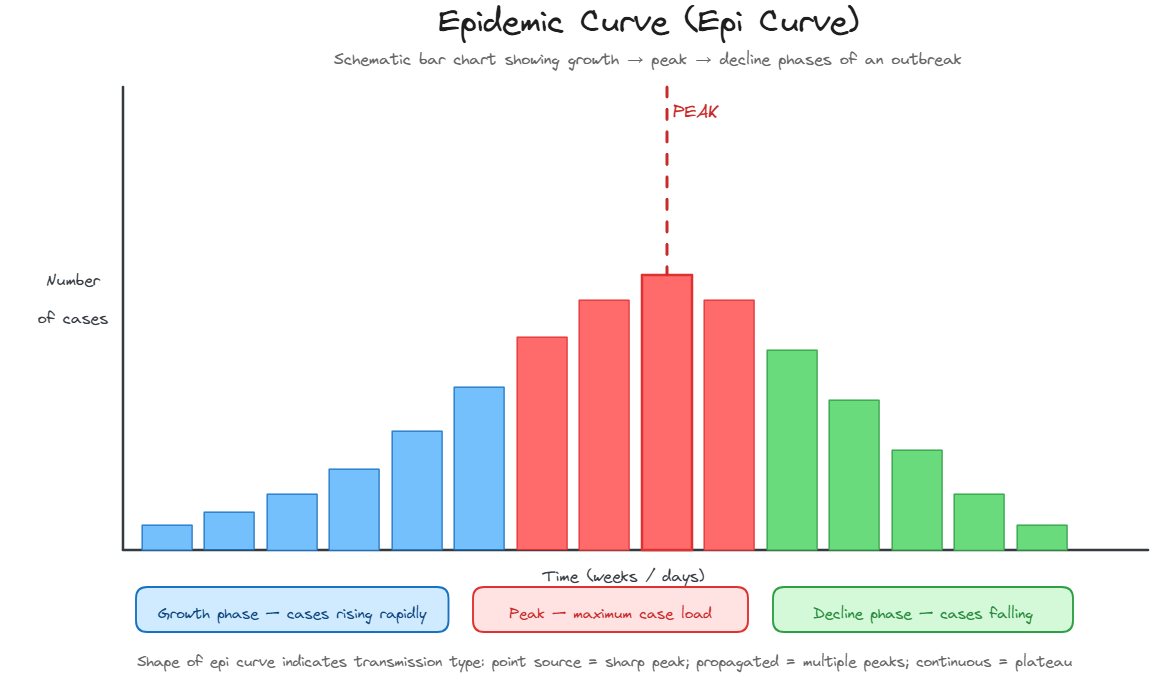
Epidemic Curve — COVID-19 Schematic
SARS-CoV-2 — the virus causing COVID-19 — is a non-cellular pathogen: a single-stranded RNA virus approximately 100 nm in diameter, roughly 1000 times smaller than the width of a human hair. When it emerged in late 2019, contact tracing teams in Wuhan rapidly collected primary transmission data by interviewing patients and mapping cases to common locations, identifying the Huanan Seafood Market as an early cluster. Within weeks, secondary data from published genomic analyses confirmed human-to-human transmission was occurring. By March 2020, the WHO declared a global pandemic — the first since the 2009 H1N1 influenza outbreak. The speed at which SARS-CoV-2 spread globally illustrates why correctly classifying a pathogen and understanding its transmission route is not an academic exercise — it directly determines the response. You will use COVID-19 data in Activity 2 and Short Answer Q3.
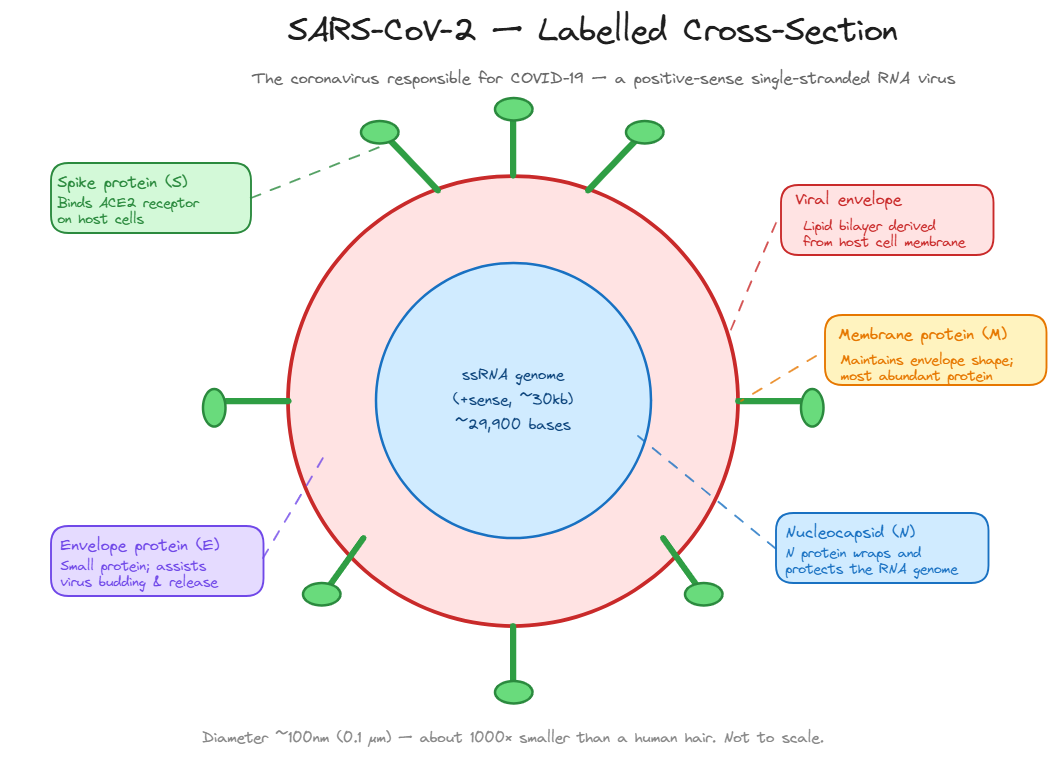
SARS-CoV-2 Labelled Structure
Infectious vs Non-Infectious
- Infectious disease: caused by a pathogen, can be transmitted between hosts.
- Non-infectious disease: caused by genetic, lifestyle, or environmental factors — not transmissible.
- Pathogen: any organism or agent that invades a host and causes disease.
- Examples: COVID-19 (infectious); type 2 diabetes (non-infectious).
Pathogen Categories
- Microorganisms: bacteria, fungi, protozoa — living cells.
- Macroorganisms: helminths (worms), ectoparasites (lice, ticks) — visible parasites.
- Non-cellular: viruses (DNA/RNA + protein coat), prions (misfolded proteins), viroids (RNA — plants only).
- Viruses are NOT living cells — they cannot reproduce independently.
Pathogens in Plants and Animals
- Both kingdoms affected by bacteria, viruses, fungi, protozoa, helminths.
- Viroids: plant pathogens only (e.g. potato spindle tuber viroid).
- Prions: animal pathogens only (e.g. BSE — mad cow disease).
- Classification matters: determines treatment approach.
Collecting Transmission Data
- Primary: contact tracing, case reporting, serology surveys (collected directly).
- Secondary: historical records, published research, WHO/CDC surveillance.
- Epidemiologists use both types to map transmission patterns and epidemic curves.
- Data collection drives the public health response to outbreaks.
A fresh set drawn from this lesson's question bank — feedback shown immediately. +5 XP per correct · +25 XP all correct
Pick your answer, then rate your confidence — that tells the system what to drill next.
UnderstandBand 3(3 marks) 1. Distinguish between infectious and non-infectious disease. In your answer, refer to the role of pathogens and give one example of each type of disease.
1 mark: definition of infectious disease referencing pathogens and transmission · 1 mark: definition/description of non-infectious disease · 1 mark: one correct example of each
ApplyBand 3(3 marks) 2. Classify the following pathogens into the correct category and provide a reason for each classification: (a) influenza virus, (b) Plasmodium falciparum, (c) the prion causing CJD.
1 mark per correct classification with reason
EvaluateBand 5(4 marks) 3. Evaluate the usefulness of contact tracing as a method for collecting data on COVID-19 transmission. In your answer, describe what contact tracing involves, identify one strength and one limitation of this method, and explain how a second data collection method could be used to address the limitation.
1 mark: description of contact tracing · 1 mark: identified strength with reasoning · 1 mark: identified limitation · 1 mark: second method logically addresses the limitation
Show all answers
Multiple choice
MC answers and full explanations are shown inline as you complete each question. Use the retry button to attempt a fresh set from the lesson bank.
Short Answer Model Answers
Q1 (3 marks): An infectious disease is caused by a pathogen — an organism or agent that invades a host and causes harm — and can be transmitted between hosts, either directly or indirectly. For example, COVID-19 is an infectious disease caused by the SARS-CoV-2 virus, which spreads via respiratory droplets. A non-infectious disease is not caused by a pathogen and cannot be transmitted from person to person; it arises from genetic, lifestyle, or environmental factors. For example, type 2 diabetes is a non-infectious disease caused by lifestyle factors including diet and physical activity, combined with genetic predisposition.
Q2 (3 marks): (a) Influenza virus: non-cellular pathogen. A virus consists only of genetic material (RNA in this case) enclosed in a protein coat. It has no cell membrane, cannot metabolise, and can only replicate inside a host cell — it is not a living cell. (b) Plasmodium falciparum: microorganism (specifically a protozoan). It is a single-celled eukaryotic organism that can carry out all life processes independently and reproduces inside red blood cells. (c) The prion causing CJD: non-cellular pathogen. A prion is a misfolded protein — it contains no nucleic acid and is not a living organism. It causes disease by inducing normal cellular proteins to misfold, but it has no cellular structure whatsoever.
Q3 (4 marks): Contact tracing involves interviewing diagnosed patients to identify people they came into contact with during their infectious period, then notifying and testing those contacts to interrupt transmission chains. A strength is that it provides specific, direct data on transmission routes and settings — for example, confirming whether disease is spreading through households, workplaces, or healthcare settings. A limitation is that contacts can only be identified if the patient recalls them; community transmission from brief or anonymous encounters (e.g. public transport) cannot be traced, leading to unknown-source cases. This limitation could be addressed by serology surveys — testing a population sample for antibodies to estimate how many people have been exposed, even without known contact histories. This provides population-level exposure data even where individual chains cannot be reconstructed.
Five timed questions on what infectious disease is and how it spreads. Beat the boss to bank a tier — gold (perfect + fast), silver (80%+), or bronze (cleared).
⚔ Enter the arenaClimb platforms, hit checkpoints, and answer quick-recall questions on this lesson. Lighter than the boss — pure recall practice.
You were asked whether all microorganisms cause disease. The verdict: this is a significant misconception.
The human body hosts approximately 38 trillion bacterial cells — most are essential symbionts supporting digestion, vitamin production, and immune development. Scientists have identified around 1,400 species of bacteria known to cause human disease out of an estimated one trillion bacterial species on Earth. That is an extraordinarily small fraction. Most microorganisms are decomposers, soil builders, photosynthesisers, or human symbionts.
Furthermore, viruses — which many people consider the archetypal "harmful microorganism" — are not microorganisms at all. They are non-cellular. The term microorganism applies only to living cells.
If you disagreed with the statement, you were correct. If you agreed, the key insight to carry forward is: pathogenicity (the ability to cause disease) is a specific, relatively rare characteristic — not a defining feature of all microscopic life.