Biology • Year 12 • Module 7 • Lesson 1
What Is Infectious Disease?
Lock in the core vocabulary — infectious disease, pathogen, host, vector — classify the three categories of pathogen, and recall how epidemiologists collect disease-transmission data.
1. Label the pathogen classification diagram
The diagram below shows the three-category classification system for pathogens introduced in this lesson. Write the missing labels into boxes A–H. Each label is drawn from the lesson's key terms and pathogen-grid content. 8 marks
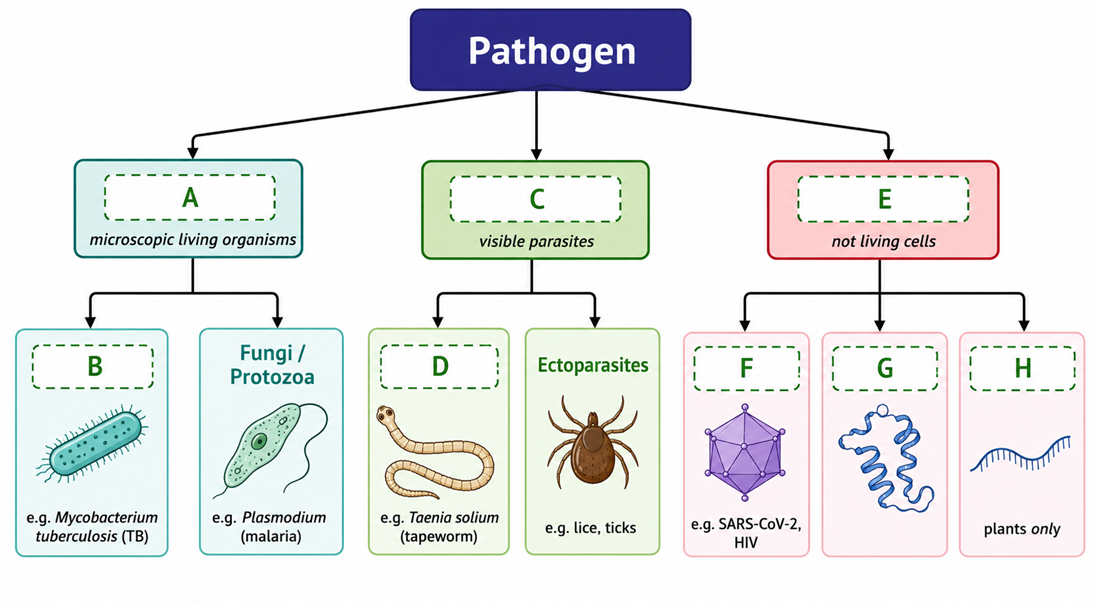
| Box | Label clue | Your label |
|---|---|---|
| A | The main category: microscopic living organisms (bacteria, fungi, protozoa) | |
| B | The sub-category of microorganism that includes Mycobacterium tuberculosis and Salmonella | |
| C | The main category: large enough to see with the naked eye; includes worms | |
| D | The sub-category of macroorganism that includes tapeworms, roundworms, and flukes | |
| E | The main category: not living cells; cannot metabolise or reproduce independently | |
| F | Examples within this non-cellular category: SARS-CoV-2, influenza, HIV, HPV | |
| G | Misfolded proteins that cause BSE and CJD — in this non-cellular sub-category | |
| H | Small RNA molecules — a non-cellular pathogen that infects plants only |
2. Term–definition match
The twelve definitions below are shuffled. In the right-hand column write the matching term from this list: infectious disease, non-infectious disease, pathogen, host, vector, reservoir, transmission, microorganism, macroorganism, prion, viroid, epidemiologist. 12 marks
| # | Definition (shuffled) | Matching term |
|---|---|---|
| 2.1 | A disease caused by a pathogen that can spread between hosts. | |
| 2.2 | An organism or agent that enters a host and causes harm. | |
| 2.3 | A disease caused by genetic, lifestyle, or environmental factors — not transmissible from person to person. | |
| 2.4 | An organism that harbours a pathogen. | |
| 2.5 | An organism that transmits a pathogen from one host to another without necessarily becoming ill itself. | |
| 2.6 | A population or environment where a pathogen naturally lives and is maintained over time. | |
| 2.7 | The passing of a pathogen from one host to another, either directly or indirectly. | |
| 2.8 | A microscopic living organism — examples include bacteria, fungi, and protozoa. | |
| 2.9 | A large, visible parasite such as a tapeworm, roundworm, tick, or louse. | |
| 2.10 | A misfolded protein that causes disease by inducing normal proteins to misfold — contains no nucleic acid. | |
| 2.11 | A small RNA molecule that causes plant disease and is the simplest known pathogen. | |
| 2.12 | A scientist who studies the patterns, causes, and transmission of diseases in populations. |
3. True or false — with correction
For each statement, circle T or F. If the statement is false, write the corrected version on the line below. 10 marks (1 for T/F, 1 for correction where needed)
3.1 All microorganisms are pathogens — they are harmful by nature. T / F
3.2 Viruses are classified as microorganisms because they are microscopic. T / F
3.3 Infectious diseases can spread between hosts; non-infectious diseases cannot. T / F
3.4 Type 2 diabetes is an infectious disease because it can appear in multiple family members. T / F
3.5 Prions can be destroyed by standard heat sterilisation methods. T / F
4. Function recall
Answer each question in 1–2 sentences using precise terms from the lesson. 8 marks (2 each)
4.1 What is the defining functional difference between an infectious disease and a non-infectious disease?
4.2 Why does classifying a pathogen as bacterial versus viral matter for the treatment of the disease it causes?
4.3 What is the role of a vector in disease transmission? Give one named example from the lesson.
4.4 What is the difference between primary data and secondary data in the context of disease transmission research?
5. Fill-in-the-blank — COVID-19 as a case study
Complete the paragraph using words from the word bank below. Each word is used once. 8 marks
Word bank: non-cellular · SARS-CoV-2 · infectious · pathogen · RNA · contact tracing · primary · transmission · host · secondary
COVID-19 is an ____________ disease caused by the ____________, a ____________ ____________. The virus is classified as a non-cellular ____________ because it consists only of genetic material (____________) enclosed in a protein coat and requires a ____________ cell to reproduce. Epidemiologists tracked its spread using ____________, a ____________-data collection method, and also analysed published WHO surveillance reports, which are an example of ____________ data.
6. Build a concept map
Draw labelled arrows between the six terms below to show how they connect. Each arrow must carry a linking phrase (e.g. "enters and harms", "collects data on", "can spread via"). Aim for at least 6 labelled arrows. 6 marks
Supplied terms: pathogen · host · infectious disease · vector · epidemiologist · transmission.
Q1 — Labelled diagram
A: microorganisms (microscopic living organisms). B: bacteria. C: macroorganisms (visible parasites). D: helminths. E: non-cellular pathogens. F: viruses. G: prions. H: viroids.
Q2 — Term–definition matches
2.1 infectious disease • 2.2 pathogen • 2.3 non-infectious disease • 2.4 host • 2.5 vector • 2.6 reservoir • 2.7 transmission • 2.8 microorganism • 2.9 macroorganism • 2.10 prion • 2.11 viroid • 2.12 epidemiologist.
Q3 — True / false with correction
3.1 False. Correction: the vast majority of microorganisms are not pathogens. Most are decomposers, soil builders, or human symbionts; only a tiny fraction of known species cause disease.
3.2 False. Correction: viruses are not microorganisms — they are non-cellular. Microorganisms are living cells; viruses have no cell membrane, cannot metabolise, and cannot reproduce independently.
3.3 True.
3.4 False. Correction: type 2 diabetes is a non-infectious disease caused by lifestyle and genetic factors. Its appearance in multiple family members reflects shared genes and lifestyle, not transmission of a pathogen.
3.5 False. Correction: prions are exceptionally resistant to inactivation — they cannot be destroyed by standard heat sterilisation (autoclaving) because they are misfolded proteins, not living organisms with heat-sensitive enzymes.
Q4.1 — Infectious vs non-infectious
An infectious disease is caused by a pathogen — a living organism or agent that enters a host and causes harm — and can be transmitted between hosts. A non-infectious disease has no such pathogen; it arises from genetic mutations, lifestyle factors, or environmental exposures and cannot spread from person to person.
Q4.2 — Why pathogen classification matters for treatment
Bacteria are living cells, so they can be targeted by antibiotics, which exploit features of bacterial biology (e.g. cell wall synthesis). Viruses are non-cellular and lack these features entirely, so antibiotics have no effect on them; antivirals (which target viral replication inside host cells) must be used instead. Correct classification prevents inappropriate treatment.
Q4.3 — Role of a vector
A vector is an organism that carries and transmits a pathogen from one host to another, often without becoming ill itself. Named example: Anopheles mosquitoes transmit Plasmodium (the protozoan causing malaria) between human hosts.
Q4.4 — Primary vs secondary data
Primary data is collected directly by the investigator — for example, swabbing patients or interviewing contacts during contact tracing. Secondary data is collected by someone else and then used for analysis — for example, reviewing published WHO surveillance reports or historical death records to reconstruct an epidemic curve.
Q5 — Cloze answers (in order)
infectious · SARS-CoV-2 · non-cellular · pathogen · pathogen · RNA · host · contact tracing · primary · secondary
Note: "non-cellular" and "pathogen" appear as consecutive blanks in the original sentence (a non-cellular pathogen). Either ordering across those two blanks is acceptable provided both terms appear.
Q6 — Sample concept map
A correct map should include arrows such as:
- pathogen — enters and harms → host
- pathogen — causes → infectious disease
- host — develops → infectious disease
- vector — facilitates → transmission
- transmission — moves → pathogen between hosts
- epidemiologist — collects data on → transmission
- epidemiologist — investigates outbreaks of → infectious disease
Award full marks for at least 6 correctly labelled arrows that respect causal direction. Any biologically valid linking phrases are accepted.