Unit Synthesis and Depth Study Prep
When COVID-19 arrived in Australia in early 2020, the Australian Health Protection Principal Committee had to connect 6 separate scientific fields, virology, epidemiology, immunology, pharmacology, public health, and sociology, within days to form a response.
Printable Worksheets
Print or save as PDF, or build a custom worksheet from any module's questions.
Q1 · What do you already know about how different disease topics, like pathogens, the immune system, and vaccines, connect to each other?
Q2 · A new disease outbreak occurs in a community. Predict three different areas of science you would need to investigate to understand and control it.
● Know
- Key concepts from across the Disease unit
- How disease concepts interconnect
- The structure and expectations of a depth study
● Understand
- How scientific concepts build on each other
- How to connect ideas from different parts of the unit
- What makes a good scientific investigation question
● Can do
- Synthesise concepts across the unit
- Formulate investigable questions
- Plan a depth study using scientific methodology
A well-constructed concept map turns a folder of facts into a web of understanding. For the Disease unit, the major branches should cover: types of disease, transmission methods, the immune system, prevention and treatment, and challenges such as antibiotic resistance and health inequity. The power of a concept map lies not in the nodes but in the arrowsthe relationships you draw between ideas.
Strong arrows have labels. Vaccination → herd immunity might be labelled requires ~95% coverage for measles. Antibiotic resistance → natural selection might be labelled driven by overuse and incomplete courses. Social determinants → Indigenous health might be labelled includes housing, education, and access. These labelled relationships are what examiners reward: they show you understand how concepts interact, not just what they are.
A student draws five branches from a central Disease bubble. From Transmission, an arrow points to Vector with the label mosquitoes for malaria, ticks for Lyme disease. From Immune System, an arrow points to Vaccination with the label memory cells enable faster secondary response. Each arrow is a mini-explanation.
The University of Queensland uses concept mapping in its medical program because research shows students who build maps score higher on problem-solving questions than students who rely on flashcards alone.
Vaccine efficacy tells us how well a vaccine works under ideal conditions, such as in a clinical trial. It is calculated as the percentage reduction in disease risk among vaccinated people compared to unvaccinated people. The formula is: (Rate in unvaccinated minus Rate in vaccinated) divided by Rate in unvaccinated, multiplied by 100. If 10% of unvaccinated people catch a disease and only 2% of vaccinated people catch it, the efficacy is (10 minus 2) divided by 10 times 100 = 80%.
Efficacy is not the same as effectiveness. Efficacy is measured in controlled trials; effectiveness is measured in the real world, where storage, timing, and individual health vary. Both matter, but efficacy tells us the biological potential of the vaccine, while effectiveness tells us how well it performs in practice.
In a trial of 1,000 people, 100 unvaccinated participants catch influenza versus 10 vaccinated participants. Rate unvaccinated = 10%; rate vaccinated = 1%. Efficacy = (10% minus 1%) / 10% times 100 = 90%. The vaccine cuts risk by 90%.
NCIRS publishes real-world effectiveness data for Australian vaccines, showing that some vaccines perform slightly worse in practice than in trials due to cold-chain breaches or delayed booster doses.
A successful depth study begins with a question that is specific, testable, and linked to scientific concepts. Specific means narrow enough to investigate in the time and equipment available. Testable means you can collect measurable data that either supports or contradicts your hypothesis. Linked to concepts means it connects to the theories and principles you have learned in class, not just a random curiosity.
Once you have your question, write a hypothesis in if-then-because format. Identify your variables before you start: the independent variable is what you change; the dependent variable is what you measure; controlled variables are everything you keep constant to ensure a fair test. A method without identified variables is not a scientific method, it is just a recipe.
Poor question: Does soap work? Better question: Does antibacterial hand soap reduce bacterial colony count more than regular hand soap after 30 seconds of washing? This is specific (two soap types, fixed duration), testable (count colonies on agar plates), and linked to pathogen transmission and antimicrobial action.
The Young Scientist Awards program run by the Science Teachers Association of NSW celebrates depth studies that show clear variable identification and creative experimental design, skills that universities and employers highly value.
Wrong: "A depth study is just a long essay about a disease." No, a depth study is an investigation. It requires you to ask a question, gather evidence, analyse data, and draw conclusions. It is active science, not just research.
Right: A depth study is an active scientific investigation requiring a specific question, evidence gathering, data analysis, and evidence-based conclusions, not merely a literature review or essay.
Wrong: "The different topics in this unit have no connection to each other." No, they are deeply connected. Pathogens cause disease, which the immune system fights, which vaccines train, which antibiotics treat, which resistance limits, which public health prevents. Every topic links to others.
Right: Every topic in this unit is interconnected: pathogens cause disease, the immune system fights infection, vaccines train adaptive immunity, antibiotics treat bacterial infections, resistance emerges through natural selection, and public health coordinates prevention at the population level.
Wrong: "Once you memorise facts about disease, you understand it." No, true understanding means being able to explain connections, apply concepts to new situations, and evaluate evidence. Facts are tools; understanding is the ability to use them.
Right: True understanding of disease requires explaining connections between concepts, applying knowledge to novel scenarios, and evaluating evidence, memorising isolated facts alone does not demonstrate understanding.
Australian Scientists Fighting Disease
Professor Fiona Stanley (AC): An Australian epidemiologist who founded the Telethon Kids Institute in Perth. Her research on birth defects, Indigenous health, and population health methods transformed Australian public health. She championed the use of population data to guide health policy.
Professor Ian Frazer: Co-developer of the HPV vaccine at the University of Queensland. His work has prevented countless cases of cervical cancer worldwide and put Australia on track to eliminate cervical cancer entirely.
Modern Australian research: Today, Australian scientists at WEHI, the Doherty Institute, CSIRO, and universities across the country continue to fight disease. During COVID-19, Australian researchers contributed to vaccine development, genomic surveillance, and long COVID research. Aboriginal and Torres Strait Islander researchers are increasingly leading health research that addresses community priorities with cultural authority.
✍ Copy Into Your Books
▾Unit Connections
- Pathogen -> Transmission -> Defence -> Treatment
- Infectious vs non-infectious disease
- Local, national, and global perspectives
Key Formulas
- Herd immunity threshold ≈ 1 - 1/R0
- Incidence rate = (new cases/population) × multiplier
- Case fatality rate = (deaths/cases) × 100%
Depth Study Steps
- Choose topic -> Formulate question -> Research -> Hypothesis -> Method -> Data collection -> Analysis -> Conclusions -> Communication
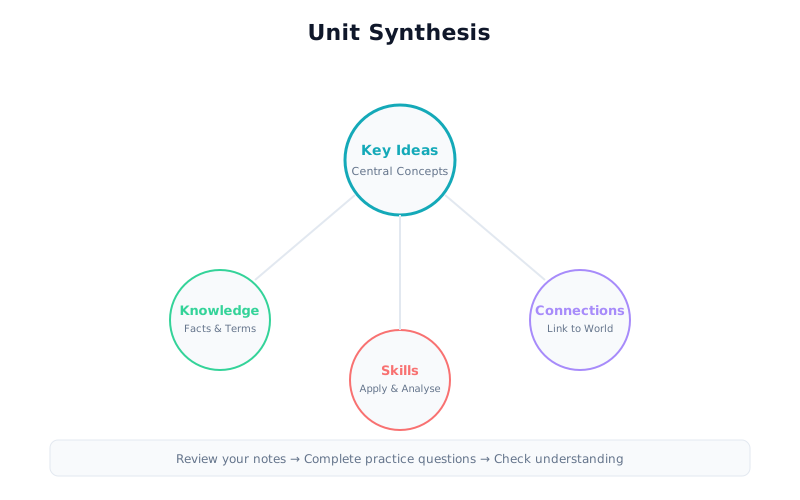
Concept Connections
Depth Study Planning
At the start of this lesson, you were challenged to connect every concept from this unit, epidemiology, chemistry, public health, and social science, into one coherent story about how diseases start, spread, and get stopped.
Now that you've worked through the synthesis activities, how well can you tell that story? Which disciplines did you find hardest to connect, and what does it tell you about how complex real disease outbreaks actually are?
Q1. 1. Synthesise your understanding by explaining how at least three concepts from this unit connect to explain one real-world health issue of your choice. 4 MARKS
Q2. 2. Evaluate the statement: "Infectious diseases are no longer a major health threat because we have vaccines and antibiotics." Use evidence from across the unit. 4 MARKS
Q3. 3. Design an investigation to test whether a particular intervention reduces the spread of bacteria in a school environment. Include your hypothesis, variables, method, and analysis plan. 4 MARKS
Revisit Your Thinking
Go back to your Think First answer. Has your understanding changed?
- How has your understanding of disease and health developed across this entire unit?
- What connections between concepts do you find most powerful or surprising?
Model answers (click to reveal)
Answers
▾MCQ 1
AThe first line of defence includes physical and chemical barriers such as skin, mucous membranes, stomach acid, tears, and saliva.
MCQ 2
BVaccines present antigens to the immune system, stimulating the production of memory B and T cells that enable rapid response to future infection.
MCQ 3
BA pandemic is an epidemic that has spread across multiple countries or continents, affecting large numbers of people globally.
MCQ 4
BViruses are not cells and use the host cell's own machinery to replicate. Antibiotics target bacterial structures (cell walls, ribosomes) that viruses do not have.
MCQ 5
CThe independent variable is the factor deliberately changed by the investigator. The dependent variable is measured, and controlled variables are kept constant.
Short Answer 1
Model answer: (Example: COVID-19) COVID-19 demonstrates how multiple unit concepts interconnect. First, SARS-CoV-2 is a virus (Lesson 2: pathogens) that spreads through respiratory droplets and aerosols (Lesson 3: transmission). When the virus enters the body, the immune system responds: physical barriers in the respiratory tract (Lesson 5), inflammation and phagocytes (Lesson 6), and eventually specific antibody and T cell responses (Lesson 7). Vaccination (Lesson 8) trains this immune response by presenting spike protein antigens, generating memory cells that enable faster responses to future infection. When treatments were needed, antiviral drugs (Lesson 11) like remdesivir were used, though their effectiveness was limited, demonstrating the challenge of treating viral infections compared to bacterial ones. Public health measures (Lesson 19) including masks, distancing, and border controls aimed to break transmission chains. The pandemic also highlighted global health interdependence (Lesson 17): no country could control COVID-19 alone, and vaccine nationalism prolonged the pandemic. Finally, the pandemic's disproportionate impact on disadvantaged communities illustrated the importance of social determinants of health (Lesson 16).
Short Answer 2
Model answer: This statement is dangerously incorrect. While vaccines and antibiotics are powerful tools, infectious diseases remain a major threat for several reasons. First, antimicrobial resistance (Lesson 12) is rendering antibiotics ineffective against increasingly common "superbugs." MRSA and CRE already kill thousands, and without new antibiotics, even routine surgery may become life-threatening. Second, new infectious diseases continue to emerge (Lesson 17). COVID-19 killed over 6 million people globally despite modern medicine. HIV/AIDS still causes 650,000 deaths annually despite effective treatments. Third, vaccine hesitancy (Lesson 9) has reduced coverage in some communities, leading to measles outbreaks even in wealthy countries. Fourth, non-infectious diseases (Lesson 13) now cause more deaths than infectious diseases globally, but infectious diseases still kill millions, particularly in developing countries with limited healthcare access. The truth is that infectious and non-infectious diseases are both major threats, and complacency about either is dangerous.
Short Answer 3
Model answer: Hypothesis: Installing hand sanitiser stations at classroom entrances will reduce bacterial contamination on high-touch surfaces compared to classrooms without sanitiser stations. Independent variable: Presence or absence of hand sanitiser stations. Dependent variable: Number of bacterial colonies grown from surface swabs (measured as colony-forming units per cm²). Controlled variables: Same type of surfaces swabbed (door handles, desks), same time of day, same swabbing technique, same growth medium and incubation conditions, similar class sizes and activities. Method: (1) Select 10 classrooms; randomly assign 5 to receive sanitiser stations and 5 as controls. (2) Swab identical high-touch surfaces in all classrooms before and after the intervention. (3) Plate swabs on agar plates and incubate for 48 hours at 37°C. (4) Count bacterial colonies. (5) Repeat on three separate days for reliability. (6) Calculate mean bacterial counts for sanitiser and control classrooms. (7) Compare using appropriate statistical analysis. Safety: Wear gloves; disinfect work surfaces; autoclave or safely dispose of bacterial cultures. Analysis: Present data in tables and graphs. If sanitiser classrooms show significantly lower bacterial counts, the hypothesis is supported. Consider limitations: bacterial counts do not measure pathogenicity; behaviour change may vary; short time frame may not capture long-term effects.