Gas Exchange in Plants
In 2022, Sydney Aquarium educators demonstrated that a single sprig of aquatic pond weed releases over 300 oxygen bubbles per minute when placed under bright light.
Printable Worksheets
Print or save as PDF, or build a custom worksheet from any module's questions.
Q1 · Q2: Have you ever seen bubbles on underwater pond weed in sunlight? What do you think those bubbles are, and where do they come from?
● Know
- plants exchange gases with the environment
- leaves are key structures in plant gas exchange
- surface features help leaves exchange gases effectively
● Understand
- plants do not need lungs to exchange gases
- gas exchange depends on structure and surface area
- plant gas exchange and plant transport are connected but not identical ideas
● Can do
- link leaves and surfaces to gas exchange
- explain why plant gas exchange counts as a real biological process
- prepare for later comparison with animal gas exchange
Hold a small potted plant over a glass of water in bright sunlight and you will notice tiny bubbles forming on the leaf surfaces, oxygen made inside the leaf escaping into the surrounding water. This movement of gases between a living thing and its environment is what scientists call gas exchange, and plants do it through microscopic pores rather than lungs.
Plants exchange gases with the environment even though they do not have lungs. The important scientific idea is not whether the structure looks like an animal organ. The important idea is whether gases can move between the organism and the outside world. In plants, leaves and their surfaces are central to that process.
Write a short paragraph explaining how a plant can exchange gases without having lungs. Use the terms leaf, surface and environment.
Put these stages of plant gas exchange in the correct order.
- The leaf surface interacts with the outside environment
- Cells use the exchanged gases for their processes
- Gases move between the plant and its surroundings
- Gases are present in the environment outside the plant
Leaves are broad, exposed structures that interact directly with the environment. That makes them useful sites for gas exchange. Surface features on leaves support this exchange by helping gases move between the plant and the outside environment.
Leaves
- large exposed surfaces
- main site linked to plant gas exchange
Surface Features
- support movement of gases
- help exchange happen with the environment
Biological Role
- exchange is part of keeping cells functioning
- shows structure-function links again
- Leaves
- Surface features
- Gas exchange
- Support movement of gases between plant and environment
- Movement of gases between organism and environment
- Broad, exposed structures that interact with the environment
Last lesson focused on water and dissolved substances moving through the plant. This lesson focuses on gases moving between the plant and the environment. These are different processes, but they both depend on organised structures and linked functions. That is why leaves matter in more than one way: they are involved in transport-related processes and in gas exchange.
Misconceptions to Fix
✗ Wrong: Plants only photosynthesise and do not carry out cellular respiration.
✓ Right: Plants carry out cellular respiration at all times (day and night) using mitochondria, releasing CO₂. Photosynthesis only occurs in the presence of light. During the day, photosynthesis rates exceed respiration rates, so the net gas exchange appears to be CO₂ in, O₂ out.
A student writes: “Gas exchange is only an animal process because animals breathe.” Rewrite this into a stronger scientific explanation.
Claim-Evidence-Reasoning Frame
Claim: State whether the student's explanation is scientifically correct or incomplete.
Evidence: Refer to evidence about plants, leaves and gas exchange from the lesson.
Reasoning: Explain why gas exchange does not require lungs and why plants still exchange gases.
Explore the neuron. What is the role of the axon and how does the signal travel?
Wrong: Plants do not exchange gases because they do not breathe like animals.
Right: Gas exchange is the movement of gases between an organism and its environment. Plants exchange carbon dioxide and oxygen through leaf surfaces without lungs.
Wrong: Leaves only lose water; they do not take in any gases.
Right: Leaves are the main site of gas exchange in plants. They take in carbon dioxide and release oxygen, as well as being linked to water loss.
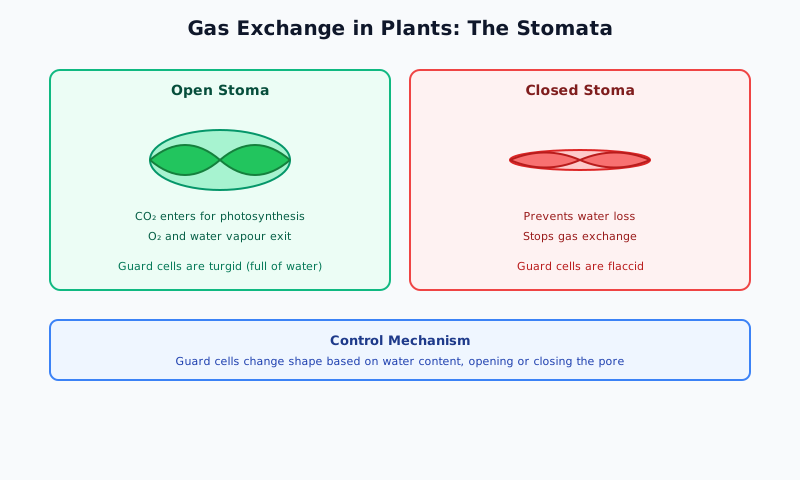
Diagram 2: Stomata Open and Closed
Comparison illustration showing stomata pores open and closed, with labels indicating how they control gas exchange.
Today's hook pointed to those tiny bubbles rising from pond weed, pure oxygen made by the plant, as proof that leaves swap gases through microscopic pores and that plants breathe in the opposite direction to you.
Now that you've worked through the lesson, can you explain exactly what those bubbles are, where they come from, and why plants release oxygen during the day? What did you find most surprising about how plant gas exchange actually works?
Q1. Explain how plants can exchange gases with the environment even though they do not have lungs.
1 mark for stating plants exchange gases without lungs; 1 mark for mentioning leaf/surface involvement; 1 mark for naming gases exchanged.Q2. Describe the role of leaves and leaf surface features in plant gas exchange.
1 mark for leaf role; 1 mark for surface features supporting gas movement; 1 mark for interaction with environment; 1 mark for clear explanation.Q3. Why is it scientifically stronger to say plants exchange gases rather than saying they “do not breathe” and stopping there?
1 mark for stating "exchange gases" is more accurate; 1 mark for explaining that "do not breathe" ignores the process; 1 mark for linking leaf structure to gas exchange; 1 mark for using an example.Model answers (click to reveal)
Model Answers
+Multiple Choice
1: B. Plants exchange gases with the environment using their own structures.
2: C. Leaves are exposed structures that interact with the environment.
3: A. Surface features support movement of gases between plant and environment.
4: D. Plants still exchange gases even without lungs.
5: B. Transport and gas exchange are different but both depend on organised structures.
Short Answer 1 (3 marks)
Plants can exchange gases because gas exchange does not require lungs specifically. Gases move between the plant and the environment using plant structures, especially leaves and their surfaces.
1 mark for no lungs needed. 1 mark for leaf/surface. 1 mark for gases named.
Short Answer 2 (4 marks)
Leaves are important because they are exposed plant structures that interact directly with the environment. Surface features of leaves help support gas exchange by allowing gases to move between the plant and its surroundings.
1 mark for leaf role. 1 mark for surface features. 1 mark for environment interaction. 1 mark for clarity.
Short Answer 3 (4 marks)
It is stronger because it focuses on the actual biological process. Stopping at “do not breathe” ignores that plants still exchange gases with the environment using their own structures and surfaces.
1 mark for accuracy of exchange. 1 mark for breathing ignores process. 1 mark for leaf structure link. 1 mark for example.
Revisit Your Thinking
Return to the opening prompt. Can you now explain plant gas exchange using leaves, surfaces and environment language?
Model answers (click to reveal)
Model Answers
+Multiple Choice
1: B. Plants exchange gases with the environment using their own structures.
2: C. Leaves are exposed structures that interact with the environment.
3: A. Surface features support movement of gases between plant and environment.
4: D. Plants still exchange gases even without lungs.
5: B. Transport and gas exchange are different but both depend on organised structures.
Short Answer 1 (3 marks)
Plants can exchange gases because gas exchange does not require lungs specifically. Gases move between the plant and the environment using plant structures, especially leaves and their surfaces.
1 mark for no lungs needed. 1 mark for leaf/surface. 1 mark for gases named.
Short Answer 2 (4 marks)
Leaves are important because they are exposed plant structures that interact directly with the environment. Surface features of leaves help support gas exchange by allowing gases to move between the plant and its surroundings.
1 mark for leaf role. 1 mark for surface features. 1 mark for environment interaction. 1 mark for clarity.
Short Answer 3 (4 marks)
It is stronger because it focuses on the actual biological process. Stopping at “do not breathe” ignores that plants still exchange gases with the environment using their own structures and surfaces.
1 mark for accuracy of exchange. 1 mark for breathing ignores process. 1 mark for leaf structure link. 1 mark for example.
● Plant Gas Exchange
Plants exchange gases with the environment even though they do not have lungs.
● Leaves
Leaves are key structures in plant gas exchange because they interact with the environment.
● Surface Features
Leaf surface features help support the movement of gases.
● Bridge Forward
Next lesson shifts to animal transport with the circulatory system.