Unit Synthesis and Depth Study Preparation
In 2023, a CSIRO Year 10 Science extension student traced the Haber process across 19 chemical concepts in one depth study, every concept in this unit connects to at least one other.
Printable Worksheets
Print or save as PDF, or build a custom worksheet from any module's questions.
Q1 · Without looking at your notes, how many of the big ideas from this unit can you name? Jot down as many as you can in 60 seconds.
Q2 · Pick any two topics from this unit and explain how they connect to each other, could one affect the other in real life?
● Know
- How acids/bases, reaction types, rate factors and energy changes connect
- What makes a good depth study question and hypothesis
- The key Working Scientifically skills applied across the unit
● Understand
- That real-world chemistry problems require multi-concept reasoning
- How scientific investigations follow a logical sequence from question to conclusion
- That chemistry connects to industry, environment and everyday life
● Can do
- Solve problems requiring knowledge from multiple parts of the unit
- Design a depth study investigation with valid variables and controls
- Communicate scientific reasoning using evidence and correct terminology
Sketch a mind map with "Chemical Reactions" at the centre and try to draw lines to every lesson topic, if you can fill a whole page with connections, you have genuinely understood the unit; if you can only manage a list, you have memorised it but not mastered it. This unit has covered the fundamental principles of chemical reactions. A depth study allows you to explore one area in greater detail, applying multiple concepts from the unit.
Choosing a topic: Pick something that genuinely interests you. Good topics include: the chemistry of a specific industrial process (Haber, Contact, steel-making), environmental chemistry (ocean acidification, air pollution, greenhouse effect), biochemical reactions (enzymes, fermentation, respiration), or materials chemistry (plastics, alloys, nanomaterials).
Research question: Formulate a specific, investigable question. Bad: "What is steel-making?" Good: "How do temperature and carbon content affect the mechanical properties of steel, and what trade-offs do metallurgists face in optimising these properties?"
Connecting concepts: A strong depth study connects reaction types, equations, energy changes, rates, and real-world applications. Do not just describe - analyse and evaluate.
Depth study topic: The chemistry of bushfire suppression.
Research question: "How do chemical fire retardants work, and what are the trade-offs between effectiveness and environmental impact?"
Connections to unit:
- Reaction types: Combustion (fuel + O2 -> CO2 + H2O); retardants interfere with the radical chain mechanism.
- Equations: Write balanced equations for combustion of cellulose and the chemical reactions of retardants.
- Energy: Combustion is exothermic; retardants may be endothermic decomposers that absorb heat.
- Rates: Retardants slow combustion rate by reducing radical concentration or forming protective char layers.
- Environment: Some retardants contain heavy metals or persistent organic pollutants; evaluate alternatives.
Australian depth study opportunities: Australian students have unique opportunities for chemistry depth studies. Visit a winery to study fermentation. Tour a water treatment plant to study neutralisation and precipitation. Interview a metallurgist at BlueScope Steel. Analyse local air quality data from the NSW Office of Environment and Heritage. Volunteer with a Landcare group studying soil pH and remediation. The Australian context provides rich, authentic chemistry investigations that connect classroom learning to real communities and industries.
A depth study is just a long essay summarising information from books and websites. This is false. A depth study requires original thinking, critical evaluation, and connection of concepts. Summarising Wikipedia is not a depth study. You must formulate your own research question, evaluate sources critically, analyse data, and draw evidence-based conclusions. The best depth studies include primary data collection - experiments, surveys, or interviews - rather than relying solely on secondary sources.
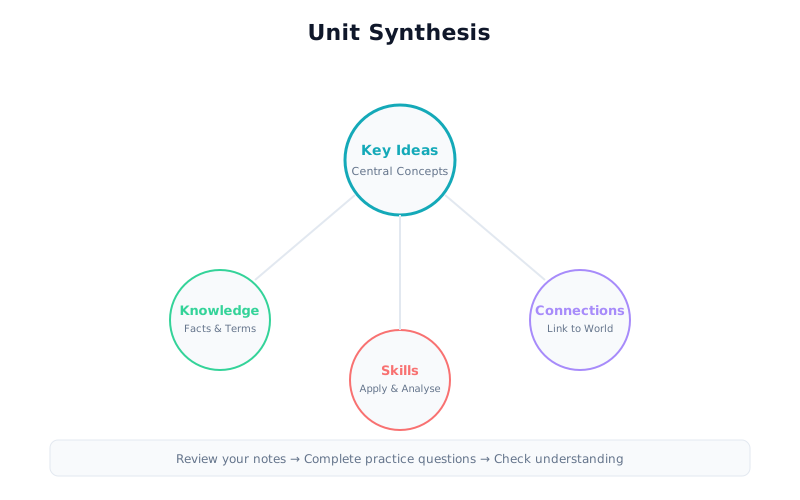
Connect the key concepts from this unit. Click two connected ideas to explain the link.
Research skills are essential for depth studies and for life beyond school.
Reliable sources:
- Peer-reviewed journals: Articles evaluated by experts before publication. Examples: Journal of the American Chemical Society, Nature Chemistry, Australian Journal of Chemistry.
- Government reports: CSIRO reports, Australian Bureau of Statistics data, EPA reports. Generally reliable but may reflect policy priorities.
- Textbooks: Curated by experts, reviewed, and updated. Good for foundational knowledge.
- University websites: Lecture notes and research summaries from reputable institutions.
Unreliable sources: Blogs without author credentials, social media posts, product advertisements, conspiracy websites. These may contain misinformation or biased information.
Evaluating sources: Check author credentials, publication date, funding sources, and whether claims are supported by evidence. Be especially sceptical of sensational claims that contradict established science.
When researching ocean acidification for a depth study, you might consult:
Reliable: IPCC reports on ocean chemistry, peer-reviewed articles from journals like Marine Chemistry, CSIRO ocean monitoring data, AIMS research publications.
Unreliable: Blog posts claiming ocean acidification is a hoax, social media memes with cherry-picked data, articles from think tanks funded by fossil fuel interests without disclosure.
The reliable sources present converging evidence from multiple independent research groups using different methods. The unreliable sources rely on rhetorical tricks, out-of-context quotes, and logical fallacies. Learning to distinguish them is a critical skill.
Australian scientific publishing: Australia has strong scientific publishing infrastructure. The Australian Academy of Science publishes historical records and science policy documents. CSIRO Publishing produces peer-reviewed journals in chemistry, biology, and environmental science. The Royal Australian Chemical Institute (RACI) publishes Chemistry in Australia magazine and supports chemistry education. Students can access many of these resources through their school library or the National Library of Australia Trove database.
All information on the internet is equally valid; it is just different opinions. This is dangerously false. There is objective reality, and some statements about it are true while others are false. Scientific claims can be tested against evidence. The idea that all viewpoints are equally valid is called false balance or bothsidesism. In science, not all opinions deserve equal weight. Claims supported by evidence from multiple independent studies deserve more credibility than claims contradicted by evidence.
Structuring your depth study effectively will maximise your mark and your learning.
Introduction: State your research question and explain why it matters. Provide background context. Outline what you will investigate and how.
Methodology: If you conducted experiments, describe them in detail so someone could repeat them. Include risk assessments. If you used secondary research, describe your search strategy and source evaluation criteria.
Results / Findings: Present data clearly. Use tables, graphs, and diagrams. Do not interpret here - just present.
Analysis / Discussion: Interpret your findings. Connect to chemical principles from this unit. Discuss limitations and alternative explanations. Compare your findings with published research.
Conclusion: Answer your research question directly. Summarise key findings. Suggest areas for further investigation.
References: List all sources using consistent formatting (APA, Harvard, or Vancouver style).
Depth study structure example: "Investigating the effect of temperature on vitamin C degradation in orange juice."
Introduction: Vitamin C is essential for health but degrades when heated. This study investigates how temperature affects the rate of vitamin C degradation, relevant to cooking and storage practices.
Method: Titrate orange juice samples with iodine solution after heating to 20C, 40C, 60C, 80C, and 100C for 10 minutes. Control: identical juice unheated. Repeat 3 times per temperature.
Results: Table and graph of vitamin C concentration vs temperature.
Analysis: Degradation rate increases exponentially with temperature. At 100C, 70% of vitamin C is lost. This is consistent with thermal decomposition kinetics. Limitations: only one juice type tested; heating time fixed at 10 minutes.
Conclusion: Heating orange juice above 60C causes significant vitamin C loss. Minimal heating preserves nutritional value.
Australian student research: The Young Scientist Awards and STANSW Young Scientist program recognise outstanding student research projects across Australia. Many winning projects are chemistry-based investigations conducted by high school students. These programs provide mentorship, feedback, and public recognition that encourages students to pursue science careers. Australian universities also offer summer research programs for talented high school students, providing early exposure to laboratory research and scientific mentorship.
The conclusion of a depth study should introduce new information not mentioned earlier. This is false. The conclusion should summarise and synthesise what has already been presented. Introducing new evidence in the conclusion is poor academic practice because readers cannot evaluate evidence that has not been discussed. The conclusion answers the research question based on the evidence and analysis already presented. It looks backward, not forward.
Quick-fire true or false on unit concepts.
A catalyst increases the rate but is not consumed.
Exothermic reactions absorb energy from surroundings.
Increasing temperature always increases reaction rate.
Balanced equations obey conservation of mass.
Surface area only matters for solid reactants.
Neutralisation produces salt and water.
Endothermic reactions have negative delta H.
The reactivity series predicts displacement reactions.
Wrong: "Each topic in this unit is separate and unrelated." No � the concepts are deeply interconnected. Acid-base reactions are a reaction type, their rate depends on concentration and temperature, and they can be exothermic or endothermic. Real chemistry always involves multiple concepts.
Right: The concepts in this unit are deeply interconnected. For example, an acid-base reaction is a specific reaction type whose rate depends on concentration, temperature and catalysts, and which may also involve energy changes. Strong responses link these ideas together rather than treating them as separate topics.
Wrong: "A depth study needs to discover something completely new." No � depth studies investigate a question thoroughly. The value is in the quality of your method, analysis and reasoning, not in discovering unknown science.
Right: A depth study is assessed on the rigour of your method, the quality of your analysis and the strength of your reasoning, not on novelty. Investigating a well-known phenomenon carefully and drawing well-supported conclusions is exactly what the task requires.
Wrong: "If I memorise all the facts, I do not need to understand the connections." No � this level assessment rewards multi-concept reasoning. The highest-band responses show you can integrate acids/bases, reaction types, rates and energy changes in a single explanation.
Right: Memorising facts is not enough at this level. Top responses demonstrate connected understanding, explaining how changing concentration affects both reaction rate and the behaviour of a buffer, for example, shows genuine conceptual depth that rote recall cannot replicate.
Chemistry That Shapes Australia
Australia's economy and environment are shaped by chemical reactions at every scale. The Great Barrier Reef is threatened by ocean acidification, a neutralisation problem at planetary scale. Australian farmers apply millions of tonnes of fertiliser made via the Haber process. The steel that builds our cities comes from reduction reactions in blast furnaces.
Australian scientists are at the forefront of green chemistry research: developing catalysts that work at lower temperatures, designing biodegradable plastics that break down through controlled decomposition, and using Aboriginal and Torres Strait Islander knowledge of cool burning to manage fire chemistry. The chemistry you have learned in this unit is the foundation for understanding, and improving, all of these.
✍ Copy Into Your Books
▾Reaction Types Summary
- Synthesis: A + B -> AB
- Decomposition: AB -> A + B
- Displacement: A + BC -> AC + B
- Neutralisation: Acid + Base -> Salt + Water
- Combustion: Fuel + O2 -> CO2 + H2O + energy
Rate Factors
- Concentration: more particles, more collisions
- Surface area: more exposed particles
- Temperature: faster, more energetic collisions
- Catalysts: alternative pathway, lower energy needed
Energy Changes
- Exothermic: releases heat (combustion, neutralisation)
- Endothermic: absorbs heat (thermal decomposition, photosynthesis)
Multi-Concept Scenario Analysis
Design Your Investigation
At the start of this lesson, the hook reminded you that you've covered 19 lessons of chemical reactions, from pH indicators to industrial catalysts to climate chemistry, and that every big idea connects to at least one other.
Now that you've mapped those connections, which link between topics surprised you the most? Think back to lesson 1 and the burning log hook, how many other lessons in this unit does that single idea about conservation of mass actually connect to?
Q1. 1. A car battery uses sulfuric acid. Over time, the acid concentration decreases and the battery produces less electrical energy. Using concepts from this unit, explain why decreasing acid concentration reduces the reaction rate and suggest one way a mechanic could test whether the battery acid is still strong enough. 4 MARKS
Q2. 2. A student investigates how surface area affects the rate of reaction between calcium carbonate and hydrochloric acid. They use marble chips (large) and powdered marble (small) with the same mass and the same acid concentration. Sketch the shape of two curves they might obtain on the same graph, labelling which curve is which. Explain why the curves have different shapes but the same final height. 4 MARKS
Q3. 3. Evaluate how Aboriginal and Torres Strait Islander Peoples' use of controlled cool burning demonstrates understanding of multiple chemical reaction concepts. In your answer, refer to at least two of: reaction types, rate factors, energy changes and conservation of mass. 4 MARKS
Revisit Your Thinking
Go back to your Think First answer. Has your understanding changed?
- Can you now identify more concepts from the unit that apply to the acid spill scenario?
- How has your view of chemistry in the real world changed since Lesson 1?
Model answers (click to reveal)
Answers
▾MCQ 1
DAntacid tablets contain bases that neutralise stomach acid. The crushed tablet has greater surface area, so the neutralisation reaction is faster. This involves both reaction type (neutralisation) and rate factor (surface area).
MCQ 2
BAs reactants are used up, their concentration decreases. With fewer particles per unit volume, successful collisions become less frequent and the reaction slows down. This is explained by collision theory.
MCQ 3
CCombustion of wood releases heat and light, making it exothermic. Thermal decomposition and photosynthesis are endothermic. Neutralisation is exothermic.
MCQ 4
ARepeating measurements improves reliability by reducing the impact of random errors. Calculating a mean gives a more representative value. This is a fundamental Working Scientifically skill.
MCQ 5
DThe rate of a reaction depends on factors like concentration, temperature and catalysts, not on whether it is exothermic or endothermic. Rusting is a slow exothermic reaction, disproving the claim that slow reactions are endothermic. Catalysts can speed up reactions without changing their energy classification.
Short Answer 1
Model answer: As the battery is used, sulfuric acid is consumed in chemical reactions at the electrodes. The concentration of acid decreases over time. According to collision theory, lower concentration means fewer acid particles per unit volume, so there are fewer successful collisions with the electrode material per second. This reduces the reaction rate and the electrical output. A mechanic could test the acid strength by measuring its pH with pH indicator paper or a pH meter. If the pH is significantly higher than the original (closer to neutral), the acid has weakened and the battery may need recharging or replacing.
Short Answer 2
Model answer: The graph would show two curves starting at zero and rising to the same final height. The powdered marble curve would be steeper initially, reaching the plateau faster than the marble chips curve. Both curves flatten at the same height because both samples have the same mass of calcium carbonate, so the total amount of carbon dioxide that can be produced is the same. The powdered marble reacts faster because it has a much larger surface area, exposing more particles to collisions with acid. The marble chips have less surface area, so collisions are less frequent and the reaction is slower.
Short Answer 3
Model answer: Aboriginal cultural burning demonstrates sophisticated understanding of combustion chemistry. By controlling fuel load (amount of dry leaves and grass), burn practitioners control the rate of the combustion reaction, less fuel means a slower reaction that releases less heat (energy change). This is a form of rate control through concentration. The burns also demonstrate understanding that combustion requires fuel, oxygen and heat, and that removing one factor stops the reaction. Cool burning respects conservation of mass: the same total mass of carbon, hydrogen and oxygen enters and leaves the reaction, just in different forms (ash, carbon dioxide, water vapour). This knowledge has sustained Australian ecosystems for tens of thousands of years.