Evidence-Based Argumentation in Genetics and Evolution
A 2023 Pew Research survey found 97% of Australian scientists accept evolution, yet only 66% of the general public do, a 31% gap explained by misunderstanding one word: "theory".
Printable Worksheets
Print or save as PDF, or build a custom worksheet from any module's questions.
Q1 · Your friend says "evolution is just a theory". Using only what you already know, how would you explain what "theory" means in science?
Think about the difference between a scientific theory and an everyday guess or hunch.
Q2 · A website claims "vaccines alter your DNA" but provides no peer-reviewed studies. List two questions you would ask to evaluate this claim.
Consider source credibility, evidence quality and whether the claim matches established scientific understanding.
● Know
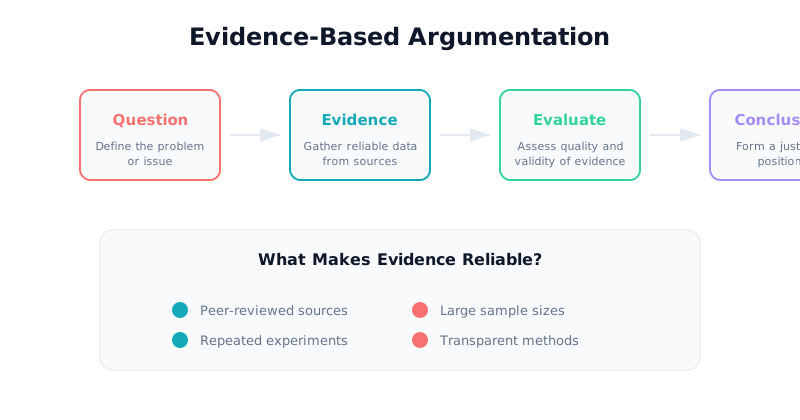
- The three parts of a claim-evidence-reasoning (CER) argument
- Key criteria for evaluating the reliability of a scientific source
- Common signs of bias in media and online sources
● Understand
- Why reasoning connects evidence to claims and separates opinion from science
- That peer review and institutional affiliation affect source reliability
- How scientific arguments are refined through critique and new evidence
● Can do
- Construct a CER argument about a genetics or evolution question
- Evaluate sources for reliability, bias and evidence quality
- Communicate scientific conclusions using appropriate vocabulary and structure
Tell a friend "I have a theory about who ate my lunch" and they will nod. Tell a scientist "evolution is just a theory" and they will pause, because you have just used the same word to mean two completely different things. In everyday conversation, 'theory' often means a guess or a hunch. In science, the word has a very different meaning. A scientific theory is a comprehensive, well-tested explanatory framework that unifies a large body of evidence and makes testable predictions. The germ theory of disease, the theory of plate tectonics, the theory of general relativity, and the theory of evolution by natural selection are all scientific theories. They are not guesses, they are the highest level of scientific understanding, supported by decades or centuries of observation and experiment.
Evolutionary theory is one of the most robust theories in science because it is supported by multiple independent lines of evidence that all converge on the same conclusion. Fossils show change over time. Comparative anatomy reveals homologous structures inherited from common ancestors. Molecular biology shows that all life shares the same genetic code and that DNA similarity correlates with evolutionary relatedness. Biogeography explains the distribution of species across continents and islands. No single piece of evidence 'proves' evolution, but the consilience of all these independent lines makes the theory overwhelmingly well supported.
If you find a watch on the ground, you might infer a watchmaker. But if you find a thousand watches, each slightly different, arranged in a sequence from simple to complex, with older models in deeper rock layers, you would infer a history of gradual change. Living things are like those watches: the fossil record, the molecular clock and the distribution of species across the globe all tell a coherent story of descent with modification. The theory of evolution is the explanation that makes sense of all these observations together.
Australian science education: The Australian Academy of Science publishes resources that explain the nature of scientific theories and why evolution is central to modern biology. Their 'Nova' documentaries and classroom materials emphasise that understanding evolution is essential for careers in medicine, agriculture, conservation and biotechnology in Australia.
The phrase 'just a theory' is a common rhetorical tactic used to dismiss well-established science. It exploits the difference between the everyday and scientific meanings of 'theory'. When someone says evolution is 'just a theory', they reveal that they do not understand how science uses the term. A scientific theory is not a speculation awaiting promotion to fact, it is an explanatory framework that has already passed countless tests and integrates mountains of evidence.
Click each sentence that supports the claim.
Australian researchers use CER every day in public health debates. When Professor Fiona Stanley argued that folate fortification of bread would reduce neural tube defects, she presented a claim (fortification reduces spina bifida rates), evidence (randomised controlled trials showing 50–70% reduction) and reasoning (folate is essential for neural tube closure during early embryonic development). The argument was so compelling that Australia mandated folate fortification in 2009. This is how science changes policy, not through shouting, but through structured, evidence-based argumentation.
Scientists construct arguments using the CER framework: Claim, Evidence, Reasoning. The claim is the statement you are trying to support. The evidence is the specific data, observations or measurements that bear on the claim. The reasoning is the logical connection that explains why the evidence supports the claim, using accepted scientific principles.
When applied to evolution, a claim might be: 'Whales evolved from terrestrial mammals.' The evidence could include: fossil intermediates with both legs and flippers (Ambulocetus, Pakicetus); vestigial hip bones in modern whales; and DNA evidence showing whales are nested within the artiodactyl (even-toed ungulate) group, most closely related to hippos. The reasoning connects these facts: common ancestry predicts nested patterns in the fossil record, vestigial structures and molecular phylogenies. The convergence of all three independent lines strongly supports the claim.
Claim: Birds evolved from dinosaurs. Evidence 1: Archaeopteryx and other fossils have both dinosaur teeth and bird feathers. Evidence 2: Many dinosaurs had feathers, not just birds. Evidence 3: Birds and dinosaurs share over 80 skeletal features, including a furcula (wishbone) and a particular ankle structure. Evidence 4: DNA shows birds are most closely related to theropod dinosaurs such as Velociraptor. Reasoning: Common ancestry predicts that descendants will retain traits from their ancestors. The shared traits are not functional requirements for flight, they are historical signatures of descent.
Australian palaeontology: Australian researchers at Museums Victoria and Flinders University have described feathered dinosaur fossils from China and contributed to the growing evidence that birds are living dinosaurs. Their work demonstrates how international scientific collaboration builds cumulative evidence for major evolutionary transitions.
A hallmark of scientific thinking is that claims must be supported by convergent evidence from multiple independent sources. If one line of evidence is flawed, others should still support the conclusion. Evolution passes this test brilliantly: fossils, anatomy, embryology, molecular biology, biogeography and direct observation all point to the same conclusion. No single discovery could overturn evolution, because the evidence is so multifaceted.
Science is also self-correcting. When new evidence contradicts an existing theory, scientists revise or replace the theory. This happened when Newtonian mechanics was extended by Einstein's relativity, and when the discovery of DNA transformed our understanding of heredity. Evolutionary theory itself has been revised many times, the modern synthesis combined Darwin's natural selection with Mendelian genetics, and ongoing discoveries in epigenetics and developmental biology continue to refine it. A theory that cannot be revised is dogma, not science.
In the 1970s, some scientists proposed that birds evolved from crocodilians rather than dinosaurs. This hypothesis was tested by comparing fossils, anatomy and eventually DNA. The evidence overwhelmingly supported the dinosaur origin, and the crocodilian hypothesis was abandoned. Science did not fail, it worked exactly as it should. Wrong ideas are proposed, tested against evidence, and discarded when they fail. The remaining ideas are the ones that have survived every test.
Australian science communication: Organisations like the Australian Science Media Centre (AusSMC) help journalists and the public understand how scientific consensus develops through peer review, replication and convergent evidence. Their resources explain why 'teaching both sides' of established science is misleading when one side is supported by evidence and the other is not.
Here's a student's argument about evolution. One line has a logical error, click it.
- The student claims that because we have not observed a fish turning into a frog, evolution must be false.
- Evolutionary theory does not predict that individual fish transform into frogs during their lifetime.
- Evolution predicts gradual change over millions of years through differential survival and reproduction in populations.
- The student's argument is a strawman because it misrepresents what evolutionary theory actually claims.
- Because the student has not personally seen evolution, it must not have happened anywhere in the world.
Wrong: "If a source is published online, it must be reliable."
Right: Anyone can publish online. Reliability depends on peer review, author expertise, citations and transparency, not on whether something looks professional or appears high in search results.
Wrong: Anyone can publish online. Reliability depends on peer review, author expertise, citations and transparency, not on whether something looks professional or appears high in search results.
Right: Correct, reliability depends on peer review, author expertise, citations and transparency, not on whether a source appears online or looks professional.
Wrong: "In science, a 'theory' is just a guess that has not been proven."
Right: In science, a theory is a well-substantiated explanation supported by extensive evidence from multiple independent lines of inquiry. The theory of evolution is as well supported as the theory of gravity.
Wrong: In science, a theory is a well-substantiated explanation supported by extensive evidence from multiple independent lines of inquiry. The theory of evolution by natural selection is as well supported as the theory of gravity. A "guess" in science is called a hypothesis.
Right: Correct, a scientific theory is a well-substantiated explanation backed by extensive evidence. The theory of evolution is supported by genetics, palaeontology, anatomy and molecular biology.
Analysing a Flawed Argument
1 Identify at least three problems with this argument (e.g., weak evidence, logical fallacies, unreliable source).
2 Rewrite the argument as a proper CER response about whether GM foods should be regulated in Australia. Include a clear claim, at least one piece of strong evidence, and reasoning.
3 The flawed argument uses an anecdote ("my uncle felt sick") as evidence. Explain why anecdotes are scientifically weak, and describe what kind of evidence would be stronger.
Constructing a CER Response
1 Question: Should Australia allow gene editing in human embryos to prevent inherited diseases? Construct a CER argument with a clear claim, two pieces of evidence, and reasoning.
2 Question: A social media post claims that "vaccines alter your DNA." Evaluate this claim using source reliability criteria. Is the claim supported by scientific evidence? Explain.
3 Question: Scientists have observed that cane toads in Australia are evolving longer legs and spreading faster than when they were first introduced. Construct a CER argument explaining why this is an example of evolution by natural selection.
Copy Into Your Book
▼CER Framework
- Claim = specific, testable answer to the question
- Evidence = observable, measurable data
- Reasoning = explains WHY evidence supports the claim
- All three needed for a scientific argument
Source Reliability
- Peer-reviewed = evaluated by independent experts
- Author expertise = relevant qualifications and affiliation
- Citations = references to other studies
- Transparency = methods described, data available
Bias Warning Signs
- Financial conflict of interest
- No citations or author listed
- Emotional or absolute language
- Profit linked to the conclusion
Scientific Writing
- State claim first, clearly and specifically
- Use data, not vague descriptions
- Link evidence to scientific principles
- Acknowledge limitations and uncertainty
At the start of this lesson you were told that the theory of evolution is supported by evidence from four independent fields, genetics, fossils, anatomy and biogeography, making it one of the most thoroughly tested ideas in all of science, yet roughly 1 in 3 Australians are still unsure about it. That gap between evidence and public understanding was the challenge set for this lesson.
Now that you have built skills in evidence-based argumentation, write the argument you would make to that sceptical person. Use at least two specific lines of evidence from this unit and explain why personal opinion is not a valid counterargument to scientific evidence.
Q1. Explain the three parts of a claim-evidence-reasoning (CER) argument. Use an example about evolution or genetics. 4 MARKS
Q2. Read this claim: "Humans are not evolving anymore because we have medicine and technology." Identify the claim, evaluate whether the evidence supports it, and explain your reasoning. 4 MARKS
Q3. Describe two criteria you would use to evaluate whether a source about genetic technologies is reliable. Explain why each criterion matters. 4 MARKS
Revisit Your Initial Thinking
Go back to your Think First responses at the top of the lesson.
- Did you identify that a convincing argument needs claim, evidence and reasoning?
- Did you recognise that peer review, author expertise and citations are key to trusting a source?
- Write one sentence explaining the most important thing you learned about distinguishing science from misinformation.
Model answers (click to reveal)
Comprehensive Answers
▼Activity 1, Analysing a Flawed Argument
1. Problem 1: The evidence is a single anecdote ("my uncle felt sick"), which is not reproducible, measurable or representative of a population [1 mark]. Problem 2: The argument commits a logical fallacy, "natural things are always better" is an appeal to nature, not a scientific principle [1 mark]. Problem 3: The source is a blog with no citations, no peer review and no identifiable author, making it unreliable [1 mark].
2. Claim: GM foods in Australia should be regulated through rigorous safety testing and clear labelling [1 mark]. Evidence: Multiple peer-reviewed studies, including meta-analyses published in Journal of Animal Science, have found no consistent evidence of harm from GM foods approved for human consumption [1 mark]. Reasoning: Scientific regulation requires reproducible evidence of safety or harm. Without large-scale, controlled studies showing risk, banning GM foods is not justified by the current evidence base, though ongoing monitoring is scientifically appropriate [1 mark].
3. Anecdotes are scientifically weak because they involve a single observation with no control group, no blinding and no way to rule out coincidence or other causes [1 mark]. The uncle might have felt sick for unrelated reasons (food poisoning, virus, anxiety). Stronger evidence would be a randomised controlled trial or a meta-analysis of multiple independent studies measuring health outcomes in large populations [1 mark].
Activity 2, Constructing a CER Response
1. Claim: Australia should permit gene editing in human embryos only to prevent serious inherited diseases, under strict regulatory oversight [1 mark]. Evidence 1: In 2019, a Chinese scientist edited human embryos without oversight, causing international condemnation and demonstrating that unregulated use causes harm [1 mark]. Evidence 2: The UK's Human Fertilisation and Embryology Authority has approved controlled research on embryo editing for mitochondrial diseases, showing that regulated research can proceed safely [1 mark]. Reasoning: Gene editing offers the potential to eliminate devastating genetic conditions, but the technology also raises ethical concerns about unintended effects and eugenics. Strict regulation balances scientific benefit against ethical risk, which is why Australia should follow a regulated, disease-limited approach [1 mark].
2. Source reliability: The claim lacks peer-reviewed citations and contradicts established molecular biology [1 mark]. Scientific evidence: Vaccines contain mRNA or weakened pathogens that stimulate immune response, but no vaccine licensed in Australia integrates into human DNA. The mRNA in COVID-19 vaccines remains in the cytoplasm and is degraded within days; it never enters the nucleus where chromosomes are stored [1 mark]. Conclusion: The claim is not supported by scientific evidence and appears to originate from misinformation sources rather than peer-reviewed research [1 mark].
3. Claim: The rapid spread of longer-legged cane toads in Australia is an example of evolution by natural selection [1 mark]. Evidence: Field studies by researchers at the University of Sydney have shown that toads at the invasion front have significantly longer legs than toads at the source population, and they travel faster [1 mark]. Reasoning: Longer-legged toads can cover more ground in a given time, reaching new habitats and resources ahead of shorter-legged toads. Because leg length is heritable, the offspring of faster, longer-legged toads also tend to have longer legs. Over generations, the proportion of longer-legged toads increases in the population, the definition of natural selection acting on heritable variation [1 mark].
Multiple Choice
1. CReasoning explains why the evidence supports the claim. Evidence is the data, not the reasoning. The question is separate from the reasoning, and the source list is part of referencing, not reasoning.
2. BPeer-reviewed journal articles from university research teams undergo expert evaluation and are the gold standard for scientific information. Social media posts, product blogs and sensational headlines lack these safeguards.
3. DIn science, a theory is a well-supported, comprehensive explanation backed by extensive evidence. The theory of evolution is supported by genetics, palaeontology, comparative anatomy and biogeography. "Just a theory" misrepresents the scientific meaning of the word.
4. AThis claim is specific, cites worldwide hospital data, and acknowledges a correlation with a known mechanism. The other options rely on anecdotes, make absolute unsupported predictions, or commit logical fallacies.
5. BThe website has a financial conflict of interest (selling organic supplements) and provides no peer-reviewed evidence. These are serious red flags for bias and unreliability.
Short Answer Model Answers
Q6 (4 marks): A CER argument has three parts. Claim is a specific, testable statement that answers the question [1 mark]. Evidence is observable, measurable data from experiments, field studies or reliable datasets [1 mark]. Reasoning is the logical explanation of why the evidence supports the claim, using scientific principles [1 mark]. Example: Claim, "The peppered moth population in industrial England evolved darker colouration due to natural selection" [0.5 mark]. Evidence, "Bird predation experiments showed dark moths survived better on soot-covered trees" [0.5 mark]. Reasoning, "Because colour is heritable and predators selectively removed light moths from dark backgrounds, the allele frequency for dark colour increased over generations" [1 mark].
Q7 (4 marks): The claim is that "humans are not evolving anymore because we have medicine and technology" [1 mark]. This claim is poorly supported by evidence. While medicine and technology have reduced selection pressure for some traits (e.g., resistance to certain infections), humans continue to evolve in measurable ways [1 mark]. Evidence includes the rapid increase in lactase persistence in some populations, changes in height and skin pigmentation across generations, and genetic adaptation to high-altitude environments [1 mark]. Reasoning: Evolution simply requires heritable variation, differential survival/reproduction and time. Medicine does not eliminate these three conditions; it changes which traits are selected for. Therefore the claim overstates the effect of technology and ignores ongoing evolutionary processes [1 mark].
Q8 (4 marks): Criterion 1, Peer review: I would check whether the source has been peer-reviewed. Peer review means independent experts have evaluated the methods, data and conclusions before publication [1 mark]. This matters because it catches errors, biases and unsupported claims that non-experts might miss [1 mark]. Criterion 2, Author expertise and affiliation: I would check whether the authors have relevant qualifications and are affiliated with recognised institutions (e.g., universities, CSIRO, medical research institutes) [1 mark]. This matters because expertise ensures the authors understand the complex science involved, and institutional affiliation provides accountability and access to resources for rigorous research [1 mark].