Ethics of Genetic Technologies
In 2018, Chinese researcher He Jiankui edited the embryos of twin girls to resist HIV, and was sentenced to 3 years in prison for crossing an ethical line scientists worldwide condemned.
Printable Worksheets
Print or save as PDF, or build a custom worksheet from any module's questions.
Q1 · What does 'ethics' mean to you in the context of science and technology?
Think about situations where scientific progress might conflict with personal values or social concerns.
Q2 · Should parents be allowed to choose their baby's eye colour using genetic technology? Give one reason for and one reason against.
Consider issues of autonomy, equality and whether genetic traits should be treated like consumer choices.
● Know
- Key ethical frameworks: beneficence, autonomy, justice
- Major ethical issues: privacy, GM food safety, designer babies, biodiversity
- Australian regulations on GM crops and gene editing
● Understand
- How to evaluate genetic technologies using evidence and multiple perspectives
- Why ethical debates require scientific literacy, not just opinion
- The tension between individual benefit and societal risk
● Can do
- Apply ethical frameworks to real genetic technology scenarios
- Construct evidence-based arguments for and against specific technologies
- Explain how Australian law balances innovation and protection
Two parents sit in a clinic in 2024. A doctor tells them that for $5,000 they can screen their embryos and implant only the ones free of a fatal genetic disease, but they could also choose eye colour or above-average height. Do they say yes, and how far do they go? Genetic technology has outpaced our ethical frameworks. We can now sequence genomes, edit genes and screen embryos for disease, but should we? One of the most debated scenarios is the 'designer baby': a child whose genetic traits have been selected or edited before birth. This could range from preventing a fatal disease to choosing eye colour, athletic ability or intelligence.
The core ethical tensions are consent (the child cannot choose their genes), equity (only the rich might afford enhancements) and unintended consequences (editing one gene might disrupt others we do not yet understand). Religious and philosophical perspectives also differ: some view genome editing as 'playing God', while others see it as a moral obligation to prevent suffering if we have the power to do so.
Preimplantation genetic testing (PGT) already allows parents undergoing IVF to screen embryos for serious genetic diseases such as cystic fibrosis or Tay-Sachs disease. Most ethicists support this medical use. But what if screening could predict adult height, musical ability or personality traits? The line between therapy and enhancement is blurry, and society has not yet decided where to draw it.
Australian bioethics: The Australian Health Ethics Committee (AHEC) regularly reviews emerging genetic technologies and advises the National Health and Medical Research Council (NHMRC). Their guidelines emphasise that genetic interventions must respect human dignity, promote justice and ensure that benefits are shared equitably across Australian society.
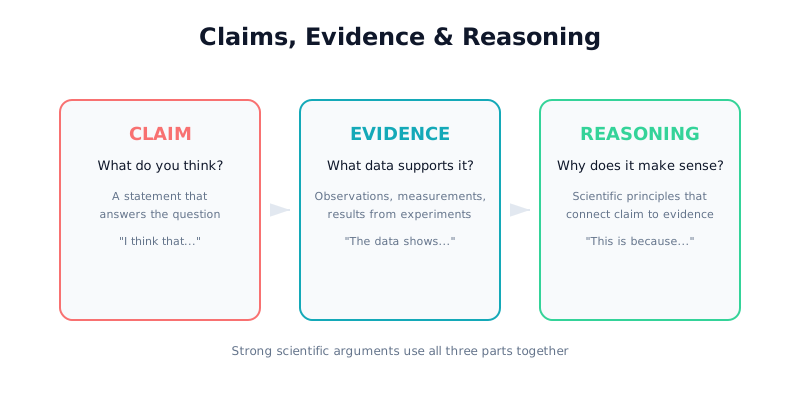
Click each sentence that supports the claim.
The Golden State Killer Case
In 2018, California police arrested Joseph James DeAngelo for a series of murders and rapes committed between 1974 and 1986. They had his crime scene DNA but no match in police databases. Instead, they uploaded the profile to a public genealogy website and found distant relatives who had voluntarily submitted their DNA. By building a family tree, investigators narrowed the search to DeAngelo. The case demonstrated both the extraordinary power of genetic databases and the privacy implications: people who submitted DNA for ancestry research unwittingly helped identify a relative who was a suspect.
As genetic data becomes cheaper to generate, the question of who owns and controls it becomes urgent. Your genome is uniquely yours, yet it also reveals information about your relatives. If you share your genetic data with a company or research study, can it be sold to insurers? Can law enforcement access it without a warrant? Can it be used to discriminate in employment?
For Indigenous Australians, these questions have additional weight. Historical abuses of genetic research, including taking samples without proper consent, have created deep mistrust. Many Indigenous communities now demand data sovereignty: the right to control how their genetic information is collected, stored and used. organisations like AIATSIS (Australian Institute of Aboriginal and Torres Strait Islander Studies) develop ethical guidelines that centre community consent and benefit-sharing.
In 2019, a US detective used a public genetic genealogy database to identify a suspect in a decades-old cold case. While this solved a serious crime, it also meant that millions of people who had uploaded their DNA for ancestry research became searchable by law enforcement, including distant relatives who had never consented to police access.
Australian Indigenous genomics: The National Centre for Indigenous Genomics (NCIG) at the Australian National University works with Indigenous communities to store and study genetic samples ethically. Their governance model ensures that communities retain control over their data and that research benefits flow back to the people who contributed, setting a global standard for Indigenous data sovereignty.
- Consent
- Equity
- Privacy
- Data sovereignty
- Protecting genetic information from unauthorised access or misuse
- Individuals must understand and agree to how their genetic data is used
- Indigenous communities controlling how their genetic data is collected and used
- Fair access to genetic technologies regardless of wealth or location
Navigating the ethics of genetic technology requires more than knowing the science. It requires understanding how scientific facts intersect with values, culture and power. A scientifically literate citizen should be able to read a news article about gene editing, identify the actual claims, distinguish them from hype, and recognise whose interests are being served.
Regulation must be adaptive. Technology moves faster than legislation, and rigid rules can become obsolete or drive research underground. At the same time, laissez-faire approaches risk harm to individuals and communities. The best regulatory frameworks are transparent, involve diverse stakeholders, and are reviewed regularly as technology and social values evolve.
Australia's regulatory framework for gene technology is often cited as a balanced model. It permits research and clinical applications under strict oversight, bans heritable germline modification, and requires public consultation before approving new uses. This does not eliminate ethical tension, but it ensures that decisions are made through accountable processes rather than by individual scientists acting alone.
Australian governance: The NHMRC funds research into the ethical, legal and social implications of genetic technologies through its Embryo Research Licensing Committee and Human Genetics Advisory Committee. These bodies ensure that Australian policy keeps pace with scientific advances while reflecting community values.
Wrong: "All genetic technologies are either completely safe or completely dangerous."
Right: Genetic technologies must be evaluated case by case, considering the organism, trait, application and context. Scientific evidence, not blanket statements, should guide decisions.
Wrong: Each genetic technology must be evaluated case by case, considering the specific organism, trait, application and context. Bt cotton and CRISPR sickle cell therapy have very different risk profiles. Scientific evidence, not blanket statements, should guide evaluation.
Right: Each genetic technology has a different risk profile depending on its specific use. Bt cotton and CRISPR sickle cell therapy, for example, require very different ethical and safety evaluations.
The ethics of genetic technologies extend far beyond individual patient consent. They touch on fundamental questions about human identity, social justice, and the kind of society we want to create. Three ethical domains are particularly important: therapy versus enhancement, genetic privacy, and Indigenous data sovereignty.
Therapy versus enhancement: Most people agree that using gene editing to prevent serious diseases like cystic fibrosis or sickle cell anaemia is ethically justified. But what about editing genes to increase height, intelligence, or athletic ability? This distinction between therapy (restoring normal function) and enhancement (exceeding normal function) is philosophically contested. Some argue that the line is arbitrary - if we can prevent disease, why not improve wellbeing? Others argue that enhancement undermines human equality by creating genetic hierarchies.
Genetic privacy: Your genome is not just your own information - it reveals health risks shared by your parents, siblings, and children. If you upload your DNA to a genealogy database, you are also exposing information about relatives who never consented. Genetic data breaches are permanent - you cannot change your DNA like you can change a password.
Indigenous data sovereignty: Indigenous Australians have specific concerns about genetic research. Historical exploitation, including theft of remains and unauthorised use of biological samples, has created deep mistrust. Indigenous data sovereignty means that Indigenous communities must control how their genetic data is collected, stored, and used.
In 2018, a Chinese scientist announced the birth of gene-edited twins whose embryos had been modified to resist HIV infection. The scientific community condemned the experiment as premature, unethical, and illegal under Chinese regulations at the time. The researcher was imprisoned, but the incident highlighted how quickly gene editing technology is outpacing regulatory frameworks. It also raised the therapy-enhancement question: the edit was intended to prevent disease (HIV resistance), but it was unnecessary because other preventive measures exist, and it introduced unknown long-term risks to the children.
Australian genetic ethics: The National Health and Medical Research Council (NHMRC) establishes ethical guidelines for human genetic research in Australia. These guidelines require free, prior, and informed consent from Indigenous communities for genetic research involving Aboriginal and Torres Strait Islander peoples. The guidelines also prohibit reproductive cloning and restrict human embryo research to 14 days of development. These frameworks attempt to balance scientific freedom with ethical boundaries.
Ethical concerns about genetics are just fear of new technology. This is false. The concerns are substantive and evidence-based. Gene editing can cause off-target mutations with unknown consequences. Genetic enhancement could exacerbate social inequality. Genetic databases can be misused by law enforcement, insurance companies, or employers. These are not imaginary risks - they are documented or highly probable outcomes that require careful governance.
Ethical Framework Application
1 A company offers free genome sequencing to all employees, claiming it will help tailor health programs. Employees who refuse are denied a health insurance discount.
2 Australian regulators approve a drought-resistant GM wheat for commercial farming, but require small farmers to pay a licensing fee for the seeds.
3 A fertility clinic offers to use CRISPR to edit embryos so that resulting children will have a lower lifetime risk of heart disease.
Perspective Cards
1 "Australia should ban all genetically modified crops."
2 "Police should be allowed to collect DNA from every Australian at birth for a national database."
3 "CRISPR should be allowed to edit human embryos to prevent serious genetic diseases."
Copy Into Your Book
▼Ethical Frameworks
- Beneficence = do good, maximise benefit
- Autonomy = respect informed choice
- Justice = fair distribution of benefits/risks
Key Issues
- Privacy of genetic information
- GM food safety and labelling
- Designer babies and enhancement
- Biodiversity and gene flow
Australian Regulators
- OGTRoversees GM organisms
- FSANZassesses GM food safety
- NHMRCoversees human research
Key Laws
- Gene Technology Act 2000
- Prohibition of Human Cloning Act 2002
- Research Involving Human Embryos Act 2002
- Germline editing is ILLEGAL in Australia
At the start of this lesson you were told about a Chinese scientist who gene-edited human embryos to make them resistant to HIV and was then sentenced to three years in prison. That case was chosen to show you that even technologies with potential medical benefits can cross ethical lines that society has decided matter, and that science alone cannot settle those arguments.
Now that you have worked through different ethical frameworks and case studies, would you reach the same conclusion as the scientific community about that scientist's actions? What has this lesson changed about how you approach decisions where genetic technology and ethics collide?
Q1. Define the three ethical frameworks of beneficence, autonomy and justice, and give one example of how each applies to genetic technologies. 3 MARKS
Q2. Explain why storing DNA in a police database raises privacy concerns that storing fingerprints does not. Refer to the information content of DNA in your answer. 4 MARKS
Q3. Evaluate the statement: "Australia should allow human germline editing for serious diseases but ban it for enhancement." In your answer, refer to ethical frameworks, scientific evidence and Australian law. 5 MARKS
Revisit Your Initial Thinking
Go back to your Think First responses at the top of the lesson.
- Did your initial response consider multiple perspectives, or were you mainly on one side?
- Has learning about ethical frameworks changed how you would evaluate the scenario?
- Write one sentence explaining how you will approach ethical questions about genetic technologies differently in the future.
Model answers (click to reveal)
Comprehensive Answers
▼Activity 1, Ethical Framework Application
1. Company genome sequencing: Beneficence: Tailored health programs could improve employee health [1 mark]. Autonomy: Denying a discount to those who refuse coerces employees into surrendering genetic privacy [1 mark]. Justice: Employees who cannot afford full insurance without the discount are unfairly disadvantaged [1 mark].
2. GM wheat with licensing fee: Beneficence: Drought-resistant wheat benefits food security and farmer livelihoods [1 mark]. Autonomy: Farmers can choose whether to buy the seeds [1 mark]. Justice: Licensing fees may disadvantage small farmers who cannot afford them, concentrating benefits among larger operations [1 mark].
3. CRISPR to reduce heart disease risk: Beneficence: Lower heart disease risk improves health and lifespan [1 mark]. Autonomy: Parents make the decision, but the child cannot consent to genetic changes that affect their entire life [1 mark]. Justice: Only wealthy families could afford the service, creating genetic inequality [1 mark].
Activity 2, Perspective Cards
1. Ban all GM crops: FOR: Precautionary principle, long-term ecological effects are unknown; gene flow to wild relatives could create superweeds; corporate control of seeds harms small farmers [1 mark]. AGAINST: Major scientific organisations confirm approved GM foods are safe; Bt cotton has reduced pesticide use by 85% in Australia; GM crops can improve food security in drought-prone regions [1 mark].
2. National DNA database at birth: FOR: Would solve crimes faster, including cold cases and missing persons; could identify remains after disasters; exonerates innocent people [1 mark]. AGAINST: Massive invasion of privacy; DNA contains health and ancestry information unrelated to crime; data breaches could expose sensitive information; creates a surveillance state; relatives are implicated without consent [1 mark].
3. Embryo editing to prevent disease: FOR: Eliminates devastating suffering from diseases like Huntington's or cystic fibrosis; prevents disease rather than treating symptoms; parents acting out of love and beneficence [1 mark]. AGAINST: Germline changes affect all descendants who cannot consent; off-target effects could cause new problems; slippery slope toward enhancement editing; reduces genetic diversity; currently illegal in Australia for good reason [1 mark].
Multiple Choice
1. BJustice concerns fair distribution. Option A (beneficence) is about doing good. Option C (autonomy) is about choice. Option D (consent) is related to autonomy.
2. CFSANZ assesses GM food safety. Option A (OGTR) oversees environmental release of GM organisms. Option B (AFP) handles forensics. Option D (NHMRC) oversees human research ethics.
3. DGermline editing is prohibited in Australia. Option A is false, somatic CRISPR is permitted. Option B is biologically false. Option C is wrong, FSANZ regulates food, not clinical procedures.
4. AJustice concerns inequality of access. Option B is factually wrong, gene therapies do work for some conditions. Option C concerns autonomy, not justice. Option D is an ideological argument, not a justice argument.
5. BAutonomy supports the right to know and choose. Option A is false, major reviews find approved GM food safe. Option C is absurd. Option D is false, Australia has comprehensive GM regulations.
Short Answer Model Answers
Q6 (3 marks): Beneficence is the principle of doing good and maximising benefit [1 mark]. Example: Using CRISPR to cure sickle cell disease benefits the patient enormously. Autonomy is the right of individuals to make informed decisions about their own bodies and lives [1 mark]. Example: People should be able to choose whether to have genetic testing without coercion. Justice is the fair distribution of benefits, risks and costs across society [1 mark]. Example: If gene therapies are only available to the rich, health inequality worsens, a justice concern.
Q7 (4 marks): DNA raises greater privacy concerns than fingerprints because it contains vastly more information [1 mark]. A fingerprint only identifies a person, but DNA reveals health risks, ancestry, biological relationships and potentially behavioural traits [1 mark]. If a police database is breached, fingerprint data is relatively harmless, but stolen DNA data exposes sensitive personal and family information that cannot be changed [1 mark]. Additionally, DNA profiling of one person reveals information about their relatives, who never consented to having their genetic data stored [1 mark].
Q8 (5 marks): This statement reflects a position that many ethicists and policymakers find reasonable, but it is not without challenges [1 mark]. Ethical frameworks: Beneficence supports germline editing for diseases because it prevents suffering [1 mark], but autonomy is violated because future generations cannot consent to inherited genetic changes [1 mark]. Scientific evidence: Off-target effects and incomplete understanding of gene interactions mean germline editing is not yet safe enough for clinical use [1 mark]. Australian law: Currently, all human germline editing is prohibited under the Prohibition of Human Cloning for Reproduction Act 2002, regardless of whether the intent is therapeutic or enhancement [1 mark]. A more evidence-based position might be to maintain the ban while research continues, with regular policy reviews as the science matures.
Jump Through Genetics!
Climb platforms using your knowledge of bioethics, genetic regulation and societal impacts. Pool: Lesson 10.