Environmental Management and Pandemic Control
In 2020, Australia chose elimination. New Zealand chose elimination. Sweden chose mitigation. The UK tried mitigation, then restrictions, then vaccines. Three years later, the data was in. Pandemic control is not just a biology problem — it is a decision about what level of harm a society will accept, and which tools it will use to limit it.
Practise this lesson
Four printable worksheets that build from the foundations up to exam-style questions — start at whatever level suits you.
In March 2020, governments around the world had to make decisions about COVID-19 with very limited information — about how transmissible it was, how lethal it was, or whether vaccines would arrive.
Before reading: what factors do you think should determine whether a government pursues pandemic elimination (trying to stop all transmission) vs mitigation (accepting some transmission while limiting harm)? Who should make that decision, and on what basis?
Know
- Environmental management strategies for infectious disease control
- The distinction between pandemic elimination and mitigation
- Key non-pharmaceutical interventions (NPIs) used in pandemic response
- The role of One Health in managing zoonotic disease emergence
Understand
- Why environmental management is a first-line defence against zoonotic pandemics
- The epidemiological reasoning behind different pandemic control strategies
- How layers of intervention interact to reduce R number below 1
Can Do
- Evaluate pandemic control strategies using epidemiological data
- Analyse the trade-offs between elimination and mitigation approaches
- Apply the R number concept to assess intervention effectiveness
Core Content
Stopping disease at the source — One Health
Environmental management targets the conditions that allow pathogens to emerge, persist, and spread — addressing disease at the source rather than waiting for human infection to occur. It operates across three scales: the natural environment, human-built environments, and the interface between them.
Managing Zoonotic Disease Emergence
Approximately 75% of emerging infectious diseases in humans originate in animals — zoonoses. The conditions that drive zoonotic spillover (transmission from animal to human) are increasingly well understood: habitat destruction forces wildlife into contact with human settlements; intensive agriculture creates dense populations of genetically similar animals that amplify pathogen transmission; climate change shifts the geographic ranges of vectors and reservoir species; wildlife trade and wet markets concentrate diverse species in close proximity.
One Health recognises that human health cannot be separated from animal and ecosystem health — 75% of emerging infectious diseases originate in animals
Key Environmental Management Strategies
What to write in your book
- Environmental management stops disease at the source — before human infection.
- One Health: human + animal + ecosystem health are inseparable; ~75% of emerging infections are zoonoses.
- Spillover drivers: habitat destruction, intensive agriculture, climate change, wildlife trade/wet markets.
- Strategies: habitat protection, water treatment, vector control, waste management, wildlife-trade regulation, farm biosecurity.
An infectious disease that can spread from animals to humans is called a _____.
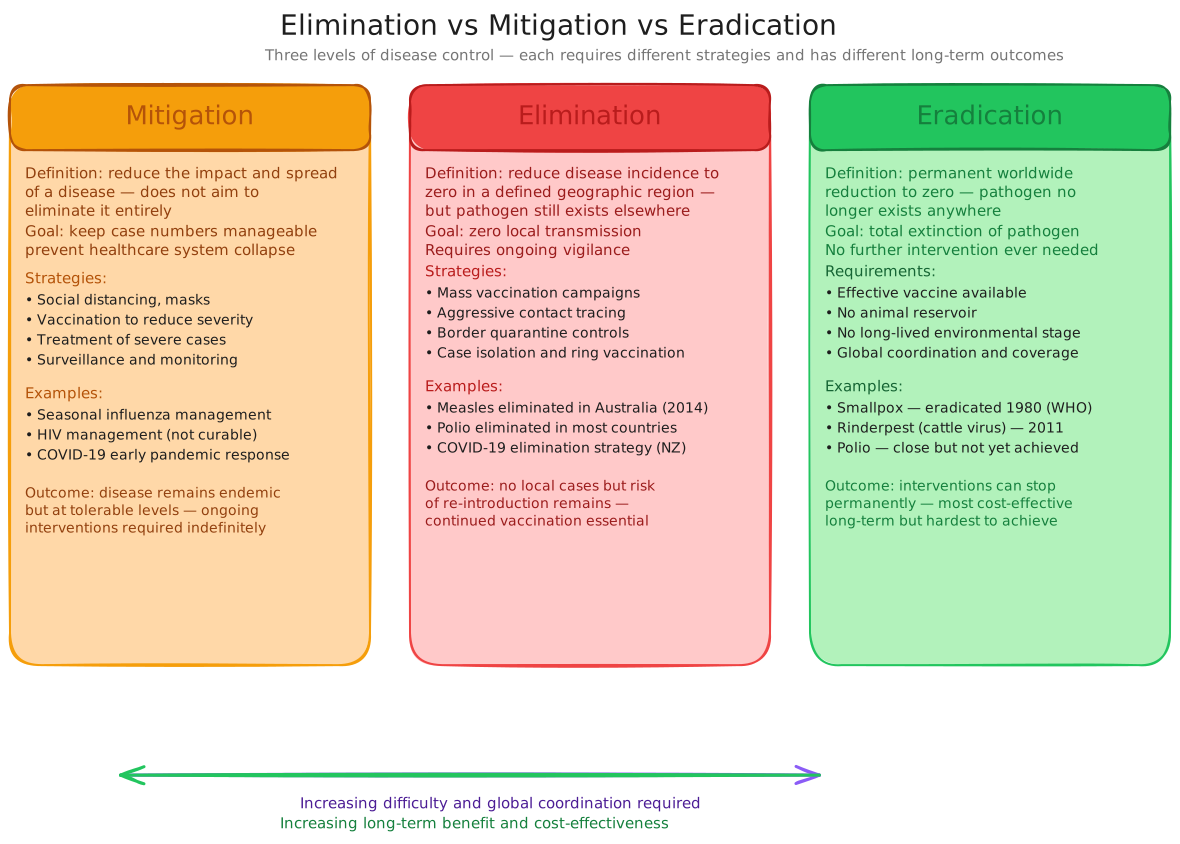
Elimination vs Mitigation Pathways
The R number and the strategic choice it shapes
When a novel pathogen emerges and spreads globally, public health authorities face a fundamental strategic choice between two broad approaches, each with distinct biological logic and social trade-offs.
The epidemiological goal is the same: keep R below 1. The strategies differ in how aggressively they pursue zero transmission vs managed transmission
The R Number — The Central Metric
The effective reproduction number (R or Re) is the average number of secondary infections produced by one infected person in a population with existing immunity and interventions in place. It differs from R₀ (which assumes a fully susceptible population with no interventions). Pandemic control succeeds when R is kept consistently below 1 — each generation of cases is smaller than the last and the outbreak declines.
Every non-pharmaceutical intervention (NPI) and vaccine reduces R by a certain amount. The strategy behind layered interventions is that each layer — masks, distancing, ventilation, testing, vaccination — reduces R by a fraction, and the combined effect of multiple partial interventions can bring R below 1 even when no single intervention does so alone.
Non-Pharmaceutical Interventions (NPIs)
What to write in your book
- Elimination: drive local transmission to zero (borders, lockdowns, testing/tracing, isolation).
- Mitigation: accept some transmission; focus on reducing severe disease and hospital overload.
- R (effective): secondary infections per case under current immunity + interventions. R>1 grows, R=1 stable, R<1 declines.
- Layered NPIs reduce R multiplicatively — combined effect can push R below 1 when no single measure can.
An outbreak is shrinking when the effective reproduction number R is:
Error Spotting — Pandemic Control
Pattern B — Error Spotting
A student wrote the following passage about pandemic control. It contains four factual errors. Identify each, explain what is wrong, and write the correction.
- List the four errors in the passage.
- For each error, write one sentence explaining what is wrong and the correct information.
- Rewrite the passage correctly in your own words.
Australia and New Zealand both pursued aggressive elimination strategies in 2020–2021 — closing borders, imposing strict quarantine, and suppressing community transmission to near-zero for extended periods. Sweden pursued mitigation from the start, keeping schools and businesses open and relying on voluntary behaviour change.
You will analyse NPI effectiveness data in Activity 1 and evaluate these strategies in Short Answer Q3.
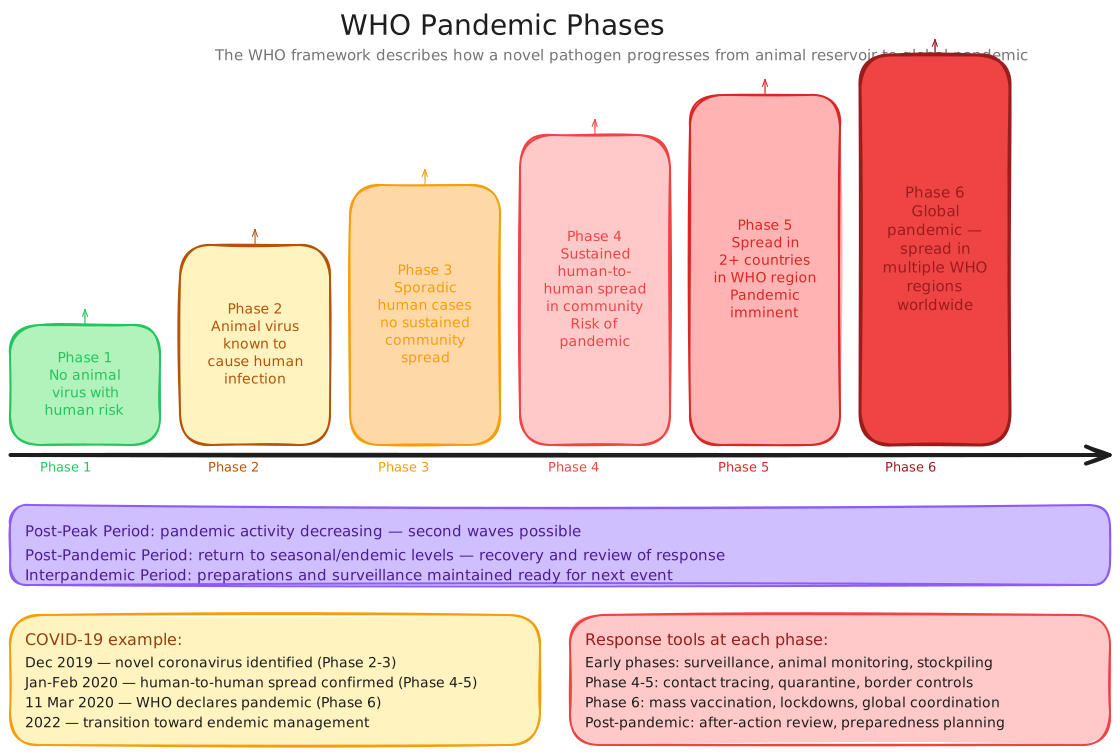
Pandemic Response Phases
Environmental Management
- Targets disease at the source — before human infection occurs.
- One Health: human + animal + ecosystem health are inseparable.
- 75% of emerging infections are zoonoses.
- Strategies: habitat protection; water treatment; vector control; waste management; wildlife trade regulation; agricultural biosecurity.
Elimination vs Mitigation
- Elimination: drive local transmission to zero; requires strict border control and rapid suppression.
- Mitigation: accept some transmission; focus on reducing severe disease and hospital overload.
- Both aim to keep R below 1 — different tools and trade-offs.
- COVID: elimination worked until high-R variants made it unsustainable.
The R Number
- R above 1: outbreak growing exponentially.
- R = 1: outbreak stable.
- R below 1: outbreak declining.
- Layered NPIs: each reduces R by a fraction; combined effect can bring R below 1 when no single measure can.
Non-Pharmaceutical Interventions
- Physical distancing: fewer contacts = fewer transmission events.
- Masking: source control + protection.
- Ventilation: dilutes airborne pathogen concentration.
- Testing and tracing: identifies cases before they become infectious.
- School/workplace closures: reduces contact density.
Environmental Disease Management — 5-Step Strategy
A fresh set drawn from this lesson's question bank — feedback shown immediately. +5 XP per correct · +25 XP all correct
Pick your answer, then rate your confidence — that tells the system what to drill next.
ApplyBand 4(3 marks) 1. Explain how environmental management strategies can prevent the emergence of pandemic diseases, using two specific examples. In your answer, refer to the One Health framework and identify the link in the chain of infection that each strategy targets.
1 mark: One Health correctly defined with zoonosis statistic · 1 mark: example 1 with chain of infection link · 1 mark: example 2 with chain of infection link (different from example 1)
UnderstandBand 5(3 marks) 2. Explain the concept of the effective reproduction number R and describe how layered non-pharmaceutical interventions can bring R below 1 even when no single intervention is sufficient on its own. Use specific examples of NPIs in your answer.
1 mark: R correctly defined (effective; accounts for immunity and interventions; differs from R₀) with above/below 1 interpretation · 1 mark: layered approach — multiplicative not additive; each NPI reduces R by a fraction · 1 mark: specific NPI examples with mechanisms
EvaluateBand 6(4 marks) 3. Compare Australia's elimination strategy and Sweden's mitigation strategy during 2020–2021. Evaluate the biological effectiveness of each approach, refer to the concept of R and variant emergence, and assess the conditions under which each strategy was most and least appropriate.
1 mark: factual comparison of outcomes (Australia 909 deaths vs Sweden ~9786 in 2020) · 1 mark: R framework — both aimed for R below 1; different thresholds · 1 mark: variant emergence — Omicron R₀ 8–15 made elimination impossible · 1 mark: evaluative conclusion — elimination superior at low R₀; mitigation the only viable option at high R₀
Show all answers
Multiple choice
Q1 — C: The One Health rationale for pandemic prevention is that 75% of emerging infections are zoonoses — they originate in animals and spill over into humans. Preventing spillover at the animal-human-ecosystem interface is more upstream and more effective than waiting for human infection to occur and then responding. (A) describes vaccine coordination — a benefit of international collaboration but not the core One Health rationale. (B) describes surveillance data sharing — also valuable but not the defining feature of One Health. (D) describes specific policy measures that are not conditions of WHO membership.
Q2 — B: R (effective) accounts for real-world conditions — existing population immunity from prior infection or vaccination, and the effect of interventions already in place. R₀ assumes a fully susceptible population with no interventions. As immunity builds and interventions are applied, R falls below R₀. (A) is wrong — R measures transmission, not mortality. (C) is wrong — R can be estimated at any stage of an outbreak. (D) is wrong — R applies to any transmissible disease regardless of route.
Q3 — D: The Omicron variant's R₀ of approximately 8–15 meant that keeping effective R below 1 required either extremely high population immunity (approaching 90%+ with vaccines that retained effectiveness against Omicron) or maintaining restrictions so severe that they were socially and economically unsustainable. The biological arithmetic made elimination impossible — not logistical barriers (C) or waning vaccines alone (A), and not natural immunity (B) which was not widespread in Australia at that point.
Q4 — A: The layered approach works because each intervention reduces R multiplicatively. Starting from R=2.5, a 20% reduction gives 2.0, a further 20% gives 1.6, and so on — the combined effect can bring R below 1 even when no single measure does. (B) is wrong — many NPIs target the same transmission route and their effects do overlap to some degree. (C) is wrong — pathogens do not develop resistance to NPIs in the same way bacteria develop antibiotic resistance. (D) is not a real WHO requirement.
Q5 — C: Habitat fragmentation and deforestation push wildlife species into contact with human settlements and domestic animals — creating new opportunities for pathogens to make cross-species jumps that would not have occurred in intact ecosystems. This is the primary driver of zoonotic spillover risk. (A) is not a well-supported mechanism. (B) describes a different hypothesis (ancient pathogen release) that is not the primary mechanism. (D) is an interesting ecological concept but not the main mechanism linking deforestation to emerging infectious disease.
Short Answer Model Answers
SA1: The One Health framework recognises that human health, animal health, and ecosystem health are inseparable — that disease in humans cannot be fully understood or prevented without considering the health of the animals and environments with which humans interact. This is particularly important for emerging pandemic threats because approximately 75% of emerging infectious diseases in humans originate in animals. Preventing zoonotic spillover at the source is more effective than waiting for human infection and then responding. Example 1 — Habitat protection and land use management targets the reservoir link in the chain of infection. When forests are cleared and wildlife habitat is fragmented, wild animals that carry pathogens are forced into closer proximity with human settlements and livestock. Protecting intact habitat maintains a physical buffer between wildlife reservoir species and human hosts — reducing the frequency of cross-species contact events that could lead to spillover. This has direct relevance to Ebola virus (reservoir: fruit bats; spillover facilitated by forest clearing in Central Africa) and Hendra virus (reservoir: flying foxes; spillover to horses and humans increased as flying fox habitat contracted). Example 2 — Regulation of wildlife trade and live animal markets targets the transmission link. Live animal markets that concentrate diverse species — including wildlife — in close proximity create ideal conditions for pathogen exchange between species and eventual spillover to humans. Restricting or eliminating unregulated wildlife trade reduces these high-risk contact events. The emergence of SARS-CoV-1 (2003) and the likely emergence of SARS-CoV-2 (2019) have both been linked to live animal market environments in which diverse mammalian species were held in close contact.
SA2: The effective reproduction number R (sometimes written R or R-effective) is the average number of secondary infections produced by one infectious person in a population that has existing immunity and in which interventions are already in place. It differs from R₀, which assumes a completely susceptible population with no interventions. As population immunity increases (through vaccination or prior infection) and as interventions are applied, R falls below R₀. Pandemic control succeeds when R is kept consistently below 1 — each generation of cases is smaller than the last and the outbreak declines. When R exceeds 1 the outbreak grows exponentially; when R equals 1 the outbreak is stable. Layered non-pharmaceutical interventions can bring R below 1 through a multiplicative effect even when no single intervention is sufficient alone. This works because each NPI reduces the probability of transmission per contact, or the number of contacts per day, by a fraction. For example: mask wearing reduces R by approximately 10–15% by reducing the emission of infectious particles (source control) and the inhalation of infectious particles by susceptible individuals. Physical distancing reduces R by approximately 15–25% by reducing the number of close contacts per day — fewer opportunities for transmission. Testing and contact tracing can reduce R by 20–35% by identifying infectious individuals early and quarantining their contacts before they can transmit further. If baseline R is 2.5 and masking reduces it by 12%, distancing by 20%, and testing/tracing by 30%, the combined effect — applied multiplicatively — is approximately 2.5 × 0.88 × 0.80 × 0.70 ≈ 1.23. Adding indoor venue closures (reducing by a further 30%) brings this to approximately 0.86 — below 1 and into decline. No single measure achieved this; the combination did.
SA3: Australia and Sweden represent the clearest real-world comparison of elimination and mitigation strategies during the COVID-19 pandemic's pre-vaccine phase. Australia's elimination strategy aimed to drive effective R to or near zero through aggressive border closure, mandatory hotel quarantine for international arrivals, and rapid suppression of any community transmission through contact tracing and targeted lockdowns. Sweden's mitigation strategy accepted ongoing transmission, keeping schools and most businesses open, and relied on voluntary behaviour change and eventual development of population immunity. In 2020, the outcomes were stark: Australia recorded approximately 909 COVID-19 deaths for the entire year; Sweden recorded approximately 9,786 deaths — a death rate per capita that exceeded several countries that had imposed stricter restrictions. In terms of the R framework, Australia's strategy kept effective R close to zero for extended periods — no community transmission means R effectively equals zero for weeks or months at a time. Sweden's strategy accepted R hovering around 1 or above, with periodic surges and healthcare strain. Both strategies technically aimed to keep R below the threshold at which healthcare systems would collapse — but Australia's threshold was zero transmission while Sweden's was manageable transmission. The emergence of new variants fundamentally changed the equation. The Delta variant (R₀ approximately 5–7) stretched elimination strategies significantly — the 2021 Delta outbreak in NSW eventually forced Australia's transition from elimination to "living with COVID." The Omicron variant (R₀ approximately 8–15) made elimination mathematically impossible for any country regardless of willingness: achieving R below 1 with Omicron would have required vaccination coverage and restriction levels that were not achievable or sustainable anywhere. At this point all countries effectively transitioned to mitigation by necessity. The evaluation is therefore context-dependent: elimination was biologically superior to mitigation in 2020 when the original strain had an R₀ of 2–3 and vaccines were not yet available. It saved lives and bought critical time for vaccine development and rollout. It became unsustainable not because it was strategically wrong but because the biological parameters of the pandemic changed. Mitigation — which appeared less effective in 2020 — became the only viable strategy in 2022 not because Sweden's approach was vindicated but because the virus had evolved beyond what any elimination-focused strategy could contain. Neither approach was universally correct: the optimal strategy was determined by the variant's R₀ value, the availability of vaccines, and the population's capacity to sustain restrictions.
Five timed questions on environmental management and pandemic control. Beat the boss to bank a tier — gold (perfect + fast), silver (80%+), or bronze (cleared).
⚔ Enter the arenaClimb platforms, hit checkpoints, and answer quick-recall questions on this lesson. Lighter than the boss — pure recall practice.
You were asked what factors should determine whether a government pursues elimination or mitigation, and who should make that decision.
The biology gives a clear answer to the first part: the primary determinant should be whether elimination is biologically achievable given the pathogen's R₀. If R₀ is 2–3 (original COVID), elimination is mathematically possible with border controls and contact tracing. If R₀ is 8–15 (Omicron), elimination requires restricting contact to a degree no society will sustain — mitigation is the only realistic option.
The politics and ethics are harder. Elimination protects lives but imposes enormous costs on economic activity, education, and social connection. Mitigation accepts preventable deaths in exchange for preserving normal life. Both involve genuine trade-offs between competing goods — not a simple right and wrong. The COVID pandemic was unusual in making these trade-offs so visible and so nationally divergent that a genuine natural experiment in pandemic strategy played out in real time.
The lesson this module closes with: disease control is always both biological and social. The biology tells you what is possible. The society decides what it will do with that possibility — and both the knowledge and the decision matter.