Biology • Year 12 • Module 7 • Lesson 21
Environmental Management and Pandemic Control
Lock in the core vocabulary, the One Health framework, the R number logic, and the distinction between elimination and mitigation strategies.
1. Label the One Health framework diagram
The diagram below shows the three-circle One Health framework. Write the missing labels into boxes A–H. Each label comes from the lesson's Key Terms, the One Health SVG, or the environmental management strategy table. 8 marks
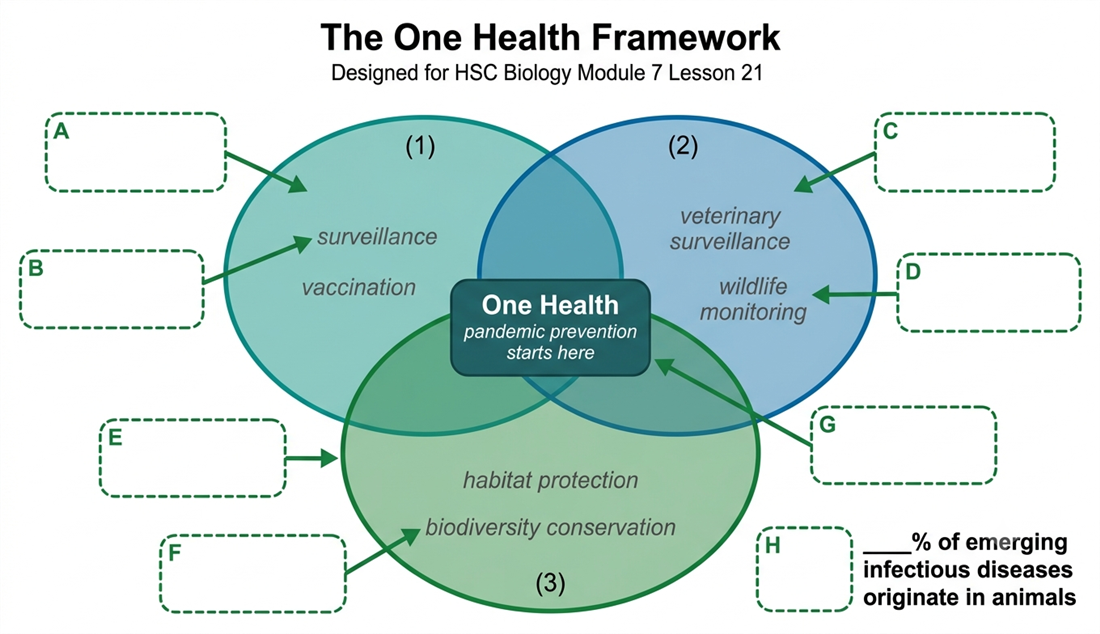
- A — name of the left circle (human ___) _______________________
- B — one human health intervention listed in the lesson _______________________
- C — name of the right circle (___ health) _______________________
- D — one animal health intervention listed in the lesson _______________________
- E — name of the bottom circle (___ health) _______________________
- F — one ecosystem strategy listed in the lesson _______________________
- G — name of the framework at the centre _______________________
- H — % of emerging infectious diseases that originate in animals _______________________
| Box | Your label |
|---|---|
| A | |
| B | |
| C | |
| D | |
| E | |
| F | |
| G | |
| H |
2. Term–definition match
The ten definitions below are shuffled. In the right-hand column write the matching term from this list: environmental management, zoonosis, One Health, elimination, mitigation, effective reproduction number, non-pharmaceutical intervention, spillover, biosecurity, vector control. 10 marks
| # | Definition (shuffled) | Matching term |
|---|---|---|
| 2.1 | An infectious disease that can spread from animals to humans. | |
| 2.2 | The average number of secondary infections caused by one infected person under current real-world conditions (existing immunity and interventions). | |
| 2.3 | Disease-control strategies that change environmental conditions to reduce pathogen emergence or spread. | |
| 2.4 | Reducing disease harm while accepting some ongoing transmission rather than stopping it completely. | |
| 2.5 | A framework linking human, animal and ecosystem health in disease prevention. | |
| 2.6 | Reducing local disease transmission to zero in a defined geographic area. | |
| 2.7 | Measures to prevent the introduction or spread of disease-causing organisms in agriculture, borders and livestock. | |
| 2.8 | The event when a pathogen jumps from an animal reservoir into a human host. | |
| 2.9 | A disease-control approach that does not involve pharmaceuticals — examples include masking, distancing, and ventilation. | |
| 2.10 | Managing insect and arthropod populations (e.g. draining standing water) to reduce transmission of vector-borne disease. |
3. True or false — with correction
For each statement, circle T or F. If the statement is false, write the corrected version on the line provided. 10 marks (1 for T/F, 1 for the correction where needed)
3.1 The effective reproduction number R is the same as R0 because both describe transmission in the same conditions. T / F
3.2 When R is consistently above 1, the outbreak is growing exponentially. T / F
3.3 Approximately 75% of emerging infectious diseases in humans originate in animals. T / F
3.4 An elimination strategy accepts some ongoing community transmission as long as severe disease is controlled. T / F
3.5 Layered non-pharmaceutical interventions can together bring R below 1 even when no single NPI achieves this on its own. T / F
4. Function recall
Answer each in 1–2 sentences using precise terms from the lesson. 8 marks (2 each)
4.1 What is the function of habitat protection as a pandemic prevention strategy, and which type of disease does it mainly target?
4.2 What is the function of contact tracing and isolation in terms of the R number?
4.3 What is the function of improved indoor ventilation as an NPI, and which transmission route does it mainly target?
4.4 What is the epidemiological function of keeping R consistently below 1 during an outbreak?
5. Fill in the blanks — pandemic control logic
Complete the paragraph using the word bank below. Each word is used once only. 8 marks
Word bank: below, zero, mitigation, elimination, R, zoonoses, One Health, multiplicative
During the COVID-19 pandemic, Australia initially pursued an _______________________ strategy, aiming to drive community transmission to _______________________ through border closure and rapid suppression. Sweden instead adopted a _______________________ strategy, accepting ongoing transmission while focusing on reducing severe disease. Both strategies shared the same epidemiological goal: keeping the effective reproduction number _______________________ _______________________ 1 so that each generation of cases is smaller than the last. Every non-pharmaceutical intervention reduces _______________________ by a fraction, and because the effects combine in a _______________________ way, multiple partial interventions can succeed together even when no single measure can. The _______________________ framework recognises that pandemic prevention depends on addressing disease at the human-animal-ecosystem interface, because approximately 75% of emerging infections are _______________________.
6. Build a concept map — pandemic control
Draw labelled arrows between the six terms below to show how they connect. Each arrow must carry a linking phrase (e.g. "reduces", "is kept below by", "uses"). Aim for at least 6 labelled arrows. 6 marks
Supplied terms: effective R number · non-pharmaceutical interventions · elimination strategy · mitigation strategy · One Health · zoonotic spillover.
Q1 — One Health diagram labels
A: human health. B: any valid human health intervention from the lesson — e.g. surveillance, vaccination, treatment. C: animal health. D: any valid animal health intervention — e.g. veterinary surveillance, wildlife monitoring, livestock biosecurity. E: ecosystem health. F: any ecosystem strategy — e.g. habitat protection, biodiversity conservation, climate action. G: One Health. H: 75%.
Q2 — Term–definition matches
2.1 zoonosis • 2.2 effective reproduction number • 2.3 environmental management • 2.4 mitigation • 2.5 One Health • 2.6 elimination • 2.7 biosecurity • 2.8 spillover • 2.9 non-pharmaceutical intervention • 2.10 vector control.
Q3 — True / false with correction
3.1 False. Correction: R (effective) differs from R0 — R0 assumes a completely susceptible population with no interventions, while R accounts for existing immunity and interventions already in place. As immunity builds and interventions are applied, R falls below R0.
3.2 True.
3.3 True.
3.4 False. Correction: it is the mitigation strategy that accepts some ongoing transmission while focusing on reducing severe disease. An elimination strategy aims to drive local transmission to zero.
3.5 True.
Q4.1 — Function of habitat protection
Habitat protection reduces the frequency of contact between wildlife reservoir species and human settlements or livestock, limiting the opportunity for zoonotic spillover. It mainly targets zoonoses — infectious diseases with animal reservoir hosts, including bat-borne viruses such as Hendra virus and Ebola.
Q4.2 — Function of contact tracing and isolation
Contact tracing identifies people who have been exposed to an infectious case, and isolation prevents them from transmitting the pathogen before they themselves become symptomatic. This breaks transmission chains early and directly lowers the effective R number by reducing the number of secondary cases each infected person goes on to generate.
Q4.3 — Function of ventilation
Improved indoor ventilation dilutes and removes airborne pathogen particles from enclosed spaces, reducing the concentration of aerosols that a susceptible person inhales. It primarily targets aerosol (airborne) transmission routes, as seen in COVID-19, tuberculosis, and measles.
Q4.4 — Function of R below 1
When R is kept consistently below 1, each generation of cases is smaller than the previous one — the outbreak is declining. Sustained R below 1 is the epidemiological condition under which an outbreak will eventually end; it means each case on average produces fewer than one new case.
Q5 — Cloze paragraph answers (in order of blanks)
elimination • zero • mitigation • R • below • R • multiplicative • One Health • zoonoses.
Note: the blank sequence requires "R" then "below" as adjacent words for "R below 1" — accept either order if the student preserves the full phrase meaning.
Q6 — Sample concept map
A correct map should include arrows such as:
- elimination strategy — aims to drive → effective R number (to zero)
- mitigation strategy — aims to keep → effective R number (below 1)
- non-pharmaceutical interventions — reduce → effective R number
- One Health — prevents / reduces → zoonotic spillover
- zoonotic spillover — can initiate outbreaks requiring → elimination strategy or mitigation strategy
- non-pharmaceutical interventions — are core tools of both → elimination strategy and mitigation strategy
Award 1 mark per correctly labelled, biologically valid arrow (causal direction must be correct). Full marks for 6 or more.