Indigenous Protocols and Bush Medicine
A West Australian plant used by Aboriginal communities for generations was found to contain compounds active against HIV. A US government agency filed a patent on it. The community that had known about it for millennia received nothing — and had no legal standing to object. This lesson is about who owns traditional knowledge, and why the answer matters for medicine.
Practise this lesson
Four printable worksheets that build from the foundations up to exam-style questions — start at whatever level suits you.
A pharmaceutical company discovers that a plant used by an Indigenous community has potent medicinal properties. They isolate the active compound, develop it into a drug, and file a patent. The drug sells for hundreds of millions of dollars per year.
Before reading: who do you think should benefit from this drug's commercial success? The company that developed it? The community whose knowledge directed researchers to the plant? The country where the plant grows? And what obligations, if any, does the company have?
Know
- What bush medicine is and how it is used
- Key examples of Australian bush medicine plants and their documented properties
- What biopiracy is and how it occurs
- The Nagoya Protocol and its role in protecting traditional knowledge
Understand
- Why intellectual property law inadequately protects traditional knowledge under current frameworks
- The ethical dimensions of bioprospecting vs biopiracy
- Why benefit sharing and free prior informed consent matter
Can Do
- Evaluate a bioprospecting scenario against ethical and legal frameworks
- Distinguish legitimate research collaboration from exploitative appropriation
- Apply knowledge of bush medicine to a structured analysis question
Core Content
Tens of thousands of years of empirical plant knowledge
Bush medicine refers to the use of native Australian plants, animals, and minerals in traditional healing practices by Aboriginal and Torres Strait Islander peoples. This knowledge represents tens of thousands of years of empirical observation, trial, and refinement — a pharmacopoeia developed through direct experience of the Australian environment and its biological resources.
Bush medicine is not a relic of the past. It is actively used across Australia — particularly in remote and regional communities where access to Western medicine may be limited, but also by choice in communities where traditional healing practices are maintained as part of cultural identity and wellbeing. Knowledge of bush medicine is held by specific knowledge-holders within communities, transmitted through oral tradition, and often inseparable from spiritual and cultural frameworks.
Documented Bush Medicine Plants — Key Examples
Many bush medicine plants have had their traditional applications scientifically validated — raising significant questions about who owns this knowledge
What to write in your book
- Bush medicine = native plants/animals/minerals used in traditional healing; tens of thousands of years of empirical refinement.
- Examples: tea tree (antimicrobial), smoke bush (anti-HIV compounds), eucalyptus/cineole (anti-inflammatory), Kakadu plum (highest known Vitamin C), eremophila (MRSA research), lemon myrtle (citral).
- Knowledge is held by specific knowledge-holders, transmitted orally, and embedded in cultural frameworks — still actively used.
Bush medicine is purely a historical practice and is no longer used in Australian communities today.
Indigenous communities often have established protocols for sharing traditional medicinal knowledge that must be respected in bioprospecting.
Bioprospecting always benefits Indigenous communities by providing them with direct financial compensation for their traditional knowledge.
Annotated Research — Bush Medicine Plant of Choice
Pattern A — Draw and Annotate
Choose one Australian bush medicine plant from those covered in this lesson (or one you research independently). In your book, produce an annotated entry that includes:
- The plant's common and scientific name, and the Country/nation where it has traditional significance.
- A sketch or description of the plant's appearance.
- The traditional use(s) of the plant in the relevant community — described respectfully and in cultural context.
- The documented biological mechanism that explains why it works (e.g. which compounds are active and what they do).
- Whether the plant has been commercialised, and if so, whether there is evidence of benefit-sharing with the original knowledge-holding community.
- An evaluative statement: does the current commercial use of this plant reflect ethical bioprospecting or biopiracy (or something in between)?
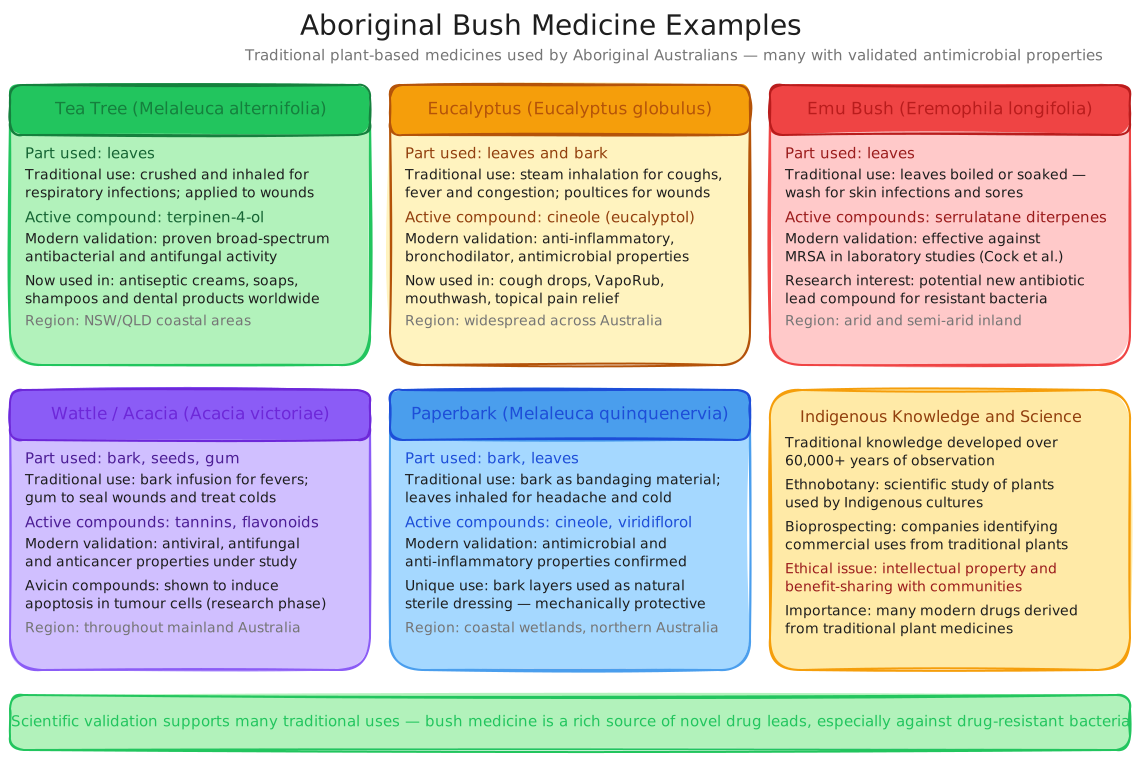
Bush Medicine — Plants and Uses
Same knowledge, opposite ethics — it all depends on the process
When a pharmaceutical company, research institution, or government agency uses traditional biological knowledge to develop a commercial product — without the consent of the knowledge-holding community and without sharing benefits — this is called biopiracy. The term captures both the biological and the legal dimensions: the biological resource (the plant) and the traditional knowledge (its application) are appropriated without authorisation.
Bioprospecting and biopiracy use the same biological knowledge — the difference is consent, process, and benefit sharing
Why Current Patent Law Fails to Protect Traditional Knowledge
Standard patent law protects inventions that are novel, useful, and non-obvious. Traditional knowledge — including knowledge of medicinal plants — often fails on the "novelty" test from the perspective of the knowledge-holding community (it is not new to them), but it may appear novel to a patent examiner who is unaware of its traditional use. This creates a legal gap: a company can take knowledge that has existed in a community for generations, frame it as a "new discovery," and obtain patent protection — legally excluding the original knowledge-holders from commercialising the resource.
This is compounded by the fact that oral traditional knowledge is typically not documented in the forms that patent offices recognise as "prior art" — the existing knowledge base that prevents a patent from being granted on something already known. If traditional knowledge is not in a patent database, a scientific journal, or a book, a patent examiner may not find it.
The Nagoya Protocol
The Nagoya Protocol on Access and Benefit-Sharing is an international agreement under the Convention on Biological Diversity, adopted in 2010 and entering into force in 2014. It establishes a framework requiring that:
- Access to genetic resources and traditional knowledge requires the prior informed consent (PIC) of the country and/or community from which it is taken
- Benefit sharing — any commercial benefits arising from the use of those resources must be shared equitably with the providers
- Mutually agreed terms — the terms of access and benefit sharing must be negotiated and agreed before use begins, not retrospectively
Australia ratified the Nagoya Protocol in 2022. Implementation requires domestic legislation that gives effect to the access and benefit-sharing requirements — still developing at state and federal levels.
What to write in your book
- Biopiracy = using traditional biological knowledge for a commercial product WITHOUT consent or benefit sharing.
- Bioprospecting vs biopiracy: same knowledge — the distinction is the process (FPIC + benefit-sharing agreement).
- Patent law gap: undocumented oral knowledge isn't found as "prior art", so patents can be granted on it.
- Nagoya Protocol (in force 2014; Australia ratified 2022): prior informed consent + mutually agreed terms + benefit sharing.
What is the key difference between ethical bioprospecting and biopiracy?
In the early 1990s, the US National Cancer Institute (NCI) collected samples of a Western Australian shrub known as smoke bush (Conospermum spp.) as part of a broad bioprospecting program. Laboratory screening found that compounds from the plant — later named conospermines — had significant activity against HIV in cell culture.
You will evaluate this case in Activity 1 and Short Answer Q3.
Bush Medicine
- Traditional healing using native Australian plants — tens of thousands of years of empirical development.
- Key examples: tea tree (antimicrobial); smoke bush (anti-HIV compounds); eucalyptus (anti-inflammatory); kakadu plum (Vitamin C); eremophila (MRSA research).
- Knowledge held by specific knowledge-holders; transmitted orally; embedded in cultural frameworks.
Biopiracy vs Bioprospecting
- Bioprospecting: use of traditional knowledge WITH free prior informed consent and benefit-sharing agreement.
- Biopiracy: use WITHOUT consent or benefit sharing — community receives nothing from commercial use of their knowledge.
- The biological knowledge is identical — the ethical distinction is in the process.
Nagoya Protocol (2014)
- International framework under the Convention on Biological Diversity.
- Requires: prior informed consent; benefit-sharing; mutually agreed terms.
- Australia ratified 2022.
- Limitations: not retrospective; requires domestic legislation; enforcement limited.
IP and Traditional Knowledge
- Patent law requires novelty — traditional knowledge may not qualify as prior art if undocumented.
- Oral knowledge not recognised in patent databases = legal gap.
- Smoke bush (WA): NCI filed patent on anti-HIV compounds without Noongar consent.
- Advocacy led to development of Nagoya Protocol and Australian ABS legislation.
Biopiracy vs Ethical Use of Traditional Knowledge
A fresh set drawn from this lesson's question bank — feedback shown immediately. +5 XP per correct · +25 XP all correct
Pick your answer, then rate your confidence — that tells the system what to drill next.
UnderstandBand 4(3 marks) 1. Explain what biopiracy is, using the smoke bush case as a specific example. In your answer, identify what was taken, by whom, from which community, and why the community had no legal recourse under the existing patent system at the time.
1 mark: biopiracy correctly defined (without consent; no benefit sharing) · 1 mark: smoke bush specifics (NCI; Conospermum; anti-HIV compounds; Noongar community) · 1 mark: no legal recourse — oral knowledge not in patent databases; not recognised as prior art
ApplyBand 4(3 marks) 2. Describe the key requirements of the Nagoya Protocol. Explain two limitations that mean it does not fully protect against biopiracy in all circumstances.
1 mark: Nagoya Protocol requirements correctly stated (FPIC; mutually agreed terms; benefit sharing) · 1 mark: limitation 1 with explanation · 1 mark: limitation 2 with explanation
EvaluateBand 6(4 marks) 3. Evaluate the ethical obligations of researchers and pharmaceutical companies when using traditional Indigenous knowledge in drug development. In your answer, refer to the concepts of free prior informed consent, benefit sharing, and the difference between bioprospecting and biopiracy.
1 mark: FPIC obligation — must be obtained before research begins; genuine and informed · 1 mark: benefit sharing — proportional to contribution of traditional knowledge · 1 mark: bioprospecting vs biopiracy distinction — process determines which applies · 1 mark: overall evaluation with reference to commercial value of traditional knowledge creating proportional obligation
Show all answers
Multiple choice
Q1 — B: Biopiracy specifically refers to the appropriation of traditional knowledge or genetic resources without consent and without benefit sharing. (A) describes illegal poaching but not biopiracy. (C) is too broad — ethically conducted research with consent and benefit-sharing is not biopiracy. (D) describes a separate issue (synthetic analogue patents) that may or may not involve biopiracy.
Q2 — D: Patent examiners search written, indexed databases. Oral traditional knowledge — regardless of how ancient or widespread — will not be found if it has not been documented in a form that patent search tools can access. This is the core legal gap. (A) is wrong — oral knowledge can constitute prior art if it can be demonstrated; it is the practical discoverability that is the problem. (B) is wrong — traditional knowledge is not automatically public domain. (C) is wrong — patent searches cover many languages and formats.
Q3 — A: The Nagoya Protocol's core requirements are prior informed consent from the community/country and a benefit-sharing arrangement agreed before use begins — not after commercial success. (B) invents a specific percentage that is not in the Protocol. (C) describes open-access publishing — not a Nagoya requirement. (D) inverts the Protocol's logic — it does not require scientific validation before access.
Q4 — C: The smoke bush case demonstrated that standard biodiversity collection permit systems in WA at the time did not require consultation with, or consent from, Indigenous communities as a condition of collecting plants. This allowed the NCI to obtain collection permits legitimately and then use the collected material for pharmaceutical research and patent filing without any community engagement being required. (A) is wrong — the community did not successfully use patent law. (B) is wrong — the properties were not previously documented scientifically. (D) is wrong — the Nagoya Protocol did not exist at the time.
Q5 — B: Ethical bioprospecting under the Nagoya Protocol requires: engaging the community before research begins; obtaining genuine free prior informed consent in writing; negotiating a benefit-sharing agreement; proceeding only on mutually agreed terms. (A) is a collection permit approach without community consent — closer to biopiracy. (C) starts research before consent — the Protocol requires consent before, not after. (D) defers community engagement to after findings are established — the Protocol is explicit that access must be agreed before use begins.
Short Answer Model Answers
SA1: Biopiracy refers to the appropriation of traditional biological knowledge or genetic resources by a company, research institution, or government agency without the free prior informed consent of the knowledge-holding community, and without sharing any commercial benefits that result. In the smoke bush case, the US National Cancer Institute (NCI) collected samples of Conospermum species from Western Australia as part of a broad bioprospecting program. Laboratory screening identified compounds — later named conospermines — with significant activity against HIV in cell culture. The NCI filed a patent on these compounds. The Noongar people of south-western Western Australia had traditional knowledge of the smoke bush plant's medicinal properties — it had been used for generations for respiratory conditions and as part of healing ceremonies. The community was not consulted, was not notified of the patent filing, and was offered no benefit-sharing arrangement. The community had no effective legal recourse under the existing patent system at the time for a fundamental reason: their knowledge was oral, not documented in any written or indexed form that a patent examiner would search. Patent law requires a patent to be novel — but novelty is assessed by searching existing written prior art databases. Traditional oral knowledge, however ancient and well-established within a community, is not discoverable by patent search tools unless it has been recorded in an indexed written source. The Noongar community's knowledge therefore did not legally exist as prior art, and the patent could be granted without any acknowledgment of the traditional knowledge that had, in effect, directed researchers to the plant in the first place.
SA2: The Nagoya Protocol on Access and Benefit-Sharing, adopted in 2010 and entering into force in 2014, establishes three core requirements for access to genetic resources and traditional knowledge for commercial purposes. First, free prior informed consent (FPIC) must be obtained from the community or country from which the resources or knowledge are taken — before research or collection begins. The consent must be genuinely free (not coerced), prior (given before access), and informed (the community understands what they are consenting to). Second, mutually agreed terms must be negotiated — the conditions of access must be agreed between the researcher/company and the community before any use of the knowledge occurs. Third, equitable benefit sharing must be agreed — any commercial benefits arising from the use of the resources must be shared with the providers according to the agreed terms. Despite these requirements the Protocol has two significant limitations. First it is not retrospective — it applies only to resources accessed after it entered into force in 2014. Historical cases of biopiracy such as the smoke bush patent are not covered; communities affected by pre-2014 appropriations have no remedy under the Protocol. Second effective implementation requires domestic legislation in each signatory country — and the strength and detail of this legislation varies considerably. Australia ratified the Protocol in 2022 but domestic access and benefit-sharing legislation is still developing at federal and state levels. Without strong domestic law the Protocol's requirements may not be enforceable in practice even for post-2014 cases.
SA3: Researchers and pharmaceutical companies working with traditional Indigenous knowledge have both ethical and, increasingly, legal obligations that extend well beyond what standard research ethics frameworks typically require. The first obligation is free prior informed consent. FPIC must be obtained before any research begins — not as a formality, but as a genuine process of engagement in which the community understands what is proposed, what the potential commercial outcomes are, who will own any resulting intellectual property, and what benefits they might receive. FPIC obtained after research has established promising findings is not truly free or prior — the power dynamic has already shifted. The second obligation is equitable benefit sharing. Traditional knowledge dramatically reduces the cost and time of drug development by directing researchers to biologically active compounds that might otherwise require years of random screening to identify. The commercial value of this contribution is substantial. Benefit-sharing agreements should reflect this — whether through royalties on commercial products, co-ownership of intellectual property, research funding for community health priorities, or other mutually agreed arrangements. Acknowledgement in a paper, while appropriate, is not a substitute for financial benefit sharing. The distinction between bioprospecting and biopiracy lies entirely in the process of engagement. The same plant compound can be the subject of ethical bioprospecting (with FPIC and a benefit-sharing agreement) or biopiracy (without these). Researchers cannot claim they were engaged in legitimate bioprospecting simply because they did not intend to harm the community — the standard is procedural, not intentional. Overall, the ethical obligations of researchers and companies in this area are proportional to the contribution that traditional knowledge makes to their research. Where traditional knowledge provides the essential lead that makes a commercial product possible — as in the smoke bush case — the obligation to obtain consent and share benefits is correspondingly strong. The development of the Nagoya Protocol and increasing domestic legislation in countries including Australia reflects a growing international consensus that traditional knowledge must be treated as an asset with a legitimate owner, not as a free resource available to whoever can exploit it first.
Five timed questions on bush medicine, biopiracy, and the Nagoya Protocol. Beat the boss to bank a tier — gold (perfect + fast), silver (80%+), or bronze (cleared).
⚔ Enter the arenaClimb platforms, hit checkpoints, and answer quick-recall questions on this lesson. Lighter than the boss — pure recall practice.
You were asked who should benefit from a drug developed from traditional plant knowledge — the company, the community, or both. The law and ethics have been slowly converging on an answer: both, proportionally.
The company that isolates compounds, runs clinical trials, and navigates regulatory approval contributes genuinely to the drug's development — that investment deserves protection and return. But the traditional knowledge that directed researchers to the plant in the first place is also a contribution — one that may have taken thousands of years to develop and that the community owns collectively. Ignoring that contribution is not a neutral act; it is a choice to recognise one form of knowledge and dismiss another.
The Nagoya Protocol's answer is: negotiate before you start, share benefits equitably, and make the process transparent. This is not radical — it is the same logic that applies to any joint venture where multiple parties contribute to a commercial outcome. The radical idea, historically, was that traditional knowledge was free for the taking.