Biology • Year 12 • Module 7 • Lesson 20
Indigenous Protocols and Bush Medicine
Build the core vocabulary — bush medicine plants, biopiracy, free prior informed consent, the Nagoya Protocol — so you can apply these terms accurately in exam conditions.
1. Label the bush medicine plant summary diagram
The diagram below shows six Australian bush medicine plants and their key documented properties. Write the missing plant names and properties into boxes A–H. All labels are drawn from the lesson's Key Terms panel and Content cards. 8 marks
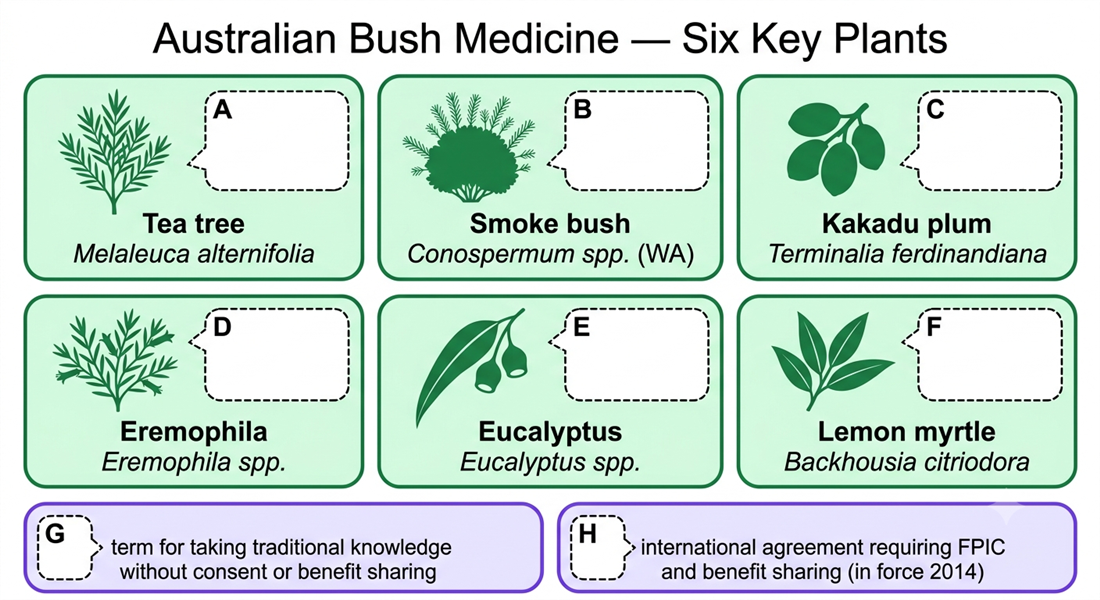
- A — Tea tree (Melaleuca alternifolia) documented scientific property ________________________
- B — The Aboriginal community whose traditional knowledge of smoke bush was not consulted ________________________
- C — Kakadu plum (Terminalia ferdinandiana) documented property (name the key nutrient) ________________________
- D — The antibiotic-resistant pathogen that Eremophila research is currently targeting ________________________
- E — The main active compound in eucalyptus with documented anti-inflammatory properties ________________________
- F — Lemon myrtle (Backhousia citriodora) is documented as the strongest natural antimicrobial due to high ________________________ content
- G — Term for use of traditional biological knowledge without consent or benefit sharing ________________________
- H — International framework adopted in 2010, in force from 2014, requiring free prior informed consent and benefit sharing ________________________
| Box | Your label |
|---|---|
| A | |
| B | |
| C | |
| D | |
| E | |
| F | |
| G | |
| H |
2. Term–definition match
The definitions below are shuffled. In the right-hand column write the matching term from this list: bush medicine, traditional knowledge, bioprospecting, biopiracy, free prior informed consent, benefit sharing, prior art, Nagoya Protocol, bioactive compound, intellectual property. 10 marks
| # | Definition (shuffled) | Matching term |
|---|---|---|
| 2.1 | Traditional use of native plants, animals or minerals for healing by Aboriginal and Torres Strait Islander peoples. | |
| 2.2 | Knowledge held and transmitted by communities through cultural practice and relationship to Country. | |
| 2.3 | Commercial use of biological resources or traditional knowledge without consent or benefit sharing. | |
| 2.4 | Searching biological resources for useful compounds, ideally with consent and benefit-sharing arrangements in place. | |
| 2.5 | Permission given by communities — genuinely free, obtained before research begins, and based on full understanding of what is proposed — for use of their knowledge or resources. | |
| 2.6 | Fair return of financial, scientific or social benefits to the knowledge-holding community whose resources or knowledge was used. | |
| 2.7 | Existing knowledge that prevents a patent being granted because the claimed invention is not novel — must be documented in a form that patent offices can search. | |
| 2.8 | The international agreement under the Convention on Biological Diversity (2010) requiring prior informed consent and benefit sharing for access to genetic resources and traditional knowledge. | |
| 2.9 | A chemical substance produced by a living organism that has a biological effect on other organisms — the target of pharmaceutical bioprospecting. | |
| 2.10 | Legal rights protecting creations of the mind, including patents on novel compounds — the framework whose limitations allow traditional knowledge to be appropriated without consent. |
3. True or false — with correction
For each statement, circle T or F. If the statement is false, write the corrected version on the line below. 10 marks (1 for T/F + 1 for correction where false)
3.1 Bush medicine is primarily a historical practice and is no longer used by Aboriginal and Torres Strait Islander communities today. T / F
3.2 A company can ethically commercialise a traditional plant compound if they obtain a legitimate patent for it, regardless of whether they consulted the knowledge-holding community. T / F
3.3 Traditional oral knowledge is not always recognised as prior art in patent systems because it is typically not documented in indexed databases that patent examiners can search. T / F
3.4 The Nagoya Protocol applies retrospectively to cases of biopiracy that occurred before 2010. T / F
3.5 Scientific validation of a plant compound's properties is required before Indigenous plant knowledge can be considered legitimate knowledge. T / F
4. Function recall
Answer each in 1–2 precise sentences. 8 marks (2 each)
4.1 What is the function of free prior informed consent in an ethical bioprospecting arrangement?
4.2 What legal gap in standard patent law allows biopiracy to occur even when no law is technically broken?
4.3 What are the three core requirements of the Nagoya Protocol for accessing genetic resources or traditional knowledge?
4.4 Why was the Noongar community unable to use patent law to challenge the US National Cancer Institute's patent on smoke bush compounds?
5. Complete the passage
Fill in each blank with the correct term from the word bank below. Each term is used once. 8 marks
Word bank: biopiracy · bioprospecting · free prior informed consent · benefit sharing · prior art · Nagoya Protocol · conospermines · Noongar
In the early 1990s, the US National Cancer Institute collected specimens of smoke bush (Conospermum spp.) from Western Australia and identified compounds — later named — with activity against HIV. The collection permits did not require consultation with the people, who had used the plant for generations. Because the community's knowledge was oral and not recorded in any indexed database, it could not function as that would prevent a patent being granted. This is a clear example of — the appropriation of traditional knowledge without or . The case became a landmark example that drove advocacy for the , which establishes a framework requiring consent and equitable benefit distribution before any activity begins.
Q1 — Bush medicine plant diagram labels
A: broad-spectrum antimicrobial and antifungal (tea tree). B: Noongar people of south-western Western Australia. C: highest known Vitamin C content of any food (3000 mg/100 g) — antioxidant / antimicrobial properties. D: MRSA (methicillin-resistant Staphylococcus aureus). E: cineole (anti-inflammatory compound). F: citral. G: biopiracy. H: Nagoya Protocol (on Access and Benefit-Sharing).
Q2 — Term–definition matches
2.1 bush medicine • 2.2 traditional knowledge • 2.3 biopiracy • 2.4 bioprospecting • 2.5 free prior informed consent • 2.6 benefit sharing • 2.7 prior art • 2.8 Nagoya Protocol • 2.9 bioactive compound • 2.10 intellectual property
Q3 — True / false with correction
3.1 False. Correction: Bush medicine is actively used across Australia today — particularly in remote and regional communities, and by choice in communities that maintain traditional healing practices as part of cultural identity and wellbeing.
3.2 False. Correction: A patent grants legal rights but does not confer ethical approval. Ethical commercialisation requires free prior informed consent from the knowledge-holding community and a benefit-sharing agreement — requirements captured in the Nagoya Protocol.
3.3 True.
3.4 False. Correction: The Nagoya Protocol is not retrospective — it applies only to genetic resources and traditional knowledge accessed after it entered into force in 2014. Historical cases such as the smoke bush patent are not covered.
3.5 False. Correction: Traditional plant knowledge has value within its own cultural knowledge systems independently of Western scientific validation. Scientific study can describe biochemical mechanisms, but it does not make traditional knowledge more legitimate — it translates it into a different knowledge system's terms.
Q4.1 — Function of free prior informed consent
FPIC ensures that a community genuinely authorises research or commercial use of their knowledge or resources before it begins — the consent must be free (not coerced), prior (given before access), and informed (the community understands what is proposed and the potential commercial outcomes). It is the procedural mechanism that converts potentially exploitative bioprospecting into ethical research.
Q4.2 — Legal gap enabling biopiracy
Patent law requires an invention to be novel — meaning it must not already exist as "prior art" in indexed, searchable databases. Traditional knowledge held and transmitted orally is typically not documented in patent databases or scientific journals. A patent examiner therefore cannot find it, and the "discovery" appears novel, allowing a patent to be granted even though the knowledge has existed in the community for generations.
Q4.3 — Three core requirements of the Nagoya Protocol
(1) Free prior informed consent — must be obtained from the community or country before any access begins. (2) Mutually agreed terms — conditions of access must be negotiated and agreed between the researcher/company and the community before use. (3) Equitable benefit sharing — any commercial benefits arising from use of the resources must be shared with the providers according to agreed terms.
Q4.4 — Why Noongar community had no legal recourse
The Noongar community's knowledge of smoke bush's medicinal properties was held and transmitted orally — it was not documented in any form that patent offices index or search. Without a written record in a searchable database, the knowledge could not constitute prior art under the patent system. The NCI patent therefore appeared valid legally even though the knowledge that directed researchers to the plant was not new — it was simply new to Western databases.
Q5 — Cloze passage answers
In order: conospermines / Noongar / prior art / biopiracy / free prior informed consent / benefit sharing / Nagoya Protocol / bioprospecting