Hygiene, Quarantine and Public Health
In 1847, Ignaz Semmelweis discovered that doctors washing their hands before delivering babies could cut the death rate from 10% to under 2%. The medical establishment mocked him, dismissed him, and had him committed to an asylum. He died of the same infection he had spent his life trying to prevent. He was right.
Practise this lesson
Four printable worksheets that build from the foundations up to exam-style questions — start at whatever level suits you.
Before antibiotics, before vaccines, before germ theory was even accepted — hand-washing alone cut maternal mortality by 80% in Vienna's maternity wards.
Before reading: what other non-pharmaceutical, non-vaccine public health measures do you think have had the largest impact on reducing infectious disease transmission? Predict at least three — and for each, explain the mechanism by which they reduce transmission.
Know
- The key public health strategies for controlling infectious disease
- How quarantine and isolation differ
- The role of sanitation, clean water, and food safety
- Contact tracing and its role in outbreak control
Understand
- Why multiple overlapping strategies (layered defence) are more effective than any single measure
- Why hygiene interventions often outperform medical treatments in mortality reduction
- The tensions between individual rights and public health necessity
Can Do
- Classify public health strategies by the transmission route they interrupt
- Evaluate the effectiveness of hygiene and quarantine measures using data
- Apply the "chain of infection" model to analyse an outbreak scenario
Core Content
Break any link to stop the spread
Every outbreak requires a connected chain: a pathogen source, a mode of transmission, and a susceptible host — and public health interventions work by breaking one or more links.
Public health interventions target different links — the more links broken simultaneously, the more effective the overall response
What to write in your book
- Chain of infection: agent → reservoir → portal of exit → transmission → portal of entry → susceptible host
- Break the reservoir: sanitation, clean water, food safety, isolation
- Break transmission: handwashing, PPE, quarantine, distancing
- Protect host: vaccination, PPE, chemoprophylaxis
Public health interventions work by breaking one or more links in the _____ of infection.
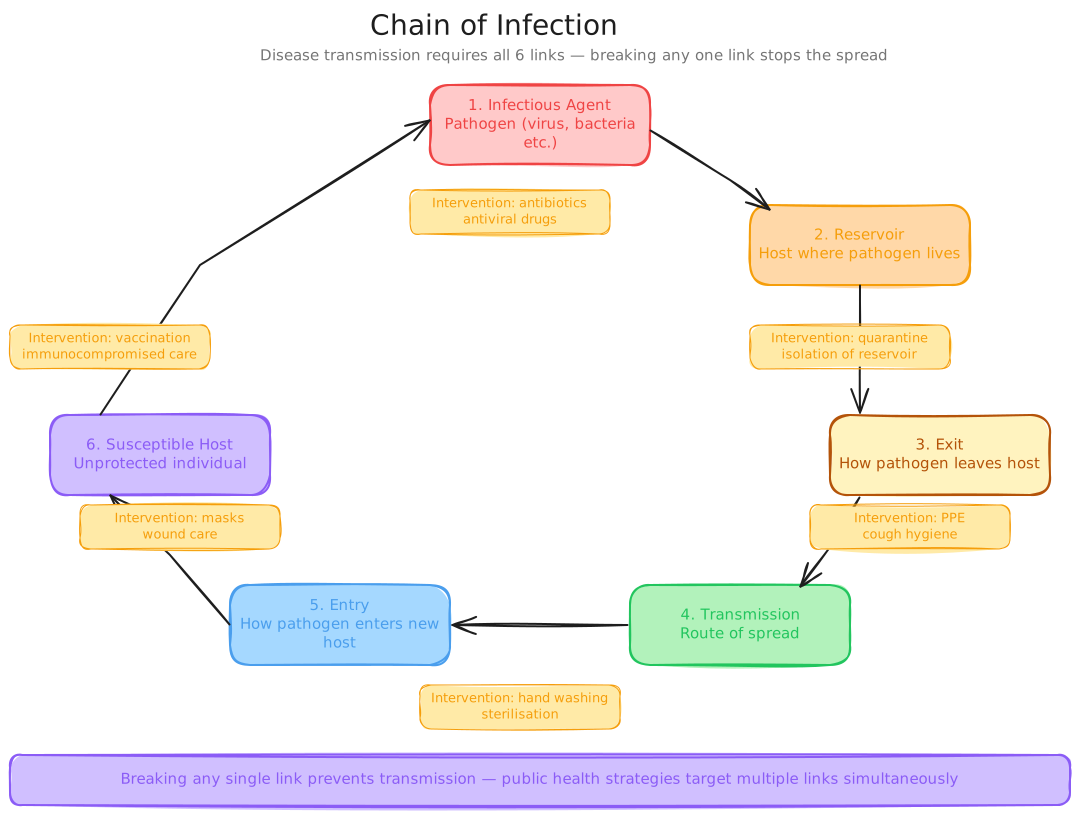
Chain of Infection — 6 Links
Hygiene · isolation/quarantine · contact tracing · surveillance · sanitation
Each strategy interrupts the chain of infection at a specific point — and layering several together is far more powerful than any one alone.
Hygiene
Hygiene refers to practices that reduce the transmission of pathogens between individuals or from environmental sources. It is the most broadly effective and cost-efficient public health intervention — Semmelweis's handwashing data demonstrated this in 1847, decades before anyone understood how germs caused disease.
Quarantine and Isolation
These terms are often confused but refer to distinct measures targeting different populations.
| Term | Applied To | Purpose | Example |
|---|---|---|---|
| Isolation | People who are confirmed infected and infectious | Prevent transmission from known cases to susceptible individuals | COVID-positive patient isolated at home or hospital; TB patient in negative-pressure room |
| Quarantine | People who have been exposed but are not yet known to be infected (incubation period) | Prevent potential transmission during the incubation period — before symptoms appear | Close contacts of Ebola case quarantined for 21 days; international travellers during pandemic |
| Cohorting | Groups of infected patients housed together | Reduce spread to uninfected patients while managing multiple cases with limited resources | COVID ward in hospital |
Contact Tracing
Contact tracing is the systematic identification and follow-up of individuals who may have been exposed to a confirmed case. It works by locating potential secondary cases during their incubation period — before they become infectious — and placing them in quarantine before they can transmit further. Effective contact tracing requires rapid case identification, thorough interviewing, timely notification, and resources to support quarantine.
Surveillance and Notification
Certain diseases are notifiable in Australia — healthcare providers are legally required to report confirmed or suspected cases to public health authorities. This creates a surveillance network that detects outbreaks early and triggers a public health response. Notifiable diseases include measles, tuberculosis, meningococcal disease, hepatitis A and B, and salmonellosis.
Sanitation and Safe Water
Access to safe drinking water and adequate sanitation has had a larger impact on infectious disease mortality than any medical intervention in history — including antibiotics and vaccines. The epidemiological transition that dramatically reduced deaths from typhoid, cholera, dysentery, and typhus in Europe and North America in the late 19th and early 20th centuries was driven primarily by clean water infrastructure and sewage systems, not by medicine.
What to write in your book
- Hygiene: soap disrupts membranes + physically removes pathogens (most cost-efficient measure)
- Isolation = confirmed cases; quarantine = exposed/unconfirmed (duration = max incubation)
- Contact tracing → quarantine contacts before they become infectious
- Sanitation/clean water = the single greatest historical reducer of infectious disease mortality
Quarantine (as opposed to isolation) is applied to people who are:
Error Spotting — Public Health Measures
Pattern B — Error Spotting
A student wrote the following passage about public health strategies. It contains four factual errors. Identify each, explain what is wrong, and write the correction.
- List the four errors in the passage.
- For each, write one sentence explaining what is wrong and what the correct information is.
- Rewrite the passage correctly in your own words.
In 1847, Ignaz Semmelweis was working at the Vienna General Hospital's maternity wards. He noticed a striking discrepancy: Ward 1, staffed by medical students and doctors who came directly from performing autopsies, had a maternal mortality rate of ~10%. Ward 2, staffed by midwives who did not perform autopsies, had a rate of ~4%. When his colleague Jakob Kolletschka died from a wound infection after a student's scalpel slipped during an autopsy, Semmelweis recognised the similarity between Kolletschka's symptoms and those of the dying mothers.
Semmelweis's story is not just a historical tragedy — it is a case study in how strong evidence can be rejected when it challenges professional identity and existing paradigms. You will analyse his data in Activity 1 and Short Answer Q3.
Hygiene Strategies
- Handwashing — breaks contact/faecal-oral/droplet transmission.
- Respiratory hygiene — reduces droplet/aerosol spread.
- Food safety — prevents foodborne pathogen multiplication.
- Clean water/sanitation — removes waterborne pathogens.
Isolation vs Quarantine
- Isolation: confirmed infected cases — prevents transmission from known cases.
- Quarantine: exposed but unconfirmed — prevents transmission during incubation.
- Duration = maximum incubation period of the disease.
Chain of Infection
- Infectious agent → Reservoir → Transmission → Portal of entry → Susceptible host.
- Break any link to prevent disease spread.
- Layered strategies break multiple links simultaneously.
Semmelweis Key Data
- Ward 1 (doctors from autopsies): ~10% mortality → ~1.27% after handwashing.
- Ward 2 (midwives, no autopsies): ~4% throughout.
- Rejected because it implied doctors caused deaths — professional identity barrier.
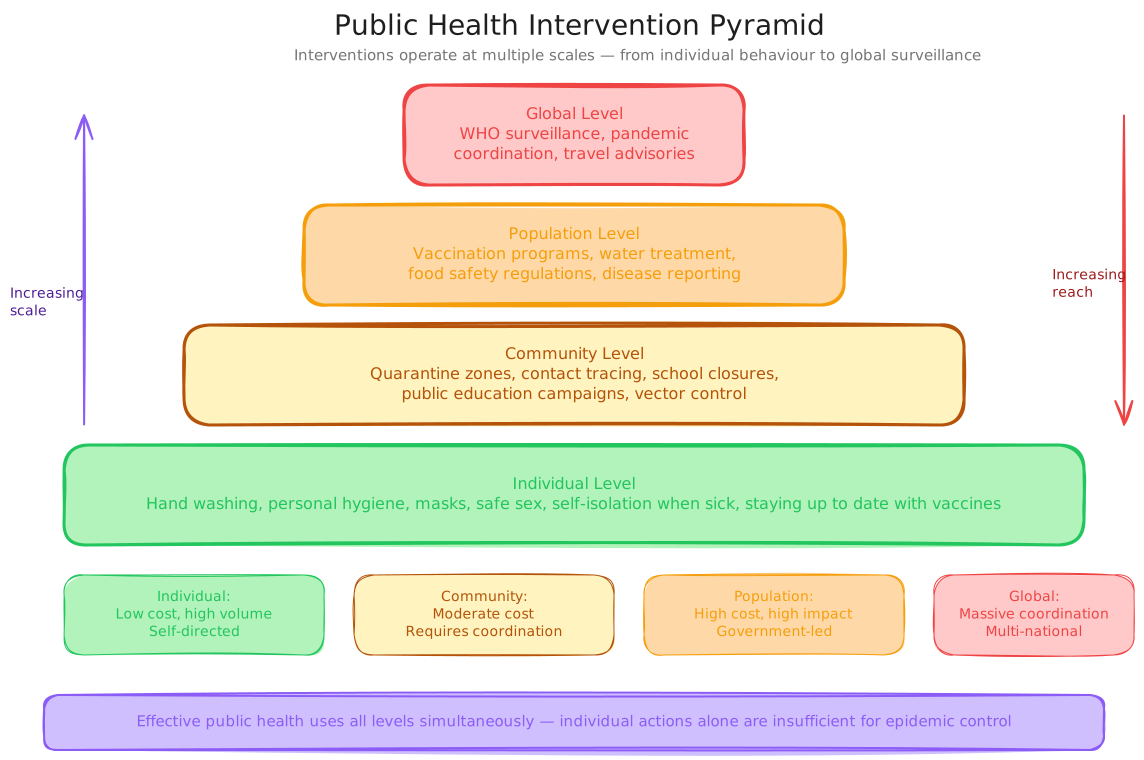
Public Health Intervention Pyramid
Disease Control Strategy — Decision Guide
A fresh set drawn from this lesson's question bank — feedback shown immediately. +5 XP per correct · +25 XP all correct
Pick your answer, then rate your confidence — that tells the system what to drill next.
ApplyBand 3(3 marks) 1. Describe two public health strategies that target different links in the chain of infection. For each, identify which link it targets, explain the mechanism by which it reduces transmission, and give a specific example.
1 mark: strategy 1 — link, mechanism, example · 1 mark: strategy 2 — different link, mechanism, example · 1 mark: explicit statement that the two target different links
UnderstandBand 4(3 marks) 2. Explain the difference between quarantine and isolation, including who each is applied to, the purpose of each, and why the duration of quarantine is specifically set to match the incubation period of the disease.
1 mark: quarantine — exposed/unconfirmed · 1 mark: isolation — confirmed infectious · 1 mark: quarantine duration = maximum incubation
EvaluateBand 5(4 marks) 3. Using Semmelweis's handwashing data, evaluate the effectiveness of hygiene as a public health strategy. In your answer, describe the evidence Semmelweis presented, explain why it was initially rejected, and assess what it demonstrates about the relationship between hygiene and infectious disease control.
1 mark: evidence (Ward 1 ~9.5%→~1.27%; vs Ward 2) · 1 mark: rejection reason (professional identity / miasma / no mechanism) · 1 mark: assessment — dramatic reduction; predated germ theory · 1 mark: broader implication (sanitation/hygiene historically more impactful)
Show all answers
Multiple choice
MC answers and full explanations are shown inline as you complete each question. Use the retry button to attempt a fresh set from the lesson bank.
Short Answer Model Answers
Q1 (3 marks): Strategy 1 — Clean water supply and sewage treatment target the reservoir link. The reservoir for waterborne diseases such as cholera (Vibrio cholerae) and typhoid is contaminated water — both source and vehicle of transmission. By treating drinking water (chlorination, filtration, UV) and safely disposing of sewage away from water supplies, the pathogen is removed from the reservoir before it can reach susceptible hosts, regardless of their immune status. Strategy 2 — Handwashing with soap targets the transmission link. Soap disrupts the lipid membranes of enveloped pathogens and the mechanical action physically removes pathogen particles from the skin, interrupting hand-to-mouth, hand-to-surface, and direct contact transmission — for example, preventing faecal-oral transmission of rotavirus. These two strategies target different links: clean water acts on the environmental reservoir, while handwashing acts on the transmission route.
Q2 (3 marks): Quarantine is applied to individuals who have been exposed to a confirmed case but are not yet known to be infected. Its purpose is to prevent potential transmission during the incubation period — when an individual may not yet show symptoms but could already transmit the pathogen. Isolation is applied to individuals confirmed to be infected and infectious; its purpose is to prevent transmission from known cases to susceptible individuals. The key distinction is certainty of infection: quarantine manages uncertainty (might be infected), isolation manages confirmed risk (is infected). Quarantine duration is set to match the maximum incubation period because if a quarantined person has not developed symptoms by the end of the maximum incubation period, it is very unlikely they are infected; releasing them earlier risks releasing a person still in the pre-symptomatic phase who may become infectious after release.
Q3 (4 marks): Semmelweis's evidence was quantitative and systematic: he compared maternal mortality in two wards of the same hospital over years. Ward 1 (medical students/doctors coming from autopsies) had mortality of ~6–11%; Ward 2 (midwives, no autopsies) had ~2–4%. After he introduced chlorinated lime handwashing in May 1847, Ward 1 mortality fell from ~9.5% (Jan–May 1847) to 1.27% (Jun–Dec 1847) — an ~87% reduction — and stayed below 2%. Despite this, the findings were rejected for reasons unrelated to data quality: accepting them meant accepting that doctors were transmitting lethal infection from autopsied bodies to patients, an intolerable challenge to professional identity; and Semmelweis had no mechanism compatible with the prevailing miasma theory (germ theory came later). The data demonstrates that hygiene — interrupting transmission via contaminated hands — is a highly effective, independently powerful intervention that predated microbiology by ~20 years. More broadly, it illustrates the historical pattern that sanitation, clean water, and hygiene reduced infectious disease mortality more dramatically than specific medical interventions; the great mortality declines from cholera, typhoid, and dysentery largely preceded effective antibiotics or vaccines.
Five timed questions on hygiene, quarantine, and public health. Beat the boss to bank a tier — gold (perfect + fast), silver (80%+), or bronze (cleared).
⚔ Enter the arenaClimb platforms, hit checkpoints, and answer quick-recall questions on this lesson. Lighter than the boss — pure recall practice.
You were asked to predict three non-pharmaceutical, non-vaccine public health measures and explain their transmission-interruption mechanisms.
The strongest candidates from history: clean water and sanitation (eliminated cholera and typhoid in Europe — far more lives saved than any antibiotic), handwashing (Semmelweis; dramatically reduced maternal mortality), food safety regulations (eliminated most foodborne outbreak chains at source), and respiratory hygiene (mask use, covering coughs — reduces droplet transmission of influenza, TB, COVID-19).
If you predicted handwashing — the data speaks for itself. If you predicted quarantine or isolation — correct, but note these manage cases and contacts rather than the environmental reservoir. If you predicted clean water — this is arguably the single greatest public health intervention in human history.
The key insight this lesson: most of the dramatic gains in life expectancy over the last 150 years came not from medicine, but from engineering — pipes, drains, and water treatment. Medicine then accelerated gains that infrastructure had started. The chain of infection framework explains why: removing the reservoir (clean water) permanently breaks transmission, regardless of individual immunity.