Biology • Year 12 • Module 7 • Lesson 15
Hygiene, Quarantine and Public Health
Lock in the core vocabulary: chain of infection, the distinction between quarantine and isolation, hygiene mechanisms, and the role of sanitation in historical mortality reduction.
1. Label the chain of infection diagram
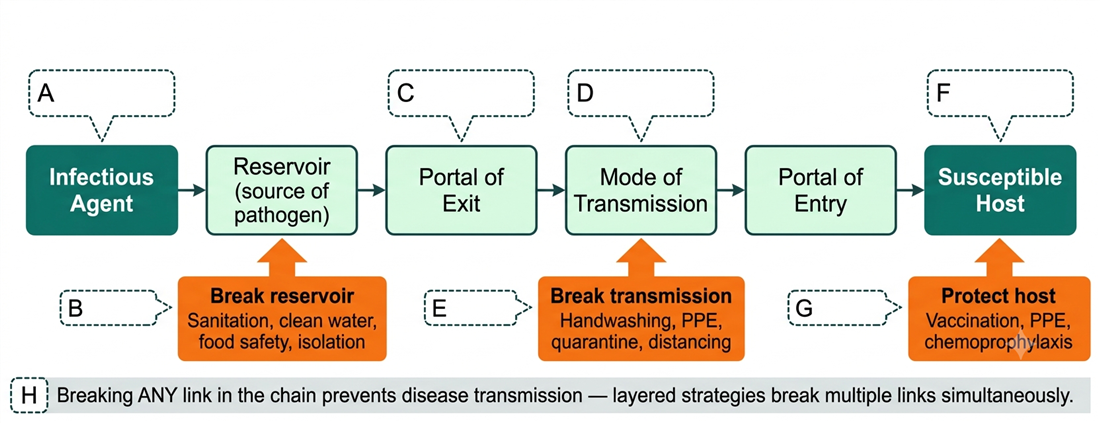
The diagram below shows the six links in the chain of infection and three intervention points where public health strategies can break the chain. Write the missing labels into boxes A–H. Use terms from the lesson's Key Terms or lesson content. 8 marks
| Box | Your label |
|---|---|
| A | |
| B | |
| C | |
| D | |
| E | |
| F | |
| G | |
| H |
2. Term–definition match
The ten definitions below are shuffled. In the right-hand column write the matching term from this list: hygiene, isolation, quarantine, contact tracing, notifiable disease, chain of infection, sanitation, cohorting, incubation period, layered defence. 10 marks
| # | Definition (shuffled) | Matching term |
|---|---|---|
| 2.1 | Separating confirmed infectious cases from susceptible individuals to prevent disease transmission. | |
| 2.2 | The sequence of linked steps — from infectious agent through to susceptible host — that must all be connected for disease to spread. | |
| 2.3 | Identifying and following up people who may have been exposed to a confirmed case during their incubation period. | |
| 2.4 | Safe disposal of waste, particularly sewage, and management of water supply to prevent pathogen contamination. | |
| 2.5 | Using multiple overlapping public health strategies simultaneously so that if one fails, others still block transmission. | |
| 2.6 | A disease that healthcare providers are legally required to report to public health authorities. | |
| 2.7 | Separating exposed but unconfirmed individuals during the incubation period before infection is confirmed. | |
| 2.8 | Practices that reduce the transmission of pathogens through hands, surfaces, food, water or respiratory droplets. | |
| 2.9 | Grouping confirmed infected patients together to limit spread to uninfected patients when managing multiple cases. | |
| 2.10 | The period between exposure to a pathogen and the appearance of symptoms, during which a person may or may not be infectious. |
3. True or false — with correction
For each statement, circle T or F. If false, write the corrected version on the line below. 10 marks (1 T/F, 1 correction where needed)
3.1 Quarantine is applied to individuals who are confirmed to be infected and infectious. T / F
3.2 Alcohol-based hand sanitiser is always more effective than soap and water for removing all types of pathogens. T / F
3.3 The duration of quarantine is set to match the maximum incubation period of the disease. T / F
3.4 The primary driver of reduced infectious disease mortality in 19th-century Europe was the development of antibiotics. T / F
3.5 Contact tracing places identified contacts in quarantine — not isolation — because they are not yet confirmed cases. T / F
4. Function recall
Answer each in 1–2 sentences using precise lesson terms. 8 marks (2 each)
4.1 What is the function of handwashing with soap in interrupting the chain of infection? Include the mechanism.
4.2 What is the function of quarantine in an outbreak, and which link in the chain does it target?
4.3 What is the function of notifiable disease reporting in a public health surveillance system?
4.4 What is the function of clean water and sewage treatment in reducing infectious disease mortality — and why did this have a larger historical impact than antibiotics?
5. Build a concept map
Draw labelled arrows between the six terms below to show how they are connected. Each arrow must carry a linking phrase (e.g. "breaks", "targets", "detects", "reduces"). Aim for at least 6 labelled arrows. 6 marks
Supplied terms: chain of infection • quarantine • isolation • contact tracing • sanitation • infectious disease transmission.
Q1 — Labelled diagram
A: Infectious Agent (pathogen — e.g. bacterium, virus, fungus). B: Break the reservoir — sanitation, clean water, food safety, isolation of confirmed cases. C: Portal of Exit (the route a pathogen leaves the reservoir/host — e.g. respiratory droplet, faeces, blood). D: Mode of Transmission (how the pathogen travels — direct contact, droplet, airborne, faecal-oral, vector). E: Break the transmission link — handwashing with soap, PPE, physical distancing, quarantine. F: Susceptible Host (an individual with no or incomplete immunity who can become infected). G: Protect the host — vaccination, chemoprophylaxis, PPE. H: Breaking any single link in the chain prevents disease transmission (or: "layered strategies break multiple links simultaneously").
Q2 — Term–definition matches
2.1 isolation • 2.2 chain of infection • 2.3 contact tracing • 2.4 sanitation • 2.5 layered defence • 2.6 notifiable disease • 2.7 quarantine • 2.8 hygiene • 2.9 cohorting • 2.10 incubation period.
Q3 — True / false with correction
3.1 False. Correction: quarantine is applied to exposed but unconfirmed individuals during the incubation period. Isolation is applied to confirmed infectious cases.
3.2 False. Correction: soap and water is superior for pathogens such as Clostridioides difficile (C. diff — spores are alcohol-resistant) and norovirus. Sanitiser is not effective against these organisms. For visibly soiled hands, soap and water is always required.
3.3 True.
3.4 False. Correction: the primary driver was improved sanitation — clean water supply and sewage disposal — which dramatically reduced deaths from cholera, typhoid and dysentery. Antibiotics were not widely available until the 1940s, well after the largest mortality reductions had occurred.
3.5 True.
Q4.1 — Function of handwashing
Handwashing with soap targets the transmission link in the chain of infection. Soap disrupts the lipid membranes of enveloped viruses and some bacteria, and the mechanical action of rubbing and rinsing physically removes pathogens from skin surfaces, preventing them from reaching portals of entry (e.g. mouth, nose, eyes).
Q4.2 — Function of quarantine
Quarantine separates exposed individuals during their incubation period — before infection is confirmed and before they may become infectious — targeting the mode of transmission link. By isolating potential cases before symptoms appear, quarantine prevents pre-symptomatic or asymptomatic transmission to susceptible hosts.
Q4.3 — Function of notifiable disease reporting
Mandatory reporting of notifiable diseases (e.g. measles, tuberculosis, meningococcal disease in Australia) creates a surveillance network that detects outbreaks early, before they become large. This triggers a rapid public health response — contact tracing, quarantine, vaccination campaigns — while case numbers are still small and manageable.
Q4.4 — Function of clean water and sanitation; historical impact
Clean water and sewage treatment target the reservoir link, permanently removing waterborne pathogens such as Vibrio cholerae (cholera) and Salmonella typhi (typhoid) from the water supply. This permanently breaks the chain before any individual immunity is needed. Antibiotics require the chain to proceed all the way to the susceptible host before they act; removing the reservoir stops transmission at source for everyone simultaneously — which is why sanitation reduced population-level mortality far more rapidly and broadly than antibiotic treatment could.
Q5 — Sample concept map
Minimum arrows for full marks:
- chain of infection — enables → infectious disease transmission (when all links are connected)
- sanitation — breaks the reservoir link of → chain of infection
- sanitation — reduces → infectious disease transmission
- contact tracing — identifies contacts, leading to → quarantine
- quarantine — if infection confirmed, transitions to → isolation
- isolation — breaks the transmission link of → chain of infection
Any biologically valid linking phrases are accepted. Award 1 mark per correctly labelled arrow that respects causal direction (max 6).