Vaccination — Active and Passive Immunity
In 1955, Jonas Salk announced a working polio vaccine. Within two years, polio cases in the US dropped by 85–90%. A disease that had paralysed hundreds of thousands of children per year — including a future US president — was being dismantled by a syringe. This lesson is about how that is possible, and why it sometimes isn't.
Practise this lesson
Four printable worksheets that build from the foundations up to exam-style questions — start at whatever level suits you.
In 1952, the United States recorded 57,879 polio cases — the worst outbreak in American history. Children were placed in iron lungs to breathe. Pools, cinemas, and libraries closed every summer in fear. By 1961, cases had fallen to 161.
Before reading: what do you think a successful mass vaccination program actually does to a disease at the population level — not just the individual level? How does vaccinating individuals change the fate of the pathogen itself?
Know
- The distinction between active and passive immunity
- Natural vs artificial forms of each
- How herd immunity works and the thresholds for common diseases
- Why vaccination programs sometimes fail to achieve eradication
Understand
- Why herd immunity protects those who cannot be vaccinated
- Why vaccine hesitancy undermines herd immunity at the population level
- The difference between elimination, eradication, and control
Can Do
- Classify types of immunity using a two-axis framework
- Evaluate the effectiveness of vaccination programs using data
- Explain herd immunity threshold calculations
Core Content
Natural vs artificial × active vs passive
Immunity is classified along two axes: how it was acquired (natural or artificial) and what type it is (active or passive) — and exam questions frequently test correct classification.
The two-axis framework — always classify immunity by both axes: active vs passive, AND natural vs artificial
What to write in your book
- Active = own immune response → memory; slow onset; long-lasting
- Passive = pre-formed antibodies transferred; immediate; no memory; temporary
- Natural active = infection; Artificial active = vaccine
- Natural passive = maternal antibodies; Artificial passive = antivenom/immunoglobulin
Receiving pre-formed antibodies as an injection (e.g. antivenom) provides which type of immunity?
Annotated Diagram — The Four Types of Immunity
Pattern A — Draw and Annotate
In your book, draw and annotate a diagram showing all four types of immunity using the two-axis framework (active/passive × natural/artificial). For each quadrant:
- Name the type of immunity.
- Give one specific example.
- State whether memory cells are formed.
- State the approximate duration of protection.
- Identify one situation where this type of immunity would be the most appropriate protection strategy.
Breaking transmission chains by coverage
When enough individuals are immune, transmission chains break — even susceptible individuals are protected because the pathogen cannot find enough hosts to spread.
Herd immunity protects unvaccinated individuals by surrounding them with immune people — the pathogen cannot find a transmission chain
Herd Immunity Thresholds
The proportion of a population that must be immune to achieve herd immunity depends on the pathogen's basic reproduction number (R₀) — the average number of people one infected person infects in a fully susceptible population. The higher the R₀, the higher the immunity threshold required.
| Disease | R₀ (approx.) | Herd Immunity Threshold | Status |
|---|---|---|---|
| Measles | 12–18 | ~95% | Eliminated in many countries; outbreaks where coverage drops |
| Polio | 5–7 | ~80–85% | Near-eradicated globally; endemic in Pakistan and Afghanistan |
| Smallpox | 5–7 | ~80–85% | Eradicated 1980 |
| COVID-19 (original strain) | 2–3 | ~50–67% | Threshold raised by variants with higher R₀ |
| Influenza (seasonal) | 2–3 | ~50–67% | Annual vaccination required due to antigenic variation |
| Pertussis (whooping cough) | 12–17 | ~92–94% | Resurgent in populations with declining booster rates |
What to write in your book
- Herd immunity = enough immune individuals to break transmission chains
- Threshold = 1 − (1/R₀); higher R₀ → higher threshold
- Measles R₀ 12–18 → ~95%; polio R₀ 5–7 → ~80–85%
- Protects those who can't be vaccinated (newborns, immunocompromised)
The herd immunity threshold is calculated as 1 − (1/R₀), where R₀ is the basic _____ number.
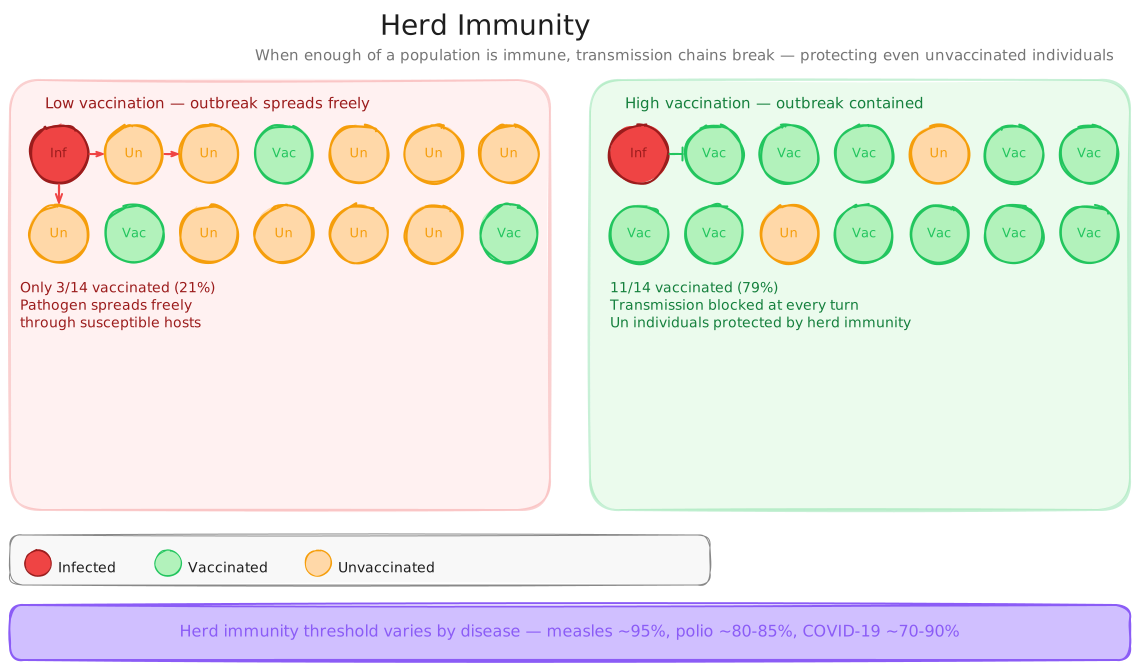
Herd Immunity Population Diagram
Control · elimination · eradication
Vaccination programs can achieve three levels of disease control, depending on coverage, vaccine effectiveness, and pathogen characteristics.
Control
Elimination
Eradication
Why Some Diseases Cannot Be Eradicated
Eradication is extraordinarily difficult. The conditions that allowed smallpox eradication were almost uniquely favourable: no animal reservoir, obvious visible symptoms, a stable highly effective vaccine, and a virus that did not mutate rapidly. Diseases that resist eradication typically have one or more of the following features:
- Animal reservoirs: Influenza circulates in birds and pigs; even if humans were fully immune, the virus would survive in animal populations and re-emerge (zoonotic re-introduction)
- Rapid antigenic variation: HIV and influenza mutate fast enough that existing immunity does not prevent new strains
- Long asymptomatic period: HIV-infected individuals may not know they are infected and can unknowingly transmit for years
- Geopolitical barriers: Polio persists in regions where vaccination campaigns are impeded by conflict, distrust, or logistical collapse
- Vaccine limitations: Some vaccines (e.g. current influenza vaccines) provide imperfect or short-lived immunity, requiring annual re-vaccination
What to write in your book
- Control: reduced incidence; disease still present
- Elimination: zero cases in a defined area; pathogen still elsewhere
- Eradication: permanent global zero — only smallpox achieved (1980)
- Barriers to eradication: animal reservoirs, antigenic variation, asymptomatic spread, geopolitics
Smallpox is the only human disease ever:
Data Analysis — Measles Cases and Vaccination Coverage
Pattern A — Structured Data Analysis
The table below shows measles vaccination coverage and annual case numbers in a hypothetical country over 15 years.
| Year | Vaccination coverage (%) | Measles cases (annual) |
|---|---|---|
| 1 | 55 | 8,200 |
| 3 | 68 | 4,400 |
| 5 | 80 | 1,100 |
| 7 | 88 | 310 |
| 9 | 95 | 12 |
| 11 | 97 | 3 |
| 12 | 91 | 480 |
| 13 | 89 | 1,240 |
| 14 | 93 | 210 |
| 15 | 96 | 8 |
- Describe the trend in measles cases between Years 1 and 11. What does this suggest about the effectiveness of the vaccination program during this period?
- Between Years 11 and 13, vaccination coverage dropped from 97% to 89% and cases rose from 3 to 1,240. Explain why a drop of only 8 percentage points in coverage produced such a dramatic increase in cases, referring to the concept of herd immunity threshold.
- The measles herd immunity threshold is approximately 95%. Using Years 9–11 (coverage ≥95%) and Years 12–13 (coverage 89–91%), explain how crossing this threshold in either direction affects disease transmission.
- By Year 15, coverage had recovered to 96% and cases fell to 8. Has the country achieved elimination? Justify your answer using the definition of elimination and the data provided.
- A government advisor suggests discontinuing the measles vaccination program once coverage consistently reaches 97% for three years. Evaluate this recommendation.
Polio was one of the most feared diseases of the 20th century — largely because it preferentially struck children, was highly visible (iron lungs, leg braces, wheelchairs), and had no effective treatment. Franklin D. Roosevelt, who contracted polio in 1921, co-founded the National Foundation for Infantile Paralysis in 1938 — later renamed the March of Dimes after comedian Eddie Cantor suggested Americans send their dimes directly to the White House. The campaign raised millions for research and directly funded Jonas Salk's work on an inactivated polio vaccine. On April 12, 1955 — exactly ten years after Roosevelt's death — Salk's vaccine was declared "safe, effective, and potent." Americans wept in the streets. Church bells rang. Within two years, polio cases dropped by 85–90%. By 1961, Albert Sabin's oral attenuated vaccine was licensed — easier to administer globally. Polio has since been eliminated from every country except Pakistan and Afghanistan, where vaccination campaigns continue despite security challenges.
The gap between 350,000 cases per year and fewer than 20 is a direct measure of what sustained vaccination programs achieve at the population level. You will evaluate vaccination program effectiveness using data in Activity 2 and Short Answer Q3.
Active vs Passive Immunity
- Active: own immune response → memory formed; slow onset; long-lasting.
- Passive: pre-formed antibodies transferred; immediate; no memory; temporary.
- Natural active = infection. Artificial active = vaccine.
- Natural passive = maternal antibodies. Artificial passive = antivenom/Ig.
Herd Immunity
- When enough immune individuals break transmission chains.
- Threshold = 1 − (1/R₀).
- Higher R₀ → higher threshold (measles: 95%; polio: 80–85%).
- Protects those who cannot be vaccinated (newborns, immunocompromised).
Levels of Disease Control
- Control: reduced incidence; disease still present.
- Elimination: zero cases in a defined area; pathogen still elsewhere.
- Eradication: permanent global zero — only smallpox achieved.
Why Eradication Is Difficult
- Animal reservoirs (influenza in birds/pigs).
- Rapid antigenic variation (HIV, influenza).
- Asymptomatic transmission (HIV, polio).
- Geopolitical barriers (polio in Pakistan/Afghanistan).
Herd Immunity — High vs Low Coverage
A fresh set drawn from this lesson's question bank — feedback shown immediately. +5 XP per correct · +25 XP all correct
Pick your answer, then rate your confidence — that tells the system what to drill next.
UnderstandBand 3(3 marks) 1. Using two specific examples, explain the difference between natural passive immunity and artificial passive immunity. For each, describe how the antibodies are acquired and explain why protection is temporary.
1 mark: natural passive — example and mechanism · 1 mark: artificial passive — example and mechanism · 1 mark: why both are temporary (no memory cells; antibodies catabolised)
UnderstandBand 4(3 marks) 2. Explain the concept of herd immunity, including how the herd immunity threshold is determined and why it differs between diseases. Use measles and polio as examples.
1 mark: herd immunity defined · 1 mark: threshold determined by R₀ (1 − 1/R₀) · 1 mark: measles vs polio comparison
EvaluateBand 5(4 marks) 3. Evaluate the effectiveness of global polio vaccination programs, referring to the historical reduction in cases, the current status of eradication efforts, and the barriers that have prevented complete eradication.
1 mark: quantitative evidence (350,000/year in 1988 → <20 now) · 1 mark: current status (endemic only Pakistan/Afghanistan) · 1 mark: barriers (conflict, distrust, logistics — not vaccine failure) · 1 mark: overall evaluative conclusion
Show all answers
Multiple choice
MC answers and full explanations are shown inline as you complete each question. Use the retry button to attempt a fresh set from the lesson bank.
Short Answer Model Answers
Q1 (3 marks): Natural passive immunity occurs when pre-formed antibodies are transferred from one individual to another through a natural biological process — without medical intervention and without the recipient's immune system being activated. An example is the transfer of IgG antibodies from a pregnant mother to her foetus across the placenta during the third trimester, protecting the newborn before its own immune system matures. Artificial passive immunity occurs when pre-formed antibodies are deliberately administered through a medical procedure. An example is antivenom — antibodies produced in horses or sheep exposed to snake venom; when injected into a snakebite victim, they immediately neutralise circulating toxins. Both are temporary because in neither case does the recipient's immune system mount its own response — no clonal selection, no plasma cells, no memory B or T cells. The transferred antibodies are gradually catabolised over weeks to months, and protection fades as their concentration declines.
Q2 (3 marks): Herd immunity occurs when a sufficient proportion of a population is immune (through vaccination or prior infection) that the pathogen cannot find enough susceptible hosts to sustain transmission chains — protecting even non-immune individuals indirectly. The threshold is determined by the basic reproduction number (R₀): threshold = 1 − 1/R₀. A higher R₀ means each infected person infects more people, so a larger proportion must be immune. Measles has an R₀ of 12–18, giving a threshold of ~93–95% — one of the highest of any human pathogen. Polio has an R₀ of 5–7, giving a threshold of ~80–85%. This is why measles outbreaks occur rapidly when coverage drops even a few percent, while polio can be controlled at lower coverage levels.
Q3 (4 marks): The global polio vaccination program (WHO Global Polio Eradication Initiative, launched 1988) has been one of the most successful public health interventions in history. In 1988 polio was endemic in 125 countries and paralysed ~350,000 children per year; by 2024 wild poliovirus type 1 is endemic in only Pakistan and Afghanistan, with fewer than 20 cases globally — a reduction of more than 99.9%. Multiple regions have been certified polio-free (Americas 1994, Western Pacific including Australia 2000, India 2014). The barriers preventing complete eradication are non-biological: armed conflict disrupts campaigns and displaces populations; misinformation (e.g. false sterilisation claims) generates distrust; vaccination workers have been attacked. The vaccine itself is effective, there is no animal reservoir, and the virus does not mutate fast enough to escape immunity. Overall, the program represents an extraordinary success — the final 0.1% is a governance and security challenge, not an immunological one.
Five timed questions on active/passive immunity and herd immunity. Beat the boss to bank a tier — gold (perfect + fast), silver (80%+), or bronze (cleared).
⚔ Enter the arenaClimb platforms, hit checkpoints, and answer quick-recall questions on this lesson. Lighter than the boss — pure recall practice.
You were asked what a successful mass vaccination program actually does to a disease at the population level — and how vaccinating individuals changes the fate of the pathogen itself.
The answer: vaccination changes the proportion of susceptible individuals in the population. Below the herd immunity threshold, the pathogen can find enough susceptible hosts to sustain transmission — each infected person, on average, infects at least one other. Above the threshold, transmission chains break — infected individuals are increasingly surrounded by immune people who cannot be infected, and the chain dies out. The pathogen's "reproductive rate" effectively falls below 1.
As vaccination coverage rises through the threshold, the effect on case numbers is non-linear — a small increase in coverage near the threshold produces a disproportionately large reduction in cases. This is why the measles data in Activity 2 shows dramatic drops near the 95% threshold. And it explains why small drops in coverage below the threshold produce rapid outbreaks — the pathogen's effective reproduction number crosses back above 1.
If you predicted "fewer people get sick" — correct at the individual level. The population-level insight is that the pathogen's ability to persist depends entirely on finding susceptible hosts. Enough immunity in a population and the virus simply runs out of places to go.