Biology • Year 12 • Module 7 • Lesson 14
Vaccination — Active and Passive Immunity
Lock in the two-axis immunity framework, the key vocabulary, and the core distinctions between active and passive, natural and artificial immunity.
1. Label the immunity classification diagram
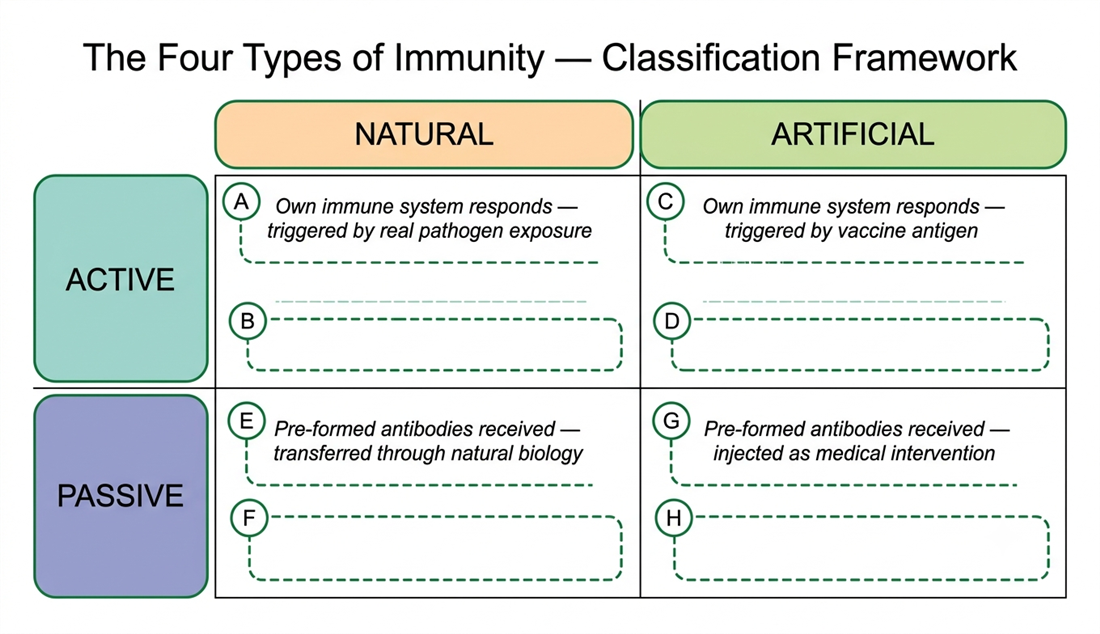
The diagram below shows the two-axis framework used to classify all four types of immunity. Write the correct label for each callout box A–H. Draw on the lesson’s Key Terms and the comparison table. 8 marks
| Box | Your label |
|---|---|
| A | |
| B | |
| C | |
| D | |
| E | |
| F | |
| G | |
| H |
2. Term–definition match
The ten definitions below are shuffled. In the right-hand column write the matching term from this list: active immunity, passive immunity, artificial active immunity, natural active immunity, artificial passive immunity, natural passive immunity, herd immunity, eradication, elimination, basic reproduction number (R&sub0;). 10 marks
| # | Definition (shuffled) | Matching term |
|---|---|---|
| 2.1 | Permanent global reduction of a disease to zero — the pathogen no longer exists in nature. | |
| 2.2 | Immunity produced when the body’s own immune system responds to an antigen, forming memory cells; long-lasting. | |
| 2.3 | The average number of secondary infections produced by one infected person in a fully susceptible population. | |
| 2.4 | Immunity gained when pre-formed antibodies from maternal sources pass to the infant via the placenta or breast milk. | |
| 2.5 | Population-level protection in which enough individuals are immune to break transmission chains, protecting even susceptible people. | |
| 2.6 | Immunity acquired when a person contracts and survives an infection, generating memory cells through natural exposure. | |
| 2.7 | Temporary immunity gained when pre-formed antibodies are injected from an external source (e.g. antivenom, immunoglobulin). | |
| 2.8 | Reduction of disease incidence to zero in a defined geographic area, but the pathogen still exists elsewhere globally. | |
| 2.9 | Immunity produced when vaccination introduces antigens that trigger the body’s own clonal selection and memory-cell formation. | |
| 2.10 | Temporary immunity resulting from receipt of pre-formed antibodies from another organism, without activating the recipient’s lymphocytes. |
3. True or false — with correction
For each statement, circle T or F. If the statement is false, write the corrected version on the line provided. 10 marks (1 for T/F, 1 for correction where needed)
3.1 Passive immunity provides immediate protection because pre-formed antibodies are already present. T / F
3.2 Passive immunity produces long-lasting protection because the transferred antibodies stimulate the formation of memory B cells. T / F
3.3 A child receiving the MMR (measles, mumps, rubella) vaccine develops artificial active immunity. T / F
3.4 Herd immunity means every individual in a population must be vaccinated in order to stop disease transmission. T / F
3.5 Measles requires a higher herd immunity threshold than polio because measles has a higher R&sub0; value. T / F
4. Function recall
Answer each question in 1–2 sentences using precise terms from the lesson. 10 marks (2 each)
4.1 What is the function of memory B cells in active immunity when the same antigen is encountered a second time?
4.2 What is the function of antivenom as a form of artificial passive immunity in a snakebite victim?
4.3 What is the function of maternal IgG antibodies transferred across the placenta to a developing foetus?
4.4 What is the function of the herd immunity threshold as a public health target in a vaccination program?
4.5 What is the function of vaccination programs beyond protecting the individuals who receive the vaccine?
5. Fill in the blanks
Complete the paragraph using the word bank below. Each word is used once. 8 marks
When a person is vaccinated, they develop immunity because their own immune system mounts a response. The vaccine introduces — molecules that trigger clonal selection — without causing disease. The resulting cells persist for years or decades, enabling a rapid secondary response if the real pathogen is encountered. By contrast, a newborn receives passive immunity when maternal antibodies cross the placenta. This protection is because the infant’s own immune system was never activated and no memory cells were formed. The transferred antibodies are gradually broken down over a period of weeks to months. At the population level, high vaccination coverage can achieve immunity, in which transmission chains break and even unvaccinated individuals gain indirect protection. The minimum proportion of the population that must be immune to achieve this is called the herd immunity , which is determined by the pathogen’s R&sub0; value.
Word bank:
antigens · artificial active · herd · IgG · memory · natural · temporary · threshold
6. Build a concept map
Draw labelled arrows between the six terms below to show how they connect. Each arrow must carry a linking phrase (e.g. “triggers formation of”, “is determined by”, “protects against”). Aim for at least 6 labelled arrows. 6 marks
Supplied terms: vaccination · memory cells · herd immunity · R&sub0; · herd immunity threshold · susceptible individuals.
Q1 — Labelled diagram
A: Natural Active. B: e.g. Contracting and recovering from chickenpox (varicella-zoster infection). C: Artificial Active. D: e.g. MMR vaccine, polio (Salk/Sabin) vaccine, influenza vaccine. E: Natural Passive. F: e.g. Maternal IgG antibodies crossing the placenta; IgA in breast milk. G: Artificial Passive. H: e.g. Antivenom for snakebite; immunoglobulin injection (e.g. anti-D in pregnancy, IVIG therapy).
Q2 — Term–definition matches
2.1 eradication • 2.2 active immunity • 2.3 basic reproduction number (R&sub0;) • 2.4 natural passive immunity • 2.5 herd immunity • 2.6 natural active immunity • 2.7 artificial passive immunity • 2.8 elimination • 2.9 artificial active immunity • 2.10 passive immunity.
Q3 — True / false with correction
3.1 True. Pre-formed antibodies are already present when received, so protection is immediate (unlike active immunity, which requires days to weeks for primary response).
3.2 False. Correction: Passive immunity is temporary, not long-lasting. The recipient’s own lymphocytes are not activated, so no memory B or T cells are formed. The transferred antibodies are catabolised over weeks to months, and protection fades as their concentration falls.
3.3 True. The MMR vaccine introduces attenuated viral antigens that trigger the recipient’s own clonal selection and memory-cell formation — this is the definition of artificial active immunity.
3.4 False. Correction: Herd immunity does not require universal vaccination. It requires that a sufficient proportion of the population is immune (the herd immunity threshold) such that transmission chains break, indirectly protecting susceptible individuals who cannot be vaccinated.
3.5 True. Measles R&sub0; ≈ 12–18 (threshold ~95%); polio R&sub0; ≈ 5–7 (threshold ~80–85%). Higher R&sub0; means more secondary cases per infected person, so more of the population must be immune to prevent sustained spread.
Q4.1 — Function of memory B cells
Memory B cells generated during the primary immune response persist in the body long-term. On re-exposure to the same antigen, they rapidly proliferate and differentiate into plasma cells without needing a full primary response — producing a faster, larger secondary antibody response that clears the pathogen before disease symptoms can develop.
Q4.2 — Function of antivenom
Antivenom contains pre-formed antibodies (produced by immunising horses or sheep with sub-lethal doses of venom) that immediately neutralise circulating venom toxins in the snakebite victim’s bloodstream. This provides immediate protection without requiring the patient’s own immune system to generate antibodies — which would be too slow to prevent tissue damage or death.
Q4.3 — Function of maternal IgG antibodies
Maternal IgG antibodies transferred across the placenta protect the newborn during the critical early months when its own adaptive immune system is immature and has not yet been exposed to pathogens. They provide a “bridge” of passive immunity against diseases the mother has encountered (through infection or vaccination) until the infant begins developing its own immune responses.
Q4.4 — Function of the herd immunity threshold
The herd immunity threshold is the minimum proportion of a population that must be immune for transmission chains to break spontaneously — i.e. for the pathogen’s effective reproduction number to fall below 1. Public health programs use this threshold as a vaccination coverage target: once coverage exceeds the threshold, the pathogen cannot sustain itself in the population even in the presence of some susceptible individuals.
Q4.5 — Function of vaccination beyond the individual
Beyond protecting vaccinated individuals, high vaccination coverage contributes to herd immunity, which indirectly protects people who cannot safely receive vaccines — including newborns too young to be vaccinated, immunocompromised individuals whose immune systems cannot mount a full response to vaccination, and people with medical contraindications. Sustained vaccination coverage also reduces overall pathogen circulation, working toward elimination or, where conditions allow, global eradication.
Q5 — Cloze answers (in order)
artificial active • antigens • memory • natural • IgG • temporary • herd • threshold
Q6 — Sample concept map
A correct map should include arrows such as:
- vaccination — triggers formation of → memory cells
- vaccination — raises proportion of immune individuals, contributing to → herd immunity
- memory cells — enable rapid response that reduces → susceptible individuals
- herd immunity — indirectly protects → susceptible individuals
- R₀ — determines the value of → herd immunity threshold
- herd immunity threshold — is the vaccination coverage needed to achieve → herd immunity
Any biologically valid linking phrases are accepted. Award full marks for at least 6 correctly labelled arrows that respect causal direction.