Learning Goals
- Describe what valency means and how it relates to an atom's outer shell electrons.
- Explain how atoms form cations (positive ions) and anions (negative ions).
- Write correct ion symbols with superscript charges for common ions.
Warm Up
Label the diagram
Use the table below to record information about each atom or ion shown. Fill in the electron configuration and charge columns for each label A–F.
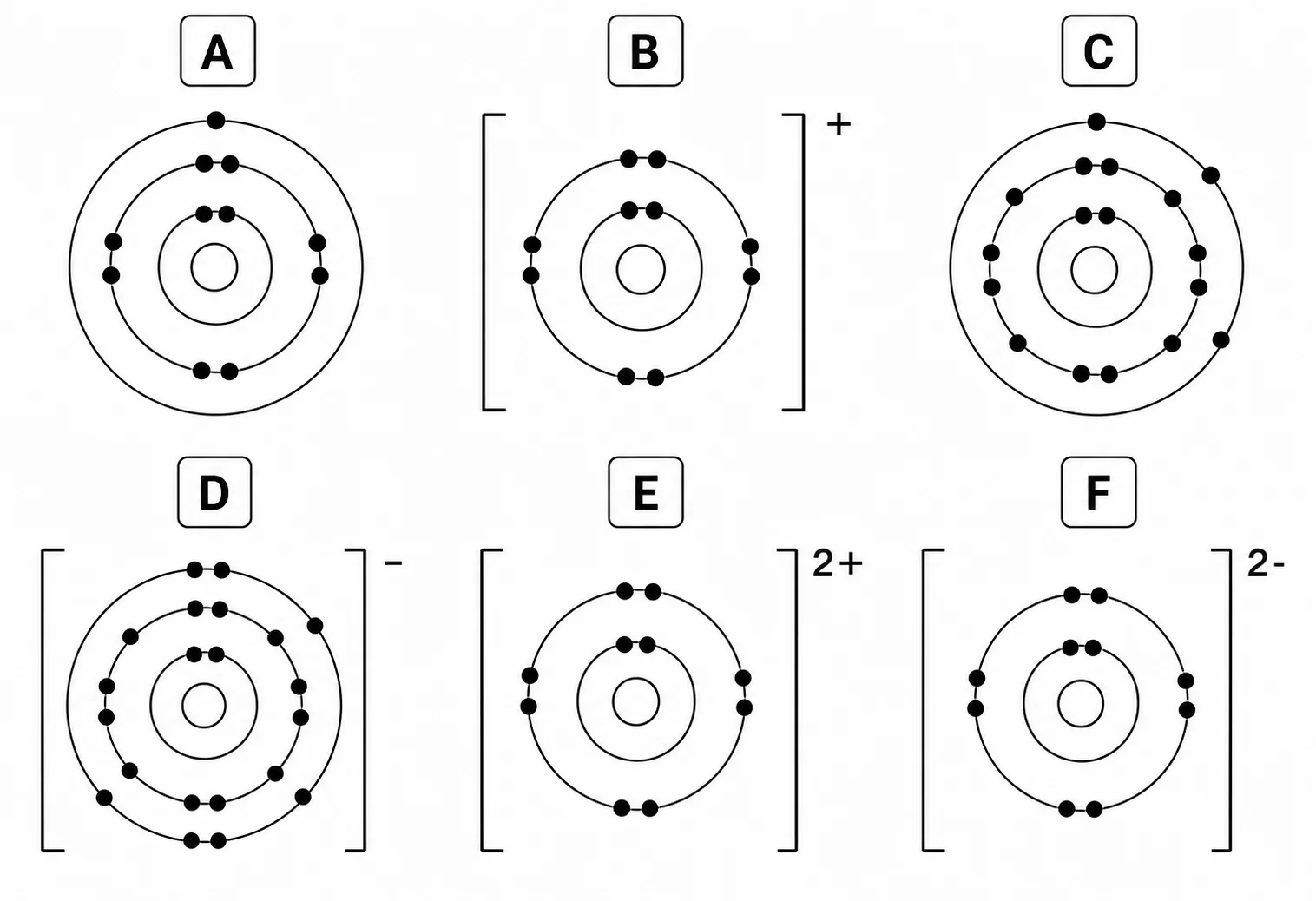
| Label |
Atom / Ion |
Electron configuration |
Charge |
| A |
Sodium atom |
|
|
| B |
Sodium ion (Na⁺) |
|
|
| C |
Chlorine atom |
|
|
| D |
Chloride ion (Cl⁻) |
|
|
| E |
Magnesium ion (Mg²⁺) |
|
|
| F |
Oxide ion (O²⁻) |
|
|
Your Turn
Fill the gap
Choose the correct word from the word bank to complete the passage below. Use each word once. Two words in the bank will not be used.
valency
cation
anion
lose
gain
positive
negative
proton
nucleus
The of an atom tells us how many electrons it needs to gain or lose to achieve a full outer shell. Metal atoms tend to electrons when they react. When an atom loses electrons, it becomes a ion called a . Non-metal atoms tend to electrons from nearby atoms. An atom that gains electrons ends up with more electrons than protons, giving it a charge, this type of ion is called an .
Show What You Know
1. Sodium has the electron configuration 2,8,1. Explain why sodium forms a Na⁺ ion rather than a Na⁻ ion.
Recall
2 marks
2. Write the correct ion symbol (including charge) for each of the following: (a) an atom that loses 2 electrons, (b) an atom that gains 1 electron.
Recall
2 marks
Wrap Up
In one sentence, what was the main idea of this lesson?