Unit Synthesis and Depth Study Prep
In 2020, the Australian Department of Health had to trace COVID-19 from its SARS-CoV-2 pathogen through airborne transmission, through vaccine immunity, through antivirals, to population-level border controls, the full disease chain in a single real crisis.
Printable Worksheets
Print or save as PDF, or build a custom worksheet from any module's questions.
Pick a disease. Trace it from pathogen to transmission to defence to prevention to public-health response.
What is the most important thing you have learned about disease in this unit?
● Know
- Key concepts from across the Disease unit
- How disease concepts interconnect
- The structure and expectations of a depth study
● Understand
- How scientific concepts build on each other
- How to connect ideas from different parts of the unit
- What makes a good scientific investigation question
● Can do
- Synthesise concepts across the unit
- Formulate investigable questions
- Plan a depth study using scientific methodology
In 2020, when SARS-CoV-2 arrived in Australia, epidemiologists at the Doherty Institute had to pull together everything in this unit simultaneously: the pathogen's biology, how droplet transmission worked, what the three lines of immune defence could do, which antivirals might help, how non-infectious disease risk interacted with COVID severity, and how public health systems needed to scale up nationally. Every concept from the last 19 lessons appeared in that one real crisis, not as isolated facts, but as a connected system. The goal of this final lesson is to see how those pieces fit together.
Consider tuberculosis as an example. Pathogen: Mycobacterium tuberculosis is a bacterium that primarily infects the lungs. Transmission: It spreads through airborne droplets when infected people cough. Defence: The first line (mucus and cilia) traps some bacteria; the second line (phagocytes) engulfs them but cannot always kill them; the third line (T cells) forms granulomas to wall off the infection. Treatment: Antibiotics like isoniazid and rifampicin are required for 6 months because the bacterium grows slowly. Prevention: The BCG vaccine provides partial protection, especially in children. Public health: Contact tracing, directly observed therapy, and screening of high-risk groups control spread.
Every disease in this unit can be traced through the same framework. The details differ, but the structure is universal.
COVID-19 demonstrates the full disease system in action. SARS-CoV-2 (pathogen) spreads via respiratory droplets and aerosols (transmission). Mucus and cilia provide partial first-line defence; innate immune cells trigger inflammation; adaptive immunity produces antibodies and T cell responses over 1-2 weeks (defence). Antivirals like Paxlovid reduce severity in high-risk patients (treatment). Vaccines train adaptive immunity without causing disease (prevention). Public health measures including masks, ventilation, quarantine, and contact tracing reduce transmission at the population level (public health).
Australian disease control: Australia response to COVID-19 integrated every concept from this unit: pathogen identification through genomic sequencing, transmission control through border measures and masks, individual protection through vaccines, treatment through antivirals and supportive care, and public health coordination through the AHPPC. The multi-layered approach recognised that no single intervention is sufficient.
Once you finish this unit, you know everything about disease. This is false. Disease science is constantly evolving. New pathogens emerge. Bacteria evolve resistance. Vaccines improve. Public health strategies adapt. The framework you have learned will help you understand new diseases as they emerge, but the specific details will always be updating.
Connect any two concepts. Write one sentence explaining the link. Build 3 links to finish.
The most important takeaway from this unit is not any single fact, but a way of thinking about disease. The disease system framework - pathogen, transmission, host defence, treatment, prevention, and public health - provides a mental model that you can apply to any disease you encounter, now or in the future.
When you hear about a new disease outbreak, ask:
- What is the pathogen? (Bacterium, virus, fungus, parasite, or non-infectious cause?)
- How does it transmit? (Air, water, food, contact, vector, or genetic/lifestyle?)
- How does the body defend against it? (Barriers, innate immunity, adaptive immunity, or none?)
- What treatments exist? (Antibiotics, antivirals, surgery, lifestyle change, or supportive care?)
- How can it be prevented? (Vaccines, hygiene, screening, behaviour change, or environmental control?)
- What public health measures are needed? (Surveillance, contact tracing, policy, or communication?)
This analytical framework protects you from misinformation. When someone claims a treatment works, you can ask: What is the mechanism? What is the evidence? Does it match the disease biology?
A social media post claims that drinking lemon juice cures COVID-19. Using the disease system framework, you can evaluate this claim. COVID-19 is caused by SARS-CoV-2, a virus that replicates inside human cells. Lemon juice is acidic and contains vitamin C, but there is no biological mechanism by which drinking it would kill intracellular viruses or prevent viral entry into cells. Clinical trials have not shown any benefit. The claim fails at the mechanism level and the evidence level.
Australian science education: The Australian Curriculum Science as a Human Endeavour strand explicitly requires students to evaluate claims and draw evidence-based conclusions. The disease system framework you have learned in this unit is exactly the kind of scientific literacy that enables informed citizenship. Organisations like the Australian Academy of Science and CSIRO produce resources to help the public evaluate health claims using evidence and reasoning.
Science gives us absolute certainties about disease. This is false. Science gives us the best current understanding based on available evidence, but that understanding is always provisional. Recommendations change as new evidence emerges. During COVID-19, advice on masks, distancing, and vaccines evolved as scientists learned more. This is not a sign that science is unreliable - it is a sign that science is self-correcting.
Scientific literacy is not just knowing facts - it is having the skills to evaluate claims, interpret evidence, and make informed decisions. In an age of health misinformation, these skills are essential for protecting yourself and your community.
The CER framework (Claim, Evidence, Reasoning) is a simple but powerful tool:
- Claim: What is being asserted?
- Evidence: What data supports or contradicts the claim? Is the evidence from a reliable source? Has it been peer-reviewed? Can it be replicated?
- Reasoning: Does the evidence actually support the claim? Are there alternative explanations? Is the reasoning logical and free from fallacies?
When evaluating health claims, look for red flags: absolute language (always, never, cure all), conspiracy theories (doctors are hiding the truth), cherry-picked data, testimonials instead of controlled studies, and attacks on legitimate science rather than engagement with evidence.
Claim: A celebrity says they cured their cancer with a special diet and no chemotherapy. Evidence: A single personal story with no medical documentation, no control group, no long-term follow-up. Reasoning: Even if the celebrity genuinely recovered, we cannot know whether the diet caused recovery, whether they had a less aggressive cancer type, or whether they also received conventional treatment they are not disclosing. Single anecdotes are not scientific evidence. To evaluate this claim, we would need randomised controlled trials comparing the special diet to standard care in similar patients.
Australian misinformation response: During COVID-19, the Australian Government established the Rapid Response Information Unit to counter health misinformation. The Therapeutic Goods Administration took legal action against companies making false claims about COVID-19 cures. These actions reflect the reality that health misinformation is not just wrong - it is dangerous and can be legally actionable.
Everyone is equally capable of evaluating health information. This is false. Health literacy varies enormously between individuals and communities. People with lower education, lower English proficiency, or limited access to reliable sources are more vulnerable to misinformation. Effective public health requires not just providing accurate information, but also making it accessible, understandable, and culturally appropriate for all populations.
True or false? Tap as fast as you can. Build a streak.
Antibiotics kill viruses.
Vaccines work by training the adaptive immune system.
Fever is always harmful and should be suppressed immediately.
Non-infectious diseases cannot spread between people.
Herd immunity protects vulnerable people who cannot be vaccinated.
Cancer is a single disease with one cause.
Public health interventions have saved more lives than hospital treatments.
Pandemics are impossible in the modern era due to medicine.
This unit has taken you from the molecular level (antibodies and antigens) to the global level (pandemics and public health policy). You have learned about the biology of disease, the mechanics of the immune system, the history of medicine, the ethics of vaccination, the sociology of health inequity, and the mathematics of epidemics. These topics are not separate - they are interconnected aspects of a single complex system.
Understanding disease is not just academic. It is practical, personal, and political. It helps you make better decisions about your own health. It helps you evaluate claims in the media. It helps you participate in democratic debates about health policy. It helps you recognise and challenge inequity.
The diseases you have studied in this unit will continue to evolve. New pathogens will emerge. Bacteria will develop resistance. Vaccines will improve. Public health strategies will adapt. The specific facts you have learned will need updating. But the framework - the way of thinking about disease as a system - will remain useful throughout your life.
In 2020, most people had never heard of mRNA vaccines. By 2022, billions of people had received them. The science of mRNA vaccines had been developed over 20 years, but the COVID-19 pandemic accelerated their application. People who understood the disease system framework - pathogen, transmission, immune response, vaccine mechanism - were better able to evaluate the new vaccines, understand why they were developed so quickly, and make informed decisions about vaccination. Scientific literacy prepared them for a world that changed rapidly.
Australian health futures: The Australian Government Medical Research Future Fund invests in emerging health technologies, including new vaccines, antimicrobial therapies, and genomic medicine. The Australian Centre for Disease Preparedness studies emerging infectious threats. The NHMRC funds research into chronic disease prevention, Indigenous health, and health services. These investments recognise that disease science is never finished - each generation must build on previous knowledge while confronting new challenges.
Science class is just preparation for exams. This is false. The scientific thinking you have practised in this unit - asking questions, evaluating evidence, recognising bias, understanding systems - is preparation for life. You will use these skills when you vote on health policy, when you decide whether to vaccinate your children, when you evaluate a diet trend, when you respond to a pandemic, and when you advocate for health equity in your community. The exam is temporary; the thinking is permanent.
Wrong: "A depth study is just a long essay about a disease." No, a depth study is an investigation. It requires you to ask a question, gather evidence, analyse data, and draw conclusions. It is active science, not just research.
Right: A depth study is an active scientific investigation that requires asking a question, gathering evidence, analysing data, and drawing conclusions. It is not just a research essay.
Wrong: "The different topics in this unit have no connection to each other." No, they are deeply connected. Pathogens cause disease, which the immune system fights, which vaccines train, which antibiotics treat, which resistance limits, which public health prevents. Every topic links to others.
Right: All topics in this unit are deeply connected: pathogens cause disease, which the immune system fights, which vaccines train, which antibiotics treat, which resistance limits, which public health prevents.
Wrong: "Once you memorise facts about disease, you understand it." No, true understanding means being able to explain connections, apply concepts to new situations, and evaluate evidence. Facts are tools; understanding is the ability to use them.
Right: True understanding means being able to explain connections between concepts, apply them to new situations, and evaluate evidence. Facts alone are not enough without the ability to use them.
Australian Scientists Fighting Disease
Professor Fiona Stanley (AC): An Australian epidemiologist who founded the Telethon Kids Institute in Perth. Her research on birth defects, Indigenous health, and population health methods transformed Australian public health. She championed the use of population data to guide health policy.
Professor Ian Frazer: Co-developer of the HPV vaccine at the University of Queensland. His work has prevented countless cases of cervical cancer worldwide and put Australia on track to eliminate cervical cancer entirely.
Modern Australian research: Today, Australian scientists at WEHI, the Doherty Institute, CSIRO, and universities across the country continue to fight disease. During COVID-19, Australian researchers contributed to vaccine development, genomic surveillance, and long COVID research. Aboriginal and Torres Strait Islander researchers are increasingly leading health research that addresses community priorities with cultural authority.
✍ Copy Into Your Books
▾Unit Connections
- Pathogen -> Transmission -> Defence -> Treatment
- Infectious vs non-infectious disease
- Local, national, and global perspectives
Key Formulas
- Herd immunity threshold ≈ 1 - 1/R0
- Incidence rate = (new cases/population) × multiplier
- Case fatality rate = (deaths/cases) × 100%
Depth Study Steps
- Choose topic -> Formulate question -> Research -> Hypothesis -> Method -> Data collection -> Analysis -> Conclusions -> Communication
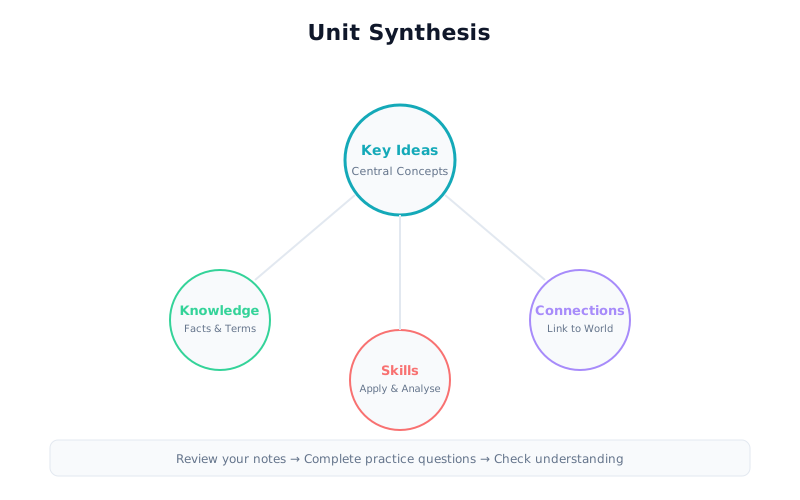
Concept Connections
Depth Study Planning
At the start of this lesson, you were challenged to pick one disease, from the flu virus to heart disease to COVID-19, and trace the entire chain from pathogen or trigger, through transmission, body defences, treatment, and population-level prevention.
Now that you've completed the unit synthesis, how clearly can you trace that chain for your chosen disease? Which step in the chain do you feel you understand best, and which would you still like to know more about?
Q1. 1. Synthesise your understanding by explaining how at least three concepts from this unit connect to explain one real-world health issue of your choice. 4 MARKS
Q2. 2. Evaluate the statement: "Infectious diseases are no longer a major health threat because we have vaccines and antibiotics." Use evidence from across the unit. 4 MARKS
Q3. 3. Design an investigation to test whether a particular intervention reduces the spread of bacteria in a school environment. Include your hypothesis, variables, method, and analysis plan. 4 MARKS
Revisit Your Thinking
Go back to your Think First answer. Has your understanding changed?
- How has your understanding of disease and health developed across this entire unit?
- What connections between concepts do you find most powerful or surprising?
Model answers (click to reveal)
Answers
▾MCQ 1
AThe first line of defence includes physical and chemical barriers such as skin, mucous membranes, stomach acid, tears, and saliva.
MCQ 2
BVaccines present antigens to the immune system, stimulating the production of memory B and T cells that enable rapid response to future infection.
MCQ 3
BA pandemic is an epidemic that has spread across multiple countries or continents, affecting large numbers of people globally.
MCQ 4
BViruses are not cells and use the host cell's own machinery to replicate. Antibiotics target bacterial structures (cell walls, ribosomes) that viruses do not have.
MCQ 5
CThe independent variable is the factor deliberately changed by the investigator. The dependent variable is measured, and controlled variables are kept constant.
Short Answer 1
Model answer: (Example: COVID-19) COVID-19 demonstrates how multiple unit concepts interconnect. First, SARS-CoV-2 is a virus (Lesson 2: pathogens) that spreads through respiratory droplets and aerosols (Lesson 3: transmission). When the virus enters the body, the immune system responds: physical barriers in the respiratory tract (Lesson 5), inflammation and phagocytes (Lesson 6), and eventually specific antibody and T cell responses (Lesson 7). Vaccination (Lesson 8) trains this immune response by presenting spike protein antigens, generating memory cells that enable faster responses to future infection. When treatments were needed, antiviral drugs (Lesson 11) like remdesivir were used, though their effectiveness was limited, demonstrating the challenge of treating viral infections compared to bacterial ones. Public health measures (Lesson 19) including masks, distancing, and border controls aimed to break transmission chains. The pandemic also highlighted global health interdependence (Lesson 17): no country could control COVID-19 alone, and vaccine nationalism prolonged the pandemic. Finally, the pandemic's disproportionate impact on disadvantaged communities illustrated the importance of social determinants of health (Lesson 16).
Short Answer 2
Model answer: This statement is dangerously incorrect. While vaccines and antibiotics are powerful tools, infectious diseases remain a major threat for several reasons. First, antimicrobial resistance (Lesson 12) is rendering antibiotics ineffective against increasingly common "superbugs." MRSA and CRE already kill thousands, and without new antibiotics, even routine surgery may become life-threatening. Second, new infectious diseases continue to emerge (Lesson 17). COVID-19 killed over 6 million people globally despite modern medicine. HIV/AIDS still causes 650,000 deaths annually despite effective treatments. Third, vaccine hesitancy (Lesson 9) has reduced coverage in some communities, leading to measles outbreaks even in wealthy countries. Fourth, non-infectious diseases (Lesson 13) now cause more deaths than infectious diseases globally, but infectious diseases still kill millions, particularly in developing countries with limited healthcare access. The truth is that infectious and non-infectious diseases are both major threats, and complacency about either is dangerous.
Short Answer 3
Model answer: Hypothesis: Installing hand sanitiser stations at classroom entrances will reduce bacterial contamination on high-touch surfaces compared to classrooms without sanitiser stations. Independent variable: Presence or absence of hand sanitiser stations. Dependent variable: Number of bacterial colonies grown from surface swabs (measured as colony-forming units per cm²). Controlled variables: Same type of surfaces swabbed (door handles, desks), same time of day, same swabbing technique, same growth medium and incubation conditions, similar class sizes and activities. Method: (1) Select 10 classrooms; randomly assign 5 to receive sanitiser stations and 5 as controls. (2) Swab identical high-touch surfaces in all classrooms before and after the intervention. (3) Plate swabs on agar plates and incubate for 48 hours at 37°C. (4) Count bacterial colonies. (5) Repeat on three separate days for reliability. (6) Calculate mean bacterial counts for sanitiser and control classrooms. (7) Compare using appropriate statistical analysis. Safety: Wear gloves; disinfect work surfaces; autoclave or safely dispose of bacterial cultures. Analysis: Present data in tables and graphs. If sanitiser classrooms show significantly lower bacterial counts, the hypothesis is supported. Consider limitations: bacterial counts do not measure pathogenicity; behaviour change may vary; short time frame may not capture long-term effects.