Unit Synthesis and Depth Study Prep
In 2019, NSW Health traced a measles outbreak in western Sydney to a single unvaccinated international traveller, using 3 separate data streams (vaccination records, hospital admissions, and contact-tracing maps) to stop transmission within 2 weeks.
Printable Worksheets
Print or save as PDF, or build a custom worksheet from any module's questions.
How are vaccination, antibiotics, and handwashing connected in preventing disease?
Why does a small drop in vaccination coverage sometimes cause large disease outbreaks?
● Know
- Key concepts from across the Disease unit
- How disease concepts interconnect
- The structure and expectations of a depth study
● Understand
- How scientific concepts build on each other
- How to connect ideas from different parts of the unit
- What makes a good scientific investigation question
● Can do
- Synthesise concepts across the unit
- Formulate investigable questions
- Plan a depth study using scientific methodology
The Disease unit is built around a single narrative arc: what disease is, how it spreads, how the body fights it, how we prevent and treat it, and how society responds. Every concept you have learned fits into this arc somewhere. Pathogens and transmission explain the cause and spread. The three lines of defence explain the biological response. Vaccines and antibiotics explain prevention and treatment. Public health and epidemiology explain the population-level response.
The connections between concepts are just as important as the concepts themselves. Vaccination coverage determines herd immunity. Antibiotic misuse drives resistance through natural selection. Social determinants shape health outcomes across populations. Global connectivity determines pandemic potential. A student who can trace these connections has mastered the unit; a student who knows only isolated facts has not.
To explain why measles outbreaks occur in wealthy countries with strong healthcare, a synthesising student connects: imported case (global travel) + low local coverage (vaccine hesitancy) + high R₀ (pathogen trait) = outbreak. No single factor explains it; the interaction does.
The Australian Curriculum Assessment and Reporting Authority (ACARA) identifies systems thinking as a key capability in science, recognising that modern challenges like pandemics and climate change require understanding connections, not just facts.
- Vaccination
- Antibiotic overuse
- Social determinants
- R₀ (basic reproduction number)
- Herd immunity
- Health disparities
- Antimicrobial resistance
- Herd immunity threshold
The mathematics of herd immunity is elegant and unforgiving. The threshold formula, 1 minus 1/R₀, means that every increase in contagiousness demands a proportional increase in immunity coverage. A disease with R₀ = 2 needs 50% coverage. R₀ = 4 needs 75%. R₀ = 10 needs 90%. R₀ = 15 (measles) needs roughly 93%. There is no negotiating with these numbers, they are determined by the biology of the pathogen and the mathematics of network spread.
Small drops in coverage create disproportionately large risks for highly contagious diseases. Dropping from 95% to 90% coverage for measles does not increase risk by 5%; it can increase outbreak probability by orders of magnitude because the disease is so contagious that every susceptible person becomes a transmission hub. This nonlinear relationship surprises many people but is fundamental to epidemic dynamics.
Measles R₀ ≈ 15, threshold ≈ 93%. If coverage is 94%, outbreaks are extremely rare. If coverage drops to 90%, imported cases regularly spark outbreaks. The 4% drop creates a massive change in risk because measles spreads so efficiently.
NCIRS modelling shows that even a 2-3% drop in measles vaccination coverage in a single Australian postcode can shift the area from protected to vulnerable, triggering targeted public-health campaigns to restore coverage before an outbreak occurs.
A fair method is the backbone of any scientific investigation. Fairness means that the only thing differing between your experimental groups is the independent variable you are testing. If you are testing whether temperature affects bacterial growth, then temperature is the only thing that should change. Everything else, type of bacteria, amount of nutrient, container size, light exposure, incubation time, must be identical across all groups. These unchanged factors are called controlled variables.
Reliability means your results are consistent and repeatable. You achieve reliability by using multiple replicates, several identical trials at each condition, and by measuring precisely. A single petri dish at each temperature tells you almost nothing, because the result might be a fluke. Three or more replicates let you see whether a pattern is real or random. Precise measurements (using a ruler with millimetre marks rather than eyeballing) reduce uncertainty and strengthen your conclusions.
A student tests bacterial growth at 20°C and 37°C using one petri dish per temperature. The 37°C dish shows more growth, but a single trial cannot rule out chance. With five dishes per temperature, the student can calculate an average and see whether the difference is consistent.
The CSIRO Education program provides free resources on experimental design for schools, emphasising that the difference between a demonstration and an experiment is the control of variables.
Wrong: "A depth study is just a long essay about a disease." No, a depth study is an investigation. It requires you to ask a question, gather evidence, analyse data, and draw conclusions. It is active science, not just research.
Right: A depth study is an active scientific investigation that requires asking a question, gathering evidence, analysing data, and drawing conclusions. It is not just a research essay.
Wrong: "The different topics in this unit have no connection to each other." No, they are deeply connected. Pathogens cause disease, which the immune system fights, which vaccines train, which antibiotics treat, which resistance limits, which public health prevents. Every topic links to others.
Right: All topics in this unit are deeply connected: pathogens cause disease, which the immune system fights, which vaccines train, which antibiotics treat, which resistance limits, which public health prevents.
Wrong: "Once you memorise facts about disease, you understand it." No, true understanding means being able to explain connections, apply concepts to new situations, and evaluate evidence. Facts are tools; understanding is the ability to use them.
Right: True understanding means being able to explain connections between concepts, apply them to new situations, and evaluate evidence. Facts alone are not enough without the ability to use them.
Australian Scientists Fighting Disease
Professor Fiona Stanley (AC): An Australian epidemiologist who founded the Telethon Kids Institute in Perth. Her research on birth defects, Indigenous health, and population health methods transformed Australian public health. She championed the use of population data to guide health policy.
Professor Ian Frazer: Co-developer of the HPV vaccine at the University of Queensland. His work has prevented countless cases of cervical cancer worldwide and put Australia on track to eliminate cervical cancer entirely.
Modern Australian research: Today, Australian scientists at WEHI, the Doherty Institute, CSIRO, and universities across the country continue to fight disease. During COVID-19, Australian researchers contributed to vaccine development, genomic surveillance, and long COVID research. Aboriginal and Torres Strait Islander researchers are increasingly leading health research that addresses community priorities with cultural authority.
✍ Copy Into Your Books
▾Unit Connections
- Pathogen -> Transmission -> Defence -> Treatment
- Infectious vs non-infectious disease
- Local, national, and global perspectives
Key Formulas
- Herd immunity threshold ≈ 1 - 1/R0
- Incidence rate = (new cases/population) × multiplier
- Case fatality rate = (deaths/cases) × 100%
Depth Study Steps
- Choose topic -> Formulate question -> Research -> Hypothesis -> Method -> Data collection -> Analysis -> Conclusions -> Communication
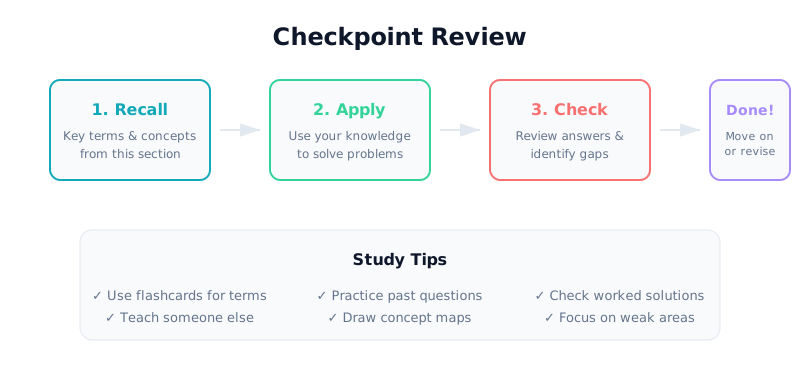
Concept Connections
Depth Study Planning
At the start of this lesson, you considered how NSW Health traced a measles outbreak in western Sydney back to a single unvaccinated traveller, connecting vaccination records, hospital data, and contact maps to understand how multiple layers of disease prevention work together.
Now that you've worked through the lesson, can you describe how handwashing, antibiotics, and vaccines each contribute a different layer of protection? What do you think happens to the whole system when just one of those layers breaks down?
Q1. 1. Synthesise your understanding by explaining how at least three concepts from this unit connect to explain one real-world health issue of your choice. 4 MARKS
Q2. 2. Evaluate the statement: "Infectious diseases are no longer a major health threat because we have vaccines and antibiotics." Use evidence from across the unit. 4 MARKS
Q3. 3. Design an investigation to test whether a particular intervention reduces the spread of bacteria in a school environment. Include your hypothesis, variables, method, and analysis plan. 4 MARKS
Revisit Your Thinking
Go back to your Think First answer. Has your understanding changed?
- How has your understanding of disease and health developed across this entire unit?
- What connections between concepts do you find most powerful or surprising?
Model answers (click to reveal)
Answers
▾MCQ 1
AThe first line of defence includes physical and chemical barriers such as skin, mucous membranes, stomach acid, tears, and saliva.
MCQ 2
BVaccines present antigens to the immune system, stimulating the production of memory B and T cells that enable rapid response to future infection.
MCQ 3
BA pandemic is an epidemic that has spread across multiple countries or continents, affecting large numbers of people globally.
MCQ 4
BViruses are not cells and use the host cell's own machinery to replicate. Antibiotics target bacterial structures (cell walls, ribosomes) that viruses do not have.
MCQ 5
CThe independent variable is the factor deliberately changed by the investigator. The dependent variable is measured, and controlled variables are kept constant.
Short Answer 1
Model answer: (Example: COVID-19) COVID-19 demonstrates how multiple unit concepts interconnect. First, SARS-CoV-2 is a virus (Lesson 2: pathogens) that spreads through respiratory droplets and aerosols (Lesson 3: transmission). When the virus enters the body, the immune system responds: physical barriers in the respiratory tract (Lesson 5), inflammation and phagocytes (Lesson 6), and eventually specific antibody and T cell responses (Lesson 7). Vaccination (Lesson 8) trains this immune response by presenting spike protein antigens, generating memory cells that enable faster responses to future infection. When treatments were needed, antiviral drugs (Lesson 11) like remdesivir were used, though their effectiveness was limited, demonstrating the challenge of treating viral infections compared to bacterial ones. Public health measures (Lesson 19) including masks, distancing, and border controls aimed to break transmission chains. The pandemic also highlighted global health interdependence (Lesson 17): no country could control COVID-19 alone, and vaccine nationalism prolonged the pandemic. Finally, the pandemic's disproportionate impact on disadvantaged communities illustrated the importance of social determinants of health (Lesson 16).
Short Answer 2
Model answer: This statement is dangerously incorrect. While vaccines and antibiotics are powerful tools, infectious diseases remain a major threat for several reasons. First, antimicrobial resistance (Lesson 12) is rendering antibiotics ineffective against increasingly common "superbugs." MRSA and CRE already kill thousands, and without new antibiotics, even routine surgery may become life-threatening. Second, new infectious diseases continue to emerge (Lesson 17). COVID-19 killed over 6 million people globally despite modern medicine. HIV/AIDS still causes 650,000 deaths annually despite effective treatments. Third, vaccine hesitancy (Lesson 9) has reduced coverage in some communities, leading to measles outbreaks even in wealthy countries. Fourth, non-infectious diseases (Lesson 13) now cause more deaths than infectious diseases globally, but infectious diseases still kill millions, particularly in developing countries with limited healthcare access. The truth is that infectious and non-infectious diseases are both major threats, and complacency about either is dangerous.
Short Answer 3
Model answer: Hypothesis: Installing hand sanitiser stations at classroom entrances will reduce bacterial contamination on high-touch surfaces compared to classrooms without sanitiser stations. Independent variable: Presence or absence of hand sanitiser stations. Dependent variable: Number of bacterial colonies grown from surface swabs (measured as colony-forming units per cm²). Controlled variables: Same type of surfaces swabbed (door handles, desks), same time of day, same swabbing technique, same growth medium and incubation conditions, similar class sizes and activities. Method: (1) Select 10 classrooms; randomly assign 5 to receive sanitiser stations and 5 as controls. (2) Swab identical high-touch surfaces in all classrooms before and after the intervention. (3) Plate swabs on agar plates and incubate for 48 hours at 37°C. (4) Count bacterial colonies. (5) Repeat on three separate days for reliability. (6) Calculate mean bacterial counts for sanitiser and control classrooms. (7) Compare using appropriate statistical analysis. Safety: Wear gloves; disinfect work surfaces; autoclave or safely dispose of bacterial cultures. Analysis: Present data in tables and graphs. If sanitiser classrooms show significantly lower bacterial counts, the hypothesis is supported. Consider limitations: bacterial counts do not measure pathogenicity; behaviour change may vary; short time frame may not capture long-term effects.