Unit Synthesis and Depth Study Prep
In 2023, CSIRO researchers identified 5 distinct pathogen types responsible for Australia's most common infections, bacteria, viruses, fungi, protists, and parasitic worms, each demanding a completely different treatment strategy.
Printable Worksheets
Print or save as PDF, or build a custom worksheet from any module's questions.
Q1 · List three different topics you have learned about disease so far, and explain how they might connect to each other.
Q2 · What do you think makes a good scientific investigation question? How is it different from a question you could just Google?
● Know
- Key concepts from across the Disease unit
- How disease concepts interconnect
- The structure and expectations of a depth study
● Understand
- How scientific concepts build on each other
- How to connect ideas from different parts of the unit
- What makes a good scientific investigation question
● Can do
- Synthesise concepts across the unit
- Formulate investigable questions
- Plan a depth study using scientific methodology
Imagine a hospital ward in 2023: one patient has a bacterial lung infection treated with antibiotics, the patient beside them has a viral cold that antibiotics cannot touch, and a third has a fungal skin infection requiring a completely different drug. This is the practical reality that pathogens create, organisms that cause disease, and they come in five main types, each with distinct structures and behaviours that demand different treatments.
Bacteria: Single-celled prokaryotes with no nucleus. They reproduce rapidly by binary fission. Some bacteria are beneficial (gut flora), but pathogenic bacteria cause diseases like tuberculosis, strep throat, and urinary tract infections. Bacteria can be treated with antibiotics.
Viruses: Non-cellular particles consisting of genetic material (DNA or RNA) inside a protein coat. They cannot reproduce independently, they hijack host cells to replicate. Viral diseases include influenza, COVID-19, measles, and HIV. Antibiotics do NOT work on viruses.
Fungi: Eukaryotic organisms including yeasts and moulds. Fungal infections include athlete foot, ringworm, and thrush. They are treated with antifungal medications.
Protozoa: Single-celled eukaryotes. Malaria (Plasmodium) and giardiasis are protozoan diseases. They are treated with antiparasitic drugs.
Parasites (helminths): Multicellular worms including tapeworms and hookworms. They are treated with antiparasitic medications.
Streptococcus pyogenes is a bacterium that causes strep throat. It is a spherical bacterium (coccus) that chains together and produces toxins that damage throat tissues. In contrast, SARS-CoV-2 (the virus that causes COVID-19) is a tiny particle about 100 times smaller than Streptococcus. It has RNA genetic material inside a lipid envelope studded with spike proteins. It cannot reproduce on its own, it must enter human cells and hijack their machinery. This fundamental difference explains why strep throat is treated with antibiotics (which target bacterial cell walls) while COVID-19 is treated with antivirals and supportive care, antibiotics would be completely ineffective against a virus.
Australian pathogen surveillance: The National Notifiable Diseases Surveillance System (NNDSS) tracks infectious diseases across Australia, categorising them by pathogen type. NSW Health and the Burnet Institute monitor emerging pathogens including drug-resistant bacteria and novel viruses. Australia unique wildlife harbours viruses with pandemic potential (like Hendra virus), and the Australian Centre for Disease Preparedness at CSIRO Geelong researches these pathogens to develop diagnostics and vaccines. Understanding pathogen classification is essential for Australia biosecurity and pandemic preparedness.
Match each pathogen type to an example disease it causes.
Pathogens cause disease through several mechanisms:
1. Toxin production: Many bacteria produce toxins, poisonous substances that damage host tissues. Exotoxins are proteins secreted by living bacteria. Examples: tetanus toxin (causes muscle spasms), cholera toxin (causes severe diarrhoea), botulinum toxin (causes paralysis, also used in Botox). Endotoxins are lipopolysaccharides in the outer membrane of Gram-negative bacteria, released when bacteria die. They trigger fever and inflammation.
2. Cell destruction: Some pathogens directly destroy host cells. Viruses replicate inside cells until they burst (lyse), releasing new virus particles. The common cold virus destroys nasal epithelial cells, causing runny nose and congestion.
3. Immune system hijacking: Some pathogens evade or manipulate the immune system. HIV infects and destroys T-helper cells, crippling the immune response. Some bacteria form biofilms, protective slime layers that shield them from immune attack and antibiotics.
Clostridioides difficile (C. diff) is a bacterium that causes severe diarrhoea, particularly in hospital patients who have received antibiotics. It produces two toxins (TcdA and TcdB) that damage the intestinal lining and trigger inflammation. Normally, harmless gut bacteria keep C. diff under control. But broad-spectrum antibiotics kill these protective bacteria, allowing C. diff to multiply and produce toxins. This is why C. diff infections are a major problem in healthcare settings. Australian hospitals monitor C. diff rates closely and use targeted antibiotic stewardship to prevent outbreaks. The NSW Clinical Excellence Commission publishes guidelines for C. diff prevention and management.
Australian toxin research: The Queensland Museum and University of Queensland researchers study Australian venomous animals (snakes, spiders, jellyfish, cone snails) whose toxins have yielded valuable medical compounds. Captopril (a blood pressure drug) was developed from jararaca snake venom. Prialt (a painkiller) comes from cone snail venom. While these are animal toxins rather than pathogen toxins, they illustrate how understanding toxin structure and function leads to medical breakthroughs. Australian researchers also study bacterial toxins to develop new antibiotics and antitoxin therapies.
One of the most important distinctions in medicine is between bacterial and viral infections, because the treatments are completely different.
Bacterial infections can be treated with antibioticsdrugs that kill bacteria or stop them from reproducing. Antibiotics target structures unique to bacteria, such as cell walls (penicillins), ribosomes (macrolides), or DNA replication (fluoroquinolones). Because human cells do not have these bacterial structures, antibiotics can kill bacteria without harming human cells.
Viral infections cannot be treated with antibiotics because viruses lack the structures antibiotics target. Viruses use host cell machinery to replicate, so killing the virus without killing the host cell is difficult. Antiviral medications target specific viral enzymes (like neuraminidase in influenza or reverse transcriptase in HIV) but are less effective than antibiotics and must be given early.
Why the distinction matters: Taking antibiotics for viral infections (like colds and flu) is useless, causes side effects, and drives the evolution of antibiotic-resistant bacteria, one of the greatest threats to global health.
During the COVID-19 pandemic, some people demanded antibiotics from their doctors, believing they would help. They did not, COVID-19 is caused by a virus (SARS-CoV-2), and antibiotics have no effect on viruses. In fact, widespread antibiotic use during the pandemic may have accelerated antibiotic resistance. Australian data from the NPS MedicineWise program showed that antibiotic prescribing for respiratory infections actually decreased during the pandemic, partly because lockdowns reduced circulating infections and partly because public awareness improved. However, inappropriate antibiotic use remains a major problem globally, with the World Health Organisation estimating that 50% of antibiotics are prescribed unnecessarily.
Australian antibiotic stewardship: Australia has one of the highest rates of antibiotic prescribing in the OECD. The Australian Commission on Safety and Quality in Health Care runs the National Antimicrobial Resistance Strategy, promoting appropriate antibiotic use in hospitals and communities. The NPS MedicineWise program educates the public that antibiotics do not treat viral infections. Australian researchers at the Peter Doherty Institute study how antibiotic resistance spreads and develop rapid diagnostics to distinguish bacterial from viral infections, ensuring antibiotics are only used when truly needed. This work is critical for preserving the effectiveness of existing antibiotics.
Find the error in this student advice about treating illness.
- Colds are caused by viruses, not bacteria.
- Antibiotics only work against bacteria, not viruses.
- Taking antibiotics for a viral infection contributes to antibiotic resistance.
- Sharing prescription antibiotics with friends is safe and effective.
Wrong: "A depth study is just a long essay about a disease." No, a depth study is an investigation. It requires you to ask a question, gather evidence, analyse data, and draw conclusions. It is active science, not just research.
Right: A depth study is an active scientific investigation where you pose a question, gather and analyse evidence, and draw conclusions. It is hands-on inquiry, not just a literature review or essay.
Wrong: "The different topics in this unit have no connection to each other." No, they are deeply connected. Pathogens cause disease, which the immune system fights, which vaccines train, which antibiotics treat, which resistance limits, which public health prevents. Every topic links to others.
Right: The topics in this unit form an integrated network: pathogens cause disease, the immune system fights back, vaccines train immunity, antibiotics treat bacterial infections, resistance limits treatments, and public health strategies prevent spread. Each concept connects to the others.
Wrong: "Once you memorise facts about disease, you understand it." No, true understanding means being able to explain connections, apply concepts to new situations, and evaluate evidence. Facts are tools; understanding is the ability to use them.
Right: True understanding in science means you can explain connections between concepts, apply ideas to new situations, and evaluate evidence critically. Memorised facts are only useful when you know how to use them.
Australian Scientists Fighting Disease
Professor Fiona Stanley (AC): An Australian epidemiologist who founded the Telethon Kids Institute in Perth. Her research on birth defects, Indigenous health, and population health methods transformed Australian public health. She championed the use of population data to guide health policy.
Professor Ian Frazer: Co-developer of the HPV vaccine at the University of Queensland. His work has prevented countless cases of cervical cancer worldwide and put Australia on track to eliminate cervical cancer entirely.
Modern Australian research: Today, Australian scientists at WEHI, the Doherty Institute, CSIRO, and universities across the country continue to fight disease. During COVID-19, Australian researchers contributed to vaccine development, genomic surveillance, and long COVID research. Aboriginal and Torres Strait Islander researchers are increasingly leading health research that addresses community priorities with cultural authority.
✍ Copy Into Your Books
▾Unit Connections
- Pathogen -> Transmission -> Defence -> Treatment
- Infectious vs non-infectious disease
- Local, national, and global perspectives
Key Formulas
- Herd immunity threshold ≈ 1 - 1/R0
- Incidence rate = (new cases/population) × multiplier
- Case fatality rate = (deaths/cases) × 100%
Depth Study Steps
- Choose topic -> Formulate question -> Research -> Hypothesis -> Method -> Data collection -> Analysis -> Conclusions -> Communication
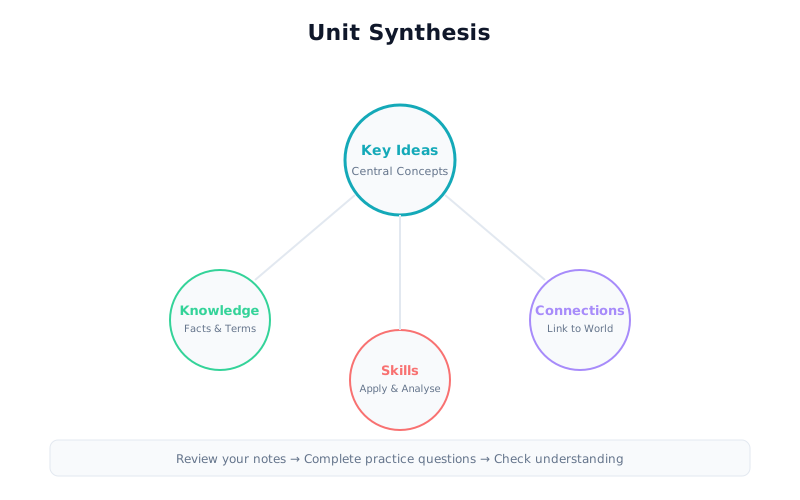
Concept Connections
Depth Study Planning
At the start of this lesson, you thought about how wildly different organisms, bacteria, viruses, fungi, and worms, all have the power to cause disease despite being as unrelated as a tree is to a smartphone.
Now that you've worked through the lesson, what do these different pathogens actually have in common that makes them capable of causing illness? Did anything surprise you?
Q1. 1. Synthesise your understanding by explaining how at least three concepts from this unit connect to explain one real-world health issue of your choice. 4 MARKS
Q2. 2. Evaluate the statement: "Infectious diseases are no longer a major health threat because we have vaccines and antibiotics." Use evidence from across the unit. 4 MARKS
Q3. 3. Design an investigation to test whether a particular intervention reduces the spread of bacteria in a school environment. Include your hypothesis, variables, method, and analysis plan. 4 MARKS
Revisit Your Thinking
Go back to your Think First answer. Has your understanding changed?
- How has your understanding of disease and health developed across this entire unit?
- What connections between concepts do you find most powerful or surprising?
Model answers (click to reveal)
Answers
▾MCQ 1
AThe first line of defence includes physical and chemical barriers such as skin, mucous membranes, stomach acid, tears, and saliva.
MCQ 2
BVaccines present antigens to the immune system, stimulating the production of memory B and T cells that enable rapid response to future infection.
MCQ 3
BA pandemic is an epidemic that has spread across multiple countries or continents, affecting large numbers of people globally.
MCQ 4
BViruses are not cells and use the host cell's own machinery to replicate. Antibiotics target bacterial structures (cell walls, ribosomes) that viruses do not have.
MCQ 5
CThe independent variable is the factor deliberately changed by the investigator. The dependent variable is measured, and controlled variables are kept constant.
Short Answer 1
Model answer: (Example: COVID-19) COVID-19 demonstrates how multiple unit concepts interconnect. First, SARS-CoV-2 is a virus (Lesson 2: pathogens) that spreads through respiratory droplets and aerosols (Lesson 3: transmission). When the virus enters the body, the immune system responds: physical barriers in the respiratory tract (Lesson 5), inflammation and phagocytes (Lesson 6), and eventually specific antibody and T cell responses (Lesson 7). Vaccination (Lesson 8) trains this immune response by presenting spike protein antigens, generating memory cells that enable faster responses to future infection. When treatments were needed, antiviral drugs (Lesson 11) like remdesivir were used, though their effectiveness was limited, demonstrating the challenge of treating viral infections compared to bacterial ones. Public health measures (Lesson 19) including masks, distancing, and border controls aimed to break transmission chains. The pandemic also highlighted global health interdependence (Lesson 17): no country could control COVID-19 alone, and vaccine nationalism prolonged the pandemic. Finally, the pandemic's disproportionate impact on disadvantaged communities illustrated the importance of social determinants of health (Lesson 16).
Short Answer 2
Model answer: This statement is dangerously incorrect. While vaccines and antibiotics are powerful tools, infectious diseases remain a major threat for several reasons. First, antimicrobial resistance (Lesson 12) is rendering antibiotics ineffective against increasingly common "superbugs." MRSA and CRE already kill thousands, and without new antibiotics, even routine surgery may become life-threatening. Second, new infectious diseases continue to emerge (Lesson 17). COVID-19 killed over 6 million people globally despite modern medicine. HIV/AIDS still causes 650,000 deaths annually despite effective treatments. Third, vaccine hesitancy (Lesson 9) has reduced coverage in some communities, leading to measles outbreaks even in wealthy countries. Fourth, non-infectious diseases (Lesson 13) now cause more deaths than infectious diseases globally, but infectious diseases still kill millions, particularly in developing countries with limited healthcare access. The truth is that infectious and non-infectious diseases are both major threats, and complacency about either is dangerous.
Short Answer 3
Model answer: Hypothesis: Installing hand sanitiser stations at classroom entrances will reduce bacterial contamination on high-touch surfaces compared to classrooms without sanitiser stations. Independent variable: Presence or absence of hand sanitiser stations. Dependent variable: Number of bacterial colonies grown from surface swabs (measured as colony-forming units per cm²). Controlled variables: Same type of surfaces swabbed (door handles, desks), same time of day, same swabbing technique, same growth medium and incubation conditions, similar class sizes and activities. Method: (1) Select 10 classrooms; randomly assign 5 to receive sanitiser stations and 5 as controls. (2) Swab identical high-touch surfaces in all classrooms before and after the intervention. (3) Plate swabs on agar plates and incubate for 48 hours at 37°C. (4) Count bacterial colonies. (5) Repeat on three separate days for reliability. (6) Calculate mean bacterial counts for sanitiser and control classrooms. (7) Compare using appropriate statistical analysis. Safety: Wear gloves; disinfect work surfaces; autoclave or safely dispose of bacterial cultures. Analysis: Present data in tables and graphs. If sanitiser classrooms show significantly lower bacterial counts, the hypothesis is supported. Consider limitations: bacterial counts do not measure pathogenicity; behaviour change may vary; short time frame may not capture long-term effects.