Stable Internal Conditions - Entry to Homeostasis
In 2021, Bureau of Meteorology health advisors confirmed that a rise of just 2 °C above the normal 37 °C body temperature is enough to trigger dangerous enzyme failure in human cells.
Printable Worksheets
Print or save as PDF, or build a custom worksheet from any module's questions.
Q1 · Q1: Why might a living thing need some internal conditions to stay fairly stable instead of changing wildly all the time?
Q2 · Q2: What happens to your body when you run around at lunchtime on a hot day? How does your body seem to "know" what to do?
● Know
- homeostasis is about keeping internal conditions within a suitable range
- body temperature and water balance are familiar examples
- stable does not mean completely unchanging
● Understand
- living systems work best when important internal conditions stay within limits
- too much change can affect wider function
- this idea connects directly to system interaction
● Can do
- define homeostasis at this level
- explain why stable internal conditions matter
- use familiar examples to show the idea clearly
When you step out of a swimming pool on a cold day, your skin instantly goes pale and you start shivering, your body is automatically pulling blood away from the surface and burning energy to warm your core back toward 37 °C. This automatic keeping of internal conditions inside safe limits, despite outside changes, is what biologists call homeostasis, and it is not about making everything exactly the same at every moment, but about keeping conditions stable enough for cells to function.
Living things are affected by changes in the outside environment. Even so, important internal conditions cannot be allowed to change wildly if the organism is going to keep functioning. At this level, the key idea is simple: living systems need internal conditions to remain within a suitable range.
Write your own this level definition of homeostasis using the phrase suitable range.
Homeostasis is the process of keeping [blank] internal conditions within a [blank] so the organism can [blank] effectively.
Homeostasis can sound abstract if it is only taught as a definition. Familiar examples make it clearer. In this lesson, the focus is not on advanced mechanisms. It is on recognising that some internal conditions matter and cannot be allowed to change too much.
Body temperature
- an internal condition that needs to stay within a suitable range
- large changes can affect how well the body functions
- this is a clear everyday example of homeostasis
Water balance
- organisms need the amount of water in the body to stay within a suitable range
- too much change can affect wider system function
- this links clearly to inputs, outputs and waste removal
A common mistake is to think that homeostasis means one exact number that never changes. That is too rigid. A stronger this level explanation says that internal conditions stay within a suitable range.
This also means homeostasis is not a separate topic floating above the unit. It builds on what you already know about input, output, transport, exchange and disruption. If those systems stop working together properly, stable internal conditions become harder to maintain.
Here's a statement with an error in it. Click the part that's wrong.
- A student writes: 'Homeostasis means the body stays exactly the same all the time. Only one system controls this, and nothing is allowed to change.' Identify the errors in this statement.
A student writes: "Homeostasis means the body never changes." Rewrite this into a stronger scientific explanation.
Claim-Evidence-Reasoning Frame
Claim: State what homeostasis actually means.
Evidence: Use facts from the lesson about suitable range.
Reasoning: Explain why "suitable range" is more accurate than "never changes".
Wrong: Homeostasis means the body never changes at all.
Right: Homeostasis means keeping important internal conditions within a suitable range, so some change is normal and expected.
Wrong: Only one body system controls homeostasis.
Right: Multiple systems work together to keep internal conditions stable. Circulation, respiration, digestion and waste removal all contribute.
Wrong: Only body temperature needs to stay steady, everything else inside an organism can vary widely.
Right: Water balance, gas exchange and other internal conditions also need to stay within suitable ranges for effective function.
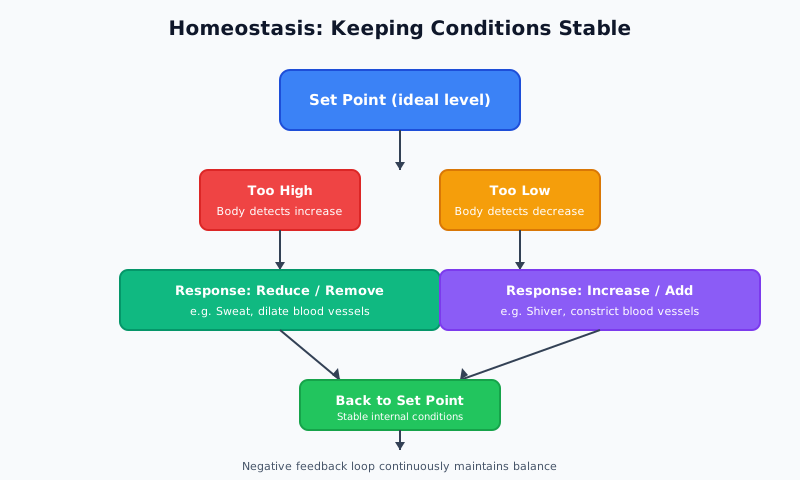
Diagram 2: Body Temperature Regulation
Comparison illustration showing temperature regulation in hot and cold conditions with colour-coded arrows for heat gain and loss.
Today's hook told you that your core body temperature is almost certainly between 36.5 °C and 37.5 °C right now, and that if it shifts just 2 degrees in either direction, your cells start to fail. That narrow safe zone is exactly what homeostasis is about.
Now that you've worked through the lesson, explain why internal conditions need to stay within a suitable range rather than changing wildly. Use the body temperature example and name at least one other condition the body keeps stable.
Q1. Define homeostasis at this level.
1 mark for internal conditions, 1 mark for suitable range, 1 mark for effective function.Q2. Explain why body temperature or water balance is a useful example of homeostasis.
1 mark for identifying the example, 1 mark for explaining it is internal, 1 mark for linking to suitable range, 1 mark for linking to function.Q3. Why is it stronger to say that internal conditions stay within a suitable range instead of saying they stay exactly the same ?
1 mark for saying suitable range allows some change, 1 mark for saying exactly the same is too rigid, 1 mark for linking to effective function, 1 mark for a concrete example.Model answers (click to reveal)
Model Answers
+Multiple Choice
1: C. This is the clearest this level definition of homeostasis.
2: A. Stable internal conditions matter because effective function depends on them.
3: B. Body temperature and water balance are the key examples in this lesson.
4: D. Suitable range means variation can happen, but not so much that normal function breaks down.
5: A. Homeostasis depends on systems working together.
6: C. That statement is the misconception challenged in this lesson.
7: B. Water balance matters because it needs to stay within useful limits.
8: D. This is the strongest link between disruption and stable internal conditions.
9: A. The lesson stays introductory and this level appropriate.
10: C. This captures the overall systems understanding of homeostasis.
Short Answer 1 (3 marks)
Homeostasis is keeping important internal conditions within a suitable range so a living thing can function effectively.
1 mark for internal conditions. 1 mark for suitable range. 1 mark for effective function.
Short Answer 2 (4 marks)
Body temperature or water balance is a useful example because it is an internal condition that cannot change too much if the organism is going to function well. It shows that homeostasis is about staying within suitable limits.
1 mark for identifying the example. 1 mark for explaining it is internal. 1 mark for linking to suitable range. 1 mark for linking to function.
Short Answer 3 (4 marks)
It is stronger because living things can still function with some variation, so the condition does not have to stay at one exact value all the time. "Suitable range" is more accurate because it allows some change while still keeping function effective.
1 mark for saying suitable range allows some change. 1 mark for saying exactly the same is too rigid. 1 mark for linking to effective function. 1 mark for a concrete example.
Revisit Your Thinking
Return to your opening response. Can you now explain stable internal conditions more precisely and use the phrase suitable range correctly?
Model answers (click to reveal)
Model Answers
+Multiple Choice
1: C. This is the clearest this level definition of homeostasis.
2: A. Stable internal conditions matter because effective function depends on them.
3: B. Body temperature and water balance are the key examples in this lesson.
4: D. Suitable range means variation can happen, but not so much that normal function breaks down.
5: A. Homeostasis depends on systems working together.
6: C. That statement is the misconception challenged in this lesson.
7: B. Water balance matters because it needs to stay within useful limits.
8: D. This is the strongest link between disruption and stable internal conditions.
9: A. The lesson stays introductory and this level appropriate.
10: C. This captures the overall systems understanding of homeostasis.
Short Answer 1 (3 marks)
Homeostasis is keeping important internal conditions within a suitable range so a living thing can function effectively.
1 mark for internal conditions. 1 mark for suitable range. 1 mark for effective function.
Short Answer 2 (4 marks)
Body temperature or water balance is a useful example because it is an internal condition that cannot change too much if the organism is going to function well. It shows that homeostasis is about staying within suitable limits.
1 mark for identifying the example. 1 mark for explaining it is internal. 1 mark for linking to suitable range. 1 mark for linking to function.
Short Answer 3 (4 marks)
It is stronger because living things can still function with some variation, so the condition does not have to stay at one exact value all the time. "Suitable range" is more accurate because it allows some change while still keeping function effective.
1 mark for saying suitable range allows some change. 1 mark for saying exactly the same is too rigid. 1 mark for linking to effective function. 1 mark for a concrete example.
● Definition
Homeostasis means keeping important internal conditions within a suitable range.
● Examples
Body temperature and water balance are familiar entry examples.
● Key Correction
Stable does not mean perfectly fixed. It means stable enough for effective function.
● Bridge Forward
Next lesson shows how multiple systems interact to support stable internal conditions.