Organisation Synthesis - From Cells to Systems
In 2021, Australian Museum biologists confirmed that a wombat and a wattle bush, though completely different, share the same 5-level organisational blueprint from cell to whole organism.
Printable Worksheets
Print or save as PDF, or build a custom worksheet from any module's questions.
Q1 · Q1: How would you prove that a plant and an animal can both be described as organised living systems?
Q2 · Q2: When you get a cut on your knee, which levels of organisation are involved in healing it?
● Know
- cells, tissues, organs and organ systems describe increasing organisation
- plants and animals both have organised interacting components
- structure and function can be linked at each level
● Understand
- living systems are defined by connected function, not by looking the same
- plant systems and animal systems are organised differently but follow the same system idea
- science explanations should show how parts connect
● Can do
- compare organisation in plants and animals
- explain levels of organisation using examples
- prepare for Checkpoint 1 with stronger system-language answers
Whether you are looking at a plant or an animal, science looks for organised levels and connected functions.
Across the first four lessons, one pattern keeps returning. Living things are made of smaller parts that combine into larger functional structures. Cells form tissues, tissues form organs, and organs can work together in organ systems. In plants, parts such as roots, stems and leaves also interact as a connected living system.
Cell Level
- basic unit of life
- smallest living building block
Tissue Level
- similar cells working together
- shared role in the organism
Organ Level
- different tissues combined
- clear major function
System Level
- parts interact and support one another
- the whole organism functions more effectively
Write one paragraph that proves a plant is a living system and one paragraph that proves an animal is a living system. In each paragraph, use at least three linked ideas from this block.
Rank these levels from smallest to largest.
- Organ system
- Cell
- Tissue
- Organ
One major misconception in this unit is that animals have systems but plants only have parts. That is too weak. Plants and animals are organised differently, but both still have interacting structures that support survival.
A student wrote: "Plants have roots, stems and leaves. Animals have organs. So animals have systems and plants do not." Explain why this answer is scientifically weak and rewrite it into a stronger version.
Claim-Evidence-Reasoning Frame
Claim: State whether the student's conclusion is correct or incorrect.
Evidence: Use definitions and examples from the lesson about systems in both plants and animals.
Reasoning: Explain why the student's logic fails and what stronger logic looks like.
This unit is not only about labels. Science uses structure to explain function. A root is not just called a root. Its structure helps it anchor the plant and absorb water and minerals. A heart is not just an organ. Its structure helps it pump blood. The key pattern is that organised structure supports organised function.
That means stronger answers describe both what a structure is and what it does. Even better answers show how one structure supports another in the wider system.
Wrong: Plants and animals are completely different because plants do not have organ systems.
Right: Both plants and animals are organised living systems. They use different structures, but both have interacting components that support survival.
Wrong: Listing parts is enough for a good science answer.
Right: Strong science answers explain how parts connect, what they do, and how their structure supports their function. Lists alone are too weak.
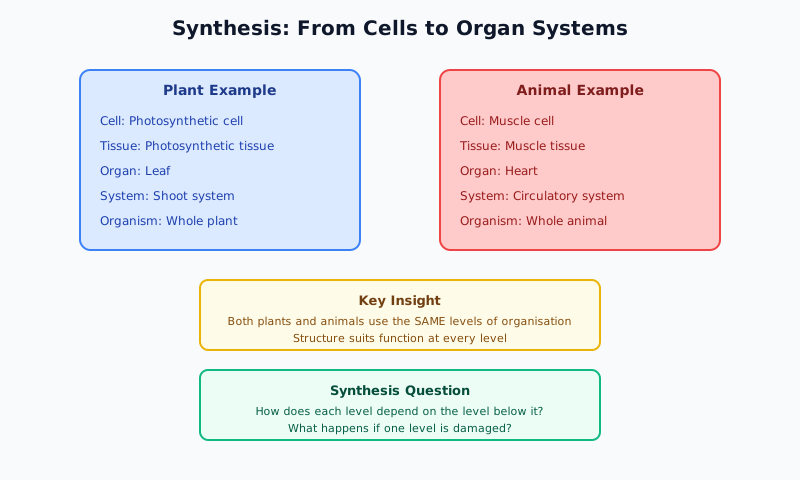
Diagram 2: Structure-Function Pair Cards
Visual cards showing four examples (e.g. root, heart, leaf, muscle tissue) with a structure image on one side and the linked function description on the other.
Today's hook pointed out that a wombat and a wattle bush look nothing alike, yet both follow the exact same organisational rules from cell to system, and challenged you to prove it. That shared blueprint is the big idea tying the whole unit together.
Now that you've worked through the lesson, can you write that proof? Use specific examples from both a plant and an animal to show that all living things share the same fundamental organisational pattern from cell to organ system.
Q1. Explain what is meant by increasing organisation in a living thing.
1 mark for describing cells, 1 mark for describing tissues or organs, 1 mark for describing organ systems or the progression.Q2. Compare how a plant and an animal can both be described as living systems.
1 mark for plant example with roles, 1 mark for animal example with roles, 1 mark for stating both are organised, 1 mark for stating both have interacting components.Q3. Why is a structure-function explanation stronger than a list of biological parts?
1 mark for explaining what structure-function means, 1 mark for explaining why a list is weak, 1 mark for linking to how the organism works, 1 mark for a concrete example.Model answers (click to reveal)
Model Answers
+Multiple Choice
1: C. Both plants and animals can be described as organised living systems with interacting parts.
2: A. This is the correct order of increasing organisation.
3: D. A list of parts is weaker because it does not show role or interaction.
4: B. This answer links structure to function and system support.
5: C. Organisation ideas prepare you for transport and exchange in living systems.
Short Answer 1 (3 marks)
Increasing organisation means that smaller living units combine into larger functional structures. Cells can form tissues, tissues can form organs, and organs may work together in organ systems.
1 mark for describing cells. 1 mark for describing tissues or organs. 1 mark for describing organ systems or the progression.
Short Answer 2 (4 marks)
A plant can be described as a living system because parts such as roots, stems and leaves have connected roles that support survival. An animal can be described as a living system because cells, tissues, organs and organ systems interact to keep the organism functioning. Both are organised living systems because their parts work together rather than in isolation.
1 mark for plant example with roles. 1 mark for animal example with roles. 1 mark for stating both are organised. 1 mark for stating both have interacting components.
Short Answer 3 (4 marks)
A structure-function explanation is stronger because it explains what a part does and how it supports the whole organism. A list of parts only names structures and does not show their roles or the interactions between them.
1 mark for explaining what structure-function means. 1 mark for explaining why a list is weak. 1 mark for linking to how the organism works. 1 mark for a concrete example or clear synthesis.
Revisit Your Thinking
Return to the opening question. Your answer should now use organisation, interaction and structure-function reasoning.
Model answers (click to reveal)
Model Answers
+Multiple Choice
1: C. Both plants and animals can be described as organised living systems with interacting parts.
2: A. This is the correct order of increasing organisation.
3: D. A list of parts is weaker because it does not show role or interaction.
4: B. This answer links structure to function and system support.
5: C. Organisation ideas prepare you for transport and exchange in living systems.
Short Answer 1 (3 marks)
Increasing organisation means that smaller living units combine into larger functional structures. Cells can form tissues, tissues can form organs, and organs may work together in organ systems.
1 mark for describing cells. 1 mark for describing tissues or organs. 1 mark for describing organ systems or the progression.
Short Answer 2 (4 marks)
A plant can be described as a living system because parts such as roots, stems and leaves have connected roles that support survival. An animal can be described as a living system because cells, tissues, organs and organ systems interact to keep the organism functioning. Both are organised living systems because their parts work together rather than in isolation.
1 mark for plant example with roles. 1 mark for animal example with roles. 1 mark for stating both are organised. 1 mark for stating both have interacting components.
Short Answer 3 (4 marks)
A structure-function explanation is stronger because it explains what a part does and how it supports the whole organism. A list of parts only names structures and does not show their roles or the interactions between them.
1 mark for explaining what structure-function means. 1 mark for explaining why a list is weak. 1 mark for linking to how the organism works. 1 mark for a concrete example or clear synthesis.
● Organisation
Living things show increasing organisation from cells to larger functional structures.
● Shared Systems Logic
Plants and animals are different, but both are organised systems with interacting parts.
● Better Explanations
Strong science answers link structure, function and interaction instead of listing terms.
● Checkpoint Ready
The first block is now consolidated and ready for Checkpoint 1.