Unit Synthesis & Depth Study Preparation
In 2004, the Indian Ocean tsunami and the 2000 Sydney Olympics both demonstrated that waves, forces, and motion are one connected physical story, not three separate topics.
Pick one piece of technology you use every day (phone, headphones, microwave, car). Which wave and motion concepts from this unit does it rely on? Try to identify at least two connections before you start the lesson.
Think about all the topics covered in Unit 3, forces, Newton's laws, motion graphs, waves, and technology. How do these ideas connect to each other? Draw or describe a web of connections between at least three of these topics.
● Know
- Key concepts from across the Waves and Motion unit
- How waves, forces, and motion interconnect
- The structure and expectations of a depth study
● Understand
- How scientific concepts build on each other
- How to connect ideas from different parts of the unit
- What makes a good scientific investigation question
● Can do
- Synthesise concepts across the unit
- Formulate investigable questions
- Plan a depth study using scientific methodology
Imagine you are one of the Geoscience Australia scientists who reconstructed the 2004 Indian Ocean tsunami in the weeks after it struck: you have seismograph records, ocean buoy wave-height data, and satellite images of the wave front. To explain what happened, you need to apply every concept from this unit at once, the wave equation to calculate speed, Newton's laws to model the force of water hitting a shoreline, and experimental reasoning to evaluate which data sources are reliable. This unit has built those tools; a depth study lets you apply them to one real question in genuine depth.
Topic selection: Choose something that genuinely interests you and connects to multiple unit concepts. Good topics include:
- A specific technology (ultrasound imaging, GPS, accelerometers, optical fibres)
- A natural phenomenon (tsunami physics, earthquake waves, animal locomotion)
- A historical investigation (Galileo inclined plane experiments, Newton development of his laws)
- An engineering challenge (bridge design, vehicle safety, sports equipment)
Research question: Formulate a specific, investigable question. Bad: "How do waves work?" Good: "How does the wavelength of light affect the resolution limit of optical microscopes, and what alternatives exist for observing smaller structures?"
Connecting concepts: A strong depth study weaves together wave properties, the wave equation, EM spectrum, forces, Newton laws, and motion graphs.
Depth study topic: The physics of cricket bat performance.
Research question: "How do bat mass, shape, and material affect the ball exit speed, and what trade-offs exist between power and control?"
Connections to unit:
- Newton Second Law: F = ma during the bat-ball collision.
- Newton Third Law: Bat exerts force on ball; ball exerts equal force on bat.
- Conservation of momentum: m_bat × v_bat + m_ball × v_ball = constant.
- Elastic collisions: Coefficient of restitution determines energy transfer.
- Waves: Vibration modes in the bat affect the sweet spot location.
- Motion graphs: High-speed video analysis of bat swing and ball exit velocity.
Australian depth study opportunities: Australian students can conduct unique physics investigations. Measure the speed of sound at different temperatures using outdoor spaces. Investigate how cricket bat sweet spot location varies with bat profile. Analyse AFL ball aerodynamics using video tracking. Study wave reflection and refraction in swimming pools or ponds. Visit the Sydney Harbour Bridge or a local dam to investigate structural forces. Use smartphone sensors to measure acceleration on amusement park rides. The Australian environment provides rich opportunities for authentic physics investigations.
A physics depth study is just research from books and websites. This is false. The best depth studies include primary data collection - experiments, measurements, surveys, or interviews. Collecting your own data and analysing it using the physics concepts from this unit demonstrates deeper understanding than summarising secondary sources. Even simple experiments with school equipment can produce valuable data if designed carefully and analysed rigorously. The key is original investigation, not just literature review.
Connect the key concepts from this unit. Click two connected ideas to explain the link.
Designing and reporting a physics depth study requires attention to experimental validity and clear communication.
Experimental design:
- State your independent, dependent, and control variables explicitly.
- Describe your method in sufficient detail for replication.
- Include risk assessments for any practical work.
- Justify your sample size and measurement instruments.
Data presentation:
- Use tables with clear headings, units, and uncertainties.
- Plot graphs with labelled axes, appropriate scales, and error bars where relevant.
- Show calculations with working.
- Identify and discuss anomalies.
Analysis:
- Compare results with theoretical predictions.
- Calculate percentage differences.
- Discuss sources of error and their impact.
- Suggest improvements.
Conclusion: Answer your research question directly. State the strength of your evidence. Acknowledge limitations.
Depth study: Investigating how string tension affects wave speed on a string.
Method: A 2 m string is stretched between two fixed points. One end is attached to a force meter to measure tension. The other end is flicked to create a pulse. Time for the pulse to travel to the end and back is measured with a stopwatch. Tension is varied by hanging different masses.
Data: Tension (N) vs time for round trip (s) for 5 trials each. Speed calculated as v = 2L/t.
Graph: Speed vs √T (should be linear if v ∝ √T).
Analysis: The graph is approximately linear with some scatter. Percentage difference from theoretical slope is 8%. Main error source: timing uncertainty (human reaction time ~0.2 s, which is significant fraction of total time ~0.5 s). Improvement: use electronic timing gates or high-speed video.
Conclusion: Wave speed on a string increases with tension, consistent with the theoretical relationship v = √(T/μ) where μ is mass per unit length.
Australian science fair culture: The Young Scientist Awards, STANSW Young Scientist, and regional science fairs provide platforms for students to present physics depth studies. These competitions value originality, rigorous methodology, and clear communication. Many past winners have conducted physics investigations that led to published papers or patent applications. Australian universities offer summer research scholarships for high school students, providing mentorship and laboratory access for ambitious projects. These opportunities encourage students to go beyond curriculum requirements and engage with authentic scientific inquiry.
Experiments that do not match theory have failed. This is false. Discrepancies between experiment and theory are opportunities for learning. They may reveal experimental errors, limitations of the theory, or new phenomena. The Michelson-Morley experiment failed to detect the aether, but this "failure" led to relativity. The Stern-Gerlach experiment produced unexpected results that led to quantum spin. In school science, discrepancies should be analysed, not hidden. Discussing why results differ from predictions demonstrates deeper understanding than forcing data to fit theory.
Evaluating sources is as important in physics as in any science.
Reliable sources:
- Peer-reviewed physics journals (Physical Review, European Journal of Physics, Australian Journal of Physics)
- Textbooks from reputable publishers
- University lecture notes and open courseware
- Government science agencies (CSIRO, Geoscience Australia, ANSTO)
- International standards bodies (BIPM, ISO)
Unreliable sources:
- Conspiracy websites claiming to overturn established physics
- Social media posts without citations
- Product advertisements with selective data
- Sites promoting perpetual motion machines or free energy devices
Red flags: Claims that violate conservation laws, appeals to secret knowledge, dismissal of peer review, and promises of revolutionary breakthroughs that mainstream science ignores. If a claim contradicts well-established physics, extraordinary evidence is required.
When researching for a depth study on renewable energy, you might encounter claims that "perpetual motion machines can generate free energy." These claims violate the First and Second Laws of Thermodynamics and have never been demonstrated under controlled conditions. The US Patent Office refuses perpetual motion patents unless working models are provided (and none ever have been). When evaluating such claims, check whether they have been published in peer-reviewed journals, replicated by independent researchers, and accepted by the scientific community. The absence of these indicators is strong evidence that the claims are unfounded.
Australian science communication: Organisations like the Australian Science Media Centre (AusSMC) and Cosmos Magazine promote evidence-based science communication. Australian physicists including Brian Schmidt (Nobel laureate), Michelle Simmons (quantum computing pioneer), and Karl Kruszelnicki (science populariser) model how to communicate physics accurately to the public. Australian science educators combat misinformation by teaching students to evaluate sources, understand the process of peer review, and recognise the hallmarks of pseudoscience. These skills protect students from misinformation throughout their lives.
Established physics cannot be challenged. This is false. Physics is constantly refined and extended. But challenging established physics requires extraordinary evidence, not just opinion. Einstein challenged Newton, but he did so with rigorous mathematics and predictions that were confirmed by observation. Anyone can challenge physics, but to be taken seriously, they must provide testable predictions, reproducible evidence, and mathematical consistency. Extraordinary claims require extraordinary evidence - this is not closed-mindedness but the standard that has made science successful.
Quick-fire true or false on unit concepts.
Sound requires a medium to travel.
Light travels faster than sound in air.
A stationary object has no forces acting on it.
F = ma means force equals mass times acceleration.
Action-reaction forces act on the same object.
The slope of a distance-time graph gives speed.
All electromagnetic waves travel at the same speed in vacuum.
Weight and mass are the same thing.
A depth study lets you explore a question that interests you. Here is a structured approach:
- Choose a topic related to waves or motion that genuinely interests you.
- Formulate an investigable questionit must be specific, testable, and linked to scientific concepts.
- Research backgroundwhat do scientists already know? What gaps remain?
- Develop a hypothesisa testable prediction with scientific reasoning.
- Design your methodidentify variables, choose equipment, plan fair tests.
- Collect and analyse datause tables, graphs, and calculations.
- Draw conclusionsdoes your evidence support your hypothesis? What are the limitations?
- Communicate findingspresent as a report, poster, or digital presentation.
Which of the following is the BEST investigable question for a depth study on waves?
Wrong: "A depth study is just a long essay about a science topic." No, a depth study is an investigation. It requires you to ask a question, gather evidence, analyse data, and draw conclusions. It is active science, not just research.
Right: A depth study is an active scientific investigation, not an essay. It requires you to develop a testable question, design a method, collect and analyse real data, and draw evidence-based conclusions. While some written communication is involved, the core of a depth study is doing science, forming hypotheses, testing them, and evaluating results.
Wrong: "Waves and forces are completely separate topics with no connection." No, they are deeply connected. Forces create waves (vibrations, accelerating charges). Waves exert forces (radiation pressure, sound pushing eardrums). Understanding both gives a more complete picture.
Right: Waves and forces are deeply interconnected. Forces cause vibrations that create mechanical waves (sound, water waves). Accelerating electric charges create electromagnetic waves (light, radio). Waves themselves can exert forces, sound waves push on your eardrums, light exerts radiation pressure. Understanding both topics together gives a richer picture of how the physical world works.
Wrong: "Once I memorise the formulas, I understand the physics." No, formulas are tools, not understanding. True understanding means being able to explain why the formulas work, apply them to new situations, and connect them to real-world phenomena.
Right: Formulas are compact tools for expressing relationships, but memorising them without understanding is not physics. True understanding means being able to explain what the variables represent, predict what happens when each changes, apply the concept to new and unfamiliar situations, and connect it to the real world, for example, knowing WHY F = ma, not just how to substitute numbers.
Australian Scientists in Waves and Motion
Ruby Payne-Scott (1912-1981): Australia's first female radio astronomer. She used radio waves to study the Sun, discovering Type I and Type II solar radio bursts. Her work laid the foundation for radio astronomy in Australia and worldwide, and she worked at what is now the CSIRO.
Dr. Elizabeth Blackburn (Nobel Prize 2009): While best known for her work on telomeres, her scientific approach exemplifies how understanding wave-based techniques (like X-ray crystallography used to study molecular structures) contributes to breakthrough discoveries. Australian scientists routinely use wave-based imaging and spectroscopy across all fields.
Modern Australian research: Today, Australian researchers at ANSTO (Australian Nuclear Science and Technology Organisation) use neutron beams (wave-particle duality) to study materials. The Australian Synchrotron generates intense X-rays for medical and materials research. CSIRO scientists use lidar (light detection and ranging) to map forests, coastlines, and atmospheric conditions. Understanding waves and motion is at the heart of Australian scientific innovation.
✍ Copy Into Your Books
▾Wave Equation
- v = f × λ (wave speed = frequency x wavelength)
- Applies to all waves
Newton's Laws
- First: objects maintain their state of motion
- Second: F = ma
- Third: every action has an equal and opposite reaction
Depth Study Steps
- Choose a topic
- Formulate a question
- Research background
- Develop a hypothesis
- Design a fair test
- Collect and analyse data
- Draw conclusions
- Communicate findings
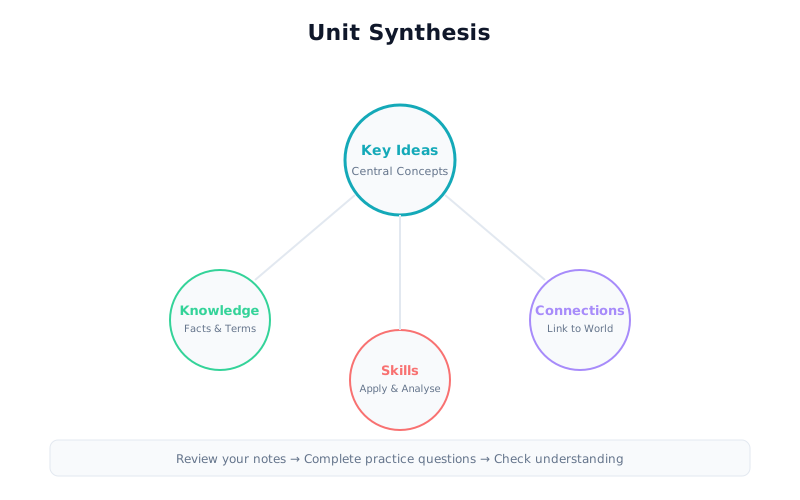
Concept Connections
Depth Study Planning
At the start of this lesson you were shown forces, motion, and waves not being three separate topics but one connected story, a tsunami starting as an unbalanced seismic force, travelling as a wave obeying the wave equation, and crashing ashore as kinetic energy governed by Newton's laws.
Now that you've worked through the lesson, how has your thinking shifted? Can you explain that hook idea more precisely using what you've learned today?
Q1. 1. Synthesise your understanding by explaining how at least three concepts from this unit connect to explain one real-world phenomenon of your choice. 4 MARKS
Q2. 2. Evaluate the statement: "Understanding waves and motion is essential for modern technology but has little relevance to understanding the natural world." Use evidence from this unit. 4 MARKS
Q3. 3. Design an investigation to test how the amplitude of a wave affects the energy it carries. Include your hypothesis, variables, method, and how you will analyse results. 4 MARKS
Revisit Your Thinking
Go back to your Think First answer. Has your understanding changed?
- How has your understanding of waves and motion developed across this entire unit?
- What connections between concepts do you find most powerful or surprising?
Model answers (click to reveal)
Answers
▾MCQ 1
BThe wave equation is v = f × λ, where v is wave speed (m/s), f is frequency (Hz), and lambda is wavelength (m).
MCQ 2
CNewton's third law states that for every action force, there is an equal and opposite reaction force. This explains rocket propulsion, walking, and many everyday phenomena.
MCQ 3
BValidity means the investigation measures what it claims to measure. A valid experiment has a fair test with appropriate variables controlled.
MCQ 4
CSound is a mechanical wave because it requires a medium (solid, liquid, or gas) to travel. Light, radio waves, and X-rays are electromagnetic waves that do not need a medium.
MCQ 5
CThe independent variable is the one deliberately changed by the investigator. The dependent variable is measured, and controlled variables are kept constant.
Short Answer 1
Model answer: (Example: rocket launch) Rocket propulsion connects three key concepts from this unit. First, Newton's third law explains the motion: as the rocket engine expels hot gases downward (action), the gases push the rocket upward with an equal and opposite force (reaction). Second, Newton's second law (F=ma) explains the rocket's acceleration: the greater the thrust force and the lighter the rocket (as fuel burns, mass decreases), the greater the acceleration. Third, the concept of waves connects to the combustion process, the burning fuel releases energy as heat and light (infrared and visible electromagnetic waves), and the exhaust gases create pressure waves. Together, these concepts explain why rockets can overcome gravity and reach orbit.
Short Answer 2
Model answer: This statement is incorrect. Understanding waves and motion is profoundly relevant to the natural world. Seismic waves (P-waves, S-waves, surface waves) reshape Earth's surface through earthquakes and have revealed the structure of Earth's interior. Ocean waves and tsunamis, driven by forces and energy transfer, shape coastlines and affect marine ecosystems. Animals use sound waves for echolocation (bats, dolphins) and communication (whales, elephants). Light waves power photosynthesis, the foundation of nearly all food chains. The Doppler effect applied to light from distant galaxies provided evidence for the expanding universe. While wave and motion science certainly enables technology (MRI, GPS, renewable energy), its relevance to understanding the natural world is equally profound and pervasive.
Short Answer 3
Model answer: Hypothesis: As the amplitude of a wave increases, the energy it carries will increase proportionally (or by the square of amplitude). Variables: Independent = amplitude of the wave (controlled by increasing the height of water waves or the displacement of a slinky). Dependent = energy transferred (measured by the distance a cork moves, or the temperature increase in a small volume of water). Controlled = wavelength, frequency, medium, distance from source. Method: (1) Set up a wave generator (e.g., ripple tank or oscillating paddle) at fixed frequency. (2) Generate waves at low amplitude and measure the energy effect (e.g., cork displacement). (3) Repeat with medium and high amplitudes, keeping all other variables constant. (4) Repeat each amplitude three times for reliability. (5) Calculate mean energy for each amplitude. Analysis: Plot energy versus amplitude. If energy increases with amplitude, the hypothesis is supported. Consider whether the relationship is linear or proportional to amplitude squared.