Motion Graphs
In 2019, a Sydney court used a car's speed-time graph to prove its speed peaked at 87 km/h, settling a crash investigation without a single eyewitness.
Look at a graph where an object's line is completely flat (horizontal). Is the object moving or stationary? How can you tell the difference between "not moving" and "moving at constant speed" on a distance-time graph?
Two runners appear on the same distance-time graph. Runner A has a steeper line than Runner B. What does the steepness (gradient) tell you? What would the graph look like if Runner A was slowing down?
● Know
- How to read distance-time and speed-time graphs
- What slope represents on each type of graph
- How to calculate distance from the area under a speed-time graph
● Understand
- Why slope on a distance-time graph equals speed
- Why slope on a speed-time graph equals acceleration
- How to compare different motions using graphs
● Can do
- Interpret distance-time and speed-time graphs
- Calculate speed and acceleration from graphs
- Sketch graphs based on a description of motion
Imagine watching a swimmer do laps: for 30 seconds they move steadily, then stop at the wall, then push off again faster. Draw position against time and you get a sloped line, a flat section, then a steeper slope. Draw speed against time and you get a constant line, a drop to zero, then a rise. Graphs are the most powerful tools for representing motion because every feature, slope, flatness, area under the curve, translates directly to a physical quantity you can calculate.
Distance-time graphs:
- Slope = speed. Steeper slope means faster speed. Shallow slope means slower speed.
- Flat line (zero slope): Distance is not changing. The object is stationary (speed = 0).
- Straight line: Constant speed. The object covers equal distances in equal times.
- Curved line: Changing speed. A curve getting steeper means speeding up; getting shallower means slowing down.
Speed-time graphs:
- Slope = acceleration. Steeper slope means greater acceleration.
- Flat line: Constant speed (zero acceleration).
- Horizontal axis (speed = 0): Stationary.
- Area under graph = distance travelled.
A cyclist journey represented on a distance-time graph:
From t=0 to t=10 min: straight line from (0,0) to (10, 3 km). Slope = 3/10 = 0.3 km/min = 18 km/h. Constant speed.
From t=10 to t=15 min: flat line at 3 km. Slope = 0. The cyclist is stationary (perhaps at traffic lights).
From t=15 to t=25 min: straight line from (15, 3) to (25, 8). Slope = 5/10 = 0.5 km/min = 30 km/h. Faster constant speed.
Total distance = 8 km. Total time = 25 min. Average speed = 8/25 = 0.32 km/min = 19.2 km/h.
On a speed-time graph, the same journey would show: 18 km/h horizontal line from 0-10 min, 0 km/h from 10-15 min, 30 km/h from 15-25 min. The area under the graph = (18 × 10/60) + 0 + (30 × 10/60) = 3 + 0 + 5 = 8 km, confirming the distance.
Australian transport data: GPS data from Australian vehicles produces distance-time and speed-time graphs that transport planners use to analyse traffic patterns. The Bureau of Infrastructure and Transport Research Economics publishes reports on congestion, travel times, and vehicle speeds across Australian cities. These analyses rely on the same graph-reading skills students learn in physics class. Real-time traffic apps like Google Maps use aggregated GPS data to estimate travel times and suggest routes, applying kinematic principles at massive scale.
A curved distance-time graph means the object is moving along a curved path. This is false. A distance-time graph only shows how distance changes with time, not the path shape. An object moving in a straight line at changing speed produces a curved distance-time graph. An object moving in a circle at constant speed produces a straight distance-time graph (if distance means distance travelled along the path). The axes are distance vs time, not position coordinates. Do not confuse the graph shape with the physical path.
Find the error in this student interpretation of a distance-time graph.
- A flat line means distance is not changing.
- If distance is not changing, the object is not moving.
- The slope of a flat line is zero, so speed is zero.
- The student is correct about constant speed but wrong about the value.
Speed-time graphs contain rich information about motion.
Acceleration from slope:
a = Δv/Δt = slope of speed-time graph.
Positive slope = speeding up (positive acceleration).
Negative slope = slowing down (deceleration or negative acceleration).
Zero slope = constant speed (zero acceleration).
Distance from area:
For constant speed: distance = speed × time = area of rectangle.
For uniformly accelerated motion: distance = average speed × time = area of trapezium or triangle.
For non-uniform acceleration: the area under the curve still equals distance, calculated by integration or by counting squares.
Constant acceleration equations: When acceleration is constant, we can derive useful equations:
v = u + at
s = ut + ½at²
v² = u² + 2as
Where u = initial velocity, v = final velocity, a = acceleration, t = time, s = distance.
A car accelerates uniformly from rest to 20 m/s in 10 seconds, then maintains this speed for 20 seconds, then brakes uniformly to rest in 5 seconds.
Speed-time graph: triangle (0-10 s) + rectangle (10-30 s) + triangle (30-35 s).
Acceleration phase: a = (20-0)/10 = 2 m/s². Distance = area = ½ × 10 × 20 = 100 m.
Constant speed phase: a = 0. Distance = 20 × 20 = 400 m.
Braking phase: a = (0-20)/5 = -4 m/s². Distance = ½ × 5 × 20 = 50 m.
Total distance = 100 + 400 + 50 = 550 m.
Total time = 35 s. Average speed = 550/35 = 15.7 m/s (56.6 km/h).
This example shows how the area method works for complex motion with multiple phases.
Australian vehicle testing: The Australasian New Car Assessment Program (ANCAP) measures braking performance using speed-time graphs. Test vehicles are accelerated to 100 km/h, then emergency braking is applied. The speed-time graph shows deceleration rate and stopping distance. Top-rated vehicles achieve stopping distances under 35 metres from 100 km/h. Australian car reviewers like Carsales and WhichCar publish braking graphs for new vehicles, allowing consumers to compare safety performance. These graphs are direct applications of speed-time analysis.
Negative acceleration always means slowing down. This is false. Negative acceleration means acceleration in the negative direction (opposite to the chosen positive direction). If an object is moving in the negative direction and experiences negative acceleration, it is speeding up in the negative direction. For example, a ball thrown upward has negative acceleration (gravity acts downward) while moving upward - it is slowing down. After reaching the peak, it moves downward with negative acceleration - now it is speeding up in the negative direction. Whether negative acceleration means slowing down depends on the direction of motion.
Velocity is speed with direction. While speed is always positive (or zero), velocity can be positive or negative depending on the chosen coordinate system.
Velocity-time graphs show velocity on the y-axis and time on the x-axis. They contain the same information as speed-time graphs but with directional information.
Key features:
- Positive velocity = moving in positive direction.
- Negative velocity = moving in negative direction.
- Crossing the time axis = momentarily stationary (changing direction).
- Slope = acceleration (same as speed-time graph).
- Area above time axis = positive displacement.
- Area below time axis = negative displacement.
- Total displacement = signed area (above minus below).
- Total distance = total area (above plus below, all positive).
A ball is thrown upward at 20 m/s. Taking upward as positive:
Velocity-time graph: straight line from (0, 20) to (2, -20), passing through (2, 0).
Slope = a = (-20 - 20)/2 = -10 m/s² (acceleration due to gravity).
At t=2 s, v=0 - the ball is at its peak.
At t=4 s, v=-20 m/s - the ball is falling at 20 m/s downward.
Displacement at t=4 s: area of triangle above axis (½ × 2 × 20 = 20 m up) plus area of triangle below axis (½ × 2 × (-20) = -20 m down) = 0 m. The ball returns to its starting point.
Total distance at t=4 s: 20 + 20 = 40 m. The ball travelled 20 m up and 20 m down.
This example illustrates the crucial difference between displacement (vector, can be zero) and distance (scalar, always positive).
Australian sports science: The Australian Institute of Sport uses velocity-time data from wearable sensors to analyse athlete performance. Sprinters velocity-time graphs show rapid acceleration from the blocks, reaching peak velocity around 40-60 metres, then slight deceleration. Coaches use these graphs to identify weaknesses - some athletes accelerate well but cannot maintain top speed; others have slow starts but strong finishes. Australian swimmers are analysed similarly, with velocity measured through underwater video tracking. These analyses help coaches tailor training to individual physiology.
Distance and displacement are the same thing. This is false. Distance is a scalar - the total path length travelled, always positive. Displacement is a vector - the change in position from start to finish, including direction. If you walk 3 m east then 3 m west, your distance is 6 m but your displacement is 0. In physics problems, it is crucial to identify whether the question asks for distance (scalar) or displacement (vector). Using displacement when distance is required (or vice versa) is a common source of errors.
- Flat line on distance-time graph
- Straight line on distance-time graph
- Positive slope on speed-time graph
- Area under speed-time graph
- Negative velocity on v-t graph
- Object moving in opposite direction
- Object is accelerating
- Distance travelled
- Object moves at constant speed
- Object is stationary
Motion graphs let us compare different objects visually:
- On a distance-time graph, the object with the steeper line is moving faster.
- On a speed-time graph, the object with the steeper positive slope has the greater acceleration.
- Two objects that meet on a distance-time graph have travelled the same distance at that time.
Example: In a race between a sprinter and a marathon runner, the sprinter's distance-time graph starts very steep (fast) but flattens out quickly (tires). The marathon runner's graph is less steep but stays steady for much longer.
On a distance-time graph, two lines cross at the 8-second mark. What does this tell you?
Wrong: "A horizontal line on a distance-time graph means the object is moving at constant speed." No, a horizontal line means the object is stationary (not moving). A straight line sloping upward means constant speed.
Right: On a distance-time graph, a horizontal (flat) line means distance is not changing, the object is stationary. Constant speed is shown by a straight diagonal line with a positive slope. The steeper the slope, the greater the speed.
Wrong: "Acceleration always means speeding up." No, acceleration is the rate of change of speed. Negative acceleration (deceleration) means slowing down.
Right: Acceleration is any change in speed, including slowing down (negative acceleration, also called deceleration). A car braking to a stop is accelerating (negatively). On a speed-time graph, acceleration shows as an upward slope and deceleration shows as a downward slope.
Wrong: "The area under a distance-time graph gives the distance travelled." No, the area under a speed-time graph gives distance. The slope of a distance-time graph gives speed.
Right: The area under a speed-time graph gives the total distance travelled. The slope (gradient) of a distance-time graph gives speed. These two rules are for different graph types and should not be confused, using the wrong rule leads to incorrect answers.
Motion Analysis in Australian Context
Formula 1 and motorsport: Australia hosts the Australian Grand Prix in Melbourne. Engineers use speed-time and distance-time graphs to analyse car performance, optimise braking points and compare lap times. Tiny differences in acceleration shown on graphs can separate first place from tenth.
Traffic management: Australian transport authorities use motion data from GPS and sensors to analyse traffic flow. Graphs of speed versus time help identify congestion points and design better road networks. Smart motorways in Sydney and Melbourne use real-time motion analysis to adjust speed limits.
Athletics coaching: Australian Institute of Sport scientists use motion graphs to analyse sprinters' acceleration patterns. Graphs showing speed over time reveal whether an athlete is reaching peak speed too early or too late in a race, allowing coaches to adjust training programs.
✍ Copy Into Your Books
▾Distance-Time Graphs
- Horizontal = stationary
- Straight line up = constant speed
- Steeper = faster
- Slope = speed
Speed-Time Graphs
- Horizontal = constant speed
- Sloping up = speeding up (accelerating)
- Sloping down = slowing down (decelerating)
- Slope = acceleration
Area Under Graph
- Area under speed-time graph = distance travelled
- Rectangle: base x height
- Triangle: 1/2 x base x height
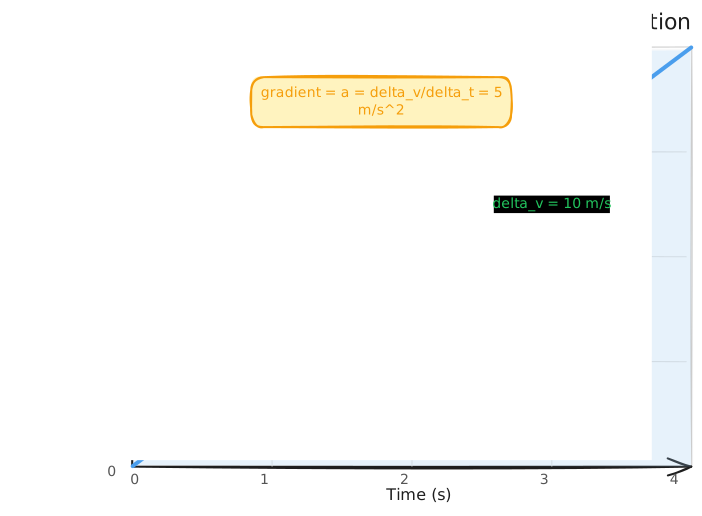
Graph Interpretation
Sketching Motion Graphs
At the start of this lesson you were shown a 2019 Sydney crash investigation settled not by eyewitnesses but by a motion graph from the car's computer, where the gradient of the speed-time curve proved the driver had braked rather than accelerated.
Now that you've worked through the lesson, how has your thinking shifted? Can you explain that hook idea more precisely using what you've learned today?
Q1. 1. Describe the motion shown by each section of a distance-time graph that: (a) is horizontal, (b) slopes upward steadily, (c) curves upward becoming steeper. 4 MARKS
Q2. 2. A car travels at 15 m/s for 10 seconds, then accelerates uniformly to 25 m/s over the next 5 seconds. Draw a speed-time graph and calculate the total distance travelled. 4 MARKS
Q3. 3. Explain how you can tell from a distance-time graph which of two objects is moving faster, and how you can tell from a speed-time graph which object has greater acceleration. 4 MARKS
Revisit Your Thinking
Go back to your Think First answer. Has your understanding changed?
- Can you now explain what the slope and area represent on different motion graphs?
- How would you use a motion graph to compare the performance of two athletes?
Model answers (click to reveal)
Answers
▾MCQ 1
CThe slope (gradient) of a distance-time graph represents speed. Steeper slope = higher speed.
MCQ 2
BA horizontal line on a speed-time graph means constant speed because the speed is not changing over time. Zero acceleration.
MCQ 3
BThe area under a speed-time graph represents the total distance travelled by the object.
MCQ 4
BAcceleration = change in speed / change in time = (20 - 0) / 5 = 4 m/s².
MCQ 5
BOn a distance-time graph, a steeper line means the object covers more distance in the same time, which means greater speed.
Short Answer 1
Model answer: (a) A horizontal line on a distance-time graph means the object is stationary, its distance is not changing over time. (b) A straight line sloping upward steadily means the object is moving at constant speed, the distance increases by the same amount each second. (c) A line that curves upward becoming steeper means the object is speeding up, it covers more distance each second, so its speed is increasing.
Short Answer 2
Model answer: The speed-time graph shows a horizontal line at 15 m/s from 0 to 10 seconds, then a straight line rising from 15 m/s to 25 m/s from 10 to 15 seconds. Distance = area under graph = (10 x 15) + 1/2 x 5 x (15 + 25) = 150 + 100 = 250 metres.
Short Answer 3
Model answer: On a distance-time graph, the object with the steeper slope is moving faster because it covers more distance in the same time. Speed equals the gradient of the distance-time graph. On a speed-time graph, the object with the steeper positive slope has greater acceleration because its speed is increasing more rapidly. Acceleration equals the gradient of the speed-time graph.