Newton's First Law, Inertia
In 1970, NASA launched Voyager's predecessor Apollo 13, its 13,800 kg service module coasting at 39,000 km/h with engines off, exactly as Newton predicted in 1687.
You are on a bus that suddenly brakes. Your body lurches forward. Why does this happen? What property of matter is responsible?
A ball rolls across a floor and eventually stops. Is a force required to keep it moving, or is something else stopping it? What would happen if the same ball were rolling in outer space with no friction?
● Know
- Newton's first law of motion
- What inertia means
- Examples of inertia in everyday life
● Understand
- Why objects in motion stay in motion unless acted on by a force
- Why force is NOT needed to keep an object moving
- How seatbelts work using inertia
● Can do
- Apply Newton's first law to real-world situations
- Explain why a moving object stops
- Predict motion based on forces
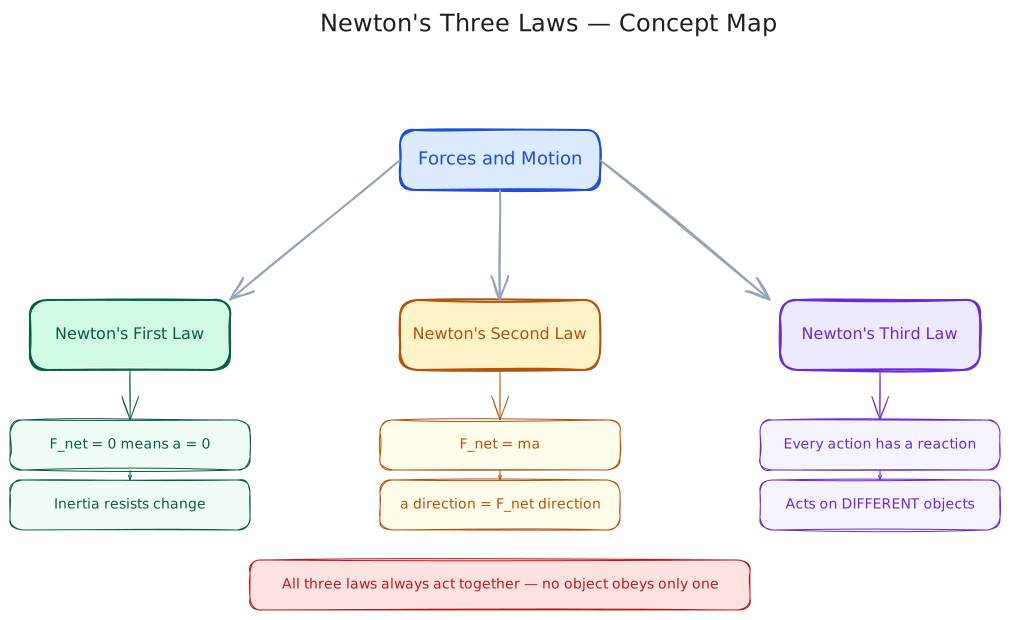
Imagine you're on a bus travelling at 60 km/h that suddenly brakes hard: your body lurches forward, sliding toward the seat in front, even though nothing pushed you. That lurch is inertia, your body wanted to keep moving at 60 km/h while the bus stopped beneath you. Newton's First Law of Motion states that an object will remain at rest or continue moving at constant velocity in a straight line unless acted upon by a net external force. Inertia is the name for this tendency of objects to resist any change in their state of motion.
Inertia is not a force. It is a property of matter. The more mass an object has, the more inertia it has, and the more force is required to change its motion. This is why it is harder to push a truck than a bicycle, and why a truck takes longer to stop.
Newton First Law seems counterintuitive because everyday experience involves friction and air resistance. On Earth, moving objects seem to slow down naturally. But in the vacuum of space, an object given a push would continue forever at constant velocity. The natural state of motion is uniform velocity, not rest.
In a car crash at 50 km/h, an unrestrained passenger continues moving at 50 km/h relative to the ground while the car crumples to a stop. Relative to the car, the passenger is hurled forward at 50 km/h - equivalent to falling from a three-storey building. The seatbelt applies a force to the passenger, gradually decelerating them with the car. Airbags provide additional force distribution over a larger area and longer time, reducing peak forces on the body. Crash tests show that seatbelts reduce fatal injuries by about 50% and airbags by a further 10-15%. These safety devices work by applying controlled forces to overcome inertia safely.
Australian vehicle safety: The Australasian New Car Assessment Program (ANCAP) crash-tests vehicles and awards star ratings based on occupant protection. Australian Design Rules mandate seatbelts, airbags, and crumple zones. The physics of inertia is directly applied: crumple zones increase collision time (reducing peak force), seatbelts and airbags distribute stopping forces across stronger body parts, and headrests prevent whiplash by supporting the head as the torso is pushed forward. Australian road safety campaigns have successfully increased seatbelt usage to over 95%, saving thousands of lives.
Inertia is a force that keeps moving objects moving. This is false. Inertia is not a force; it is a property of matter - the resistance to changes in motion. There is no "force of inertia." When a moving object continues moving, it is not because a force maintains the motion; it is because no force has stopped it. This was Galileo revolutionary insight, refined by Newton: motion does not require a cause, but changes in motion do. The idea that inertia is a force is a common misconception rooted in Aristotelian physics, which incorrectly taught that constant motion requires a constant force.
A car is travelling at 60 km/h. The driver suddenly brakes hard. Predict what happens to a mobile phone on the dashboard.
How close was your prediction?
Nice calibration, your intuition is good for this kind of problem.
Good, being surprised is the point. This answer is worth remembering.
The concept of inertia was developed through centuries of philosophical and experimental work.
Aristotle (384-322 BCE): Believed that objects naturally come to rest and that constant motion requires a constant force. This seemed consistent with everyday experience (pushed objects stop when you stop pushing), but it was fundamentally wrong because it ignored friction.
Galileo Galilei (1564-1642): Conducted experiments with inclined planes and rolling balls. He observed that a ball rolling down one plane and up another reaches nearly the same height. As the second plane is made shallower, the ball travels further to reach the same height. Extrapolating to a horizontal plane, Galileo concluded that the ball would roll forever in the absence of friction. This was the conceptual breakthrough that led to Newton First Law.
Isaac Newton (1643-1727): Formalised the principle as his First Law, defining inertia quantitatively as mass.
A magician tablecloth trick works because of inertia. A table setting (plates, glasses, cutlery) is at rest. When the cloth is pulled quickly, friction between cloth and objects acts for only a very short time before the cloth is gone. The impulse (force × time) is too small to overcome the objects inertia significantly, so they remain nearly stationary and do not fall. If the cloth is pulled slowly, friction acts for longer, giving a larger impulse, and the objects move with the cloth. The trick requires a rapid pull - minimising the time that friction can act on the objects. This is a practical demonstration of Newton First Law and the relationship between impulse and momentum.
Australian physics education: The Australian Academy of Science champions inquiry-based science education, including historical experiments that trace the development of ideas like inertia. Science by Doing resources include Galileo inclined plane experiments recreated with modern materials, allowing students to rediscover the law of inertia through their own investigations. Australian physics teachers emphasise the counterintuitive nature of Newton First Law, using demonstrations like air tracks (where friction is minimised) to show that objects really do continue moving without applied force.
In deep space, objects eventually slow down and stop because there is no force keeping them moving. This is false. In deep space, far from gravitational fields and without friction, there is no force to change an object motion. According to Newton First Law, it would continue at constant velocity forever. Voyager 1, launched in 1977, is now in interstellar space and will continue at essentially constant velocity for millions of years (until it approaches another star system or collides with something). Space is the best demonstration that motion does not require maintenance - it requires change.
Mass is the quantitative measure of inertia. The greater an object mass, the greater its resistance to changes in motion.
Mass is a scalar quantity - it has magnitude but no direction. It is measured in kilograms (kg). Mass is an intrinsic property of an object and does not depend on location, speed, or orientation. A 5 kg mass is 5 kg whether on Earth, the Moon, or in deep space, whether stationary or moving at 1000 km/h.
This is different from weight, which is a force (vector) that depends on gravitational field strength. Weight = mg. On Earth, g ≈ 9.8 N/kg. On the Moon, g ≈ 1.6 N/kg. The same object has the same mass but different weights.
Until 2019, the kilogram was defined by a physical cylinder of platinum-iridium in Paris. Since 2019, it has been defined by fixing the value of Planck constant, making the definition universal and independent of any physical artefact.
A loaded freight train might have a mass of 10,000 tonnes (10^7 kg). Its enormous inertia means it cannot stop quickly. Even with full braking, a freight train travelling at 80 km/h might need 2 km to stop. Attempting to stop faster would generate heat in the brakes that could melt them or cause wheel lockup and derailment. This is why railway crossings have such long warning times and why trains always have right of way. The physics is simple: F = ma. With enormous m, even large F produces small a. The train inertia makes it fundamentally different from road vehicles in terms of stopping distance and manoeuvrability.
Australian rail safety: Australia heavy haul railways in the Pilbara transport iron ore in trains up to 3 km long with total mass exceeding 40,000 tonnes. The inertia of these trains is staggering. Operators use distributed power (locomotives spaced along the train) to manage in-train forces and controlled braking algorithms that account for the train mass and track gradient. The Australian Transport Safety Bureau investigates rail incidents, often finding that failure to account for train inertia contributed to accidents. Understanding Newton First Law is literally a matter of life and death in Australian mining transport.
Heavier objects fall faster than light objects. This is false in vacuum, though true in air due to air resistance. Galileo reportedly demonstrated this at the Leaning Tower of Pisa (though the story may be apocryphal). In vacuum, a feather and a hammer fall at the same rate - demonstrated by astronaut David Scott on the Moon in 1971. The acceleration due to gravity (g) is independent of mass because while more massive objects have greater gravitational force, they also have greater inertia, and these two effects exactly cancel: F = ma -> mg = ma -> a = g. This is one of the most beautiful results in physics.
Seatbelts are one of the most important safety applications of Newton's first law. In a car crash, the car stops suddenly but the passengers' bodies tend to keep moving forward at the car's original speed.
A seatbelt applies a force to the passenger, bringing them to a stop safely over a longer period of time. Without a seatbelt, passengers can hit the windscreen, dashboard or steering wheel, or be thrown from the vehicle.
This is why seatbelt laws exist in every Australian state and territory.
In a car crash, why does a passenger without a seatbelt continue moving forward after the car stops?
Misconception: "A moving object needs a force to keep it moving."
Correction: This was Aristotle's view and was accepted for nearly 2000 years. Galileo and Newton showed that in the absence of friction, an object would keep moving forever. On Earth, friction and air resistance are the real reasons moving objects slow down, not a lack of force.
Why do objects on Earth slow down and stop if Newton's first law says they should keep moving?
Wrong: "Inertia is a type of force." No, inertia is a property of matter, not a force. It describes how objects resist changes to motion.
Right: Inertia is a property of matter that describes how strongly an object resists any change to its state of motion. It is not a force, no force is needed to maintain constant motion. Greater mass means greater inertia, but inertia itself never pushes or pulls anything.
Wrong: "Heavier objects fall faster because they have more inertia." No, in a vacuum, all objects fall at the same rate. Inertia affects how hard it is to stop a moving object, not how fast it falls.
Right: In the absence of air resistance, all objects fall with the same acceleration (about 9.8 m/s²) regardless of mass. Inertia describes resistance to changes in motion, a heavier object is harder to stop, but gravity accelerates all masses equally. Air resistance, not inertia, causes lighter objects to fall more slowly on Earth.
Wrong: "Seatbelts are unnecessary at low speeds." No, even at 30 km/h, a passenger's body continues moving at that speed in a crash. The forces involved are enough to cause serious injury.
Right: Seatbelts are essential at all speeds. At 30 km/h, an unrestrained passenger's body continues moving forward at that speed after the car stops, the impact force is enough to cause serious head and chest injuries. In Australia, seatbelts are legally required in every state and territory for this exact reason.
Inertia in Australian Context
Road safety: Australia's Towards Zero strategy aims to eliminate road deaths. Understanding inertia is central to this, crumple zones, seatbelts and airbags all work by managing the inertia of occupants during collisions. The Monash University Accident Research Centre (MUARC) conducts world-leading research into vehicle safety.
Train safety: Trains have enormous inertia due to their mass. Australian rail networks use long braking distances because a fully loaded freight train can take over a kilometre to stop. Understanding inertia helps design safer railway crossings and signalling systems.
Space exploration: The Australian Space Agency contributes to missions where Newton's first law is essential. In space, with negligible friction, spacecraft coast for millions of kilometres without using fuel, a direct application of inertia.
✍ Copy Into Your Books
▾Newton's First Law
- Objects stay at rest or in uniform motion unless acted on by an unbalanced force
- Force changes motion; it does not maintain it
- Galileo and Newton corrected Aristotle's 2000-year-old mistake
Inertia
- The tendency to resist changes in motion
- Greater mass means greater inertia
- Not a force, a property of matter
Safety Applications
- Seatbelts prevent passengers from continuing forward in a crash
- Crumple zones increase stopping time and reduce force
- Understanding inertia saves lives on roads and railways
Inertia Experiments
Analysing Inertia Scenarios
At the start of this lesson you were shown Voyager 1 coasting through interstellar space at 61,500 km/h with its engines off for 45 years, proof that an object in motion stays in motion unless something stops it.
Now that you've worked through the lesson, how has your thinking shifted? Can you explain that hook idea more precisely using what you've learned today?
Q1. 1. Explain Newton's first law using the example of a passenger in a car that suddenly stops. Include the concept of inertia in your answer. 4 MARKS
Q2. 2. Why is it easier to stop a bicycle than a truck moving at the same speed? Use the concept of inertia. 4 MARKS
Q3. 3. Describe the common misconception that 'force is needed to keep things moving.' Explain why this is incorrect and what actually causes moving objects to slow down on Earth. 4 MARKS
Revisit Your Thinking
Go back to your Think First answer. Has your understanding changed?
- Can you now explain why a moving object does not need a force to keep it moving?
- How would you convince someone that seatbelts are essential using Newton's first law?
Model answers (click to reveal)
Answers
▾MCQ 1
CNewton's first law states that an object remains at rest or continues at constant velocity unless acted on by an unbalanced external force.
MCQ 2
BInertia is the tendency of an object to resist changes to its motion. It depends on mass.
MCQ 3
DA truck has the greatest mass and therefore the greatest inertia, making it hardest to stop.
MCQ 4
BWhen the bus brakes, your body tends to keep moving forward due to inertia. The seat or seatbelt applies a force to stop you.
MCQ 5
CIn deep space with negligible forces, a moving object would continue moving at constant speed indefinitely due to inertia.
Short Answer 1
Model answer: When a car suddenly stops, the passenger's body continues moving forward at the car's original speed due to inertia. Inertia is the tendency of the body to resist changes to its motion. The seatbelt applies a backward force to the passenger, bringing them to a stop safely over a longer time. Without a seatbelt, the passenger would hit the windscreen or dashboard because no force acts on them to stop their forward motion.
Short Answer 2
Model answer: It is easier to stop a bicycle than a truck at the same speed because the bicycle has less mass and therefore less inertia. Inertia is the resistance of an object to changes in its motion. The truck's greater mass means it has greater inertia, so a larger force or longer time is needed to bring it to a stop. This is why trucks need much longer braking distances than bicycles.
Short Answer 3
Model answer: The common misconception, held by Aristotle for nearly 2000 years, is that a continuous force is needed to keep an object moving. Galileo and Newton showed this is incorrect: in the absence of friction, an object would keep moving forever at constant velocity. On Earth, moving objects slow down because of friction and air resistance, these are forces that oppose motion. Once you remove friction (as in space), no force is needed to maintain motion.