Learning Goals
- Identify the three parts of a nucleotide and their functions
- Label key components of the DNA double helix
- State the base pairing rules for DNA
Warm Up
Label the diagram
Use the lesson to fill in the table below. Write the name and function of each labelled part of the DNA double helix.
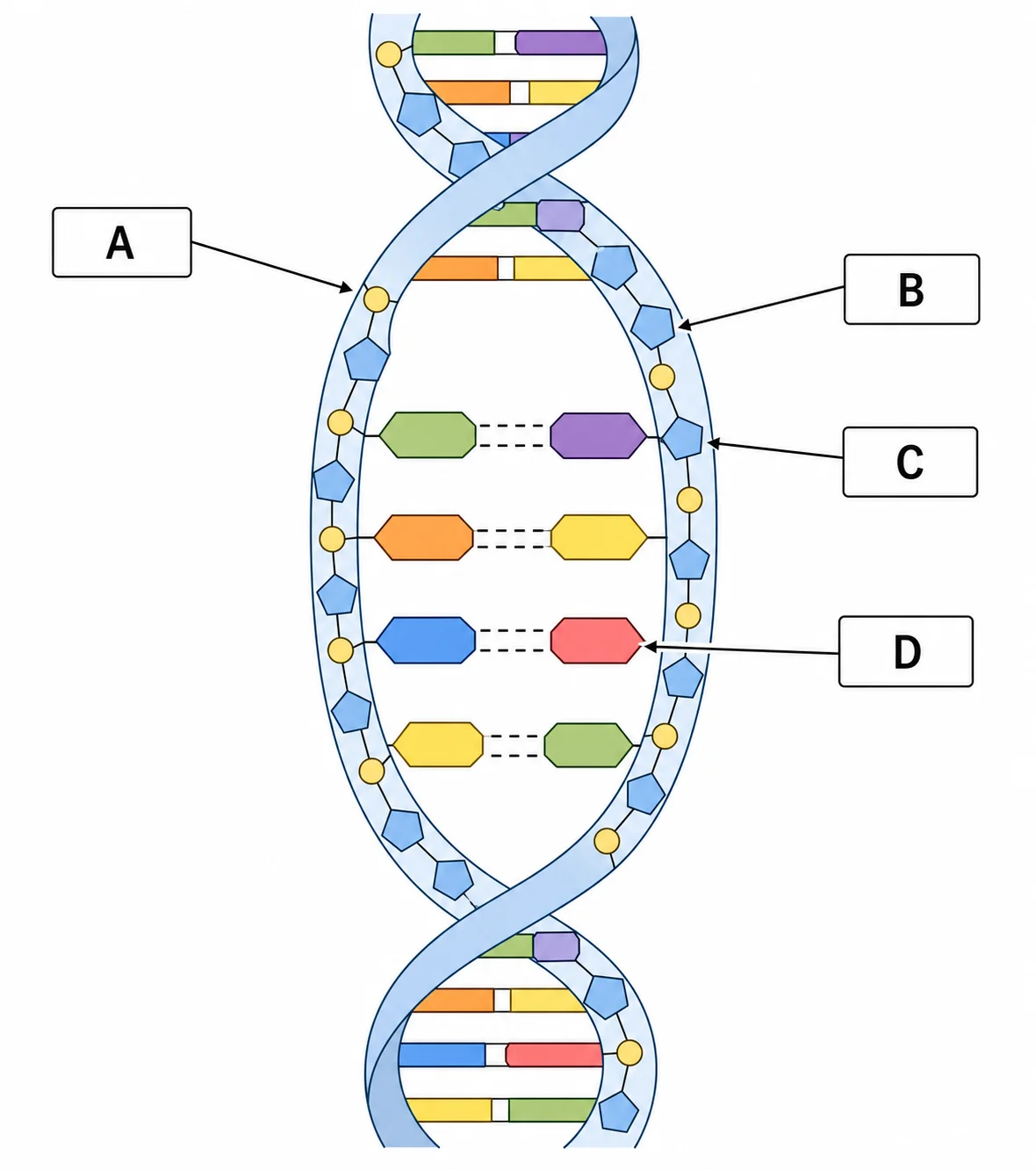
| Label | Name of part | Function |
|---|
| A | | |
| B | | |
| C | | |
| D | | |
A = phosphate group | B = deoxyribose sugar | C = nitrogenous base | D = hydrogen bonds
Your Turn
True or False? Fix the false ones
Circle T or F for each statement. If the statement is false, rewrite it correctly on the line below.
Adenine (A) pairs with guanine (G) in a DNA molecule.
Correct it:
DNA contains the base uracil, which pairs with adenine.
Correct it:
The two strands of DNA are complementary, the base sequence of one determines the sequence of the other.
Correct it:
All body cells in a human contain the same DNA sequence.
Correct it:
Show What You Know
1. A DNA strand has the sequence ATGCTA. Write the complementary strand, and explain why base pairing rules are important for DNA to store and copy information.
Recall
2 marks
2. The human genome contains approximately 3 billion base pairs but only 20,000–25,000 genes. What does this suggest about how much of the DNA actually codes for proteins?
Recall
2 marks
Wrap Up
In one sentence, what was the main idea of this lesson?