Physics • Year 12 • Module 8 • Lesson 14
The Strong Nuclear Force
Lock in the properties of the strong nuclear force, the concepts of mass defect and binding energy, and the shape of the binding-energy-per-nucleon curve before tackling harder questions.
1. Term–definition match
The definitions below are shuffled. In the right-hand column write the matching term from this list: strong nuclear force, nucleon, binding energy, mass defect, binding energy per nucleon, iron-56, fusion, fission, gluon, saturation. 10 marks (1 each)
| # | Definition | Matching term |
|---|---|---|
| 1.1 | The attractive force between nucleons; short range (~1–3 fm); charge-independent; overcomes Coulomb repulsion inside the nucleus. | |
| 1.2 | A collective term for protons and neutrons — particles inside the nucleus that experience the strong force. | |
| 1.3 | The energy required to completely separate a nucleus into its individual protons and neutrons; equal to Δm·c². | |
| 1.4 | The difference between the sum of masses of the separated nucleons and the actual nuclear mass: Δm = Zmp + Nmn − mnucleus. | |
| 1.5 | The binding energy divided by the total number of nucleons (A); used as a measure of nuclear stability. | |
| 1.6 | The nucleus at which the binding energy per nucleon is highest (~8.8 MeV); the most stable nucleus. | |
| 1.7 | The nuclear reaction in which two light nuclei combine to form a heavier nucleus, releasing energy. | |
| 1.8 | The nuclear reaction in which a heavy nucleus splits into smaller fragments, releasing energy. | |
| 1.9 | The exchange particle that mediates the strong force between quarks inside nucleons, according to quantum chromodynamics. | |
| 1.10 | The property of the strong force whereby each nucleon only interacts with its immediate neighbours, explaining why nuclear density is roughly constant. |
2. True or false — with correction
Circle T or F for each statement. If the statement is false, write the corrected version on the line below it. 12 marks (1 T/F + 1 correction each)
2.1 The strong nuclear force is attractive between proton–proton, neutron–neutron, and proton–neutron pairs. T / F
2.2 The strong nuclear force has infinite range, similar to the gravitational and electromagnetic forces. T / F
2.3 The mass of a nucleus is always slightly less than the combined mass of its separated protons and neutrons. T / F
2.4 The binding energy per nucleon peaks at uranium-238, making it the most stable nucleus. T / F
2.5 Very heavy nuclei (A > 200) tend to be unstable because the cumulative Coulomb repulsion between many protons exceeds the short-range strong force. T / F
2.6 Both fusion of light nuclei and fission of heavy nuclei can release energy because both processes move the products toward higher binding energy per nucleon. T / F
3. Fill-in-the-blank paragraph
Use the word bank to complete the passage. Each word is used once. 8 marks (1 per blank)
Word bank:
binding energy · charge-independent · electrons · femtometres · iron-56 · mass defect · protons · short
The strong nuclear force acts over a range of only a few ___________ (10−15 m), making it a ___________-range force. It attracts all nucleons regardless of their charge, so it is described as ___________. Because the strong force does not act over distances as large as the atomic radius, it does not affect ___________ orbiting the nucleus. When nucleons bind together, the nucleus has less mass than the sum of its constituent ___________ and neutrons; this difference is called the ___________. The energy equivalent of this missing mass (given by E = Δmc²) is the nuclear ___________. The nucleus with the highest binding energy per nucleon is ___________, making it the most stable nucleus in nature.
4. Function recall
Answer each question in 1–2 sentences using precise terms. 8 marks (2 each)
4.1 Why does the strong nuclear force not affect electrons orbiting the nucleus?
4.2 Explain why the strong nuclear force becomes repulsive at distances below approximately 0.5 fm.
4.3 Explain why the binding energy of a nucleus is related to a loss of mass (the mass defect).
4.4 Why do very heavy nuclei (A > 200) tend to be radioactively unstable?
5. Build a concept map
Draw labelled arrows between the six terms below to show how they connect. Each arrow must carry a linking phrase (e.g. “is converted into”, “peaks at”, “opposes”). Aim for at least 6 labelled arrows. 6 marks (1 per valid labelled arrow)
Supplied terms: strong nuclear force · mass defect · binding energy · binding energy per nucleon · iron-56 · Coulomb repulsion.
6. Label the binding-energy-per-nucleon curve
The diagram below shows the binding energy per nucleon (MeV) plotted against mass number (A). Write the correct label or value into boxes A–F. 6 marks (1 each)
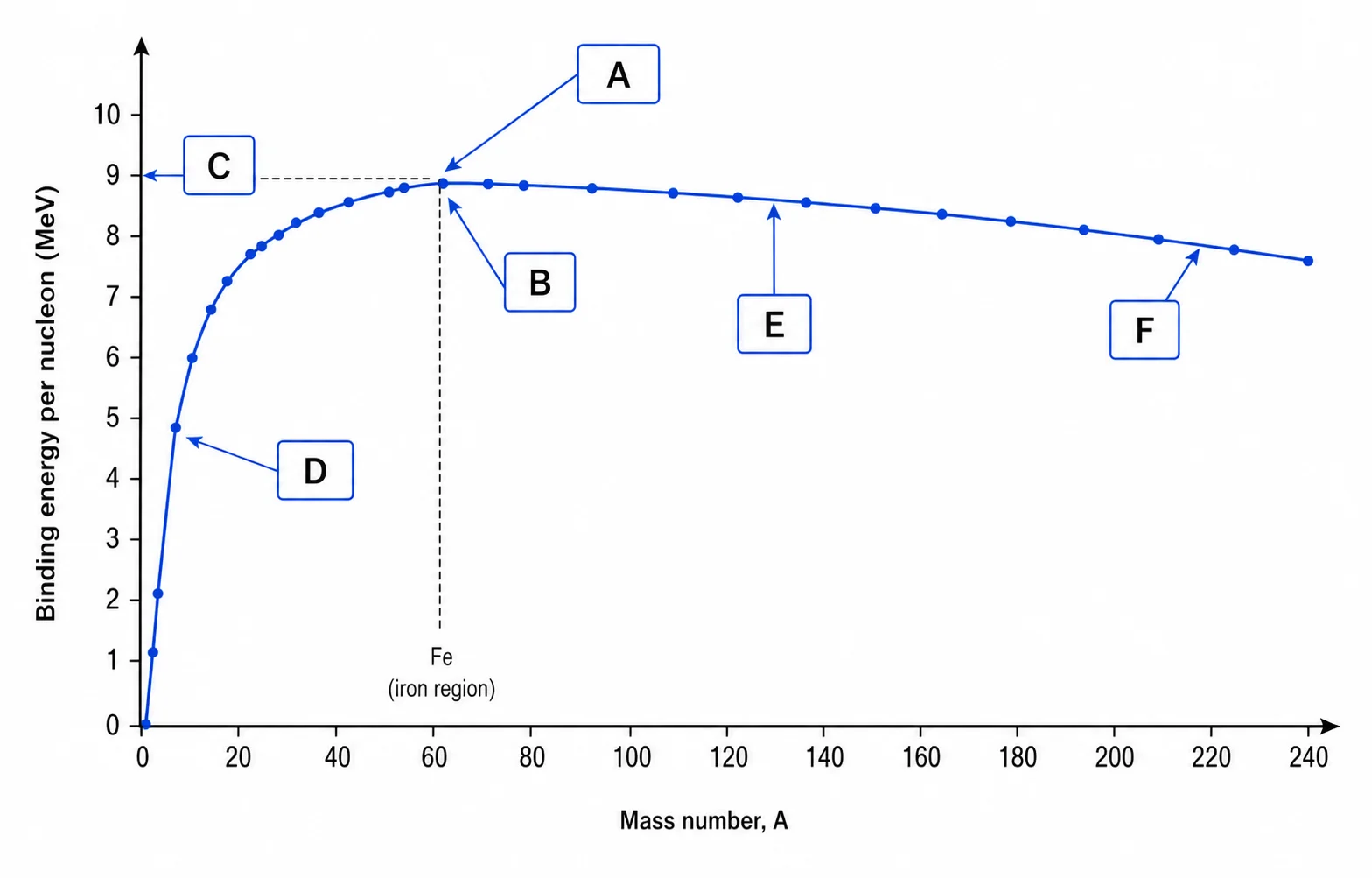
| Box | What this label should identify or state | Your answer |
|---|---|---|
| A | The name of the nucleus at the peak of the curve | |
| B | The approximate maximum binding energy per nucleon value (in MeV) | |
| C | The region (left of peak, light nuclei) where fusion releases energy | |
| D | The region (right of peak, heavy nuclei) where fission releases energy | |
| E | The approximate mass number range where the strong force begins to be overwhelmed by Coulomb repulsion (A > ___) | |
| F | The nuclear reaction named when two light nuclei combine to form a heavier one |
Q1 — Term–definition match
1.1 strong nuclear force • 1.2 nucleon • 1.3 binding energy • 1.4 mass defect • 1.5 binding energy per nucleon • 1.6 iron-56 • 1.7 fusion • 1.8 fission • 1.9 gluon • 1.10 saturation.
Q2 — True / false with correction
2.1 True. The strong nuclear force acts between all nucleon pairs (p–p, n–n, p–n) with roughly equal strength; it is charge-independent.
2.2 False. The strong nuclear force is short-range, effective only over distances of approximately 1–3 fm. Beyond this range it drops effectively to zero.
2.3 True. The mass defect is always positive: Δm = Zmp + Nmn − mnucleus > 0. The missing mass is converted to binding energy.
2.4 False. The binding energy per nucleon peaks at iron-56 (~8.8 MeV/nucleon). Uranium-238 is a very heavy, relatively unstable nucleus with lower binding energy per nucleon.
2.5 True. The strong force is short-range and saturates (acts only between nearest neighbours), while the Coulomb force between protons is long-range and accumulates for all proton pairs. In large nuclei, Coulomb repulsion wins.
2.6 True. Both fusion (combining light nuclei) and fission (splitting heavy nuclei) produce products with higher binding energy per nucleon, releasing the difference as energy.
Q3 — Cloze paragraph
In order: femtometres / short / charge-independent / electrons / protons / mass defect / binding energy / iron-56.
Q4.1 — Strong force and electrons
Electrons orbit at distances of approximately 10−10 m from the nucleus — roughly 105 times greater than the nuclear radius. Because the strong force operates only over distances of about 1–3 fm (10−15 m), it drops to effectively zero at the electron’s orbital distance and exerts no force on electrons.
Q4.2 — Repulsive at very short distances
At distances below about 0.5 fm, the strong force becomes repulsive between nucleons. This prevents nucleons from collapsing into each other and explains why atomic nuclei have a roughly constant density rather than shrinking to a point.
Q4.3 — Binding energy and mass defect
When nucleons bind together to form a nucleus, the system releases energy (binding energy). By Einstein’s mass–energy equivalence (E = mc²), this released energy corresponds to a loss of mass. The difference between the sum of individual nucleon masses and the actual nuclear mass is the mass defect, Δm, and the binding energy is Eb = Δmc².
Q4.4 — Instability of heavy nuclei
In very heavy nuclei (A > 200), there are a large number of protons. The Coulomb repulsion between protons is a long-range force that acts between every proton pair in the nucleus; it accumulates with increasing Z. The strong force, being short-range, only acts between nearest-neighbour nucleons and saturates. When Z becomes sufficiently large, the cumulative Coulomb repulsion overcomes the strong force, making the nucleus unstable and prone to radioactive decay.
Q5 — Sample concept map
Accept any six valid labelled arrows, for example:
- strong nuclear force — holds nucleons together, creating → mass defect
- mass defect — is converted into (E = Δmc²) → binding energy
- binding energy — divided by A gives → binding energy per nucleon
- binding energy per nucleon — peaks at → iron-56
- strong nuclear force — opposes → Coulomb repulsion
- Coulomb repulsion — overcomes strong force in heavy nuclei, reducing → binding energy per nucleon
Award 1 mark per valid labelled arrow. Accept alternative valid links.
Q6 — Binding-energy curve labels
A: Iron-56 (Fe-56). B: ~8.8 MeV/nucleon. C: Fusion (left side of curve, light nuclei; moving right toward iron-56 releases energy). D: Fission (right side of curve, heavy nuclei; moving left toward iron-56 releases energy). E: A > ~200 (region where Coulomb repulsion increasingly destabilises heavy nuclei). F: Fusion (combining light nuclei to form a heavier one closer to iron-56).