Physics • Year 12 • Module 8 • Lesson 12
Bohr’s Model of the Hydrogen Atom
Lock in Bohr’s three postulates, the energy-level formula, and the names of the spectral series before tackling harder questions.
1. Term–definition match
The definitions below are shuffled. In the right-hand column write the matching term from this list: ground state, excited state, quantisation, Rydberg constant, ionisation energy, Bohr radius, Lyman series, Balmer series, Paschen series, photon. 10 marks (1 each)
| # | Definition | Matching term |
|---|---|---|
| 1.1 | The lowest energy state of an atom; for hydrogen, $E_1 = -13.6$ eV. | |
| 1.2 | A higher energy electron orbit ($n > 1$) farther from the nucleus. | |
| 1.3 | The restriction of a physical quantity to discrete, allowed values only. | |
| 1.4 | The constant $R_H = 1.097 \times 10^7$ m¹ used in the wavelength formula for hydrogen transitions. | |
| 1.5 | The minimum energy needed to remove the electron completely from the ground state of hydrogen (13.6 eV). | |
| 1.6 | The radius of the first allowed orbit in hydrogen: $a_0 = 0.529 \times 10^{-10}$ m. | |
| 1.7 | The spectral series produced by transitions to $n_f = 1$; all lines are in the ultraviolet. | |
| 1.8 | The spectral series produced by transitions to $n_f = 2$; visible lines appear in this series. | |
| 1.9 | The spectral series produced by transitions to $n_f = 3$; all lines are infrared. | |
| 1.10 | A discrete packet of electromagnetic energy; emitted when an electron drops from a higher to a lower orbit. |
2. True or false — with correction
Circle T or F for each statement. If the statement is false, write the corrected version on the line below it. 12 marks (1 T/F + 1 correction each)
2.1 According to Bohr’s first postulate, electrons radiate energy continuously while orbiting the nucleus. T / F
2.2 The ground state of hydrogen has an energy of $-13.6$ eV, meaning the electron is in a bound (negative energy) state. T / F
2.3 When an electron jumps from $n = 3$ to $n = 1$, it absorbs a photon. T / F
2.4 The shortest wavelength in any spectral series corresponds to the transition from $n = \infty$ to the lowest level of that series. T / F
2.5 Bohr’s model predicts the hydrogen spectrum accurately and also successfully predicts the spectrum of helium. T / F
2.6 The Rydberg formula gives $1/\lambda$, so the largest value of $1/\lambda$ corresponds to the shortest wavelength. T / F
3. Fill-in-the-blank paragraph
Use the word bank to complete the passage. Each word is used once. 8 marks (1 per blank)
Word bank:
quantised · photon · ground · ionisation · Rydberg · infrared · angular momentum · spiral
Before Bohr, classical physics predicted that an orbiting electron would radiate energy and ___________ into the nucleus. Bohr solved this by postulating that electrons occupy ___________ orbits in which they do not radiate. His second postulate states that the ___________ of the electron is restricted to integer multiples of $\hbar$. When an electron transitions between orbits, it emits or absorbs a single ___________ whose energy equals the difference between the two levels. The lowest orbit ($n=1$) is called the ___________ state and has energy $-13.6$ eV. The energy needed to remove the electron from this state is called the ___________ energy. The ___________ formula predicts the wavelengths of all hydrogen spectral lines. The Paschen series, with transitions to $n=3$, lies entirely in the ___________ region of the spectrum.
4. Function recall
Answer each question in 1–2 sentences using precise terms. 8 marks (2 each)
4.1 What problem with the classical model of the atom did Bohr’s first postulate solve?
4.2 Why is the energy of a hydrogen electron in the ground state negative?
4.3 What is the significance of the Balmer series being in the visible region of the spectrum?
4.4 State one limitation of Bohr’s model of the hydrogen atom.
5. Build a concept map
Draw labelled arrows between the six terms below to show how they connect. Each arrow must carry a linking phrase (e.g. “is quantised in”, “emits a”, “transitions between”). Aim for at least 6 labelled arrows. 6 marks (1 per valid labelled arrow)
Supplied terms: electron orbit · energy level · photon · spectral line · quantisation · Rydberg formula.
6. Label the hydrogen energy-level diagram
The diagram below shows the allowed energy levels of hydrogen. Write the correct label or value into boxes A–F. 6 marks (1 each)
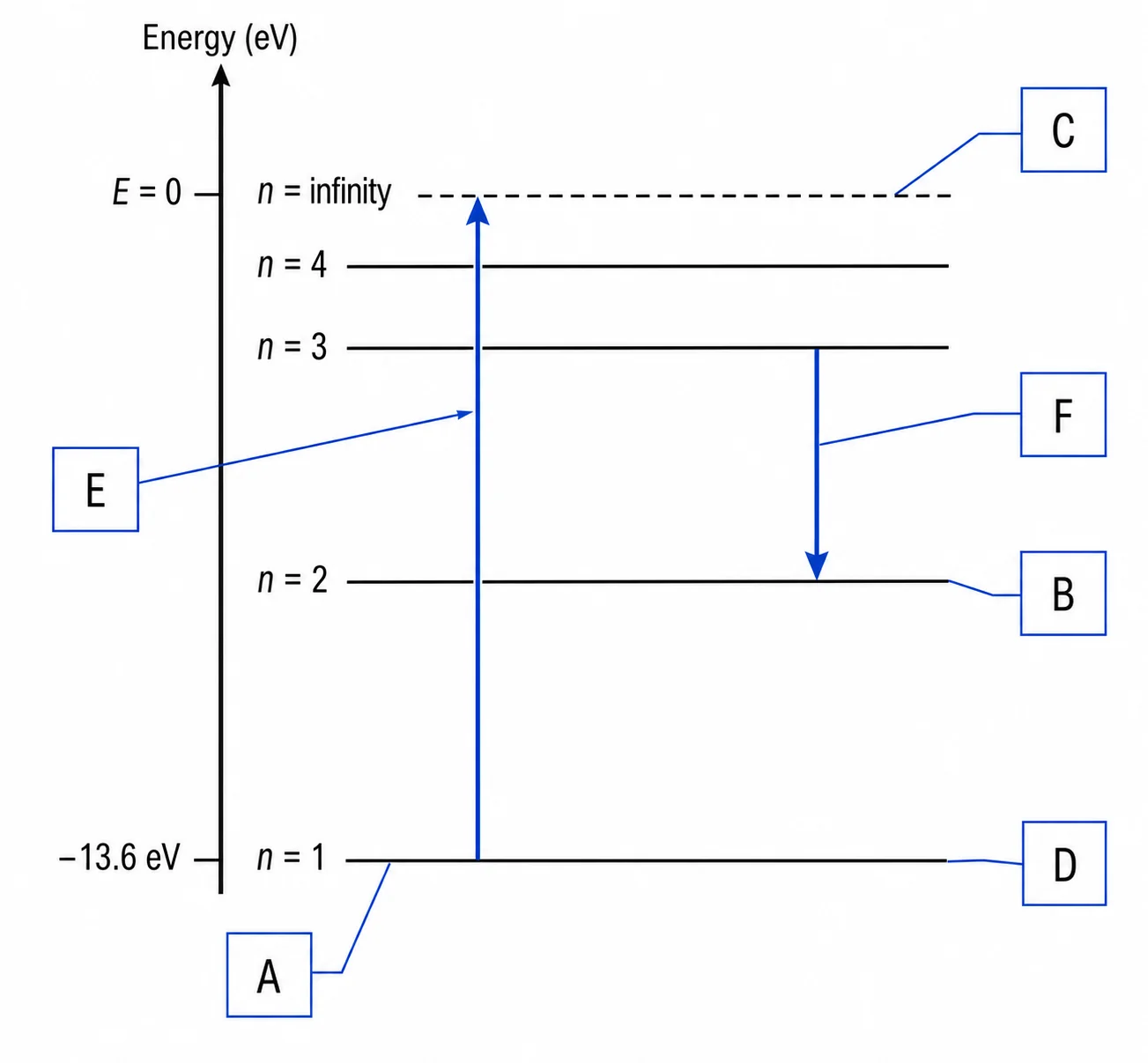
| Box | What this label should identify or state | Your answer |
|---|---|---|
| A | The quantum number of the lowest energy level (ground state) | |
| B | The energy value (in eV) of the ground state | |
| C | The quantum number of the first excited state | |
| D | The energy value (in eV) of the first excited state | |
| E | The energy at the ionisation limit ($n = \infty$) | |
| F | The spectral series name for transitions ending at $n = 2$ |
Q1 — Term–definition match
1.1 ground state • 1.2 excited state • 1.3 quantisation • 1.4 Rydberg constant • 1.5 ionisation energy • 1.6 Bohr radius • 1.7 Lyman series • 1.8 Balmer series • 1.9 Paschen series • 1.10 photon.
Q2 — True / false with correction
2.1 False. Bohr’s first postulate states that electrons in allowed orbits do not radiate energy. This was the radical departure from classical electromagnetism that prevented the electron from spiralling into the nucleus.
2.2 True. The negative value indicates a bound state; the electron is attracted to the nucleus and requires energy to be freed.
2.3 False. A downward transition (higher to lower $n$) involves the emission of a photon. An electron absorbs a photon only when jumping from a lower to a higher level.
2.4 True. The transition $n_i = \infty \to n_f$ represents the largest possible energy difference in that series, yielding the highest frequency (shortest wavelength).
2.5 False. Bohr’s model accurately predicts the hydrogen spectrum but fails for multi-electron atoms like helium because it ignores electron–electron repulsion.
2.6 True. Since $\lambda = 1/(1/\lambda)$, a larger $1/\lambda$ means a smaller $\lambda$ (shorter wavelength, higher energy, higher frequency).
Q3 — Cloze paragraph
In order: spiral / quantised / angular momentum / photon / ground / ionisation / Rydberg / infrared.
Q4.1 — Classical problem solved by Postulate 1
Classical electromagnetism predicted that an accelerating (orbiting) charge must continuously radiate energy, causing the electron to lose energy and spiral into the nucleus in a fraction of a nanosecond. Bohr’s postulate that electrons in allowed orbits do not radiate resolved this contradiction.
Q4.2 — Why ground state energy is negative
The negative energy indicates the electron is in a bound state — it is attracted to and trapped by the nucleus. Energy must be supplied to the system to free the electron (ionise the atom). Zero energy corresponds to $n = \infty$, where the electron is completely removed and at rest.
Q4.3 — Significance of the Balmer series in visible light
The Balmer series was observed by spectroscopists before Bohr developed his theory. Because these lines fall in the visible range (400–700 nm), they were the first hydrogen lines to be measured accurately. Bohr’s model predicted their wavelengths from first principles, which was a major triumph confirming quantised energy levels.
Q4.4 — One limitation of Bohr’s model
Accept any one of: (1) Only works for single-electron systems (fails for helium and multi-electron atoms). (2) Cannot explain the fine structure (small splitting) of spectral lines. (3) Cannot predict the relative intensities of spectral lines. (4) Does not explain why angular momentum is quantised — this requires full quantum mechanics (Schrödinger equation).
Q5 — Sample concept map
Accept any six valid labelled arrows, for example:
- quantisation — restricts → electron orbit
- electron orbit — has a discrete → energy level
- energy level — transition emits → photon
- photon — wavelength predicted by → Rydberg formula
- Rydberg formula — gives wavelength of → spectral line
- spectral line — is evidence of → quantisation
Award 1 mark per valid labelled arrow. Accept alternative valid links.
Q6 — Energy-level diagram labels
A: $n = 1$ (quantum number of ground state). B: $-13.6$ eV (energy of $n=1$ level). C: $n = 2$ (first excited state). D: $-3.40$ eV (energy of $n=2$ level; $E_2 = -13.6/4$). E: $E = 0$ eV (ionisation limit; electron is free). F: Balmer series (transitions to $n_f = 2$).