Physics • Year 12 • Module 8 • Lesson 6
The Stellar Life Cycle
Lock in the core vocabulary, the mass-dependent evolutionary pathways, and the fusion stage sequence before attempting harder questions.
1. Term–definition match
The definitions below are shuffled. In the right-hand column write the matching term from this list: main sequence, red giant, planetary nebula, white dwarf, supernova, neutron star, black hole, Chandrasekhar limit, proton-proton chain, r-process. 10 marks (1 each)
| # | Definition | Matching term |
|---|---|---|
| 1.1 | The stable phase of stellar evolution during which a star fuses hydrogen into helium in its core, maintaining hydrostatic equilibrium. Accounts for approximately 90% of a star’s lifetime. | |
| 1.2 | A late-stage star with an expanded, cool outer envelope, formed when core hydrogen is exhausted and shell burning begins. | |
| 1.3 | A shell of glowing gas expelled by a low-mass star as it sheds its outer layers near the end of its life, revealing the hot stellar core. | |
| 1.4 | The dense stellar remnant of a low-to-intermediate mass star, supported by electron degeneracy pressure after nuclear fusion has ceased. | |
| 1.5 | A catastrophic stellar explosion marking the death of a massive star, releasing enormous amounts of energy and dispersing heavy elements into the interstellar medium. | |
| 1.6 | An extremely dense stellar remnant formed from the collapsed iron core of a massive star, supported by neutron degeneracy pressure; typical mass < 3 M ☉. | |
| 1.7 | A stellar remnant so dense that its escape velocity exceeds the speed of light; formed when the core remnant exceeds approximately 3 M ☉. | |
| 1.8 | Approximately 1.4 M ☉; the maximum mass that can be supported by electron degeneracy pressure. Exceeding this causes collapse. | |
| 1.9 | The nuclear fusion pathway by which stars with mass < 1.3 M ☉ convert four hydrogen nuclei into one helium-4 nucleus, releasing ~26.7 MeV. | |
| 1.10 | Rapid neutron capture; a nucleosynthesis process occurring in supernovae and neutron star mergers that builds elements heavier than iron by successive neutron additions faster than beta decay. |
2. True or false — with correction
Circle T or F for each statement. If the statement is false, write the corrected version on the line below it. 12 marks (1 T/F + 1 correction each)
2.1 Massive stars (> 8 M☉) have longer main sequence lifetimes than low-mass stars because they have more hydrogen fuel available. T / F
2.2 The triple-alpha process converts three helium-4 nuclei into one carbon-12 nucleus and requires a core temperature of approximately 100 million K. T / F
2.3 A star with an initial mass of 5 M☉ will most likely end its life as a neutron star. T / F
2.4 Iron has the highest binding energy per nucleon of all nuclei, which means fusion of iron releases the most energy per reaction. T / F
2.5 Hydrogen and most helium in the universe were produced during Big Bang nucleosynthesis in the first few minutes after the Big Bang. T / F
2.6 The gravitational wave event GW170817 confirmed that neutron star mergers are a major site of the s-process (slow neutron capture). T / F
3. Fill-in-the-blank paragraph
Use the word bank to complete the passage. Each word or phrase is used once. 8 marks (1 per blank)
Word bank:
hydrostatic equilibrium · helium · iron · Chandrasekhar limit · supernova · red giant · neutron star · endothermic
When a star exhausts hydrogen in its core, it leaves the main sequence and ___________ equilibrium is disrupted. The outer layers expand and cool, forming a ___________ (or supergiant for massive stars). In the expanding core, temperatures eventually reach ~100 million K, igniting ___________ fusion via the triple-alpha process. In massive stars, fusion continues through progressively heavier elements until the core is composed entirely of ___________. Fusing iron is ___________ — it absorbs rather than releases energy — so no further energy can support the star. When the iron core exceeds the ___________ (~1.4 M☉), electron degeneracy pressure fails and the core collapses catastrophically. The resulting explosion is called a ___________. The remnant of the collapsed core, if below ~3 M☉, becomes a ___________.
4. Function recall
Answer each question in 1–2 sentences using precise terms from the lesson. 8 marks (2 each)
4.1 What is the function of radiation pressure in a main sequence star, and why is this relationship called hydrostatic equilibrium?
4.2 What is the role of electron degeneracy pressure in a white dwarf, and why does the Chandrasekhar limit (~1.4 M☉) set an upper bound on white dwarf mass?
4.3 Why does the r-process require a supernova or neutron star merger environment rather than occurring in the core of a stable massive star?
4.4 What is the significance of a star’s mass in determining its evolutionary path and final fate?
5. Build a concept map
Draw labelled arrows between the six terms below to show how they are connected. Each arrow must carry a linking phrase (e.g. “leads to”, “is supported by”, “produces”). Aim for at least 6 labelled arrows. 6 marks (1 per valid labelled arrow)
Supplied terms: main sequence · hydrogen fusion · red giant · supernova · neutron star · heavy elements.
6. Label the stellar life cycle
The diagram below shows the life cycle of a massive star (> 8 M☉), with boxes A–F representing key stages or structures. Write the correct stage name and one defining feature for each box. 12 marks (1 label + 1 feature each)
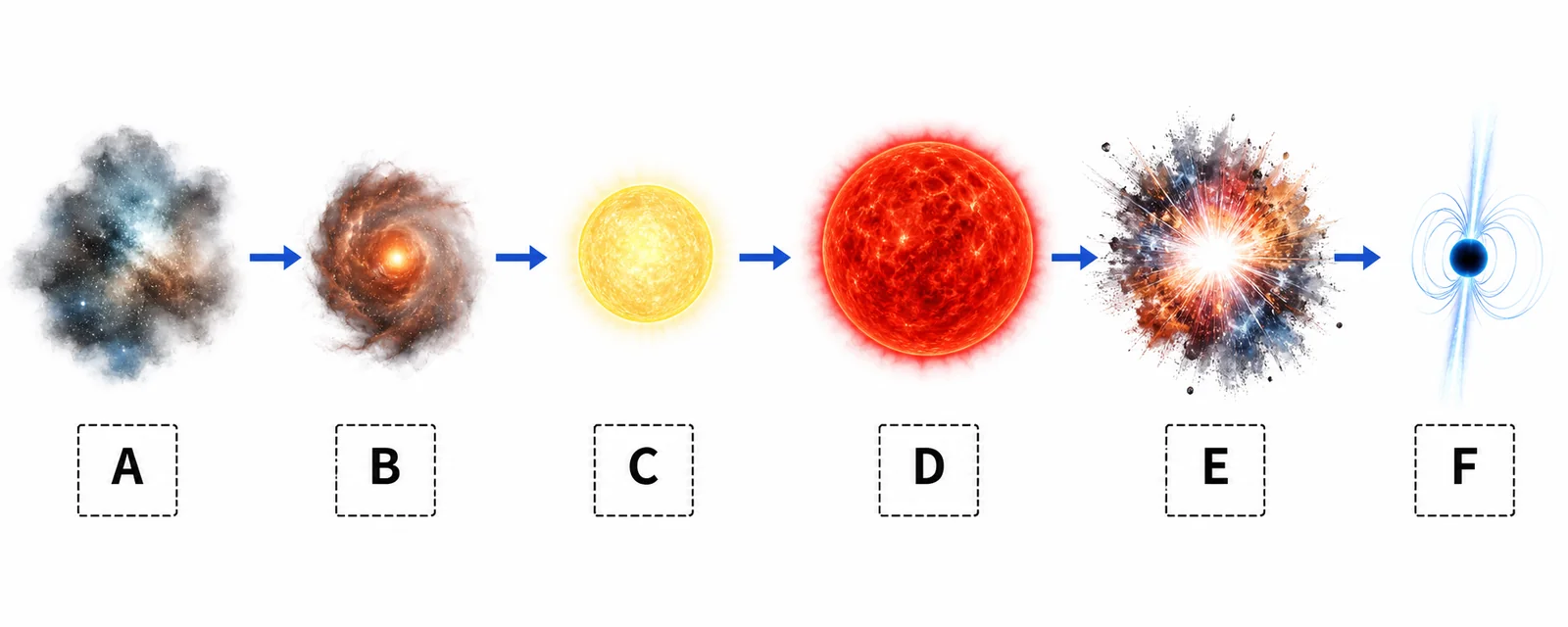
| Box | Stage name | One defining feature |
|---|---|---|
| A | ||
| B | ||
| C | ||
| D | ||
| E | ||
| F |
Q1 — Term–definition match
1.1 main sequence • 1.2 red giant • 1.3 planetary nebula • 1.4 white dwarf • 1.5 supernova • 1.6 neutron star • 1.7 black hole • 1.8 Chandrasekhar limit • 1.9 proton-proton chain • 1.10 r-process.
Q2 — True / false with correction
2.1 False. Massive stars have shorter main sequence lifetimes than low-mass stars despite having more fuel, because their much greater luminosity burns through that fuel at a far higher rate. A 20 M☉ star may live only a few tens of millions of years, whereas a 0.5 M☉ red dwarf can live hundreds of billions of years.
2.2 True. The triple-alpha process (3 4He → 12C + γ) releases 7.65 MeV per carbon nucleus and requires ~108 K.
2.3 False. A 5 M☉ star falls in the 0.5–8 M☉ range; it will end its life as a white dwarf after shedding its envelope as a planetary nebula, not as a neutron star (which requires an initial mass > 8 M☉).
2.4 False. Iron has the highest binding energy per nucleon, but this means fusion of iron absorbs energy (it is endothermic) rather than releasing it. It is precisely because iron-56 is the most tightly bound nucleus that fusing it beyond iron costs energy.
2.5 True.
2.6 False. GW170817 confirmed that neutron star mergers are a major site of the r-process (rapid neutron capture), not the s-process (slow neutron capture). The s-process occurs in asymptotic giant branch (AGB) stars.
Q3 — Cloze paragraph
In order: hydrostatic equilibrium / red giant / helium / iron / endothermic / Chandrasekhar limit / supernova / neutron star.
Q4.1 — Radiation pressure and hydrostatic equilibrium
Radiation pressure (and thermal pressure from nuclear fusion) acts outward, opposing the inward force of gravity. Hydrostatic equilibrium describes the stable balance between these two forces that keeps the star’s size constant during the main sequence phase.
Q4.2 — Electron degeneracy pressure and the Chandrasekhar limit
Electron degeneracy pressure is a quantum mechanical effect arising from the Pauli exclusion principle, which prevents electrons from occupying the same quantum state. It supports the white dwarf against gravitational collapse without the need for ongoing fusion. Above ~1.4 M☉, the gravitational force exceeds the maximum electron degeneracy pressure that can be generated, causing the white dwarf to collapse.
Q4.3 — Why the r-process needs a supernova or neutron star merger
The r-process requires an extreme flux of free neutrons bombarding nuclei faster than they can beta-decay. Stable stellar cores do not provide this neutron density. Only the catastrophic conditions of a supernova explosion or the merger of two neutron stars produce the required neutron densities (>1020 n cm−3).
Q4.4 — Role of stellar mass in evolution
A star’s initial mass is the primary factor governing every aspect of its evolution: its luminosity, its main sequence lifetime, the fusion stages it can achieve, and its final remnant. Stars < 0.5 M☉ never leave the main sequence within the age of the universe; stars 0.5–8 M☉ end as white dwarfs; and stars > 8 M☉ end in supernovae, leaving neutron stars or black holes.
Q5 — Sample concept map
Correct maps should include arrows such as:
- main sequence — is powered by → hydrogen fusion
- hydrogen fusion — exhaustion of leads to → red giant
- red giant (massive) — eventually explodes as → supernova
- supernova — remnant becomes → neutron star
- supernova — disperses → heavy elements
- heavy elements — seed new → main sequence (stars)
Award 1 mark per valid labelled arrow (minimum 6).
Q6 — Stellar life cycle labels (massive star)
A: Molecular cloud — cold, dense cloud of gas and dust that collapses under gravity to form stars. B: Protostar — collapsing pre-stellar object; core temperature still rising toward hydrogen ignition (~107 K). C: Main sequence star — stable phase powered by hydrogen fusion in the core; hydrostatic equilibrium maintained. D: Red supergiant — post-main-sequence massive star; expanded outer envelope, onion-shell structure of progressive fusion stages. E: Supernova — catastrophic core collapse and explosive ejection of outer layers when iron core exceeds the Chandrasekhar limit. F: Neutron star or black hole — remnant of collapsed core; neutron star if remnant mass < 3 M☉, black hole if > 3 M☉.