Physics • Year 12 • Module 6 • Lesson 7
The Motor Effect
Secure the core vocabulary, the F = BIl sinθ equation, and the right-hand palm rule before moving to harder problems.
1. Term–definition match
In the right-hand column write the matching term from the list below. Motor effect · Right-hand palm rule · Magnetic flux density · Current-carrying conductor · Drift velocity · Loudspeaker · Galvanometer · Perpendicular · Parallel · Tesla. 10 marks (1 each)
| # | Definition | Matching term |
|---|---|---|
| 1.1 | The force experienced by a current-carrying conductor placed in a magnetic field. | |
| 1.2 | A rule for finding force direction: thumb points along current, fingers point along B, palm faces in the direction of force. | |
| 1.3 | The SI unit of magnetic field strength, equal to one newton per ampere-metre. | |
| 1.4 | The symbol B; a measure of how strong a magnetic field is at a point in space. | |
| 1.5 | The average speed at which charge carriers move along a wire when a current flows. | |
| 1.6 | A wire or other conductor through which electric current is flowing. | |
| 1.7 | A device that converts electrical current into sound using the motor effect to vibrate a cone. | |
| 1.8 | An instrument that measures current by deflecting a coil in a magnetic field; deflection is proportional to current. | |
| 1.9 | At 90° to each other; the orientation that produces maximum motor effect force. | |
| 1.10 | In the same direction or along the same line; the orientation that produces zero motor effect force. |
2. True or false — with correction
Circle T or F for each statement. If the statement is false, write the corrected version on the line below. 12 marks (1 T/F + 1 correction each)
2.1 The motor effect force on a wire is maximum when the wire is oriented parallel to the magnetic field. T / F
2.2 Doubling the current in a wire while keeping B, l, and θ constant will double the motor effect force. T / F
2.3 If the current direction in a wire is reversed, the direction of the motor effect force is also reversed. T / F
2.4 In the formula F = BIl sinθ, the angle θ is measured between the wire and the horizontal surface. T / F
2.5 A loudspeaker relies on the motor effect: alternating current in the voice coil interacts with a permanent magnet’s field to move the cone. T / F
2.6 The motor effect force on a wire is zero when θ = 90° because sin(90°) = 0. T / F
3. Fill-in-the-blank paragraph
Use the word bank to complete the passage. Each word is used once. 8 marks (1 per blank)
Word bank:
current · field · force · maximum · motor effect · perpendicular · sin θ · zero
The ___________ is the force experienced by a wire carrying ___________ when placed in a magnetic ___________. The magnitude of this force is calculated using F = BIl ___________, where θ is the angle between the current direction and B. When the wire is ___________ to the field, θ = 90° and the force is ___________. When the wire is parallel to the field, θ = 0° and the force is ___________. The direction of the ___________ is found using the right-hand palm rule.
4. Function recall
Answer each question in 1–2 sentences using precise physics terms. 8 marks (2 each)
4.1 State the formula for the motor effect force and define every symbol, including its SI unit.
4.2 Explain, using the concept of drift velocity, why the motor effect formula F = BIl sinθ follows from F = qvB sinθ for a single charge.
4.3 State the three inputs you need to identify with the right-hand palm rule and what each part of your hand represents.
4.4 Name two devices that rely on the motor effect and briefly describe how the force is produced in each device.
5. Equation mapping — identify the variable changed
A wire originally experiences a force F in a magnetic field. In each row, only one change is made. State the new force in terms of F. 6 marks (1 each)
| Change made (all other variables constant) | New force (in terms of F) |
|---|---|
| Current is doubled (I → 2I) | |
| Magnetic field is halved (B → B/2) | |
| Wire length is tripled (l → 3l) | |
| Angle changes from 90° to 30° | |
| Current is doubled AND magnetic field is halved | |
| Current direction is reversed |
6. Label the right-hand palm rule diagram
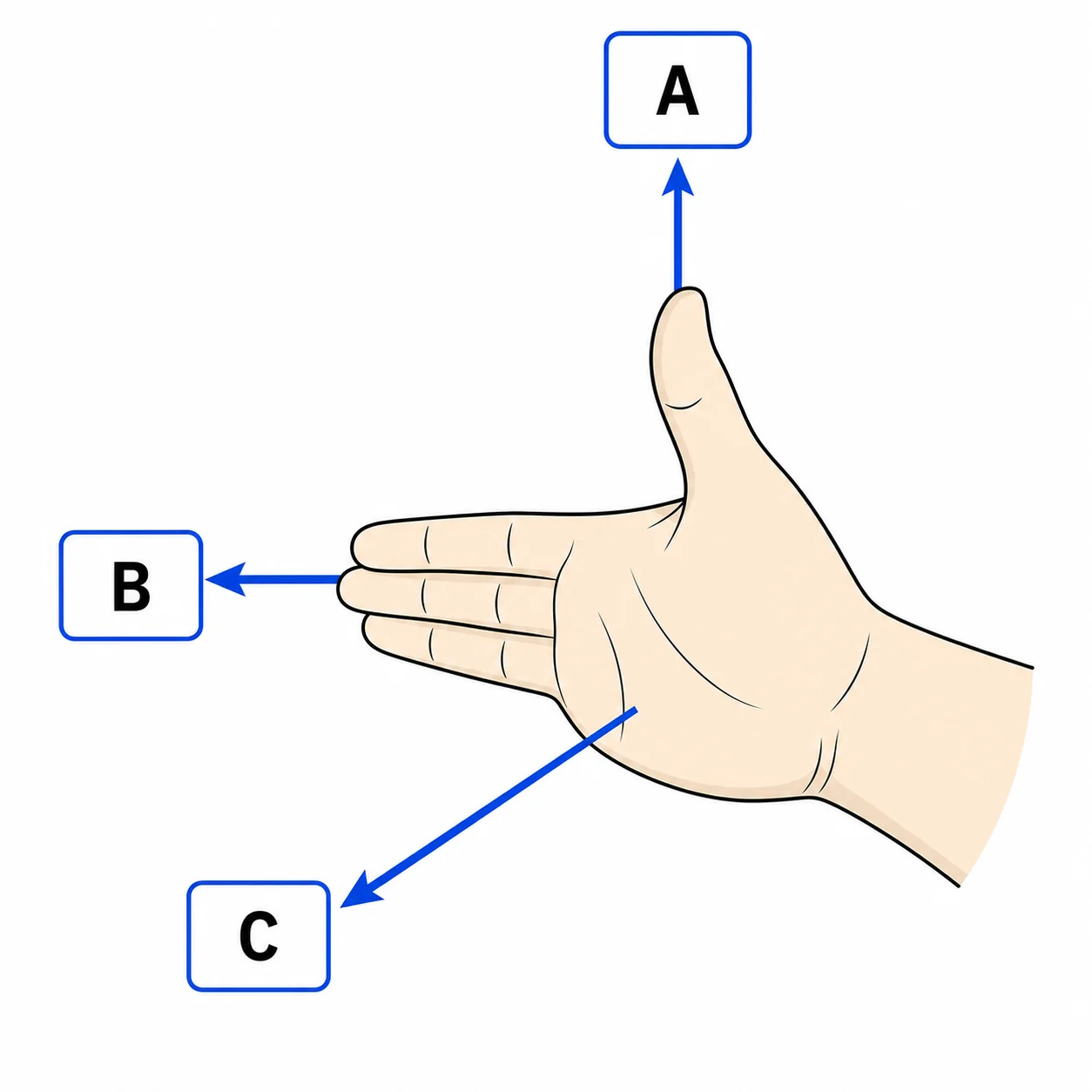
The diagram below shows a hand applying the right-hand palm rule. Label boxes A, B, and C with the correct physical quantity (current direction I, magnetic field direction B, or force direction F) and state the corresponding part of the hand for each. 6 marks (1 label + 1 hand part each)
| Box | Physical quantity | Part of hand |
|---|---|---|
| A | ||
| B | ||
| C |
Q1 — Term–definition match
1.1 Motor effect • 1.2 Right-hand palm rule • 1.3 Tesla • 1.4 Magnetic flux density • 1.5 Drift velocity • 1.6 Current-carrying conductor • 1.7 Loudspeaker • 1.8 Galvanometer • 1.9 Perpendicular • 1.10 Parallel.
Q2 — True / false with correction
2.1 False. The force is maximum when the wire is perpendicular to the field (θ = 90°); it is zero when the wire is parallel to the field (θ = 0°).
2.2 True. F = BIl sinθ; doubling I doubles F.
2.3 True. Reversing I reverses the direction of the force by the right-hand palm rule.
2.4 False. θ is the angle between the current direction and the magnetic field direction — not the angle between the wire and any surface.
2.5 True.
2.6 False. When θ = 90°, sin(90°) = 1, so the force is at its maximum value F = BIl. The force is zero when θ = 0° because sin(0°) = 0.
Q3 — Cloze paragraph
In order: motor effect / current / field / sin θ / perpendicular / maximum / zero / force.
Q4.1 — Motor effect formula
F = BIl sinθ. F = force on the conductor (N); B = magnetic flux density (T); I = current in the wire (A); l = length of the wire in the field (m); θ = angle between the current direction and the magnetic field direction (degrees or radians, dimensionless sin ratio).
Q4.2 — Derivation from single-charge formula
For a single charge q moving at drift velocity v_d, the force is F = qv_dB sinθ. In a wire of length l, the total charge is Q = It. Since the charges travel length l in time t, v_d = l/t. Substituting: F = (It)(l/t)B sinθ = BIl sinθ. The motor effect formula is simply the sum of the forces on all charge carriers moving with drift velocity.
Q4.3 — Right-hand palm rule
The three inputs are: current direction (thumb), magnetic field direction (fingers point along B), and force direction (palm pushes in the direction of F). Thumb = current direction I; fingers = magnetic field direction B; palm = direction of the force F on the conductor.
Q4.4 — Two devices using motor effect
Loudspeaker: An alternating audio current flows through a coil (voice coil) attached to a paper cone, sitting in the field of a permanent magnet. As the current reverses, the force on the coil reverses, making the cone vibrate and produce sound waves. Galvanometer: A coil carries the current to be measured and sits in the field of a permanent magnet. The motor effect force on the coil produces a torque that rotates the coil against a restoring spring; the deflection angle is proportional to the current.
Q5 — Equation mapping
I → 2I: force = 2F. B → B/2: force = F/2. l → 3l: force = 3F. θ from 90° to 30°: new force = BIl sin30° = BIl×0.5 = F/2. I→2I and B→B/2: both changes cancel, force = F. Current reversed: force magnitude = F (unchanged); direction reverses.
Q6 — Right-hand palm rule labels
A: Current direction I — represented by the thumb (pointing in the direction of conventional current flow). B: Magnetic field direction B — represented by the fingers (pointing in the direction of the field). C: Force direction F — represented by the palm (palm pushes / faces in the direction of the force on the conductor).