Physics • Year 12 • Module 6: Electromagnetism • Lesson 5
Circular Motion in Magnetic Fields
Lock in the core vocabulary, the key equations r = mv/qB and T = 2πm/qB, and the direction rules for circular particle motion before tackling harder problems.
1. Term–definition match
The definitions below are shuffled. In the right-hand column write the matching term from this list: radius of curvature, centripetal force, period (T), cyclotron frequency, charge-to-mass ratio, uniform circular motion, magnetic force, momentum, cyclotron, cyclotron radius formula. 10 marks (1 each)
| # | Definition | Matching term |
|---|---|---|
| 1.1 | The inward force required to keep an object moving in a circle; it is always directed toward the centre of the circle. | |
| 1.2 | Motion along a circular path at constant speed; the direction changes continuously but the magnitude of velocity does not. | |
| 1.3 | The distance from the centre of a circular orbit to the particle’s path: r = mv/qB. | |
| 1.4 | The time taken for one complete revolution: T = 2πm/qB. | |
| 1.5 | The number of complete revolutions per second: f = qB/2πm. | |
| 1.6 | The ratio q/m, which determines how tightly a particle curves in a given magnetic field. | |
| 1.7 | The force on a moving charged particle in a magnetic field: F = qvB (when velocity is perpendicular to B). | |
| 1.8 | The product of mass and velocity, mv; appears in the numerator of the radius formula. | |
| 1.9 | A particle accelerator that exploits the independence of orbital period from speed to keep the accelerating voltage in phase with orbiting particles. | |
| 1.10 | The equation r = mv/qB, derived by equating magnetic force to the required centripetal force. |
2. True or false — with correction
Circle T or F for each statement. If the statement is false, write the corrected version on the line below it. 12 marks (1 T/F + 1 correction each)
2.1 The magnetic force on a charged particle moving perpendicular to a magnetic field does work on the particle, increasing its speed. T / F
2.2 The radius of a charged particle’s circular path in a magnetic field increases if the magnetic field strength is increased. T / F
2.3 The period of a charged particle orbiting in a magnetic field is independent of the particle’s speed. T / F
2.4 An electron and a proton travelling at the same speed in the same magnetic field have the same orbital radius. T / F
2.5 In a cyclotron, it is necessary to increase the frequency of the alternating voltage as the particles gain speed, to keep them in phase. T / F
2.6 The cyclotron frequency depends on the particle’s charge-to-mass ratio and the magnetic field strength only. T / F
3. Fill-in-the-blank paragraph
Use the word bank to complete the passage. Each word or phrase is used once. 8 marks (1 per blank)
Word bank:
centripetal · constant · cyclotron frequency · mass-to-charge · mv/qB · perpendicular · speed · 2πm/qB
When a charged particle enters a uniform magnetic field with its velocity ___________ to the field direction, the magnetic force acts as a ___________ force, causing the particle to follow a circular path. Because the magnetic force is always perpendicular to the velocity, it does no work and the particle’s ___________ remains ___________. The radius of the circular orbit is given by r = ___________, showing that a larger momentum or smaller field gives a larger circle. The period of revolution is T = ___________, which contains no velocity term — this means the period depends only on the particle’s ___________ ratio and the field strength, a quantity known as the ___________.
4. Function recall
Answer each question in 1–2 sentences using precise terms from the lesson. 8 marks (2 each)
4.1 Explain why a charged particle moving perpendicular to a magnetic field follows a circular path rather than speeding up or slowing down.
4.2 What does it mean for the orbital period to be “independent of speed”? Give the formula that demonstrates this.
4.3 Two particles with the same charge but different masses enter the same magnetic field at the same speed. Which travels in the larger circle? By what factor?
4.4 Why is the independence of period from speed essential for a cyclotron to function?
5. Build a concept map
Draw labelled arrows between the six terms below to show how they connect. Each arrow must carry a linking phrase (e.g. “is determined by”, “provides the”, “is independent of”). Aim for at least 6 labelled arrows. 6 marks (1 per valid labelled arrow)
Supplied terms: magnetic force (F = qvB) · centripetal force (mv²/r) · orbital radius (r) · period (T) · speed (v) · magnetic field (B).
6. Label the circular-motion diagram
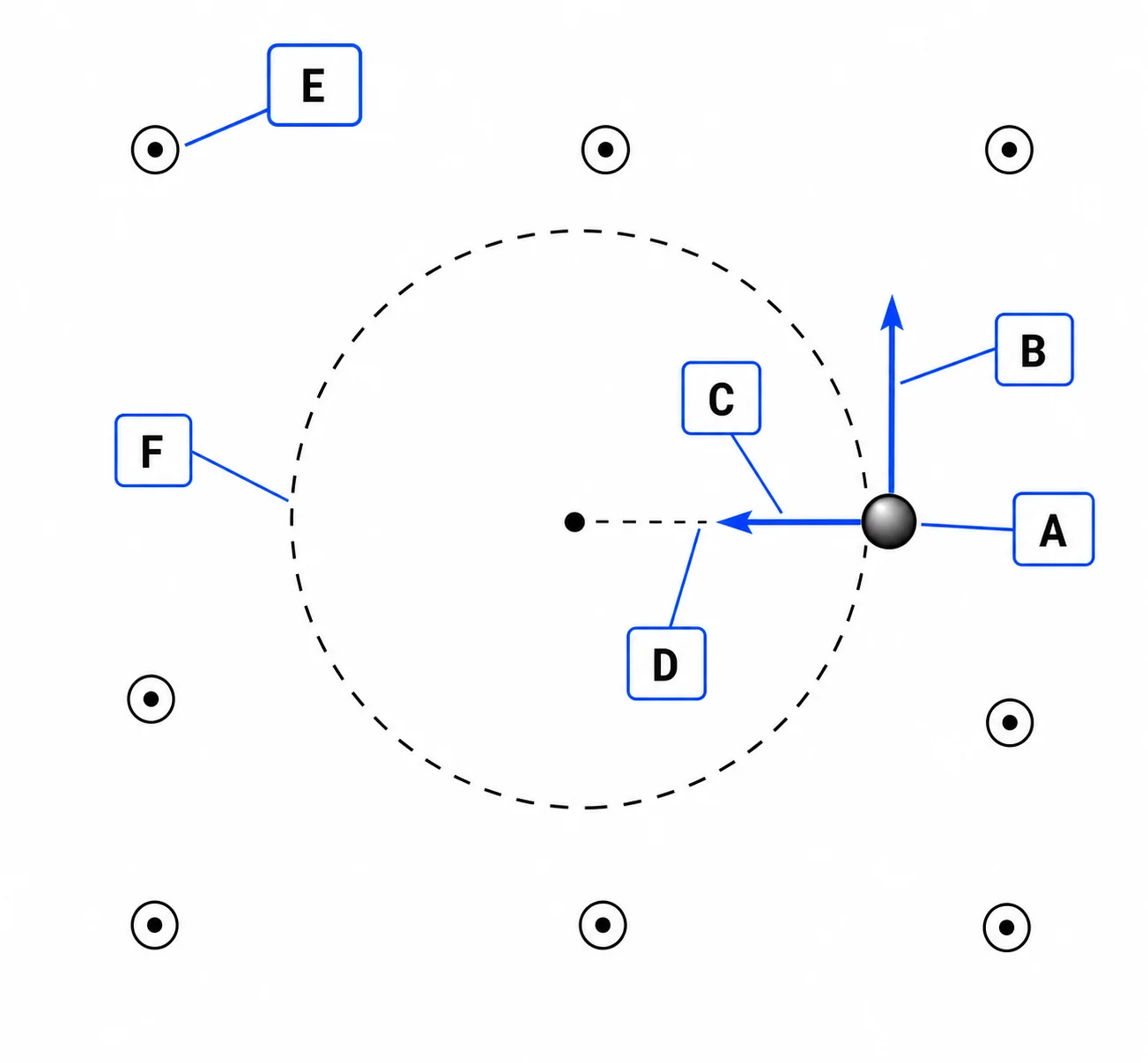
The diagram below shows a top-down view of a charged particle orbiting in a magnetic field directed out of the page. Write the correct label or description for each box A–F. 6 marks (1 each)
| Box | Label or description |
|---|---|
| A | |
| B | |
| C | |
| D | |
| E | |
| F |
Q1 — Term–definition match
1.1 centripetal force • 1.2 uniform circular motion • 1.3 radius of curvature • 1.4 period (T) • 1.5 cyclotron frequency • 1.6 charge-to-mass ratio • 1.7 magnetic force • 1.8 momentum • 1.9 cyclotron • 1.10 cyclotron radius formula.
Q2 — True / false with correction
2.1 False. The magnetic force is always perpendicular to the velocity; it does no work and therefore cannot change the particle’s speed. It only changes the direction of motion.
2.2 False. From r = mv/qB, increasing B decreases the radius (r ∝ 1/B). A stronger field curves the particle more tightly.
2.3 True. T = 2πm/qB contains no v term; the period depends only on the mass-to-charge ratio and field strength.
2.4 False. From r = mv/qB, both particles have the same charge magnitude (e) and the same speed, so r ∝ m. The proton is 1836 times more massive, so its radius is 1836 times larger than the electron’s.
2.5 False. In an ideal cyclotron, the orbital period T = 2πm/qB is independent of speed. The alternating voltage frequency is fixed at the cyclotron frequency f = qB/2πm; it does not need to change as particles gain speed.
2.6 True. f = qB/2πm depends only on q/m and B. Speed does not appear in this expression.
Q3 — Cloze paragraph
In order: perpendicular / centripetal / speed / constant / mv/qB / 2πm/qB / mass-to-charge / cyclotron frequency.
Q4.1 — Why circular, not speeding up
The magnetic force is always perpendicular to the particle’s velocity. A force perpendicular to velocity can only change its direction, not its magnitude. Therefore the particle follows a circular path at constant speed; the magnetic force acts as the centripetal force.
Marking criteria: 1 mark for stating the force is perpendicular to velocity; 1 mark for explaining this changes direction only (no work done, constant speed, circular path). Both marks required for full credit.
Q4.2 — Period independent of speed
A faster particle travels in a proportionally larger circle, covering more distance in exactly the same time as a slower particle in a smaller circle. The formula T = 2πm/qB demonstrates this: it contains no v term, so the period is the same regardless of the particle’s speed.
Marking criteria: 1 mark for the physical explanation (larger circle at higher speed, same time); 1 mark for quoting T = 2πm/qB and noting the absence of v.
Q4.3 — More massive particle has larger radius
The more massive particle travels in the larger circle. From r = mv/qB, with v, q, and B equal, r ∝ m. So if one particle has mass M and the other has mass m, the ratio of radii equals the ratio of masses: r1/r2 = M/m.
Marking criteria: 1 mark for identifying the heavier particle as having the larger radius; 1 mark for stating the proportionality r ∝ m and giving the factor correctly.
Q4.4 — Period independence and cyclotron function
A cyclotron accelerates particles by applying an alternating electric field across a gap between two D-shaped electrodes. The voltage must reverse direction each half-revolution to accelerate the particles again. If the period changed as particles gained speed, the fixed-frequency voltage would fall out of phase, and the particles would be decelerated rather than accelerated. Because T = 2πm/qB is independent of speed, the voltage can be fixed at the cyclotron frequency f = qB/2πm and will always be in phase with the particle regardless of its speed.
Marking criteria: 1 mark for explaining that the voltage frequency must match the orbital frequency; 1 mark for linking T = 2πm/qB (no v) to the voltage staying in phase as speed increases.
Q5 — Sample concept map
Correct maps should include arrows such as:
- magnetic force (F = qvB) — equals → centripetal force (mv²/r) (equating these two forces gives r = mv/qB)
- centripetal force — determines → orbital radius (r)
- speed (v) — increases → orbital radius (r) increases (r ∝ v)
- magnetic field (B) — increases → orbital radius (r) decreases (r ∝ 1/B)
- period (T) — is independent of → speed (v)
- period (T) — depends on → magnetic field (B) (T = 2πm/qB)
Award 1 mark per valid labelled arrow with a linking phrase. Minimum 6 required.
Q6 — Circular-motion diagram labels
A: Charged particle (negative electron or positive ion — accept either if consistent with the direction of force shown) • B: Velocity vector v (tangent to the circle, perpendicular to the radius at that point) • C: Magnetic force F (directed toward the centre of the circle; acts as centripetal force) • D: Radius r (line from centre to particle; length = mv/qB) • E: Magnetic field B directed out of the page (represented by a dot symbol ⊙) • F: Circular orbital path (dashed circle; radius is constant because speed is constant).
Marking criteria: 1 mark each for correctly labelling A–F. For C, accept “centripetal force” or “magnetic force” provided it is described as pointing toward the centre.