Physics • Year 12 • Module 6: Electromagnetism • Lesson 1
Electric Fields and Coulomb’s Law Review
Lock in the core vocabulary, the key formulas E = V/d and F = qE, and the direction rules for charged particles before tackling harder problems.
1. Term–definition match
The definitions below are shuffled. In the right-hand column write the matching term from this list: electric field, uniform electric field, potential difference, electric field strength (parallel plates), elementary charge, Coulomb’s law, Coulomb’s constant, field line, test charge, coulomb. 10 marks (1 each)
| # | Definition | Matching term |
|---|---|---|
| 1.1 | A region in space where a charged particle experiences a force; defined as force per unit positive charge at a point. | |
| 1.2 | A field with constant magnitude and direction at every point in the region, produced between two large parallel conducting plates. | |
| 1.3 | The work done per unit positive charge to move between two points; measured in volts (V). | |
| 1.4 | The relationship E = V/d, where d is the perpendicular separation of the plates. | |
| 1.5 | The magnitude of the charge carried by a single proton or electron: 1.60 × 10⁻¹⁹ C. | |
| 1.6 | The law stating that the electrostatic force between two point charges is proportional to the product of their charges and inversely proportional to the square of the distance between them. | |
| 1.7 | The proportionality constant k ≈ 8.99 × 10⁹ N m2 C−2 that appears in Coulomb’s law F = kq1q2/r2; its SI units ensure that forces are in newtons when charges are in coulombs and distances in metres. | |
| 1.8 | An imaginary line drawn in a field such that the tangent at any point gives the direction of the force on a positive test charge. | |
| 1.9 | A hypothetical particle with a tiny positive charge used to probe the field without disturbing it. | |
| 1.10 | The SI unit of electric charge, equal to the charge transported by a current of one ampere in one second. |
2. True or false — with correction
Circle T or F for each statement. If the statement is false, write the corrected version on the line below it. 12 marks (1 T/F + 1 correction each)
2.1 Between two large parallel plates connected to a battery, the electric field is stronger near the positive plate than near the negative plate. T / F
2.2 A negative charge placed in a uniform electric field experiences a force in the opposite direction to the field. T / F
2.3 If the plate separation is doubled while the battery voltage is kept constant, the electric field strength doubles. T / F
2.4 Coulomb’s law applies to point charges; the field between parallel plates does not follow an inverse-square law. T / F
2.5 An electron has a larger charge magnitude than a proton, which is why it accelerates faster in an electric field. T / F
2.6 Electric field lines between parallel plates always point from the positive plate toward the negative plate. T / F
3. Fill-in-the-blank paragraph
Use the word bank to complete the passage. Each word or phrase is used once. 8 marks (1 per blank)
Word bank:
coulombs · opposite · uniform · potential difference · inverse-square · qE · V/d · positive plate
Between two large parallel plates, the electric field is ___________ in magnitude and direction because the contributions from many surface charges add up evenly. Its strength is given by the formula E = ___________, where the numerator is the ___________ in volts and the denominator is the plate separation in metres. In contrast, the field around a single point charge follows an ___________ law and is not uniform. The force on any charge q in the field is F = ___________, measured in newtons when q is in ___________. A positive charge experiences force toward the negative plate; a negative charge experiences force toward the ___________. This is because the force on a negative charge is ___________ in direction to the electric field vector.
4. Function recall
Answer each question in 1–2 sentences using precise terms from the lesson. 8 marks (2 each)
4.1 What physical quantity does the spacing of electric field lines represent?
4.2 Why is gravitational force on an electron negligible compared with the electric force in a typical parallel-plate problem?
4.3 What is the function of the constant k in Coulomb’s law, and what are its SI units?
4.4 Why can the formula E = V/d not be applied to the field around a single point charge?
5. Build a concept map
Draw labelled arrows between the six terms below to show how they connect. Each arrow must carry a linking phrase (e.g. “is calculated using”, “determines the”, “causes a”). Aim for at least 6 labelled arrows. 6 marks (1 per valid labelled arrow)
Supplied terms: electric field (E) · potential difference (V) · plate separation (d) · force on charge (F) · charge (q) · acceleration (a).
6. Label the parallel-plate diagram
The diagram below shows two parallel plates and a charged particle between them. Write the correct label or value for each box A–F. 6 marks (1 each)
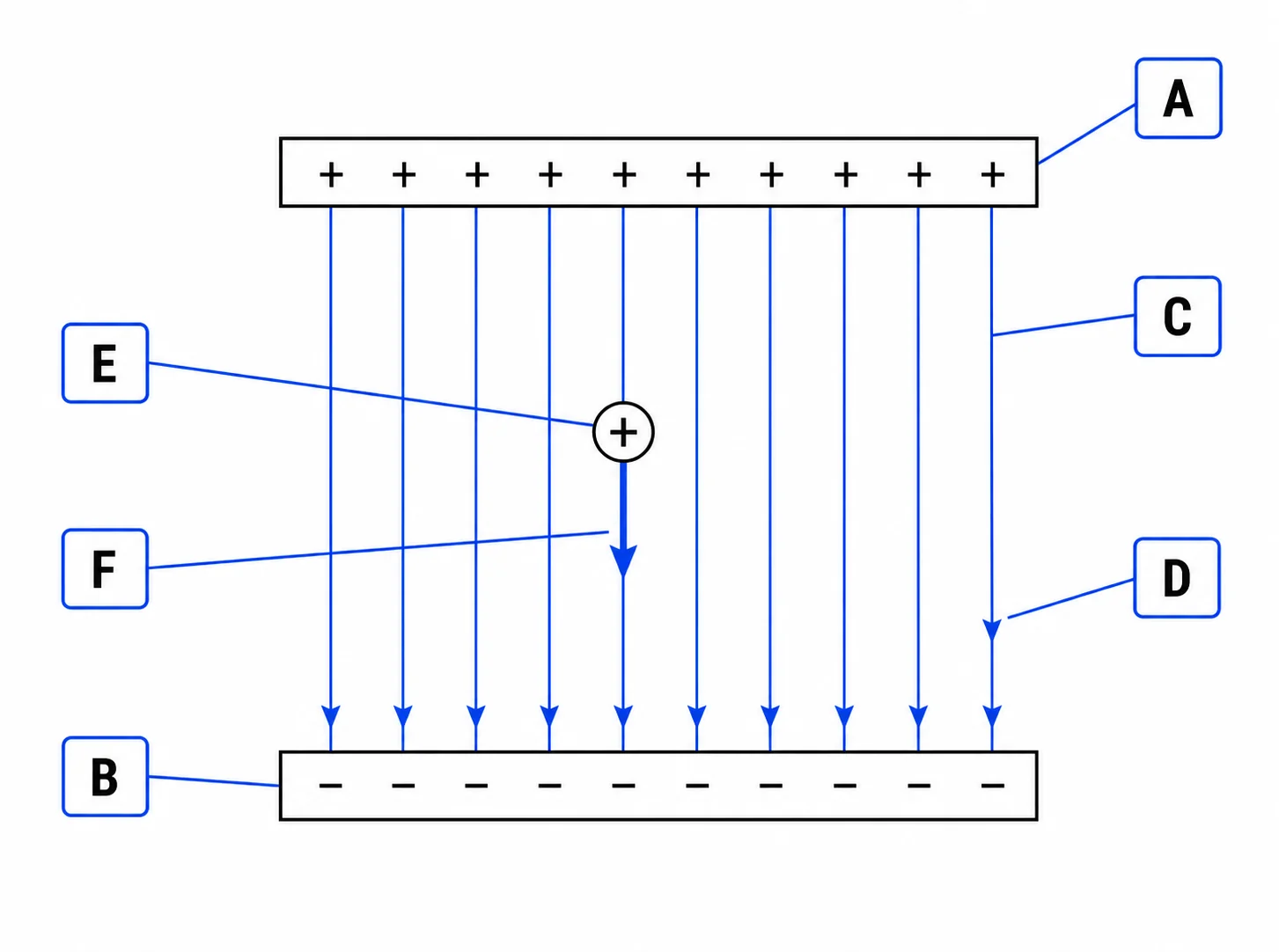
| Box | Label or description |
|---|---|
| A | |
| B | |
| C | |
| D | |
| E | |
| F |
Q1 — Term–definition match
1.1 electric field • 1.2 uniform electric field • 1.3 potential difference • 1.4 electric field strength (parallel plates) • 1.5 elementary charge • 1.6 Coulomb’s law • 1.7 Coulomb’s constant • 1.8 field line • 1.9 test charge • 1.10 coulomb.
Q2 — True / false with correction
2.1 False. Between large parallel plates the field is uniform — it has the same magnitude everywhere between the plates, not stronger near one plate. E = V/d is constant throughout the gap.
2.2 True. The force on a negative charge is F = qE; since q is negative, F is in the opposite direction to E.
2.3 False. If the separation is doubled (d → 2d) and voltage is constant, E = V/d halves, not doubles.
2.4 True. Coulomb’s law (F ∝ 1/r2) applies to point charges; the parallel-plate field is an idealisation for large plates where many surface charges produce a uniform field independent of position.
2.5 False. An electron and a proton have the same magnitude of charge (1.60 × 10⁻¹⁹ C). The electron accelerates faster because it has a much smaller mass, not a larger charge.
2.6 True. By convention, field lines point in the direction a positive test charge would move — from positive to negative plate.
Q3 — Cloze paragraph
In order: uniform / V/d / potential difference / inverse-square / qE / coulombs / positive plate / opposite.
Q4.1 — Spacing of field lines
The spacing (density) of field lines represents the magnitude of the electric field strength. Closely spaced lines indicate a stronger field; widely spaced lines indicate a weaker field. Between parallel plates, the lines are equally spaced because the field is uniform.
Q4.2 — Negligible gravity
The gravitational force on an electron is Fg = meg ≈ (9.11 × 10⁻³¹)(9.8) ≈ 8.9 × 10⁻³⁰ N. Even in a weak electric field of 10 V/m, the electric force is FE = eE = 1.60 × 10⁻¹⁸ N — about 1011 times larger. Gravity is therefore completely negligible for charged particles in electric fields.
Q4.3 — Coulomb’s constant k
Coulomb’s constant k = 8.99 × 10⁹ N m2 C−2 is the proportionality constant in Coulomb’s law F = kq1q2/r2. Its SI units (N m2 C−2) ensure that when charges are in coulombs and distance is in metres, the calculated force is in newtons.
Q4.4 — Why E = V/d cannot be used for a point charge
E = V/d assumes the field is uniform — constant in magnitude and direction between two plates with a fixed separation d. Around a single point charge the field is radial and follows E = kQ/r2; the field strength varies with distance. There is no single “separation” d to use in E = V/d.
Q5 — Sample concept map
Correct maps should include arrows such as:
- potential difference (V) and plate separation (d) — together determine → electric field (E) via E = V/d
- electric field (E) and charge (q) — together determine → force on charge (F) via F = qE
- force on charge (F) — causes → acceleration (a) via Newton’s second law
- potential difference (V) — increases → electric field (E) increases (for fixed d)
- plate separation (d) — increases → electric field (E) decreases
- charge (q) — sign determines direction of → force on charge (F)
Award 1 mark per valid labelled arrow with a linking phrase (minimum 6).
Q6 — Parallel-plate diagram labels
A: Positive plate (+) • B: Negative plate (−) • C: Electric field line (directed downward, from + to −) • D: Direction of E-field (from positive to negative plate) • E: Positive test charge (+q) • F: Force on positive charge (arrow pointing downward / toward negative plate, in same direction as E).