Physics • Year 12 • Module 5 • Lesson 9
Vertical Circular Motion
Lock in the key vocabulary, force equations, and minimum-speed relationships before tackling harder questions.
1. Term–definition match
The definitions below are shuffled. In the right-hand column write the matching term from this list: vertical circular motion, centripetal acceleration, minimum speed at the top, minimum speed at the bottom, normal force, tension, conservation of mechanical energy, clothoid loop, weight force, centripetal force. 10 marks (1 each)
| # | Definition | Matching term |
|---|---|---|
| 1.1 | Circular motion in which gravity causes the speed of the object to vary continuously with height. | |
| 1.2 | The acceleration directed toward the centre of a circular path, equal to v²/r. | |
| 1.3 | The critical speed √(rg) at which the tension or normal force in a vertical circle becomes zero. | |
| 1.4 | The minimum entry speed √(5gr) required at the lowest point to just complete a vertical loop. | |
| 1.5 | The perpendicular contact force exerted by a surface on an object resting on or moving along it. | |
| 1.6 | The pulling force exerted by a string or rope along its length, directed away from the object attached. | |
| 1.7 | The principle that the total kinetic plus potential energy of a system remains constant when only conservative forces act. | |
| 1.8 | A non-circular roller-coaster loop with continuously varying radius, designed to limit peak g-force on riders. | |
| 1.9 | The gravitational force on an object directed toward the centre of Earth; equal to mg. | |
| 1.10 | The net inward force required to keep an object moving in a circular path; not a separate force, but the resultant of real forces. |
2. True or false — with correction
Circle T or F for each statement. If the statement is false, write the corrected version on the line below it. 12 marks (1 T/F + 1 correction each)
2.1 At the top of a vertical circle, both tension and weight point downward toward the centre of the circle. T / F
2.2 At the bottom of a vertical loop, tension must overcome weight AND provide centripetal force, so tension is always less than weight. T / F
2.3 The minimum speed at the top of a vertical loop is √(rg), where r is the radius and g is gravitational acceleration. T / F
2.4 You feel heaviest at the top of a roller-coaster loop because the centripetal acceleration is greatest there. T / F
2.5 To just complete a vertical loop, the minimum speed at the bottom is √(5gr), which is √5 times the minimum speed at the top. T / F
2.6 If a ball on a string moves in a vertical circle and the speed at the top drops below √(rg), the string goes slack and the ball follows a circular path above the top. T / F
3. Fill-in-the-blank paragraph
Use the word bank to complete the passage. Each word or phrase is used once. 8 marks (1 per blank)
Word bank:
bottom · centripetal · conservation of energy · greater · minimum · non-uniform · top · zero
In vertical circular motion, the speed is not constant — this is called ___________ circular motion. The object moves fastest at the ___________ of the loop and slowest at the ___________. At the top, gravity and tension both point inward, providing the ___________ force. When the tension at the top equals ___________, the object is at its ___________ speed of √(rg). We use ___________ to relate the speed at different heights. Tension at the bottom is always ___________ than tension at the top for the same radius.
4. Function recall
Answer each question in 1–2 sentences using precise physics terms. 8 marks (2 each)
4.1 State Newton’s second law equation for the forces acting on an object at the top of a vertical circle, and explain the direction of each force.
4.2 State Newton’s second law equation for the forces acting on an object at the bottom of a vertical circle, and explain why tension is greater here than at the top.
4.3 Derive the expression vmin(top) = √(rg) by starting from the condition T = 0 at the top of the loop.
4.4 Why is the minimum entry speed at the bottom of a vertical loop √(5gr) rather than simply √(rg)?
5. Build a concept map
Draw labelled arrows between the six terms below to show how they connect. Each arrow must carry a linking phrase (e.g. “determines”, “is derived from”, “is greater than”). Aim for at least 6 labelled arrows. 6 marks (1 per valid labelled arrow)
Supplied terms: centripetal force · tension at top · tension at bottom · weight force · minimum speed · conservation of energy.
6. Label the force diagram — vertical circle at top and bottom
The diagram below shows an object on a string at the top and bottom positions of a vertical circle. Write the correct force label and its direction into each box A–F. 12 marks (1 label + 1 direction each)
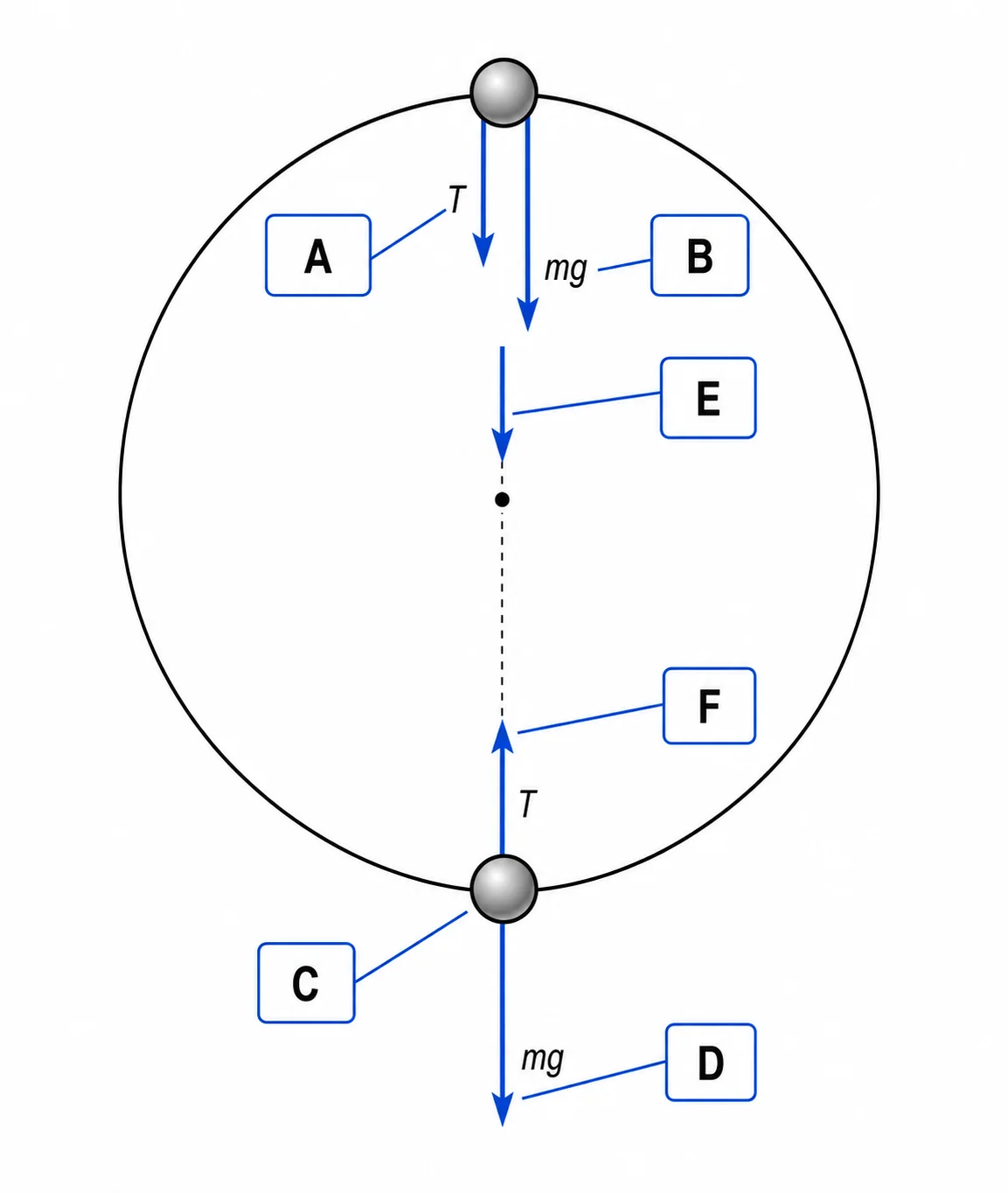
| Box | Force / quantity name | Direction (e.g. downward / toward centre) |
|---|---|---|
| A | ||
| B | ||
| C | ||
| D | ||
| E | ||
| F |
Q1 — Term–definition match
1.1 vertical circular motion • 1.2 centripetal acceleration • 1.3 minimum speed at the top • 1.4 minimum speed at the bottom • 1.5 normal force • 1.6 tension • 1.7 conservation of mechanical energy • 1.8 clothoid loop • 1.9 weight force • 1.10 centripetal force.
Q2 — True / false with correction
2.1 True. At the top, both tension (along the string) and weight (downward) point toward the centre of the circle, which is directly below the top position.
2.2 False. Tension at the bottom is always greater than weight, not less. The equation T − mg = mv²/r gives T = mv²/r + mg, which is always larger than mg.
2.3 True. Derived from setting T = 0 at the top: mg = mv²/r, so v = √(rg).
2.4 False. You feel heaviest at the bottom of the loop, where T = mv²/r + mg, exceeding your weight. At the top, T = mv²/r − mg, which is smaller (or zero at minimum speed).
2.5 True. vmin(bottom) = √(5gr) = √5 × √(gr) = √5 × vmin(top).
2.6 False. When v < √(rg) at the top, the string goes slack and the ball falls away from the circular path — it follows projectile (parabolic) motion, not circular motion.
Q3 — Cloze paragraph
In order: non-uniform / bottom / top / centripetal / zero / minimum / conservation of energy / greater.
Q4.1 — Forces at the top
At the top: T + mg = mv²/r. Both tension T (directed downward along the string toward the centre) and weight mg (directed downward due to gravity) point toward the centre, together providing the centripetal force mv²/r.
Q4.2 — Forces at the bottom
At the bottom: T − mg = mv²/r, so T = mv²/r + mg. Tension points upward (toward the centre) and weight points downward (away from the centre). Tension must overcome weight and supply the centripetal force, so it is always greater than weight alone, making it larger than the tension at the top for the same speed.
Q4.3 — Deriving vmin at the top
At the critical minimum speed, T = 0. Substituting into T + mg = mv²/r: 0 + mg = mv²/r. Dividing both sides by m: g = v²/r. Rearranging: v² = rg, so vmin(top) = √(rg).
Q4.4 — Why vmin(bottom) = √(5gr)
The object must have enough kinetic energy at the bottom to (a) convert 2mgr of KE into gravitational PE as it rises the full diameter 2r to the top, and (b) still retain enough KE to maintain vmin(top) = √(rg). Energy conservation gives: ½mvbottom² = ½m(rg) + mg(2r) = ½mrg + 2mgr = (5/2)mgr, so vbottom² = 5gr and vmin(bottom) = √(5gr).
Q5 — Sample concept map
Correct maps should include arrows such as:
- tension at top + weight force → together provide → centripetal force (at the top)
- tension at bottom − weight force → equals → centripetal force (at the bottom)
- tension at bottom → is greater than → tension at top
- minimum speed → is when → tension at top = 0
- conservation of energy → relates speed at top and bottom to derive → minimum speed
- weight force → contributes to → centripetal force (at the top)
Award 1 mark per valid labelled arrow (minimum 6, maximum 6 marked).
Q6 — Force diagram labels
At the top — A: Tension (T) — downward (toward centre). B: Weight (mg) — downward (toward centre). At the bottom — C: Tension (T) — upward (toward centre). D: Weight (mg) — downward (away from centre). E: Centripetal acceleration (ac) at top — downward (toward centre). F: Centripetal acceleration (ac) at bottom — upward (toward centre).
Award 1 mark for the correct name and 1 mark for the correct direction for each box. Accept “toward the centre of the circle” as equivalent to the stated direction.