Physics • Year 12 • Module 5 • Lesson 6
Torque and Rotational Motion
Lock in the core vocabulary, the torque formula, and the relationship between angle, distance and rotational effect before tackling harder problems.
1. Term–definition match
The definitions below are shuffled. In the right-hand column write the matching term from this list: torque, lever arm, pivot (axis of rotation), rotational equilibrium, perpendicular component, angular acceleration, moment of inertia, newton-metre (N m), couple, clockwise torque. 10 marks (1 each)
| # | Definition | Matching term |
|---|---|---|
| 1.1 | The turning effect of a force; equal to the product of the distance from the pivot and the perpendicular component of the applied force. | |
| 1.2 | The fixed point or line about which an object rotates. | |
| 1.3 | The distance measured from the pivot to the point where the force is applied, along the direction of the arm. | |
| 1.4 | The condition in which the sum of all torques acting on an object is zero, so no net rotation occurs. | |
| 1.5 | The component of a force that acts at right angles to the lever arm; this is the only part that contributes to torque. | |
| 1.6 | The rate of change of angular velocity; caused by a net torque on a rotating body. | |
| 1.7 | A measure of how mass is distributed relative to an axis of rotation; the rotational analogue of mass. | |
| 1.8 | The SI unit of torque; dimensionally equivalent to a joule but represents a turning effect, not energy. | |
| 1.9 | A pair of equal, opposite and non-collinear forces that produce a net torque but zero net force. | |
| 1.10 | A torque that tends to rotate an object in the direction a clock’s hands move when viewed from the front. |
2. True or false — with correction
Circle T or F for each statement. If the statement is false, write the corrected version on the line below it. 12 marks (1 T/F + 1 correction each)
2.1 Torque is maximised when the applied force is directed along the lever arm toward the pivot. T / F
2.2 When the angle between the force and the lever arm is 90°, the torque equals rF. T / F
2.3 Torque is measured in joules (J) because it has the same units as energy. T / F
2.4 Moving the point of force application farther from the pivot increases torque for the same applied force. T / F
2.5 Centripetal force produces a large torque because it acts on a body moving in a circle. T / F
2.6 For rotational equilibrium the sum of clockwise torques must equal the sum of anticlockwise torques. T / F
3. Fill-in-the-blank paragraph
Use the word bank to complete the passage. Each word is used once. 8 marks (1 per blank)
Word bank:
perpendicular · zero · rotation · sinθ · lever arm · newton-metres · equilibrium · pivot
Torque is the quantity that causes ___________ of a rigid body. It depends on three things: the magnitude of the applied force, the distance r from the ___________ to the point of force application (the ___________), and the angle θ between the force and the arm. Only the ___________ component of the force — equal to F ___________ — actually produces rotation. When the force is directed along the arm, the torque is ___________. Torque is measured in ___________. When the sum of all torques on an object is zero, the body is in rotational ___________.
4. Function recall
Answer each question in 1–2 sentences using precise terms from the lesson. 8 marks (2 each)
4.1 Why does pushing a door near the hinge require much more force to open it than pushing near the handle?
4.2 What is the physical significance of the angle θ in the torque formula τ = rF sinθ?
4.3 What does it mean for a seesaw to be in rotational equilibrium?
4.4 Why is torque not the same as energy, even though both are measured in N m?
5. Build a concept map
Draw labelled arrows between the six terms below to show how they connect. Each arrow must carry a linking phrase (e.g. “determines”, “is equal to”, “causes”). Aim for at least 6 labelled arrows. 6 marks (1 per valid labelled arrow)
Supplied terms: torque · force · lever arm length · angle · rotation · rotational equilibrium.
6. Label the torque diagram
The diagram below shows a force applied to a spanner at an angle. Write the correct label name and a brief description into boxes A–E. 10 marks (1 label + 1 description each)
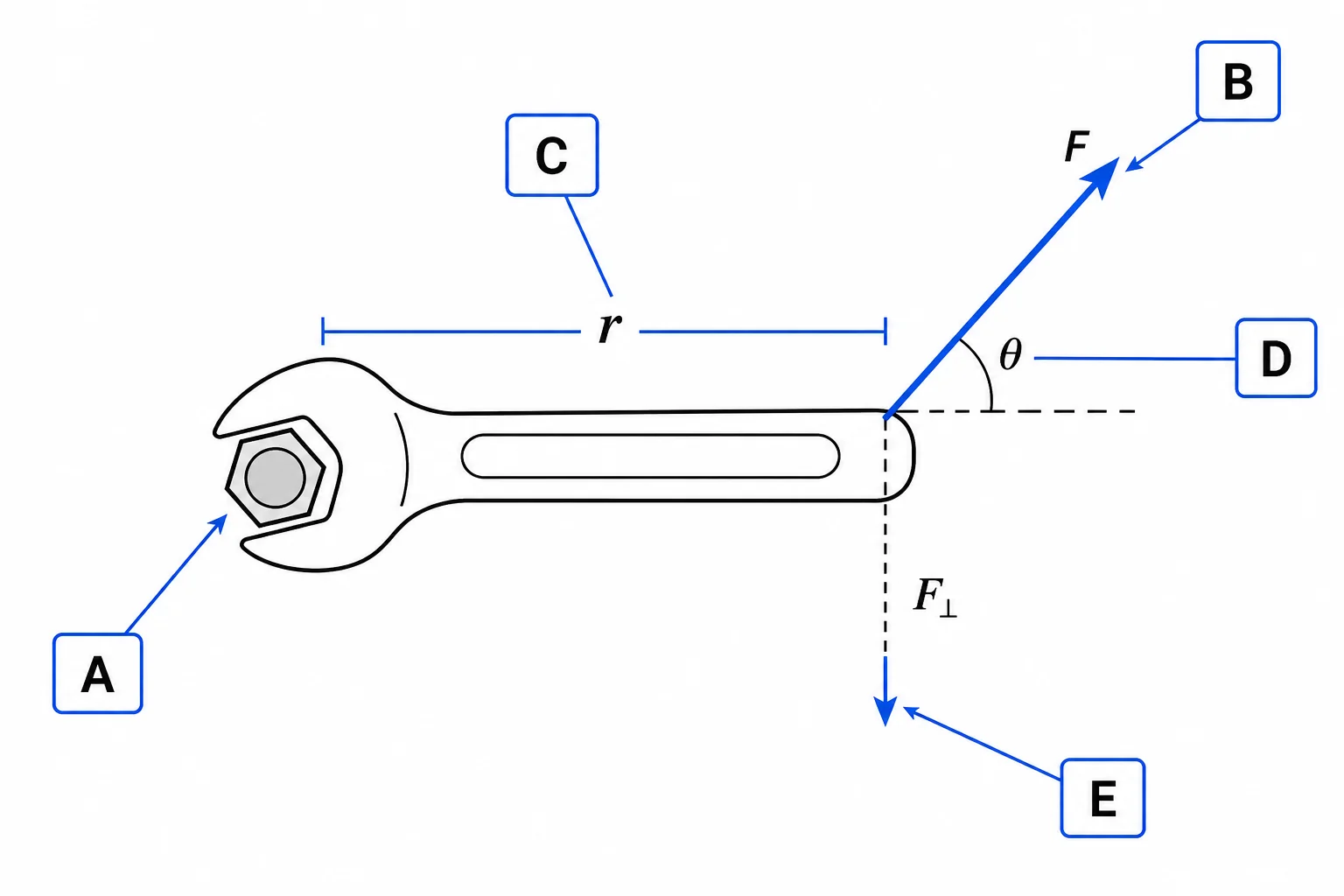
| Box | Label name | Brief description |
|---|---|---|
| A | ||
| B | ||
| C | ||
| D | ||
| E |
Q1 — Term–definition match
1.1 torque • 1.2 pivot (axis of rotation) • 1.3 lever arm • 1.4 rotational equilibrium • 1.5 perpendicular component • 1.6 angular acceleration • 1.7 moment of inertia • 1.8 newton-metre (N m) • 1.9 couple • 1.10 clockwise torque.
Marking criteria: 1 mark per correct match. No partial marks.
Q2 — True / false with correction
2.1 False. Torque is maximised when the force is applied perpendicular to the lever arm (θ = 90°), not along it. When the force is directed along the arm, sin 0° = 0 and torque is zero.
Marking criteria: 1 mark for F; 1 mark for correct statement identifying perpendicular force as maximum.
2.2 True. At θ = 90°, sin 90° = 1, so τ = rF × 1 = rF.
Marking criteria: 1 mark for T; no correction line needed.
2.3 False. Torque is measured in newton-metres (N m), not joules. Although the units are dimensionally equivalent, torque is a turning effect, not energy — calling it joules is conceptually incorrect.
Marking criteria: 1 mark for F; 1 mark for correct statement (N m, not J).
2.4 True. Because τ = rF sinθ, increasing r directly increases τ for the same F and θ.
Marking criteria: 1 mark for T.
2.5 False. Centripetal force acts through the centre of rotation (the pivot), so its perpendicular lever arm distance is zero and it produces zero torque. It maintains circular motion but does not cause angular acceleration.
Marking criteria: 1 mark for F; 1 mark for correct statement (zero torque, acts through the centre).
2.6 True. Rotational equilibrium requires ∑τ = 0, which means the sum of clockwise torques equals the sum of anticlockwise torques.
Marking criteria: 1 mark for T.
Q3 — Cloze paragraph
In order: rotation / pivot / lever arm / perpendicular / sinθ / zero / newton-metres / equilibrium.
Marking criteria: 1 mark per correct blank. Accept correct mathematical notation for sinθ (e.g. “sin θ”).
Q4.1 — Door handle near hinge
The lever arm r is very small near the hinge. Because τ = rF sinθ, a small r means a much larger force F is needed to produce the same torque required to open the door.
Marking criteria: 1 mark for identifying the small lever arm; 1 mark for linking to the torque formula correctly.
Q4.2 — Significance of θ in the formula
θ is the angle between the applied force vector and the lever arm. The factor sinθ extracts the perpendicular component of the force — the only component that produces rotation. At θ = 90° the full force contributes; at θ = 0° or 180° none of it does.
Marking criteria: 1 mark for identifying θ as the angle between force and lever arm; 1 mark for explaining that sinθ isolates the perpendicular component.
Q4.3 — Rotational equilibrium on a seesaw
A seesaw is in rotational equilibrium when the net torque about the pivot is zero: the clockwise torque produced by one side equals the anticlockwise torque produced by the other. The seesaw is balanced and does not rotate.
Marking criteria: 1 mark for stating net torque equals zero; 1 mark for explaining clockwise = anticlockwise torques.
Q4.4 — Torque vs energy
Torque is a turning effect (a vector quantity related to rotation), while energy is a scalar that represents capacity to do work. Although both use the unit N m, torque is expressed as the cross product of position and force and is not interchangeable with energy (joules).
Marking criteria: 1 mark for identifying torque as a turning effect (not energy); 1 mark for a valid distinction (vector vs scalar, or cross-product vs work).
Q5 — Sample concept map
Correct maps should include arrows such as:
- force — contributes to → torque
- lever arm length — scales → torque
- angle — modifies perpendicular component in → torque
- torque — causes → rotation
- rotational equilibrium — requires zero net → torque
- torque — balanced by equal opposite → rotational equilibrium
Marking criteria: 1 mark per valid labelled arrow (minimum 6, maximum 6 marked). Award marks for any scientifically correct relationship.
Q6 — Torque diagram labels
A: Pivot (axis of rotation) — the nut/bolt at the left end of the spanner; the fixed point about which the wrench rotates.
B: Force vector F — the applied force at the right end of the spanner; its direction determines which component is effective.
C: Lever arm length r — the distance from the pivot to the point where force is applied, measured along the wrench handle.
D: Angle θ — the angle between the applied force vector F and the lever arm; determines how much of F is perpendicular.
E: Perpendicular component F⊥ = F sinθ — the component of F at right angles to the lever arm; the only part of the force that produces torque.
Marking criteria: 1 mark per correct label name; 1 mark per accurate description (accept reasonable paraphrases). 10 marks total.