Physics • Year 12 • Module 5 • Lesson 1
Projectile Motion Fundamentals
Lock in the core vocabulary, the component equations, and the key principles of projectile motion before tackling harder questions.
1. Term–definition match
The definitions below are shuffled. In the right-hand column write the matching term from this list: projectile, trajectory, time of flight, range, maximum height, horizontal component, vertical component, independence of motion, resultant velocity, parabola. 10 marks (1 each)
| # | Definition | Matching term |
|---|---|---|
| 1.1 | An object moving through the air under the influence of gravity alone, with no other horizontal forces acting on it. | |
| 1.2 | The curved path traced by a projectile through the air from launch to landing. | |
| 1.3 | The total time a projectile remains in the air from launch until it returns to the same height (or reaches the ground). | |
| 1.4 | The total horizontal displacement of a projectile from launch point to landing point. | |
| 1.5 | The highest vertical point reached by a projectile during its trajectory, where the vertical velocity equals zero. | |
| 1.6 | The part of the launch velocity that acts in the direction parallel to the ground; remains constant throughout flight (ignoring air resistance). | |
| 1.7 | The part of the launch velocity that acts perpendicular to the ground; changes continuously due to gravitational acceleration. | |
| 1.8 | The principle that horizontal and vertical motions of a projectile are completely separate and do not affect each other, sharing only time. | |
| 1.9 | The combined velocity found by vector-adding the horizontal and vertical components at any instant during flight. | |
| 1.10 | The geometric shape described by the equation \( s_y = s_x \tan\theta - \dfrac{g s_x^2}{2v^2\cos^2\theta} \); the shape of every ideal projectile path. |
2. True or false — with correction
Circle T or F for each statement. If the statement is false, write the corrected version on the line below it. 12 marks (1 T/F + 1 correction each)
2.1 The horizontal component of a projectile’s velocity increases throughout the flight because of gravity. T / F
2.2 At the peak of a projectile’s trajectory, both the vertical velocity and the gravitational acceleration are equal to zero. T / F
2.3 For a projectile launched from ground level, the time to reach maximum height equals half the total time of flight. T / F
2.4 The total flight time of a projectile is determined by both horizontal and vertical components of the launch velocity. T / F
2.5 A ball thrown horizontally from a cliff and a ball dropped vertically from the same height will hit the ground at the same time (ignoring air resistance). T / F
2.6 Increasing the launch angle above 45° always increases the range of a projectile launched from and landing at the same height. T / F
3. Fill-in-the-blank paragraph
Use the word bank to complete the passage. Each word or phrase is used once. 8 marks (1 per blank)
Word bank:
constant · gravity · horizontal · independence · parabolic · time · vertical · zero
In projectile motion, the only force acting on the object after launch is ___________. The trajectory of a projectile is ___________ in shape. The ___________ component of velocity remains ___________ throughout the flight because there is no horizontal acceleration. The ___________ component of velocity changes continuously, reaching ___________ at the peak of the trajectory. The key principle is the ___________ of motion: horizontal and vertical motions share only ___________.
4. Function recall
Answer each question in 1–2 sentences using precise physics terms. 8 marks (2 each)
4.1 What is the function of resolving the launch velocity into horizontal and vertical components when analysing projectile motion?
4.2 Why is only the vertical component of velocity used to determine the time of flight of a projectile?
4.3 What is the value of the vertical velocity at maximum height, and which kinematic equation uses this fact to find the time to reach maximum height?
4.4 Explain why the horizontal displacement formula \( s_x = v_x t \) (constant velocity) can be used, but the full kinematic equation \( s_x = v_x t + \tfrac{1}{2}a_x t^2 \) reduces to the same thing for projectile motion.
5. Build a concept map
Draw labelled arrows between the seven terms below to show how they connect. Each arrow must carry a linking phrase (e.g. “determines”, “is found using”, “stays constant because of”). Aim for at least 7 labelled arrows. 7 marks (1 per valid labelled arrow)
Supplied terms: launch velocity · horizontal component · vertical component · time of flight · range · maximum height · gravity.
6. Label the projectile motion diagram
The diagram below shows a projectile trajectory from launch to landing with several key positions and quantities indicated. Write the correct label into boxes A–G. 7 marks (1 per label)
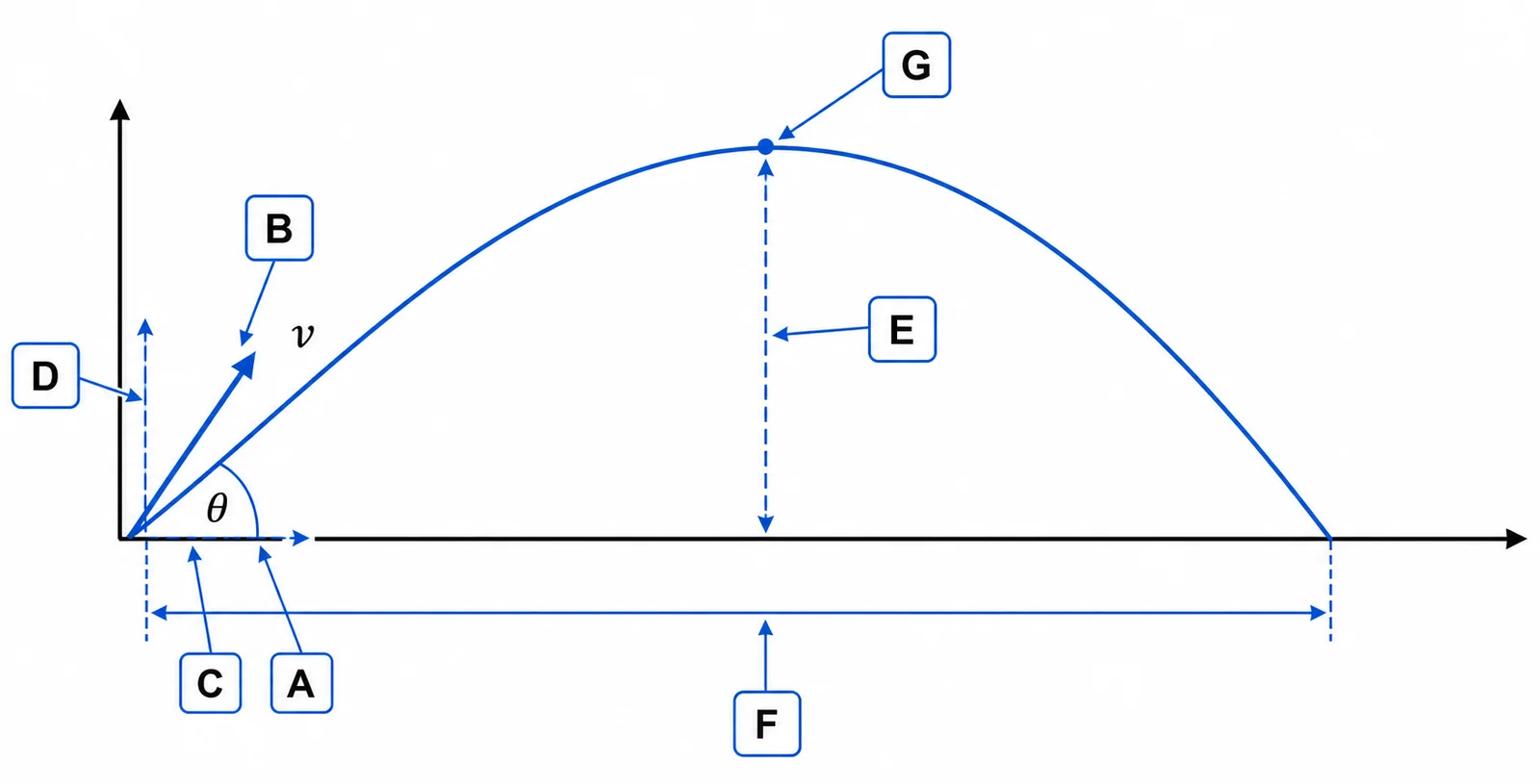
- A — _______________________
- B — _______________________
- C — _______________________
- D — _______________________
- E — _______________________
- F — _______________________
- G — _______________________
Q1 — Term–definition match
1.1 projectile • 1.2 trajectory • 1.3 time of flight • 1.4 range • 1.5 maximum height • 1.6 horizontal component • 1.7 vertical component • 1.8 independence of motion • 1.9 resultant velocity • 1.10 parabola.
Q2 — True / false with correction
2.1 False. The horizontal component of velocity remains constant throughout the flight because there is no horizontal force or acceleration (ignoring air resistance). Gravity acts only in the vertical direction.
2.2 False. At the peak, the vertical velocity is zero, but gravitational acceleration (−9.8 m/s²) acts throughout the entire trajectory, including at the peak. The acceleration is never zero during flight.
2.3 True. For a symmetric trajectory (launch and landing at the same height), the upward and downward legs are mirror images, so time to peak = ½ × total flight time.
2.4 False. The total flight time is determined only by the vertical component of velocity (and the vertical displacement). The horizontal component has no effect on flight time.
2.5 True. Both balls experience the same vertical acceleration (g = 9.8 m/s² downward) and start with zero vertical velocity. Their vertical motions are identical, so they hit the ground simultaneously.
2.6 False. For a projectile launched from and landing at the same height, range = v² sin(2θ)/g. The maximum range occurs at θ = 45° because sin(90°) = 1 is the maximum. Angles above 45° give the same range as their complementary angle below 45° (e.g. 60° gives the same range as 30°), but less than at 45°.
Q3 — Cloze paragraph
In order: gravity / parabolic / horizontal / constant / vertical / zero / independence / time.
Q4.1 — Function of resolving velocity
Resolving the launch velocity separates the problem into two independent one-dimensional motions (horizontal: constant velocity; vertical: constant acceleration due to gravity). This allows the simpler kinematic equations for each direction to be applied independently, and time acts as the connecting variable.
Q4.2 — Why only vertical component determines flight time
The flight ends when the vertical displacement returns to the launch height (or reaches the ground). Since there is no vertical displacement change caused by horizontal motion, and gravity acts only vertically, the time spent in the air is entirely governed by the vertical component of velocity and the vertical acceleration due to gravity.
Q4.3 — Vertical velocity at maximum height
The vertical velocity at maximum height is zero (vy = 0). Using vy = uy + at with vy = 0: 0 = uy − gt ⇒ t = uy/g.
Q4.4 — Why sx = vxt
For a projectile there is no horizontal acceleration (ax = 0), so the ½axt² term in the full kinematic equation is zero. The equation reduces to sx = vxt, confirming constant horizontal velocity.
Q5 — Sample concept map
Correct maps should include arrows such as:
- launch velocity — is resolved into → horizontal component
- launch velocity — is resolved into → vertical component
- gravity — continuously changes → vertical component
- vertical component — determines → time of flight
- horizontal component + time of flight — together determine → range
- vertical component + gravity — together determine → maximum height
- horizontal component — stays constant; not affected by → gravity
Award 1 mark per valid labelled arrow (minimum 7, maximum 7 marked).
Q6 — Projectile diagram labels
A: Launch angle θ (angle above the horizontal). B: Initial (launch) velocity v. C: Horizontal component vx = v cosθ. D: Vertical component vy = v sinθ (at launch). E: Maximum height (highest point on trajectory). F: Range (total horizontal displacement to landing). G: Point where vertical velocity = 0 (the peak / maximum height point).