Physics • Year 11 • Module 3 • Lesson 1
Wave Motion and Types of Waves
Apply your understanding of wave classification, energy transfer and wave vocabulary to real data, real scenarios and a diagram critique.
1. Classify six wave scenarios
The table below lists six wave examples. For each one, complete the three classification columns. 12 marks (2 per row)
| Wave example | Mechanical or electromagnetic? | Transverse or longitudinal? | Can it travel through a vacuum? (Yes/No) |
|---|---|---|---|
| Sound from a speaker travelling through air | |||
| Pulse travelling along a stretched rope | |||
| Sunlight travelling from the Sun to Earth | |||
| Seismic P-wave travelling through rock | |||
| Compression pulse along a slinky spring | |||
| FM radio signal from a Sydney broadcast tower |
1.1 For the seismic P-wave (row 4): explain what is actually oscillating and in which direction, relative to the wave’s direction of travel. 2 marks
2. Interpret a displacement–time graph for a wave particle
A particle in a medium carrying a transverse wave was monitored and its displacement from equilibrium recorded every 0.1 s. The graph below shows the result. 8 marks
Figure 2. Displacement vs time for a single particle in a medium carrying a transverse wave. Illustrative data.
2.1 From the graph, read off the period (T) and frequency (f) of the wave. Show your working. 2 marks
2.2 Identify the amplitude of this wave and explain what it represents physically. 2 marks
2.3 A student claims: “The graph shows the wave moving forward at each time step.” Identify the flaw in this interpretation. What does the graph actually show? 2 marks
2.4 If the wave speed in this medium is 2.0 m s−1, calculate the wavelength. 2 marks
3. Compare mechanical and electromagnetic waves across five features
Complete the two-column table below. For each feature, write a concise description that contrasts the two types of wave. 10 marks (1 per cell)
| Feature | Mechanical wave | Electromagnetic wave |
|---|---|---|
| Requires a medium? | ||
| Can travel through a vacuum? | ||
| What oscillates? | ||
| Speed in air (approximate) | ||
| Australian example |
4. Predict and justify — underwater sound at Sydney Harbour
Divers on a harbour-floor survey near Sydney Harbour Bridge can hear the propeller noise of a ferry approaching from 500 m away. The ferry captain uses a VHF radio to communicate with the harbour master on shore. Above the surface, you can hear the ferry’s horn from 100 m.
5 marks
4.1 For each type of communication in this scenario (underwater propeller sound, VHF radio, horn in air), classify it as mechanical or electromagnetic and as transverse or longitudinal. Justify each classification. 3 marks
4.2 Sound travels approximately four times faster in water than in air. Predict whether the diver will detect the approaching ferry earlier or later than a person standing on the dock at the same distance. Justify using the relationship v = fλ. 2 marks
5. Diagram critique — what is wrong with this wave classification poster?
A Year 11 student drew the diagram below to illustrate wave types and their properties. There are three errors in the poster. Identify each error and write the correction. 6 marks (2 per error: 1 identify, 1 correct)
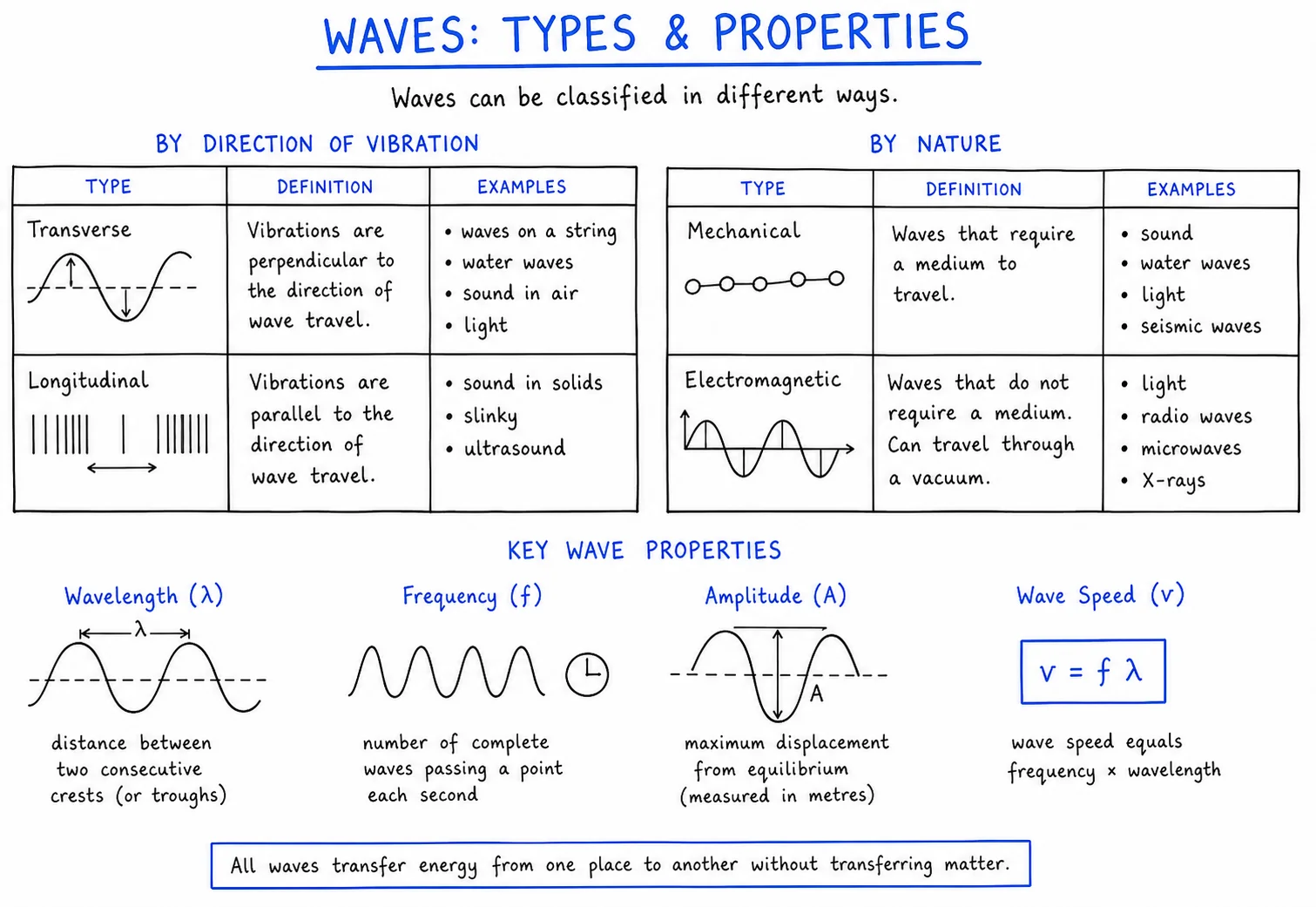
5.1 Error 1: What is wrong?
Correction:
5.2 Error 2: What is wrong?
Correction:
5.3 Error 3: What is wrong?
Correction:
Q1 — Classification table
Sound in air: mechanical; longitudinal; No. Rope pulse: mechanical; transverse; No. Sunlight: electromagnetic; transverse; Yes. Seismic P-wave: mechanical; longitudinal; No. Slinky compression: mechanical; longitudinal; No. FM radio: electromagnetic; transverse; Yes.
Q1.1 — Seismic P-wave particle motion
In a seismic P-wave, the rock particles oscillate parallel to the direction of wave travel (back and forth along the propagation direction). The wave is longitudinal, so compressions and rarefactions move through the rock in the same direction as the wave itself advances. The rock material does not travel with the wave; each particle oscillates about its rest position.
Q2.1 — Period and frequency
From the graph, one complete cycle takes from t = 0 to t = 0.4 s. Therefore T = 0.4 s. Frequency f = 1/T = 1/0.4 = 2.5 Hz.
Q2.2 — Amplitude
The amplitude is 5 cm (0.05 m) — the maximum displacement from the equilibrium position, read from the graph as the peak or trough value. Physically, amplitude represents how far the particle is displaced from its rest position at the peak of its oscillation; it relates to the energy carried by the wave (greater amplitude → more energy per oscillation).
Q2.3 — Flaw in the student’s claim
The flaw is that a displacement–time graph shows the motion of a single particle over time — it shows how the particle’s displacement changes at one fixed position in the medium. It does not show the wave pattern moving forward through space. The wave’s spatial distribution would require a displacement–position (snapshot) graph. This graph simply confirms the particle oscillates with period 0.4 s and amplitude 5 cm at its fixed location.
Q2.4 — Wavelength
v = fλ, so λ = v/f = 2.0/2.5 = 0.80 m.
Q3 — Compare and contrast table
Requires a medium? Mechanical: Yes, needs particles of a medium to oscillate. EM: No medium required; can propagate through a vacuum. Travels through vacuum? Mechanical: No. EM: Yes — light from the Sun reaches Earth through space. What oscillates? Mechanical: Particles of the medium (e.g. air molecules, water molecules, rope segments). EM: Oscillating electric and magnetic fields. Speed in air: Mechanical (sound): ~340 m s−1. EM (light): ~3 × 10⁸ m s−1 (essentially the same as in vacuum). Australian example: Mechanical: Sound from a surf lifesaver’s whistle on a Bondi beach; seismic P-waves detected at Geoscience Australia. EM: Sunlight reaching the Snowy Mountains; ABC radio broadcasts.
Q4.1 — Harbour wave classifications
Underwater propeller sound: mechanical and longitudinal. Sound requires water as a medium; water molecules oscillate parallel to the direction the sound travels. VHF radio: electromagnetic and transverse. Radio waves are self-propagating oscillating fields; they do not need a medium and can travel through the air and space. Horn in air: mechanical and longitudinal. Air molecules oscillate parallel to the propagation direction, forming compressions and rarefactions.
Q4.2 — Diver detects ferry earlier
The diver will detect the approaching ferry earlier because sound travels approximately four times faster in water than in air (as stated in the question). Since v = fλ and frequency is set by the source, the larger speed in water means a larger wavelength. The higher wave speed means the disturbance reaches the diver sooner from the same distance. The dock observer must wait longer for the sound to travel through the slower-speed medium (air).
Q5 — Diagram critique
5.1 Error 1 (sound labelled as transverse): Sound in air is a longitudinal wave, not transverse [1]. Correction: In a sound wave in air, air molecules oscillate parallel to the direction the sound travels, creating compressions (high pressure) and rarefactions (low pressure). “Transverse” means perpendicular oscillation, which does not apply to sound [1].
5.2 Error 2 (light labelled as mechanical): Light is an electromagnetic wave, not mechanical [1]. Correction: Light does not require a material medium; it can travel through the vacuum of space. Mechanical waves cannot propagate without a medium. Light consists of oscillating electric and magnetic fields that sustain each other without any material carrier [1].
5.3 Error 3 (amplitude labelled as crest-to-trough distance): The crest-to-trough distance is twice the amplitude [1]. Correction: Amplitude is defined as the maximum displacement from the equilibrium position to the crest (or trough), not the total peak-to-peak distance. Labelling the full crest-to-trough distance as amplitude doubles the actual value and will cause calculation errors [1].