Physics • Year 11 • Module 3 • Lesson 1
Wave Motion and Types of Waves
Lock in the core vocabulary, the mechanical vs electromagnetic distinction, and the transverse vs longitudinal classification before tackling harder questions.
1. Term–definition match
The definitions below are shuffled. In the right-hand column write the matching term from this list: wave, medium, mechanical wave, electromagnetic wave, transverse wave, longitudinal wave, amplitude, wavelength, frequency, period. 10 marks (1 each)
| # | Definition | Matching term |
|---|---|---|
| 1.1 | A disturbance that transfers energy from one place to another without the bulk transport of matter. | |
| 1.2 | The material substance (solid, liquid, or gas) through which a mechanical wave travels; its particles oscillate but do not travel with the wave. | |
| 1.3 | A wave that requires a medium to propagate; examples include sound and water surface waves. | |
| 1.4 | A wave that does not require a material medium and can travel through a vacuum; examples include light and radio waves. | |
| 1.5 | A wave in which the particles of the medium oscillate perpendicular to the direction of wave travel. | |
| 1.6 | A wave in which the particles of the medium oscillate parallel to the direction of wave travel; compressions and rarefactions move forward. | |
| 1.7 | The maximum displacement of a particle from its equilibrium position; measured in metres. | |
| 1.8 | The distance between two consecutive points that are in phase, such as crest to crest or compression to compression. | |
| 1.9 | The number of complete oscillations per second; measured in hertz (Hz). | |
| 1.10 | The time for one complete oscillation; the reciprocal of frequency; T = 1/f. |
2. True or false — with correction
Circle T or F for each statement. If the statement is false, write the corrected version on the line below it. 12 marks (1 T/F + 1 correction each)
2.1 A wave carries matter from the source to the receiver. T / F
2.2 Sound in air is a mechanical wave because it requires air as a medium to propagate. T / F
2.3 Visible light is a longitudinal wave because it travels in a straight line. T / F
2.4 In a transverse wave, the particles of the medium move perpendicular to the direction the wave travels. T / F
2.5 A wave with a larger amplitude travels faster than one with a smaller amplitude, in the same medium. T / F
2.6 When a wave moves from one medium to another, its frequency usually stays constant while its wavelength may change. T / F
3. Fill-in-the-blank paragraph
Use the word bank to complete the passage. Each word is used once. 8 marks (1 per blank)
Word bank:
amplitude · disturbance · electromagnetic · energy · frequency · longitudinal · medium · transverse
A wave is a ___________ that transfers ___________ from one location to another without permanently moving the particles of the ___________ along with it. Waves that need matter to carry them are called mechanical waves; those that do not are called ___________ waves. In a ___________ wave, particles of the medium oscillate perpendicular to the direction of travel, whereas in a ___________ wave they oscillate parallel to it. The maximum displacement from equilibrium is called the ___________, while the number of complete oscillations per second is the ___________.
4. Function recall
Answer each question in 1–2 sentences using precise terms from the lesson. 8 marks (2 each)
4.1 What is the defining feature that makes a wave mechanical rather than electromagnetic?
4.2 Explain why a cork floating on a pond does not travel with a ripple across the surface.
4.3 What is the difference between amplitude and wavelength? Include the standard measurement unit for each.
4.4 Why is there no sound in outer space?
5. Build a concept map
Draw labelled arrows between the six terms below to show how they connect. Each arrow must carry a linking phrase (e.g. “is a type of”, “requires”, “transfers”, “measured by”). Aim for at least 6 labelled arrows. 6 marks (1 per valid labelled arrow)
Supplied terms: wave · energy · medium · mechanical wave · electromagnetic wave · transverse wave.
6. Label the transverse wave diagram
The diagram below shows a transverse wave. Write the correct wave feature name into boxes A–F. 6 marks (1 each)
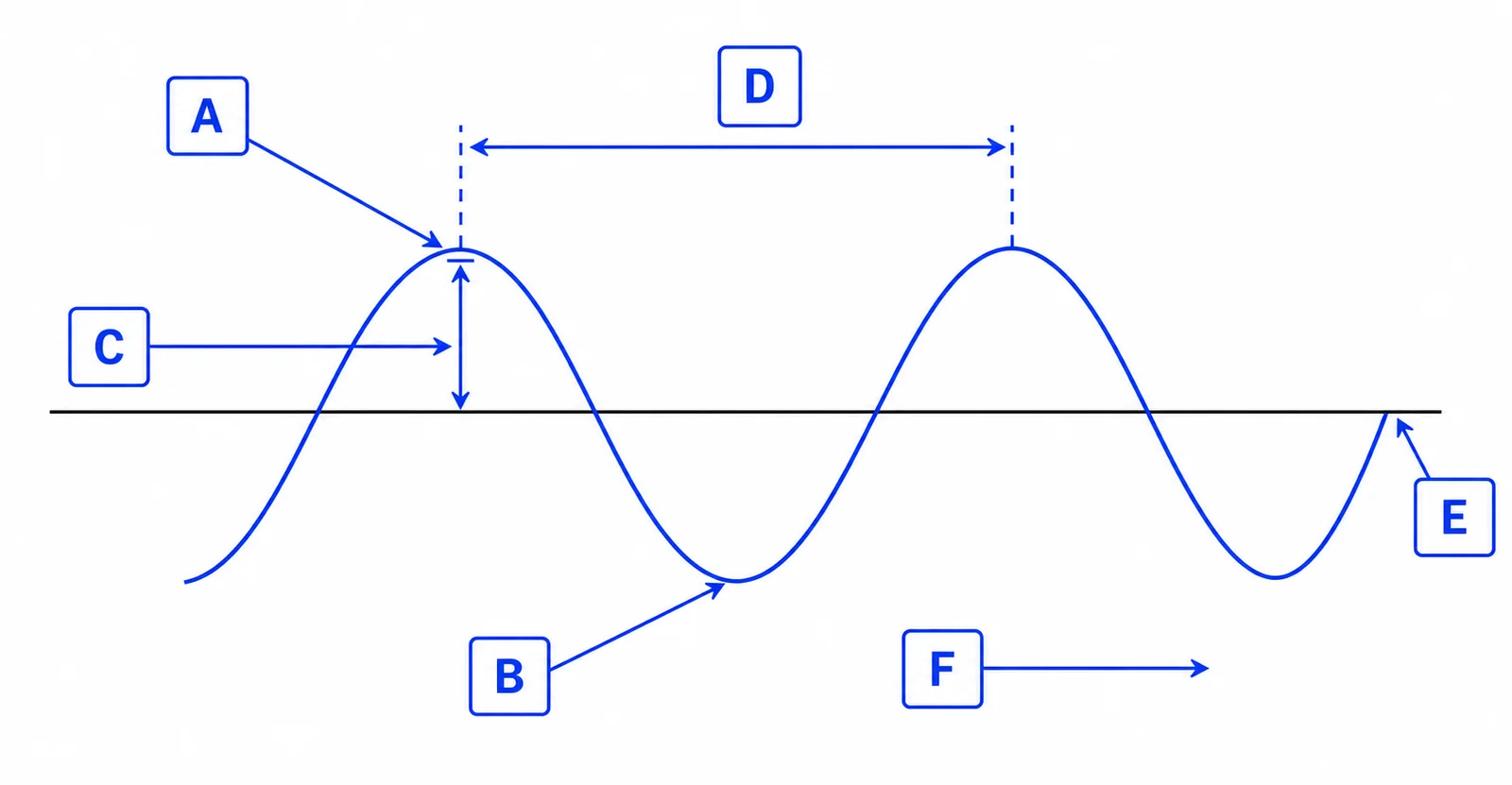
| Box | Wave feature name | One-sentence description |
|---|---|---|
| A | ||
| B | ||
| C | ||
| D | ||
| E | ||
| F |
Q1 — Term–definition match
1.1 wave • 1.2 medium • 1.3 mechanical wave • 1.4 electromagnetic wave • 1.5 transverse wave • 1.6 longitudinal wave • 1.7 amplitude • 1.8 wavelength • 1.9 frequency • 1.10 period.
Q2 — True / false with correction
2.1 False. A wave transfers energy, not matter. The particles of the medium oscillate about their equilibrium positions and do not travel with the wave.
2.2 True.
2.3 False. Visible light is a transverse electromagnetic wave. It travels in straight lines but the oscillating electric and magnetic fields are perpendicular to the direction of travel. “Travelling in a straight line” does not determine whether a wave is transverse or longitudinal.
2.4 True.
2.5 False. Amplitude measures maximum displacement; it does not determine wave speed. In a given medium, wave speed is determined by the properties of the medium (e.g. tension, density), not the amplitude of the wave.
2.6 True.
Q3 — Cloze paragraph
In order: disturbance / energy / medium / electromagnetic / transverse / longitudinal / amplitude / frequency.
Q4.1 — Defining feature of a mechanical wave
A mechanical wave requires a material medium to propagate. The particles of the medium must oscillate to pass the disturbance from one location to the next. Without a medium there are no particles to displace, so the wave cannot exist.
Q4.2 — Cork and the ripple
The cork does not travel with the ripple because waves transfer energy, not matter. The cork is a marker of one water particle’s position; that particle oscillates up and down (or in a small circle) about its equilibrium position as the disturbance passes. The energy of the disturbance moves across the pond; the water particles, and the cork, stay roughly in the same location.
Q4.3 — Amplitude vs wavelength
Amplitude is the maximum displacement of a particle from its equilibrium position, measured in metres (m) perpendicular to the wave direction. Wavelength is the distance over which the wave pattern repeats — measured in metres (m) along the direction of travel. Amplitude is a measure of the wave’s intensity; wavelength describes the spatial period of the pattern.
Q4.4 — No sound in space
Sound is a mechanical wave; it requires a medium (such as air) whose particles can oscillate and pass on the disturbance. Outer space is essentially a vacuum — there are no particles to oscillate — so sound cannot propagate. Electromagnetic waves such as light, however, can travel through space because they do not require a material medium.
Q5 — Sample concept map
Correct maps should include arrows such as:
- wave — transfers → energy
- mechanical wave — is a type of → wave
- electromagnetic wave — is a type of → wave
- mechanical wave — requires → medium
- electromagnetic wave — does not require → medium
- transverse wave — is a type of → mechanical wave (or wave)
Award 1 mark per valid labelled arrow (minimum 6, maximum 6 marked).
Q6 — Transverse wave diagram labels
A: Crest — the highest point of the wave (maximum positive displacement from equilibrium). B: Trough — the lowest point of the wave (maximum negative displacement). C: Amplitude — the distance from the equilibrium position to the crest (or trough). D: Wavelength (λ) — the distance between two consecutive points in phase (e.g. crest to crest). E: Equilibrium position — the undisturbed rest position of the medium particles. F: Direction of wave travel — the direction the disturbance (energy) propagates, perpendicular to particle motion in a transverse wave.