Physics • Year 11 • Module 2: Dynamics • Lesson 6
Work and Kinetic Energy
Lock in the core vocabulary, the work formula, the KE formula, and the work-energy theorem before tackling harder questions.
1. Term–definition match
The definitions below are shuffled. In the right-hand column write the matching term from this list: work, joule, kinetic energy, work-energy theorem, displacement, zero work, gravitational potential energy, net work, angle of application, negative work. 10 marks (1 each)
| # | Definition | Matching term |
|---|---|---|
| 1.1 | The energy a moving object possesses due to its motion; equals ½mv². | |
| 1.2 | The transfer of energy by a force acting through a displacement; equals Fs cos θ. | |
| 1.3 | The SI unit of both work and energy; equal to one newton-metre (N m). | |
| 1.4 | The principle that the net work done on an object equals its change in kinetic energy. | |
| 1.5 | A vector quantity equal to the change in position of an object; used in the work formula as s. | |
| 1.6 | The sum of work done by all forces acting on an object, including friction. | |
| 1.7 | Work done when the force component opposes motion; has a negative value and removes kinetic energy. | |
| 1.8 | Energy stored by an object due to its position in a gravitational field; equals mgΔh. | |
| 1.9 | The symbol θ in the work formula; measured between the force vector and the direction of displacement. | |
| 1.10 | The outcome when θ = 90° in the work formula; cos 90° = 0 so no energy is transferred, regardless of the force magnitude or displacement. |
2. True or false — with correction
Circle T or F for each statement. If the statement is false, write the corrected version on the line below it. 12 marks (1 T/F + 1 correction each)
2.1 A force does work on an object whenever the force and the displacement are in the same direction. T / F
2.2 The normal force acting on a box sliding horizontally across a floor does positive work on the box. T / F
2.3 Doubling the speed of an object doubles its kinetic energy. T / F
2.4 A stationary 1000 kg truck has more kinetic energy than a moving 9 g bullet travelling at 900 m/s. T / F
2.5 If the net work done on an object is negative, the object’s speed decreases. T / F
2.6 Friction always does positive work on an object because it exerts a force on it. T / F
3. Fill-in-the-blank paragraph
Use the word bank to complete the passage. Each word is used once. 8 marks (1 per blank)
Word bank:
displacement · joules · kinetic · net · negative · perpendicular · squared · theorem
Work is defined as the energy transferred by a force acting through a ___________ in the direction of that force. The unit of work is ___________, the same unit as energy. When a force acts at 90° to the direction of motion — that is, ___________ to the displacement — the work done is zero. Friction acting opposite to motion does ___________ work, removing energy from the system. The energy of a moving object is called ___________ energy and depends on the ___________ of its speed. The work-energy ___________ states that the ___________ work done on an object equals its change in kinetic energy.
4. Function recall
Answer each question in 1–2 sentences using precise terms from the lesson. 8 marks (2 each)
4.1 Why does a waiter carrying a tray horizontally across a restaurant do zero work on the tray in the physics sense?
4.2 What is the work-energy theorem, and why must you use net work rather than just the applied force alone?
4.3 A car travelling at 60 km/h has four times the kinetic energy of the same car at 30 km/h. Why is it four times, not two times?
4.4 What happens to the gravitational potential energy of an object as it falls freely? Where does that energy go?
5. Build a concept map
Draw labelled arrows between the six terms below to show how they connect. Each arrow must carry a linking phrase (e.g. “equals change in”, “converts to”, “measured in”). Aim for at least 6 labelled arrows. 6 marks (1 per valid labelled arrow)
Supplied terms: work · kinetic energy · force · displacement · joule · net work.
6. Label the four work scenarios
The diagram below shows four situations labelled A–D. For each situation, write the angle θ (between force and displacement) and whether work is positive, negative, or zero. 8 marks (1 per angle + 1 per sign)
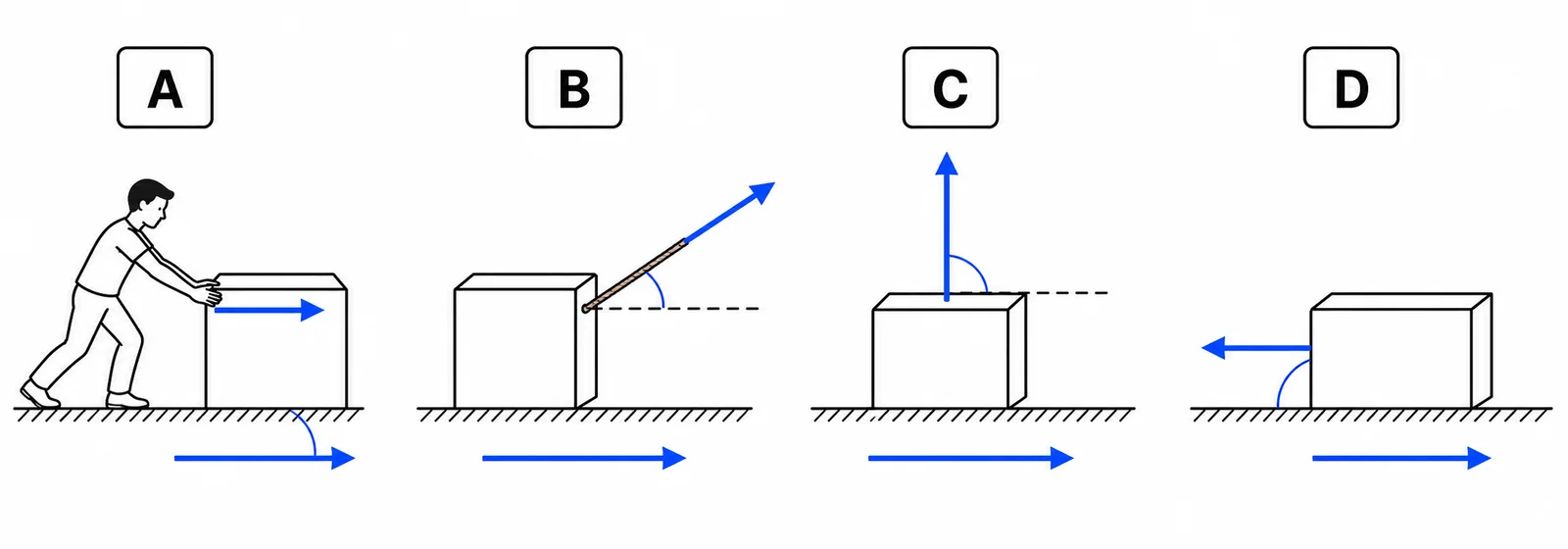
| Situation | Description | θ (degrees) | Work: positive, negative, or zero? |
|---|---|---|---|
| A | Horizontal push on a box; force and motion in the same direction | ||
| B | Rope pulling at 30° above the horizontal direction of motion | ||
| C | Normal force (upward) on a box sliding horizontally | ||
| D | Friction force acting opposite to the direction of motion |
Q1 — Term–definition match
1.1 kinetic energy • 1.2 work • 1.3 joule • 1.4 work-energy theorem • 1.5 displacement • 1.6 net work • 1.7 negative work • 1.8 gravitational potential energy • 1.9 angle of application • 1.10 zero work.
Q2 — True / false with correction
2.1 True. When θ = 0°, cos0° = 1, so W = Fs (maximum positive work).
2.2 False. The normal force acts vertically upward while the box moves horizontally. The angle between force and displacement is 90°; cos90° = 0, so the work done by the normal force is zero (not positive).
2.3 False. Doubling the speed quadruples kinetic energy because KE = ½mv² — it depends on v², not v.
2.4 False. A stationary truck has zero kinetic energy regardless of its mass. The bullet (KE = ½ × 0.009 × 900² = 3645 J) has far more KE than a stationary object of any mass.
2.5 True. Negative net work means ΔKE < 0, so KEf < KEi, meaning the object loses speed.
2.6 False. Friction opposes the direction of motion (θ = 180°), so it does negative work, removing energy from the object rather than adding it.
Q3 — Cloze paragraph
In order: displacement / joules / perpendicular / negative / kinetic / squared / theorem / net.
Q4.1 — Waiter and tray
The waiter exerts an upward force on the tray; the tray moves horizontally. The angle between the force (upward) and the displacement (horizontal) is 90°. Since cos90° = 0, W = Fscos90° = 0 J — no work is done on the tray in the physics sense, regardless of the effort involved.
Q4.2 — Work-energy theorem and net work
The work-energy theorem states that Wnet = ΔKE. Net work must be used because friction and other opposing forces simultaneously remove energy from the object while the applied force adds energy. Using only the applied force would overestimate the KE gained and give the wrong final speed.
Q4.3 — Speed and KE ratio
KE = ½mv² depends on v², not v. Doubling speed: (2v)² = 4v². So doubling v gives 4× as much KE. A car at 60 km/h has (60/30)² = 4× the KE of the same car at 30 km/h.
Q4.4 — Falling object and energy
As an object falls, its height decreases so its gravitational potential energy (ΔU = mgΔh) decreases. By the work-energy theorem, gravity does positive work on the falling object, and that energy converts entirely into kinetic energy — the object speeds up as PE decreases.
Q5 — Sample concept map
Correct maps should include arrows such as:
- force — acts through a → displacement — together produce → work
- net work — equals change in → kinetic energy
- work — is measured in → joule
- net work — is the sum of all → work
- kinetic energy — is measured in → joule
- force — magnitude affects → work
Award 1 mark per valid labelled arrow (minimum 6, maximum 6 marked).
Q6 — Four work scenarios
A: θ = 0° • Positive work (cos0° = 1; full force contributes). B: θ = 30° • Positive work (cos30° = 0.866; partial contribution). C: θ = 90° • Zero work (cos90° = 0; force perpendicular to motion). D: θ = 180° • Negative work (cos180° = −1; force opposes motion).