Physics • Year 11 • Module 2 • Lesson 4
Newton’s Laws and Friction
Lock in the key vocabulary, the two friction types, and Newton’s First and Second Laws before tackling calculations.
1. Term–definition match
The definitions below are shuffled. In the right-hand column write the matching term from this list: net force, inertia, Newton’s First Law, Newton’s Second Law, static friction, kinetic friction, coefficient of friction, normal force, free body diagram, equilibrium. 10 marks (1 each)
| # | Definition | Matching term |
|---|---|---|
| 1.1 | The vector sum of all forces acting on a single object. | |
| 1.2 | The tendency of an object to resist any change in its state of motion; proportional to mass. | |
| 1.3 | An object at rest or moving at constant velocity has zero net force acting on it. | |
| 1.4 | The acceleration of an object is directly proportional to the net force and inversely proportional to its mass: Fnet = ma. | |
| 1.5 | Friction that acts on a stationary object, opposing its tendency to slide; adjusts up to a maximum. | |
| 1.6 | Friction that acts on an object already sliding; has a constant value for a given surface pair. | |
| 1.7 | A dimensionless number that measures how much friction two surfaces generate; symbol μ. | |
| 1.8 | The contact force a surface exerts perpendicular to its face on an object resting on it; symbol FN. | |
| 1.9 | A diagram showing a single object as a dot with all forces drawn as labelled arrows pointing away from it. | |
| 1.10 | The state in which an object experiences zero net force and therefore zero acceleration. |
2. True or false — with correction
Circle T or F for each statement. If the statement is false, write the corrected version on the line below it. 12 marks (1 T/F + 1 correction each)
2.1 A constant velocity always means there are no forces acting on the object. T / F
2.2 The F in Newton’s Second Law F = ma refers to the applied force alone. T / F
2.3 Static friction is always greater in magnitude than kinetic friction for the same surface pair. T / F
2.4 Heavier objects decelerate faster than lighter objects when sliding on the same surface because they have more friction. T / F
2.5 When a van brakes suddenly, packages fly forward because a forward force pushes them toward the cabin. T / F
2.6 On a flat horizontal surface, the normal force equals the weight of the object. T / F
3. Fill-in-the-blank paragraph
Use the word bank to complete the passage. Each word is used once. 8 marks (1 per blank)
Word bank:
acceleration · coefficient · friction · inertia · kinetic · net · normal · static
Newton’s First Law describes ___________, the tendency of an object to resist changes in its motion. When a van brakes, the packages continue forward because no horizontal force acts on them — zero ___________ force means zero acceleration. Newton’s Second Law states that Fnet = ma, where the ___________ of the object equals the net force divided by its mass. The friction force on a sliding object is calculated using f = μFN, where μ is the ___________ of ___________ and FN is the ___________ force. When an object is stationary, ___________ friction acts; once it begins to slide, ___________ friction takes over, which is always smaller.
4. Function recall
Answer each question in 1–2 sentences using precise terms from the lesson. 8 marks (2 each)
4.1 What is the defining difference between static friction and kinetic friction?
4.2 Why must F in Newton’s Second Law always be the net force rather than a single applied force?
4.3 Explain why a seatbelt prevents a driver from flying forward when a van brakes suddenly.
4.4 What does it mean physically when μs > μk for a surface pair?
5. Build a concept map
Draw labelled arrows between the six terms below to show how they connect. Each arrow must carry a linking phrase (e.g. “requires”, “causes”, “is reduced by”). Aim for at least 6 labelled arrows. 6 marks (1 per valid labelled arrow)
Supplied terms: net force · acceleration · friction · normal force · Newton’s Second Law · mass.
6. Label the free body diagram
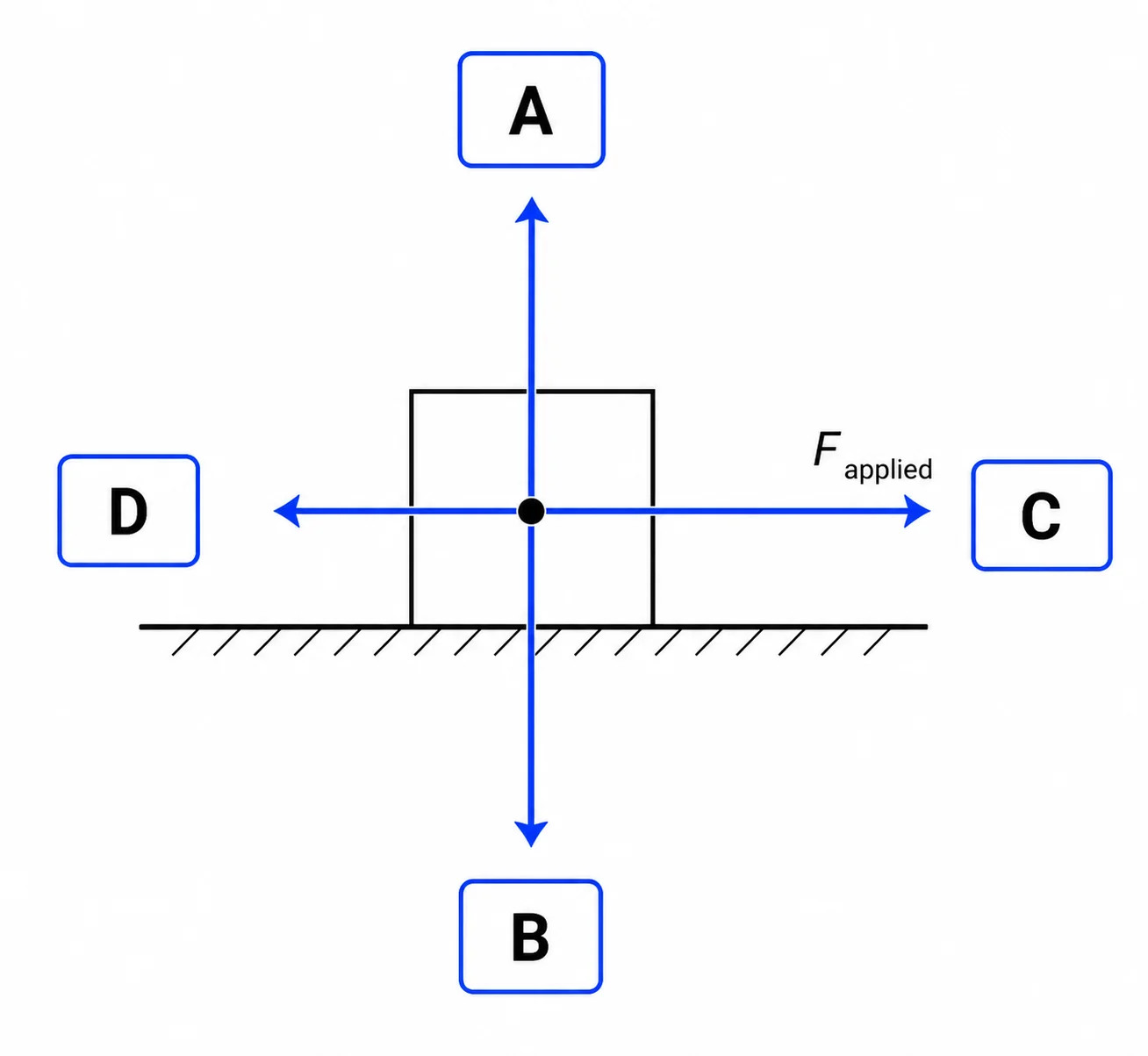
The diagram below shows a box being pushed across a flat floor. Four forces act on it. Write the correct force name and direction into boxes A–D. 8 marks (1 name + 1 direction each)
| Box | Force name | Direction |
|---|---|---|
| A | ||
| B | ||
| C | ||
| D |
Q1 — Term–definition match
1.1 net force • 1.2 inertia • 1.3 Newton’s First Law • 1.4 Newton’s Second Law • 1.5 static friction • 1.6 kinetic friction • 1.7 coefficient of friction • 1.8 normal force • 1.9 free body diagram • 1.10 equilibrium.
Q2 — True / false with correction
2.1 False. Constant velocity means the net force is zero — but forces can still be present and balanced. For example, a car cruising at constant speed has both a driving force and friction acting; they cancel each other.
2.2 False. F in Fnet = ma is the net force — the vector sum of all forces acting on the object. If friction opposes the applied force, friction must be subtracted before substituting into F = ma.
2.3 True. For any surface pair, μs > μk always. It takes more force to start an object moving than to keep it moving.
2.4 False. On the same surface, all objects decelerate at the same rate regardless of mass. Although heavier objects have greater friction (f = μmg), they also have more mass: a = F/m = μmg/m = μg — mass cancels.
2.5 False. No forward force acts on the packages. They simply continue moving forward at the van’s original velocity due to inertia (Newton’s First Law) while the van decelerates around them.
2.6 True. On a flat horizontal surface with no additional vertical force component, FN = mg.
Q3 — Cloze paragraph
In order: inertia / net / acceleration / coefficient / friction / normal / static / kinetic.
Q4.1 — Static vs kinetic friction
Static friction acts on a stationary object opposing its tendency to slide; it adjusts to match the applied force up to a maximum value (μsFN) before the object moves. Kinetic friction acts on an already-sliding object and has a constant value (μkFN) that does not depend on speed. Crucially, μs > μk, so the maximum static friction is always greater than kinetic friction.
Q4.2 — Why F must be net force
Multiple forces act on real objects simultaneously. The net force is the vector sum of all forces and is the only quantity that determines acceleration. Using only the applied force ignores opposing forces like friction, which would give an incorrect (too large) acceleration.
Q4.3 — Seatbelt explanation
When the van brakes, the seatbelt exerts a backward (negative) force on the driver. This net backward force provides the deceleration required to bring the driver to rest along with the van (Newton’s Second Law: Fnet = ma). Without the seatbelt, no horizontal force would act on the driver and they would continue forward at the original velocity (Newton’s First Law).
Q4.4 — Meaning of μs > μk
It takes more force to start an object moving from rest than to keep it sliding. The maximum static friction (μsFN) exceeds the kinetic friction (μkFN) for the same surfaces. Practically: a parked van on a slope stays put because static friction is large enough to resist gravity, but once rolling begins, the smaller kinetic friction acts and the van accelerates.
Q5 — Sample concept map
Valid arrows include:
- net force — causes → acceleration
- mass — resists → acceleration
- Newton’s Second Law — relates → net force and acceleration
- normal force — determines → friction
- friction — opposes → net force (reduces it)
- mass — proportional to → normal force (on flat surface)
Award 1 mark per valid labelled arrow (minimum 6).
Q6 — Free body diagram labels
A: Normal force (FN) — direction: upward (perpendicular to the surface). B: Weight / gravitational force (W or mg) — direction: downward. C: Applied force (Fapplied) — direction: forward (to the right). D: Kinetic friction (fk) — direction: backward (opposing motion, to the left).