Physics • Year 11 • Module 2: Dynamics • Lesson 3
Inclined Planes
Lock in the core vocabulary, the four key formulas, and the force-component logic before tackling harder inclined plane problems.
1. Term–definition match
The definitions below are shuffled. In the right-hand column write the matching term from this list: inclined plane, component, normal force, W∥ (parallel component), W⊥ (perpendicular component), coefficient of kinetic friction, critical angle, net force, free body diagram, acceleration. 10 marks (1 each)
| # | Definition | Matching term |
|---|---|---|
| 1.1 | A flat tilted surface used in physics problems to analyse the effect of gravity on an object at an angle to the horizontal. | |
| 1.2 | Part of a vector resolved along a specific direction — in inclined plane problems, gravity is split into two of these. | |
| 1.3 | The contact force the slope surface exerts on an object perpendicular to the slope; equals mg cos θ on an inclined plane. | |
| 1.4 | The component of an object’s weight acting parallel to the slope surface, directed down the slope; equals mg sin θ. | |
| 1.5 | The component of an object’s weight acting perpendicular to the slope, pressing into the surface; equals mg cos θ. | |
| 1.6 | The ratio of kinetic friction force to normal force for two surfaces in sliding contact; symbol μ. | |
| 1.7 | The slope angle at which an object just begins to slide; given by tan θc = μ. | |
| 1.8 | The vector sum of all forces acting on an object; if non-zero, the object accelerates in its direction. | |
| 1.9 | A scaled sketch showing all forces acting on a single object as arrows, with no other objects drawn. | |
| 1.10 | The rate of change of velocity; on a frictionless slope it equals g sin θ and is independent of mass. |
2. True or false — with correction
Circle T or F for each statement. If the statement is false, write the corrected version on the line below it. 12 marks (1 T/F + 1 correction each)
2.1 On an inclined plane, the normal force equals the full weight of the object: N = mg. T / F
2.2 A heavier object accelerates faster than a lighter object on the same frictionless slope. T / F
2.3 The component of weight along the slope is W∥ = mg sin θ, where θ is measured from the horizontal. T / F
2.4 The friction force on a slope is calculated using the full weight: f = μmg. T / F
2.5 At the critical angle, tan θc = μ, so you can measure the coefficient of friction using only a protractor. T / F
2.6 As the slope angle increases from 0° to 90°, the normal force increases and the downslope weight component decreases. T / F
3. Fill-in-the-blank paragraph
Use the word bank to complete the passage. Each word or expression is used once. 8 marks (1 per blank)
Word bank:
cos θ · critical angle · friction · horizontal · independent · mg sin θ · normal force · tan θ
When a block rests on a slope, gravity acts vertically downward. The component of this gravitational force along the slope equals ___________, where θ is measured from the ___________. The slope surface pushes back on the block with a ___________ perpendicular to the surface, which has magnitude mg ___________. The kinetic friction force on the slope is therefore smaller than on flat ground because the normal force is reduced. When the slope angle exceeds the ___________, the downslope component of weight is greater than the maximum static ___________ and the block slides. A key insight of inclined plane analysis is that acceleration is ___________ of mass, because mass cancels from the equation. The coefficient of friction can be found experimentally from the critical angle using the result μ = ___________.
4. Function recall
Answer each question in 1–2 sentences using precise terms from the lesson. 8 marks (2 each)
4.1 What is the function of resolving the weight vector into two components when analysing forces on an inclined plane?
4.2 Why is the normal force on an inclined plane always less than the object’s weight (except when θ = 0°)?
4.3 Why does mass cancel from the acceleration formula for a frictionless inclined plane?
4.4 Why must θ in the formula W∥ = mg sin θ be measured from the horizontal, not the vertical?
5. Build a concept map
Draw labelled arrows between the six terms below to show how they are connected. Each arrow must carry a linking phrase (e.g. “determines”, “opposes”, “equals”). Aim for at least 6 labelled arrows. 6 marks (1 per valid labelled arrow)
Supplied terms: slope angle (θ) · weight component (W∥) · normal force (N) · friction force (f) · net force · acceleration.
6. Label the forces on an inclined plane
The diagram below shows a block on a slope. Write the correct force name, direction description, and formula into boxes A–F. 6 marks (1 each)
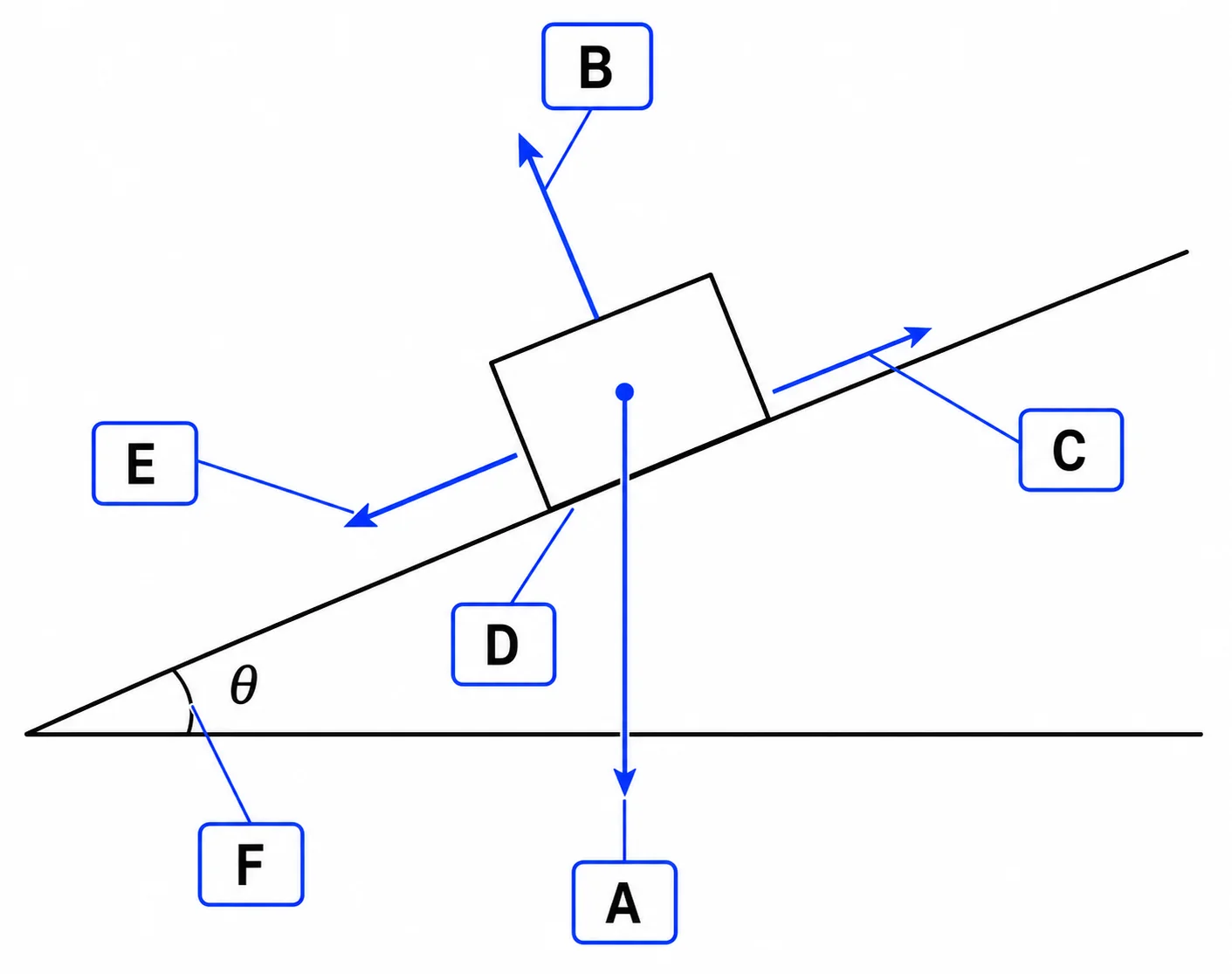
| Label | Force / quantity name | Direction | Formula |
|---|---|---|---|
| A | |||
| B | |||
| C | |||
| D | |||
| E | |||
| F |
Q1 — Term–definition match
1.1 inclined plane • 1.2 component • 1.3 normal force • 1.4 W∥ (parallel component) • 1.5 W⊥ (perpendicular component) • 1.6 coefficient of kinetic friction • 1.7 critical angle • 1.8 net force • 1.9 free body diagram • 1.10 acceleration.
Q2 — True / false with correction
2.1 False. On an inclined plane, N = mg cos θ, which is less than mg for any θ > 0°. Using N = mg on a slope leads to an incorrect friction force and net force.
2.2 False. On a frictionless slope, a = g sin θ — mass cancels entirely, so both objects accelerate at the same rate. With friction, a = g sin θ − μg cos θ — mass still cancels. This is a famous result from Galileo’s inclined plane experiments.
2.3 True.
2.4 False. On a slope, friction is f = μN = μmg cos θ. Using f = μmg ignores the reduction of the normal force due to the tilt.
2.5 True. At the critical angle, mg sin θc = μmg cos θc, which simplifies to tan θc = μ. Measuring the angle at which sliding just begins gives μ directly.
2.6 False. As θ increases, cos θ decreases, so the normal force N = mg cos θ decreases. At the same time, sin θ increases, so the downslope component W∥ = mg sin θ increases.
Q3 — Cloze paragraph
In order: mg sin θ / horizontal / normal force / cos θ / critical angle / friction / independent / tan θ.
Q4.1 — Function of resolving weight
Weight acts vertically, but the slope constrains motion to directions along and perpendicular to its surface. Resolving weight into two components — parallel (W∥) and perpendicular (W⊥) to the slope — allows Newton’s second law to be applied in these directions, which directly yields the net force and normal force without dealing with angles in every calculation step.
Q4.2 — Why N < mg on a slope
N = mg cos θ. For any angle θ > 0°, cos θ < 1, so N < mg. The slope surface can only push perpendicular to itself; it cannot oppose the full vertical weight when tilted. Only the component of weight pressing into the slope ( = mg cos θ) must be balanced by N.
Q4.3 — Why mass cancels
From Newton’s second law: Fnet = ma. On a frictionless slope, Fnet = mg sin θ. Substituting: mg sin θ = ma, so a = g sin θ. Mass m appears on both sides and cancels, leaving acceleration dependent only on g and the slope angle.
Q4.4 — Why θ is from horizontal
The angle θ is defined as the angle between the slope surface and the horizontal. The component of gravity along the slope is found by the angle between the weight vector (vertical) and the perpendicular to the slope — which equals θ. Using sin of this angle gives the parallel component. If θ were measured from the vertical, sin and cos would be swapped, giving the wrong formula.
Q5 — Sample concept map
Accept any 6 valid labelled connections, including:
- slope angle (θ) — determines magnitude of → weight component (W∥)
- slope angle (θ) — determines magnitude of → normal force (N)
- normal force (N) — determines → friction force (f)
- weight component (W∥) — acts down slope, contributing to → net force
- friction force (f) — opposes motion, reducing → net force
- net force — causes → acceleration
Award 1 mark per valid labelled arrow. Maximum 6 marks.
Q6 — Label the forces diagram
A: Weight (W) — vertically downward — W = mg. B: Normal force (N) — perpendicular to slope, away from surface — N = mg cos θ. C: Parallel weight component (W∥) — along slope, directed downhill — W∥ = mg sin θ. D: Perpendicular weight component (W⊥) — perpendicular to slope, into surface — W⊥ = mg cos θ. E: Friction force (f) — along slope, directed uphill (opposing motion) — f = μmg cos θ. F: Slope angle θ — measured between the slope surface and the horizontal.