Physics • Year 11 • Module 2: Dynamics • Lesson 2
Vector Forces — Resolution and Equilibrium
Lock in the vocabulary, formulae, and fundamental rules of vector addition and component resolution before tackling harder problems.
1. Term–definition match
The definitions below are shuffled. In the right-hand column write the matching term from this list: resultant force, component, resolution, vector, scalar, equilibrium, net force, Fx, Fy, tip-to-tail method. 10 marks (1 each)
| # | Definition | Matching term |
|---|---|---|
| 1.1 | A quantity that has both magnitude and direction (e.g. force, velocity, displacement). | |
| 1.2 | A quantity that has magnitude only and no direction (e.g. speed, mass, temperature). | |
| 1.3 | The single force that has exactly the same effect on an object as all individual forces acting together. | |
| 1.4 | The algebraic sum of all forces acting on an object; its sign and magnitude determine acceleration. | |
| 1.5 | The part of a force acting in one specific direction when the force is split into perpendicular parts. | |
| 1.6 | The process of splitting a single force into two perpendicular components. | |
| 1.7 | The state of an object when the net force acting on it equals zero in every direction; the object is stationary or moving at constant velocity. | |
| 1.8 | A graphical technique for adding vectors where the tail of each successive vector is placed at the tip of the previous one; the resultant runs from the first tail to the last tip. | |
| 1.9 | The horizontal component of a force F acting at angle θ to the horizontal, calculated as F cos θ. | |
| 1.10 | The vertical component of a force F acting at angle θ to the horizontal, calculated as F sin θ. |
2. True or false — with correction
Circle T or F for each statement. If the statement is false, write the corrected version on the line below it. 12 marks (1 T/F + 1 correction each)
2.1 The resultant of a 40 N force east and a 30 N force north is 70 N. T / F
2.2 Fx = F cos θ gives the component of a force that is adjacent to the angle θ, measured from the horizontal reference axis. T / F
2.3 An object in equilibrium must be stationary. T / F
2.4 In a 2D equilibrium problem you must verify that both ΣFx = 0 and ΣFy = 0 simultaneously. T / F
2.5 The resultant of two perpendicular components Fx and Fy is found by adding them directly: F = Fx + Fy. T / F
2.6 When forces act along the same line, a positive direction must be defined before calculating the net force. T / F
3. Fill-in-the-blank paragraph
Use the word bank to complete the passage. Each word is used once. 8 marks (1 per blank)
Word bank:
algebraic · components · cos · equilibrium · horizontal · Pythagoras · resultant · sin
When all forces act along the same line, the net force is found by ___________ addition, where forces opposing the chosen positive direction are given a negative sign. In two dimensions, forces at angles cannot be added directly; instead, each force is split into two perpendicular ___________. For a force F at angle θ above the horizontal, the ___________ component is F ___________ θ and the vertical component is F ___________ θ. Once the total x and y components are known, the magnitude of the ___________ is found using ___________’s theorem. When an object is in ___________, the net force equals zero in every direction simultaneously.
4. Function recall
Answer each question in 1–2 sentences using precise physics terms. 8 marks (2 each)
4.1 What is the purpose of defining a positive direction before solving a 1D force problem?
4.2 Why can the magnitudes of two force vectors never simply be added together when the forces act at an angle to each other?
4.3 What is the function of the tip-to-tail method in vector addition?
4.4 In a 2D equilibrium problem, why must you check both the x-direction and the y-direction before concluding that an object is in equilibrium?
5. Build a concept map
Draw labelled arrows between the six terms below to show how they connect. Each arrow must carry a linking phrase (e.g. “is found using”, “requires”, “produces”). Aim for at least 6 labelled arrows. 6 marks (1 per valid labelled arrow)
Supplied terms: vector force · components · resultant · Pythagoras’ theorem · equilibrium · positive direction.
6. Label the vector components diagram
The diagram below shows a force F acting at angle θ above the horizontal. Label each part A–F using the terms provided. 6 marks (1 per label)
Terms to use: F (resultant force) · Fx = F cos θ · Fy = F sin θ · angle θ · horizontal reference axis · right angle (90°).
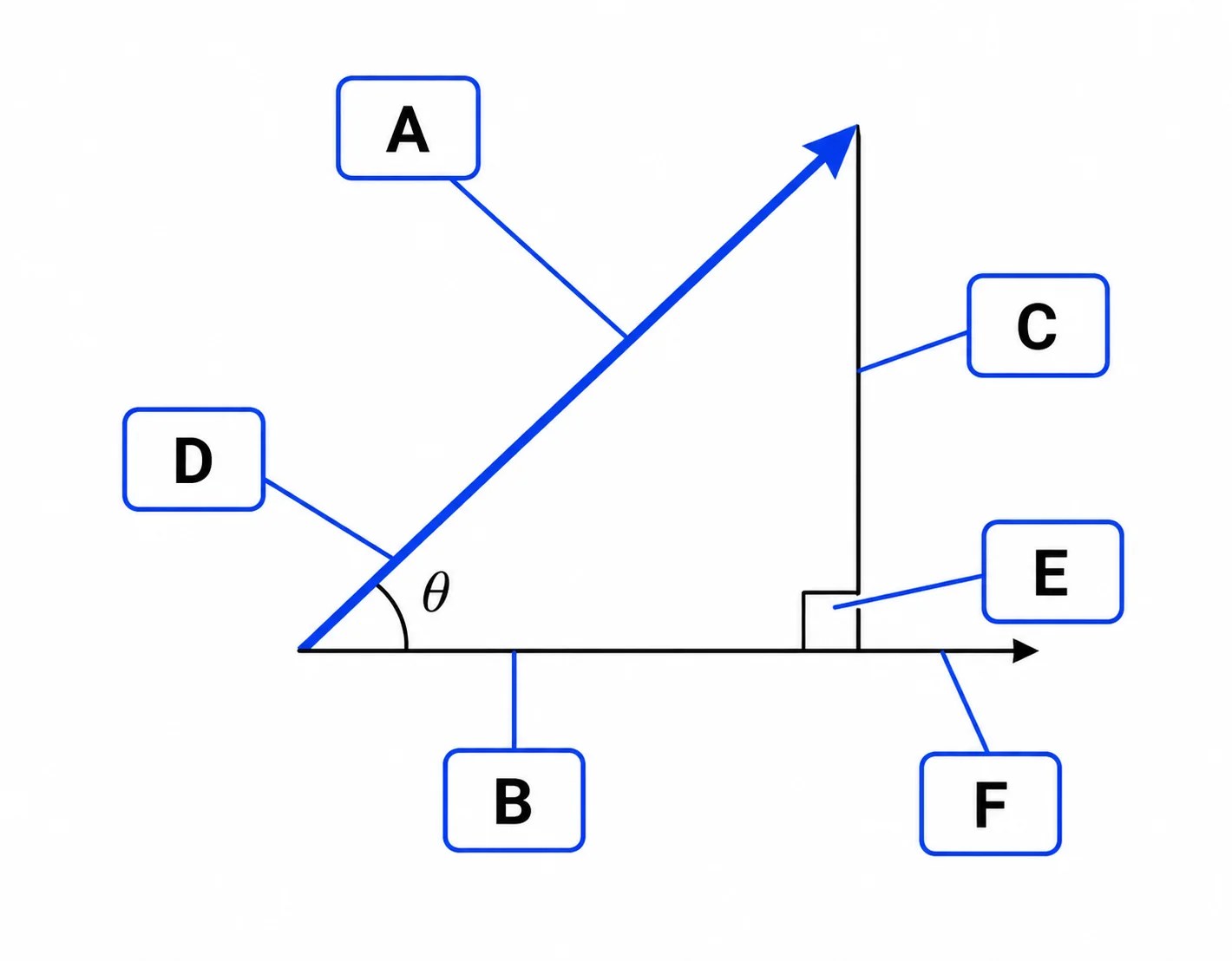
| Label | Term |
|---|---|
| A | |
| B | |
| C | |
| D | |
| E | |
| F |
Q1 — Term–definition match
1.1 vector • 1.2 scalar • 1.3 resultant force • 1.4 net force • 1.5 component • 1.6 resolution • 1.7 equilibrium • 1.8 tip-to-tail method • 1.9 Fx • 1.10 Fy.
Q2 — True / false with correction
2.1 False. Forces at right angles cannot be added arithmetically. The resultant = √(40² + 30²) = √(1600 + 900) = √2500 = 50 N, directed at 37° above the horizontal (north of east).
2.2 True. Fx = F cos θ gives the component adjacent to the angle — the component that lies along the reference axis from which θ is measured.
2.3 False. An object in equilibrium may be stationary (static equilibrium) or moving at constant velocity (dynamic equilibrium). The defining condition is net force = 0, not zero velocity.
2.4 True. In 2D, equilibrium requires ΣFx = 0 AND ΣFy = 0 simultaneously. Checking only one direction is insufficient.
2.5 False. Fx and Fy are perpendicular; they must be combined using Pythagoras’ theorem: F = √(Fx² + Fy²). Direct addition overestimates the resultant.
2.6 True. Defining positive direction is the first step of the Vector Protocol. Every sign assignment (positive or negative) in the net force equation depends on this choice.
Q3 — Cloze paragraph
In order: algebraic / components / horizontal / cos / sin / resultant / Pythagoras / equilibrium.
Q4.1 — Purpose of defining positive direction
Defining a positive direction assigns a consistent sign convention to all forces in the problem. Forces acting in the positive direction are given a positive value; forces opposing it are negative. Without this, algebraic addition of forces is ambiguous and the net force calculation will be incorrect.
Q4.2 — Why magnitudes cannot be added at an angle
Vectors have both magnitude and direction. When two forces act at an angle to each other, part of each force opposes the other. Only the components in the same direction add constructively; those in perpendicular directions combine using Pythagoras. Simply adding magnitudes ignores direction and overestimates the resultant.
Q4.3 — Function of the tip-to-tail method
The tip-to-tail method is a graphical technique for finding the resultant of two or more vectors. Each vector is drawn as an arrow (length proportional to magnitude, correct direction); the tail of each successive vector is placed at the tip of the previous one. The resultant is the arrow drawn from the tail of the first vector to the tip of the last.
Q4.4 — Why both x and y must be checked for equilibrium
A force can have components in both the x and y directions simultaneously. An object could have ΣFx = 0 (balanced horizontally) but ΣFy ≠ 0 (unbalanced vertically) — in which case it is accelerating vertically and is not in equilibrium. Both conditions must hold simultaneously.
Q5 — Sample concept map
Correct maps should include arrows such as:
- vector force — is resolved into → components
- components — are combined using → Pythagoras’ theorem
- Pythagoras’ theorem — gives the magnitude of the → resultant
- equilibrium — requires → resultant = 0
- positive direction — must be defined before calculating the → resultant
- positive direction — determines the sign of → components
Award 1 mark per valid labelled arrow (minimum 6, maximum 6 marked).
Q6 — Vector components diagram labels
A: F (resultant force) — the hypotenuse of the triangle, pointing up-right at angle θ. B: Fx = F cos θ — the horizontal base of the triangle. C: Fy = F sin θ — the vertical side of the triangle. D: angle θ — the angle between the force F and the horizontal reference axis. E: horizontal reference axis — the baseline from which θ is measured. F: right angle (90°) — the corner marker between Fx and Fy, confirming they are perpendicular.