Physics • Year 11 • Module 2 • Lesson 1
Forces and Interactions
Apply Newton’s First and Third Laws, force classification, and free body diagram skills to real data, scenarios and diagram critiques.
1. Classify force pairs — sporting and everyday scenarios
Six force pairs are described below. For each pair, complete the table by identifying the force type, stating whether they are a genuine Newton’s Third Law pair, and giving a one-sentence justification. 12 marks (2 per row)
| Force pair | Same force type? | Genuine Third Law pair? | Justification |
|---|---|---|---|
| Earth pulls Moon toward Earth / Moon pulls Earth toward Moon | |||
| A swimmer pushes water backward / Water pushes swimmer forward | |||
| Tension in a rope pulls a hanging mass upward / Weight pulls the hanging mass downward | |||
| Friction on a sled from the snow (backward) / Friction on the snow from the sled (forward) | |||
| A magnet attracts a steel paper-clip toward it / Paper-clip attracts the magnet toward it | |||
| Normal force on a box from the floor (upward) / Applied force pushing the box into the floor (downward) |
2. Interpret graph — force probe data for a skateboarder pushing off a wall
A force probe mounted on a wall records the force the skateboarder’s hands exert on the wall during a push-off. The graph below shows force (N) versus time (ms) for the push event. 8 marks
Figure 1. Force exerted by a skateboarder’s hands on a wall during a push-off event. Force probe mounted on wall surface; sampling rate 10 ms. Illustrative data based on biomechanics of push-off mechanics.
2.1 Describe the shape of the force–time graph from 0 ms to 300 ms. Include the peak value and when it occurs. 2 marks
2.2 Using Newton’s Third Law, state the magnitude and direction of the force the wall exerts on the skateboarder at 120 ms. Explain your reasoning. 2 marks
2.3 A student claims: “The wall exerts no force on the skateboarder because the wall doesn’t move.” Identify the flaw in this reasoning, using the graph data to support your response. 2 marks
2.4 The force is zero after 240 ms. Does this mean the skateboarder has stopped moving? Explain, referencing Newton’s First Law. 2 marks
3. Compare contact and field-mediated forces across five criteria
Complete the two-column table below. For each feature, write a concise description that contrasts the two force categories. 10 marks (1 per cell)
| Feature | Contact force | Field-mediated force |
|---|---|---|
| Physical contact required? | ||
| Examples (give two) | ||
| What mediates the interaction? | ||
| Can it act across a vacuum? | ||
| Australian context example |
4. Case study — Apollo 11 lunar module and Newton’s Laws
In July 1969, the Apollo 11 lunar module (LM) descended toward the Moon’s surface. The LM’s descent engine fired downward, expelling hot exhaust gases at high speed. The Moon’s gravitational field provided a constant downward pull on the 14 300 kg module. For the final stage of descent, the engine thrust was adjusted so the LM moved downward at a constant velocity of 1.5 m/s. 6 marks
4.1 State the magnitude of the net force on the LM during the constant-velocity descent. Name the law that justifies your answer. 2 marks
4.2 Identify the Newton’s Third Law pair for the engine exhaust force. State the direction and type (contact or field-mediated) of each force in the pair. 2 marks
4.3 Explain why the Third Law pair you identified in 4.2 does NOT cancel out and prevent the LM from decelerating. 2 marks
5. Diagram critique — spot three errors in this student’s free body diagram
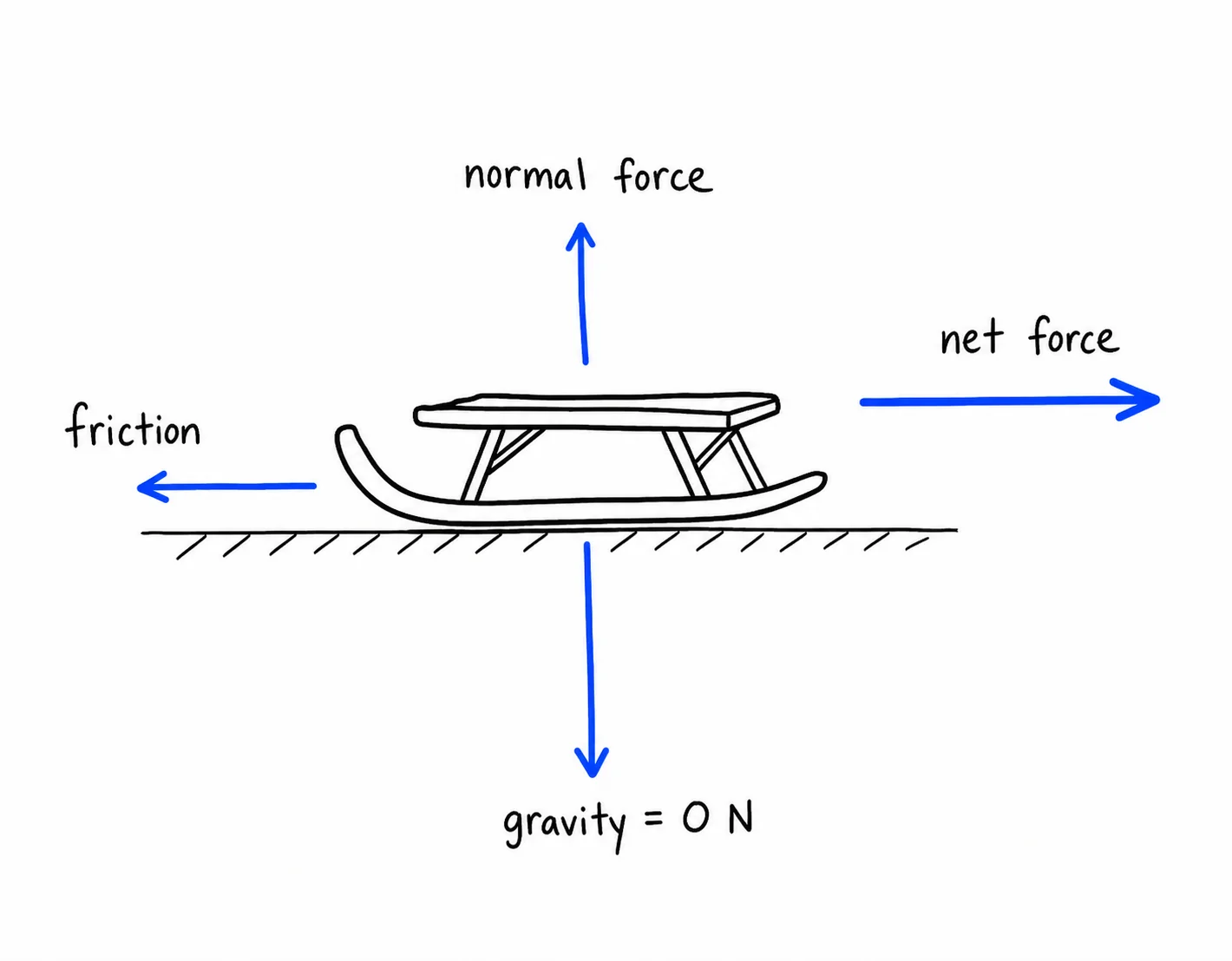
A Year 11 student drew the free body diagram below for a sled moving at constant velocity on a snowy surface. There are three errors in the diagram. Identify each error and write the correction. 6 marks (2 per error: 1 identify, 1 correct)
5.1 Error 1: What is wrong?
Correction:
5.2 Error 2: What is wrong?
Correction:
5.3 Error 3: What is wrong?
Correction:
Q1 — Force pair classification table
Earth/Moon: Yes (both gravitational field forces) / Yes — equal magnitude, opposite direction, different objects, same force type (gravitational). Swimmer/water: Yes (both contact) / Yes — swimmer pushes water backward (contact), water pushes swimmer forward (contact); different objects. Tension/weight on hanging mass: No (tension = contact; weight = gravitational) / No — different force types; both act on the same object. Sled friction: Yes (both contact/friction) / Yes — sled exerts friction forward on snow, snow exerts friction backward on sled; different objects, equal and opposite. Magnet/paper-clip: Yes (both magnetic field force) / Yes — mutual magnetic attraction; equal, opposite, different objects, same type. Normal/applied force on box: No (normal = contact from floor; applied = contact from person, different origin) / No — both act on the floor-box interface but are not an action–reaction pair in the Third Law sense; they are two independent contact forces.
Q2.1 — Graph description
The force rises from 0 N at 0 ms, increases steeply to a peak of approximately 180 N at around 120 ms, then falls symmetrically back to 0 N at approximately 240 ms [1]. After 240 ms the force remains zero as contact with the wall has ceased [1].
Q2.2 — Reaction force at 120 ms
By Newton’s Third Law, the wall exerts a force on the skateboarder of exactly 180 N [1] directed away from the wall (i.e. forward, toward the skateboarder’s direction of travel) [1]. The magnitude is equal to the force the skateboarder exerts on the wall; the direction is opposite.
Q2.3 — Flaw in student reasoning
Flaw: Whether an object moves is not the criterion for whether it exerts a force [1]. A stationary object can exert a force. The graph shows the wall exerts a reaction force — by Newton’s Third Law it must, because the skateboarder is pushing on the wall. The wall’s lack of motion is due to its enormous mass (attached to Earth), not an absence of force [1].
Q2.4 — Is the skateboarder stationary after 240 ms?
No. By Newton’s First Law, an object in motion continues at constant velocity unless acted on by a net external force [1]. Once the skateboarder’s hands leave the wall (force = 0 after 240 ms), there is no horizontal net force, so the skateboarder continues rolling forward at constant velocity [1].
Q3 — Compare and contrast table
Physical contact? Contact: Yes, objects must touch. Field: No, acts across space. Examples: Contact: normal force, friction, tension, applied force. Field: gravity, magnetic force, electrostatic force. What mediates it? Contact: direct interaction of surface atoms/electrons. Field: a gravitational, magnetic or electric field extending through space. Acts across vacuum? Contact: No (requires physical touching). Field: Yes — gravity and electromagnetism act across empty space. Australian context: Contact: AFL player kicking a football (boot on ball). Field: Earth’s gravity holding the Moon in orbit, or a compass needle aligning with Earth’s magnetic field.
Q4.1 — Net force during constant-velocity descent
Net force = 0 N [1]. Newton’s First Law (law of inertia): an object moving at constant velocity has zero net force acting on it. The engine thrust exactly balances the gravitational pull, so the velocity does not change [1].
Q4.2 — Third Law pair for exhaust force
The engine exerts a contact force on the exhaust gases, pushing them downward at high speed. The reaction force (Third Law pair) is the exhaust gases pushing back on the engine/LM upward [1]. Both forces are contact forces; the engine acts on the gases (downward) and the gases act on the engine (upward) [1].
Q4.3 — Why the pair does not cancel
Newton’s Third Law pairs act on different objects [1]. The engine force on the exhaust acts on the exhaust gases; the reaction force acts on the LM only. When calculating the net force on the LM we only include forces acting on the LM (engine thrust upward, gravity downward). The force on the exhaust gases acts on the gases — a different object — and is irrelevant to the LM’s net force calculation [1].
Q5 — Diagram critique
5.1 Error 1 (weight = 0 N): The sled has mass and is in a gravitational field, so its weight cannot be zero [1]. Correction: Weight = mg, directed downward; for a 50 kg sled, W = 50 × 9.8 = 490 N downward [1].
5.2 Error 2 (net force arrow drawn on sled): The sled moves at constant velocity, so net force = 0. A net force arrow on the diagram implies the sled is accelerating, which contradicts the constant-velocity condition [1]. Correction: No net force arrow should appear; instead, all individual force arrows should sum to zero — applied force forward = friction backward, normal force up = weight down [1].
5.3 Error 3 (normal force shorter than weight): For vertical equilibrium (no vertical acceleration), the normal force must be equal in magnitude to the weight. Drawing N shorter than W implies a non-zero net vertical force and therefore vertical acceleration [1]. Correction: Normal force arrow and weight arrow should be the same length, representing equal magnitudes in opposite directions, giving net vertical force = 0 [1].