Physics • Year 11 • Module 2 • Lesson 1
Forces and Interactions
Lock in the core vocabulary of forces, Newton’s First and Third Laws, and the free body diagram conventions before tackling harder questions.
1. Term–definition match
The definitions below are shuffled. In the right-hand column write the matching term from this list: force, Newton (N), contact force, field-mediated force, inertia, net force, static equilibrium, dynamic equilibrium, Newton’s First Law, Newton’s Third Law. 10 marks (1 each)
| # | Definition | Matching term |
|---|---|---|
| 1.1 | A push or pull between two objects; always has a source, a magnitude, and a direction. | |
| 1.2 | The SI unit of force; defined as the force that accelerates a 1 kg mass at 1 m/s². | |
| 1.3 | A force that requires physical contact between the two interacting objects. | |
| 1.4 | A force that acts across a distance without contact, transmitted via a field (e.g. gravity, magnetism). | |
| 1.5 | The tendency of an object to resist changes to its state of motion; proportional to mass. | |
| 1.6 | The vector sum of all forces acting on a single object. | |
| 1.7 | The condition in which an object is at rest and the net force acting on it equals zero. | |
| 1.8 | The condition in which an object moves at constant velocity and the net force acting on it equals zero. | |
| 1.9 | An object at rest remains at rest, and an object in motion continues at constant velocity, unless acted upon by a net external force. | |
| 1.10 | For every action force exerted by object A on object B, there is an equal and opposite reaction force exerted by object B on object A. |
2. True or false — with correction
Circle T or F for each statement. If the statement is false, write the corrected version on the line below it. 12 marks (1 T/F + 1 correction each)
2.1 Newton’s Third Law pairs act on the same object, pointing in opposite directions. T / F
2.2 An object moving at constant speed in a straight line has zero net force acting on it. T / F
2.3 A heavier object exerts a larger force on a lighter one than the lighter object exerts on it. T / F
2.4 The weight of an object and the normal force on it from a flat horizontal surface are a Newton’s Third Law pair. T / F
2.5 Gravity is classified as a field-mediated force because it acts across empty space without physical contact. T / F
2.6 A net force is needed to keep an object moving at constant velocity on a frictionless surface. T / F
3. Fill-in-the-blank paragraph
Use the word bank to complete the passage. Each word is used once. 8 marks (1 per blank)
Word bank:
acceleration · contact · different · field-mediated · inertia · magnitude · net force · vector
A force is a ___________ quantity, meaning it has both ___________ and direction. Forces that require physical contact between objects are called ___________ forces, while forces like gravity and magnetism are called ___________ forces. Newton’s First Law tells us that objects resist changes in their motion because of ___________. An object will only change its motion if a ___________ acts on it. When that net force is non-zero, the object undergoes ___________. Newton’s Third Law pairs always act on ___________ objects.
4. Function recall
Answer each question in 1–2 sentences using precise terms from the lesson. 8 marks (2 each)
4.1 What is the difference between static equilibrium and dynamic equilibrium? Give one example of each.
4.2 Why do Newton’s Third Law force pairs never cancel each other out?
4.3 State the three criteria a force pair must satisfy to be a genuine Newton’s Third Law pair.
4.4 What is the purpose of a free body diagram? Name two things that should be labelled on every force arrow.
5. Build a concept map
Draw labelled arrows between the six terms below to show how they connect. Each arrow must carry a linking phrase (e.g. “causes”, “resists”, “requires”). Aim for at least 6 labelled arrows. 6 marks (1 per valid labelled arrow)
Supplied terms: force · net force · inertia · acceleration · equilibrium · Newton’s Third Law.
6. Label the free body diagram
The diagram below shows a book resting on a horizontal table. Label force arrows A–D by writing the force name, its type (contact or field-mediated), and its direction. 8 marks (2 per arrow)
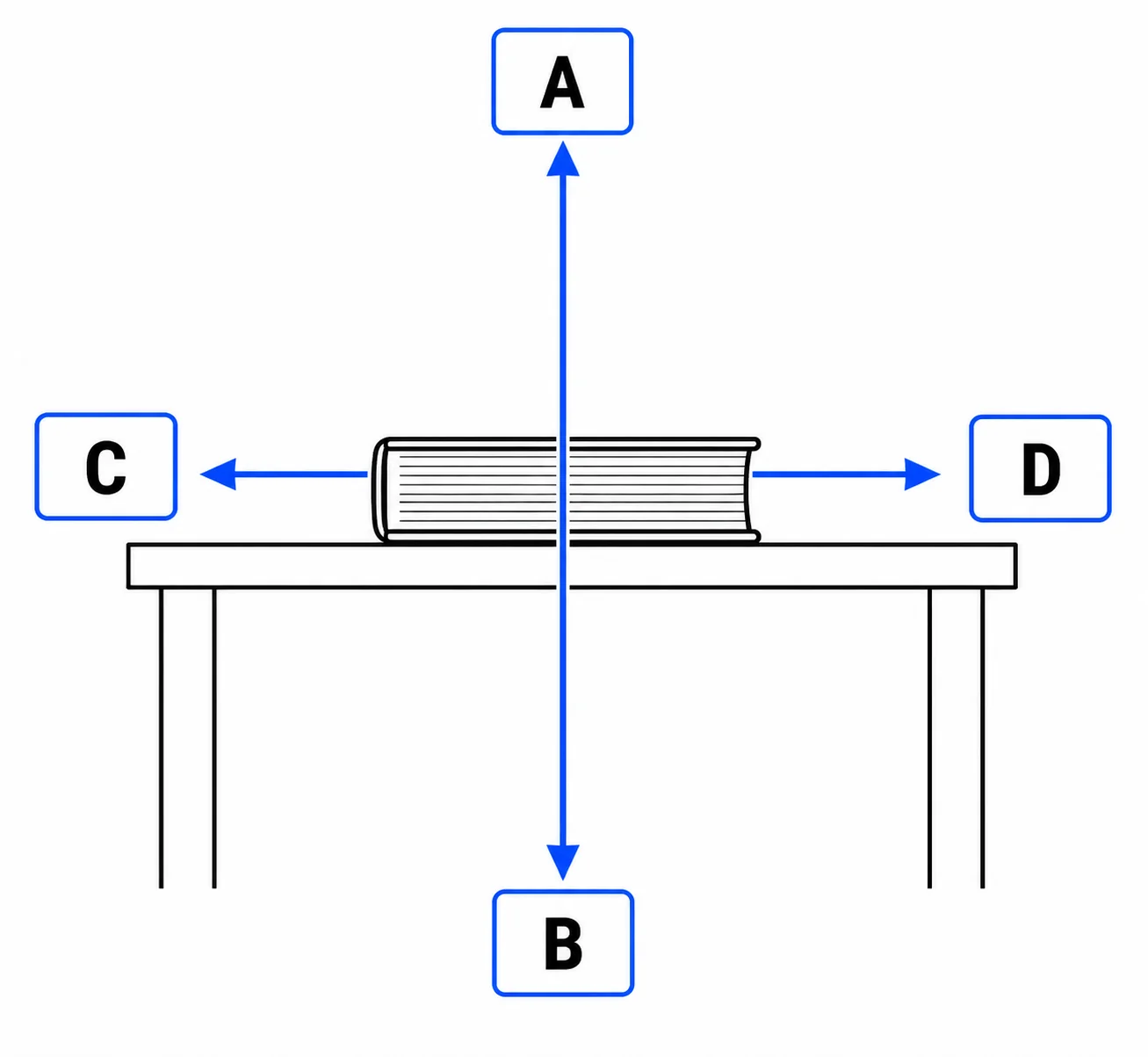
| Arrow | Force name | Type (contact / field) | Direction |
|---|---|---|---|
| A | |||
| B | |||
| C | |||
| D |
Q1 — Term–definition match
1.1 force • 1.2 Newton (N) • 1.3 contact force • 1.4 field-mediated force • 1.5 inertia • 1.6 net force • 1.7 static equilibrium • 1.8 dynamic equilibrium • 1.9 Newton’s First Law • 1.10 Newton’s Third Law.
Q2 — True / false with correction
2.1 False. Newton’s Third Law pairs act on different objects. If they acted on the same object they would cancel, and nothing could ever accelerate.
2.2 True. Constant velocity (including constant speed in a straight line) means no change in motion, so net force = 0. This is dynamic equilibrium.
2.3 False. Newton’s Third Law states that the forces in an action–reaction pair are always exactly equal in magnitude, regardless of the masses of the objects.
2.4 False. Weight is a gravitational (field-mediated) force; the normal force is a contact force. A genuine Third Law pair must be the same type of force. They are also both acting on the book, not on different objects.
2.5 True. Gravity acts across a gravitational field; no physical contact between objects is required.
2.6 False. On a frictionless surface with no applied force, no net force is needed to maintain constant velocity (Newton’s First Law). A net force would change the object’s velocity, not maintain it.
Q3 — Cloze paragraph
In order: vector / magnitude / contact / field-mediated / inertia / net force / acceleration / different.
Q4.1 — Static vs dynamic equilibrium
Static equilibrium: the object is at rest and net force = 0 (e.g. a book sitting on a desk). Dynamic equilibrium: the object moves at constant velocity and net force = 0 (e.g. a car cruising at constant speed on a straight road).
Q4.2 — Why Third Law pairs never cancel
Newton’s Third Law pairs act on different objects. To find the net force on one object you can only add forces that act on that same object. Since each force in the pair acts on a different object, they can never be combined and cannot cancel.
Q4.3 — Criteria for a genuine Third Law pair
(1) Equal in magnitude. (2) Opposite in direction. (3) The same type of force (both contact, or both gravitational, etc.) — and crucially, acting on different objects.
Q4.4 — Purpose of a free body diagram
A free body diagram shows all forces acting on a single object, isolated from its surroundings. Every force arrow should be labelled with: (1) the name of the force (e.g. weight, normal force, friction) and (2) its direction.
Q5 — Sample concept map
Correct maps should include arrows such as:
- force — combined as vectors to give → net force
- net force — causes → acceleration
- inertia — resists → acceleration
- net force = 0 — produces → equilibrium
- Newton’s Third Law — explains how force pairs between objects arise from → force
- equilibrium — means no change in motion, consistent with → inertia
Award 1 mark per valid labelled arrow (minimum 6).
Q6 — Free body diagram labels
A: Normal force — contact — upward (perpendicular to table surface). B: Weight (gravity) — field-mediated (gravitational) — downward. C & D: No force — there are no horizontal forces on a book at rest on a level frictionless table; these arrows should be labelled “none” or left blank if the diagram shows no horizontal contact. Accept any correct identification that the book is in static equilibrium: normal force up = weight down, net force = 0.