Chemistry • Year 12 • Module 8 • Lesson 15
Drug Synthesis & Green Chemistry
Lock in the core vocabulary: aspirin synthesis, atom economy, E-factor, and the twelve principles of green chemistry.
1. Label the aspirin synthesis workflow
The diagram below shows the laboratory synthesis of aspirin from start to finish. Write the missing labels into boxes A–H using terms from the lesson Key Terms panel and Cards 1–2. 8 marks
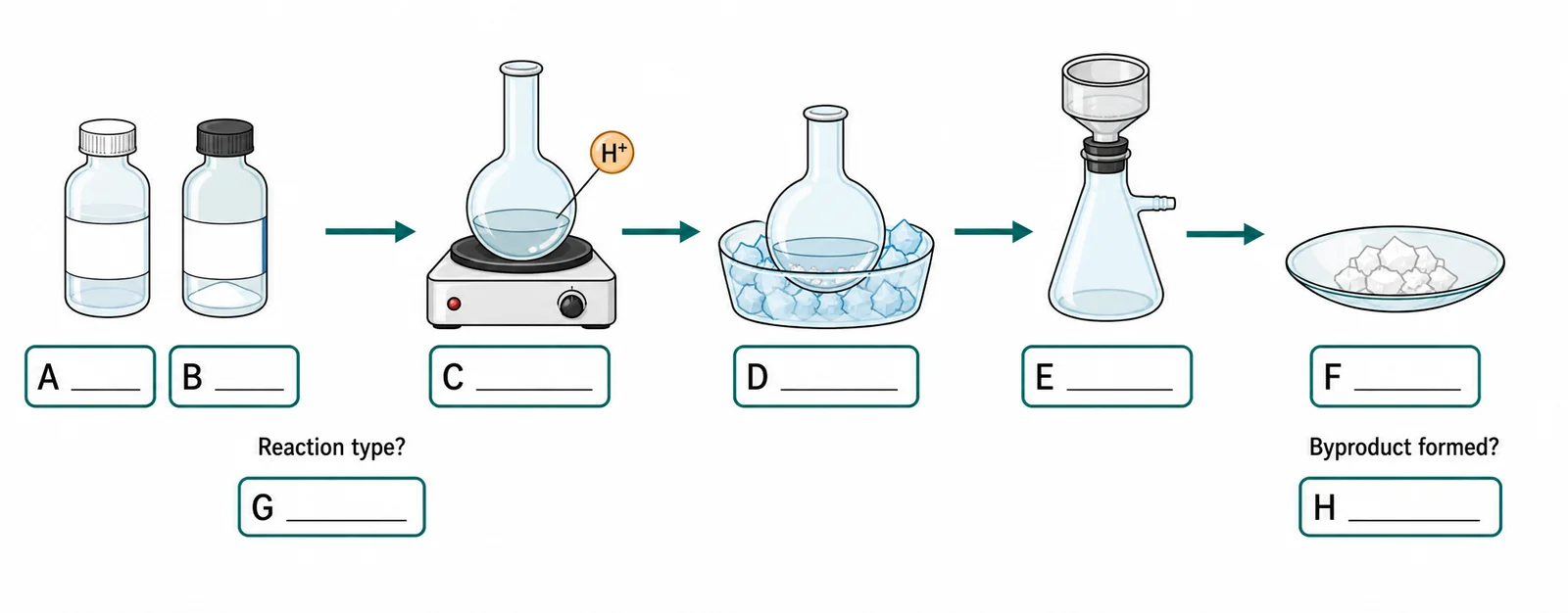
- A — first reactant (compound name) _______________________
- B — second reactant (compound name) _______________________
- C — type of catalyst added _______________________
- D — purification process (cooling to form crystals) _______________________
- E — separation technique used after crystallisation _______________________
- F — name of the desired product _______________________
- G — type of reaction (functional group formed) _______________________
- H — name of the byproduct formed _______________________
| Box | Your label |
|---|---|
| A | |
| B | |
| C | |
| D | |
| E | |
| F | |
| G | |
| H |
2. Term–definition match
The ten definitions below are shuffled. In the right-hand column write the matching term from this list: green chemistry, atom economy, E-factor, catalyst, waste minimisation, step economy, solvent selection, esterification, preclinical testing, regulatory approval. 10 marks
| # | Definition (shuffled) | Matching term |
|---|---|---|
| 2.1 | A design philosophy that minimises hazardous substances, waste and energy in chemical synthesis, guided by 12 principles. | |
| 2.2 | The ratio (expressed as a percentage) of the molar mass of the desired product to the sum of the molar masses of all products. | |
| 2.3 | The mass of waste produced per mass of product obtained in a synthesis process. | |
| 2.4 | A substance that increases reaction rate and improves selectivity without being consumed in the overall reaction. | |
| 2.5 | Designing reactions to produce no or benign byproducts, reducing environmental impact and disposal costs. | |
| 2.6 | Achieving a desired product in the fewest possible synthetic steps to reduce waste, cost and error. | |
| 2.7 | Replacing hazardous organic solvents with water, supercritical CO&sub2; or ionic liquids to reduce toxicity and flammability. | |
| 2.8 | The type of reaction in which an ester linkage is formed, as occurs when salicylic acid reacts with acetic anhydride to form aspirin. | |
| 2.9 | Laboratory and animal-model testing of a drug candidate that takes place before any human clinical trials begin. | |
| 2.10 | The final stage in pharmaceutical development in which a government body assesses whether evidence supports commercial supply of a drug. |
3. True or false — with correction
Circle T or F for each statement. If false, write the corrected version on the line below. 8 marks (1 T/F, 1 correction where needed)
3.1 Aspirin is synthesised from salicylic acid and acetic anhydride in an esterification-style reaction. T / F
3.2 A high atom economy guarantees that a synthesis route is environmentally sustainable. T / F
3.3 E-factor is calculated by dividing the mass of product by the mass of waste. T / F
3.4 A catalyst reduces environmental impact partly because it can improve reaction rate and selectivity without being consumed in the overall reaction. T / F
4. Function recall
Answer each prompt in 1–2 sentences using precise lesson terms. 10 marks (2 each)
4.1 What is the function of atom economy as a green-chemistry metric?
4.2 What is the function of E-factor in evaluating a synthesis route?
4.3 What is the function of preclinical testing in pharmaceutical development?
4.4 What is the function of solvent replacement as a green chemistry principle?
4.5 What is the function of the acid catalyst in aspirin synthesis?
5. Fill in the blanks
Complete the passage below using the word bank provided. Each word is used once. 9 marks
Word bank: salicylic acid • acetic anhydride • ethanoic acid • esterification • atom economy • E-factor • waste • catalyst • green chemistry
Aspirin is produced when reacts with in an reaction. The other product formed is . An acid is used to speed up the reaction. The philosophy of asks chemists to design processes that minimise hazardous substances and . Two quantitative measures used to judge how clean a synthesis route is are and .
Q1 — Labelled workflow
A: salicylic acid. B: acetic anhydride. C: acid catalyst (e.g. sulfuric acid / phosphoric acid). D: crystallisation. E: filtration (Buchner funnel). F: aspirin (acetylsalicylic acid). G: esterification (or acetylation / condensation). H: ethanoic acid (acetic acid).
Q2 — Term–definition matches
2.1 green chemistry • 2.2 atom economy • 2.3 E-factor • 2.4 catalyst • 2.5 waste minimisation • 2.6 step economy • 2.7 solvent selection • 2.8 esterification • 2.9 preclinical testing • 2.10 regulatory approval.
Q3 — True / false with correction
3.1 True.
3.2 False. Correction: Atom economy measures the fraction of reactant atom mass incorporated into the desired product, but a high atom economy process can still use toxic solvents, require high energy input, or generate hazardous by-products — all 12 Green Chemistry Principles must be considered holistically.
3.3 False. Correction: E-factor is calculated by dividing the mass of waste by the mass of product, not the reverse. A lower E-factor indicates less waste per unit of product.
3.4 True.
Q4.1 — Function of atom economy
Atom economy measures the percentage of reactant-side atom mass that ends up in the desired product. A higher value indicates a more efficient reaction that wastes fewer atoms on byproducts, supporting the green chemistry goal of waste prevention.
Q4.2 — Function of E-factor
E-factor measures the mass of waste produced per gram of product obtained in a synthesis process. A lower E-factor indicates a cleaner, more sustainable process; it complements atom economy by capturing practical waste burden rather than just atomic distribution.
Q4.3 — Function of preclinical testing
Preclinical testing evaluates the safety and preliminary activity of a drug candidate in laboratory models and animal studies before human clinical trials begin, providing evidence that the drug is unlikely to cause unacceptable harm in humans.
Q4.4 — Function of solvent replacement
Replacing hazardous organic solvents (e.g. halogenated solvents) with safer alternatives such as water, supercritical CO&sub2; or ionic liquids reduces toxicity risks, flammability hazards and environmental contamination in pharmaceutical synthesis.
Q4.5 — Function of the acid catalyst in aspirin synthesis
The acid catalyst increases the rate of the esterification reaction between salicylic acid and acetic anhydride, helping the reaction proceed effectively under mild heating without being consumed. It also improves selectivity, helping direct the reaction toward the aspirin product.
Q5 — Cloze paragraph
Aspirin is produced when salicylic acid reacts with acetic anhydride in an esterification reaction. The other product formed is ethanoic acid. An acid catalyst is used to speed up the reaction. The philosophy of green chemistry asks chemists to design processes that minimise hazardous substances and waste. Two quantitative measures used to judge how clean a synthesis route is are atom economy and E-factor.